Who truly benefits from the 1-percentage-point interest subsidy?
On the evening of September 29, 2026, according to CCTV News, sources from the Ministry of Finance learned that China will implement interest rate subsidies for residents who purchase homes with newly issued commercial personal housing loans starting from October 1. The annualized subsidy rate is 1 percentage point, the maximum principal for subsidy is 1 million yuan, the maximum term is 5 years, and the policy implementation period is tentatively set at 1 year.
Relevant officials stated that the central government's implementation of the residential home purchase loan interest subsidy policy is an exploration of ways to guarantee and improve people's livelihood in the housing sector. By defining the total housing price, housing area, loan category and other factors, the policy can precisely benefit target groups as much as possible, helping relatively low-income families who are preparing to buy ordinary homes "reduce their monthly mortgage payments".
Residential families that meet all the following conditions at the same time can obtain interest subsidy support
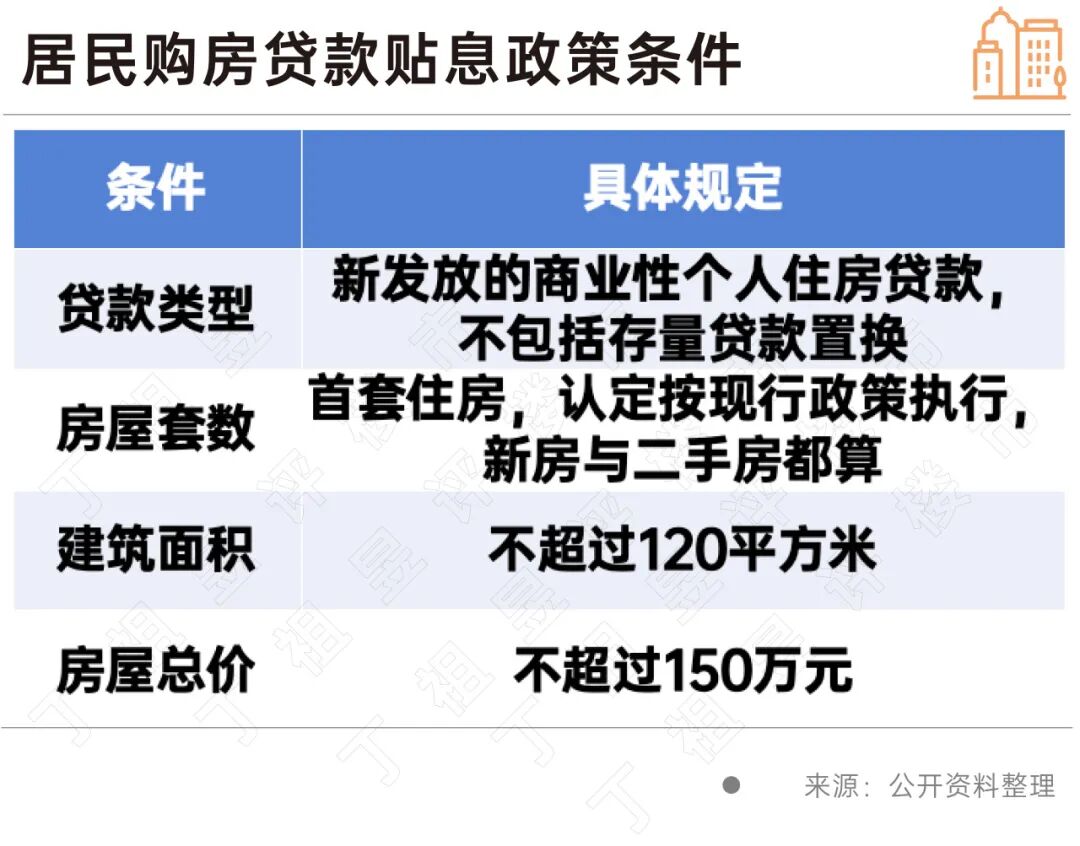
1. Purchase the first home with a newly issued commercial personal housing loan, excluding existing loan replacement. Among them, the recognition of "first home" is implemented in accordance with the current policy, including both new homes and second-hand homes.
2. The building area of the purchased housing does not exceed 120 square meters.
3. The price of the purchased housing does not exceed 1.5 million yuan.
Data from 107 cities monitored by PTI Puru Smart Cloud Monitoring shows that in the new home market, about 35.5% of transactions since 2026 have met both the conditions of total price below 1.5 million yuan and area no more than 120 square meters, and almost all cities with the highest proportion are located in Sichuan.
In the second-hand home market, among the 17 key monitored cities, the proportion of such transactions in the first 8 months of 2026 is about 53.1%, and this proportion was 46.7% for the whole year of 2025.
It is worth noting that when only looking at new homes, the core first-tier and second-tier cities are almost completely outside the scope of the policy. However, if second-hand homes are included, Shanghai, Beijing, Shenzhen, Hangzhou and Suzhou all have a transaction proportion of about 30%. The biggest contrast is in Shanghai, where only 0.2% of new home transactions meet the conditions, but this proportion rises to 37.3% for second-hand homes, and the same applies to Beijing.
This policy is not a symbolic embellishment, but is centered on the core of market transactions. Judging from its coverage and accuracy, it can be said to be the most effective and cost-effective support policy at present.
01
Judging from the press briefing by relevant officials of the Ministry of Finance, the People's Bank of China and the National Administration of Financial Regulation on the implementation of the residential home purchase loan interest subsidy policy, this interest subsidy policy mainly uses limited fiscal funds to benefit more groups with rigid housing needs, and three conditions must be met at the same time to enjoy the interest subsidy support.
First, purchase the first home with a newly issued commercial personal housing loan, excluding existing loan replacement. Among them, the recognition of "first home" is implemented in accordance with the current policy, including both new homes and second-hand homes. Second, the building area of the purchased housing does not exceed 120 square meters. Third, the price of the purchased housing does not exceed 1.5 million yuan.
In addition, there are two easily overlooked exclusions: families who use loans to purchase affordable housing, and families who use provident fund loans to purchase homes, will not be eligible for overlapping subsidies this time as they already have relevant policy support.
Families that already have mortgage loans, even if they bought homes priced below 1.5 million yuan at the beginning, cannot enjoy this 1 percentage point interest subsidy. The policy is very clear: it only subsidizes new, first-home, small-area, low-total-price home purchase behaviors, not a universal burden reduction.
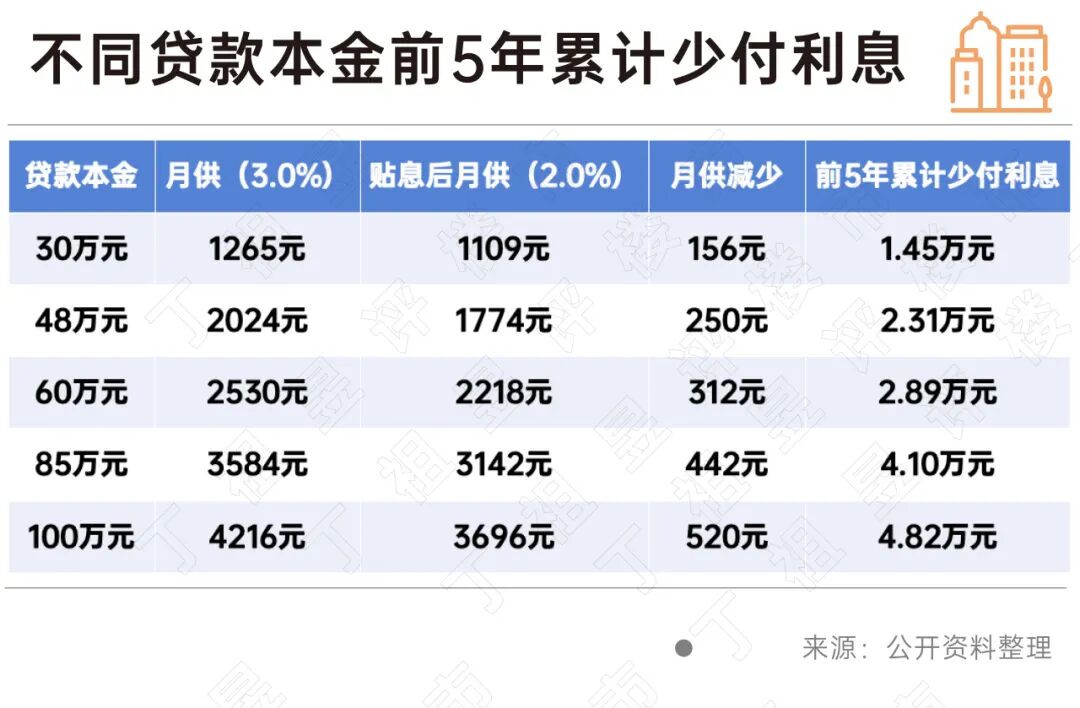
The maximum loan size eligible for interest subsidy is 1 million yuan. The financial department provides an annualized 1 percentage point interest subsidy. According to the current commercial personal housing loan interest rate level for first homes, this is equivalent to a one-third discount on the interest rate, and the maximum interest subsidy term is 5 years.
For example, for a long-term commercial personal housing loan of 1 million yuan, considering that most mortgages pay interest and repay principal on a monthly basis, and the loan balance decreases month by month, the interest subsidy policy can help borrowers reduce total interest payments by nearly 50,000 yuan at most.
But this does not mean that everyone can reduce their interest payments by nearly 50,000 yuan. The families that can fully use the 1 million yuan subsidy quota are those whose total housing price is close to 1.5 million yuan and with a relatively low down payment ratio.
02
To judge who are the real beneficiaries of this policy, in addition to calculating how much money can be saved, we also need to know how many people are covered and in which cities the beneficiaries are located.
From the data of 107 cities monitored by PTI Puru Smart Cloud, a total of about 1.0514 million new commercial residential units have been transacted since 2026, of which transactions that meet both the conditions of total price below 1.5 million yuan and area no more than 120 square meters account for about 35.5%, and this proportion was 37% for the whole year of 2025.
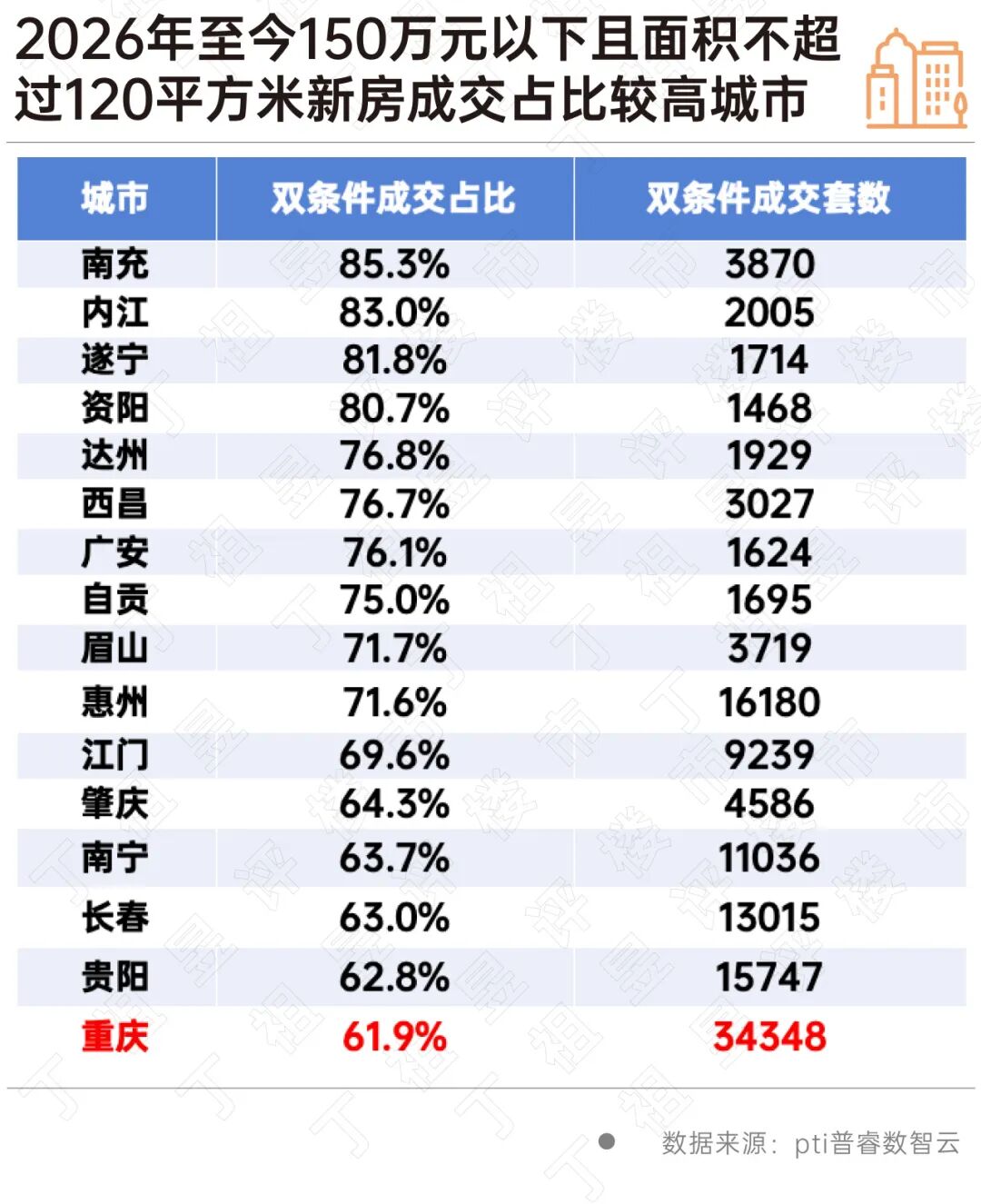
Focusing on specific cities, the cities with relatively high transaction proportion are almost all located in Sichuan, such as Nanchong, Neijiang, Suining, Ziyang, Dazhou, Xichang, Guang'an, Zigong, Meishan. In addition, Chongqing also has a relatively high proportion, and these places form the region with the densest coverage on the new home side. The new homes in these cities have low total prices and small unit sizes, making them the regions that benefit the most from the new policy.
In terms of volume, Chongqing is the only city on the new home side with both a high proportion of eligible transactions and a high number of transaction units. About 34,300 transactions meet the conditions, accounting for about 61.9% of total transactions, which makes it one of the cities that benefit the most from this new policy.
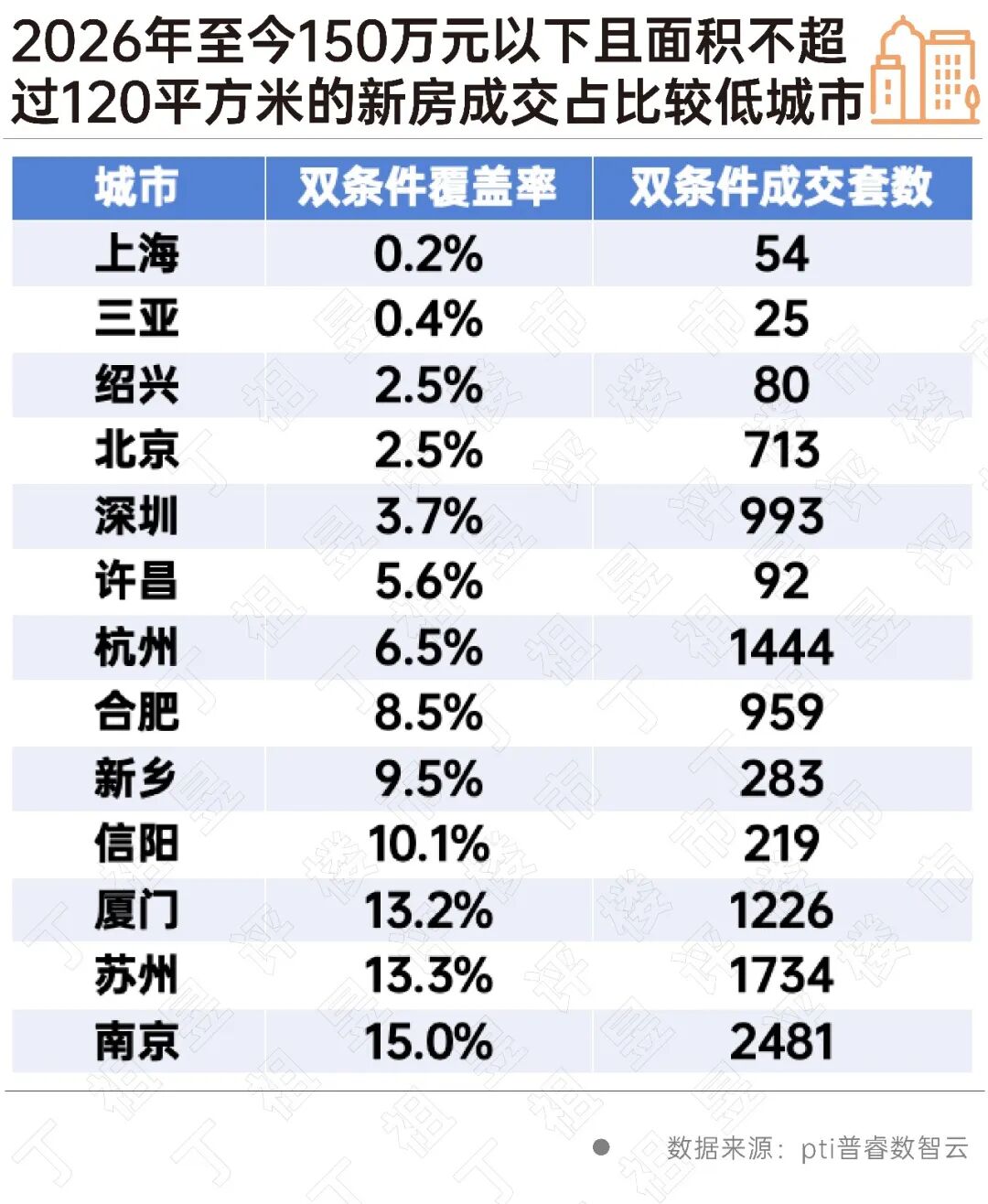
On the other hand, there are many cities whose new home market is almost unaffected by the policy. The data of Shanghai is the most striking: since 2026, a total of about 30,100 new homes have been transacted in Shanghai, and only 54 units meet both conditions.
Similarly, there are 713 eligible units in Beijing, 993 in Shenzhen, 1,444 in Hangzhou, and 959 in Hefei. The new home markets in these cities are almost entirely outside the scope of the policy.
With 10,600 eligible units and a proportion of 24.0%, Guangzhou has become the first-tier city that benefits the most on the new home side among the four first-tier cities.
03
In terms of second-hand homes, among the 17 key monitored cities of PTI Puru Smart Cloud, a total of about 1.2649 million housing units were transacted from January to August 2026, of which about 671,800 units meet both conditions, accounting for about 53.1% of total transactions.
Tianjin is the biggest beneficiary among them. Out of 108,100 second-hand housing units, about 87,000 units meet both conditions, accounting for about 80.5%, which is significantly higher than other cities in terms of both transaction volume and proportion.
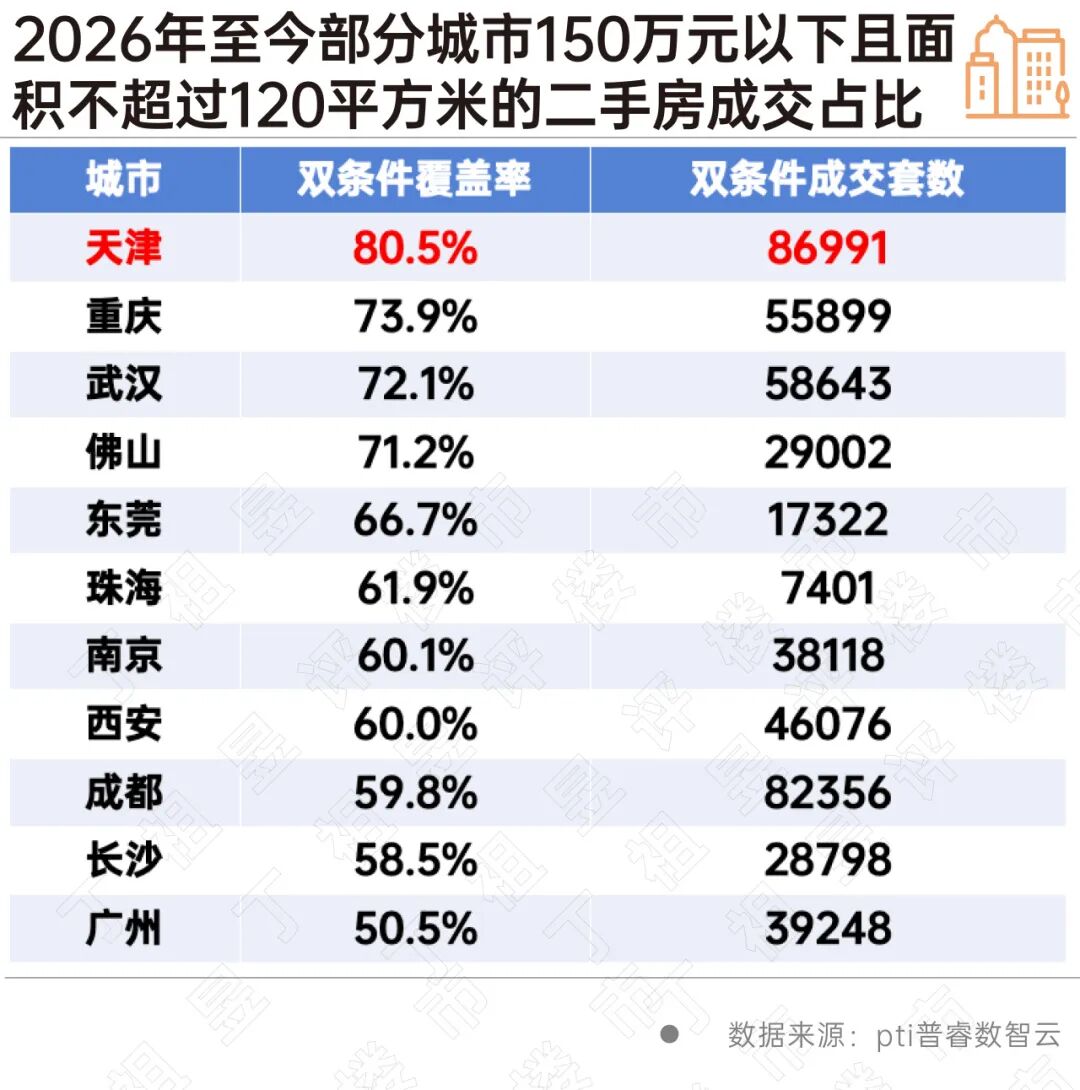
It is worth noting that if only looking at the new home market, the core first-tier and second-tier cities are almost completely outside the scope of the policy. However, if second-hand homes are included, Shanghai, Beijing, Shenzhen, Hangzhou and Suzhou all have a transaction proportion of about 30%.
The biggest contrast is in Shanghai, where only 0.2% of new home transactions meet the conditions, but this proportion rises to 37.3% for second-hand homes. The same applies to Beijing, where only 2.5% of new home transactions meet the conditions, but this proportion rises to 38.7% for second-hand homes.
Ranked by the absolute number of eligible units, the top six cities are Tianjin, Chengdu, Shanghai, Wuhan, Chongqing and Beijing. Shanghai and Beijing rank third and fifth respectively, so it cannot be said that the new policy has no impact on them. For the second-hand home markets in Shanghai and Beijing, an average of 1 in every 3 transactions is covered by the policy.
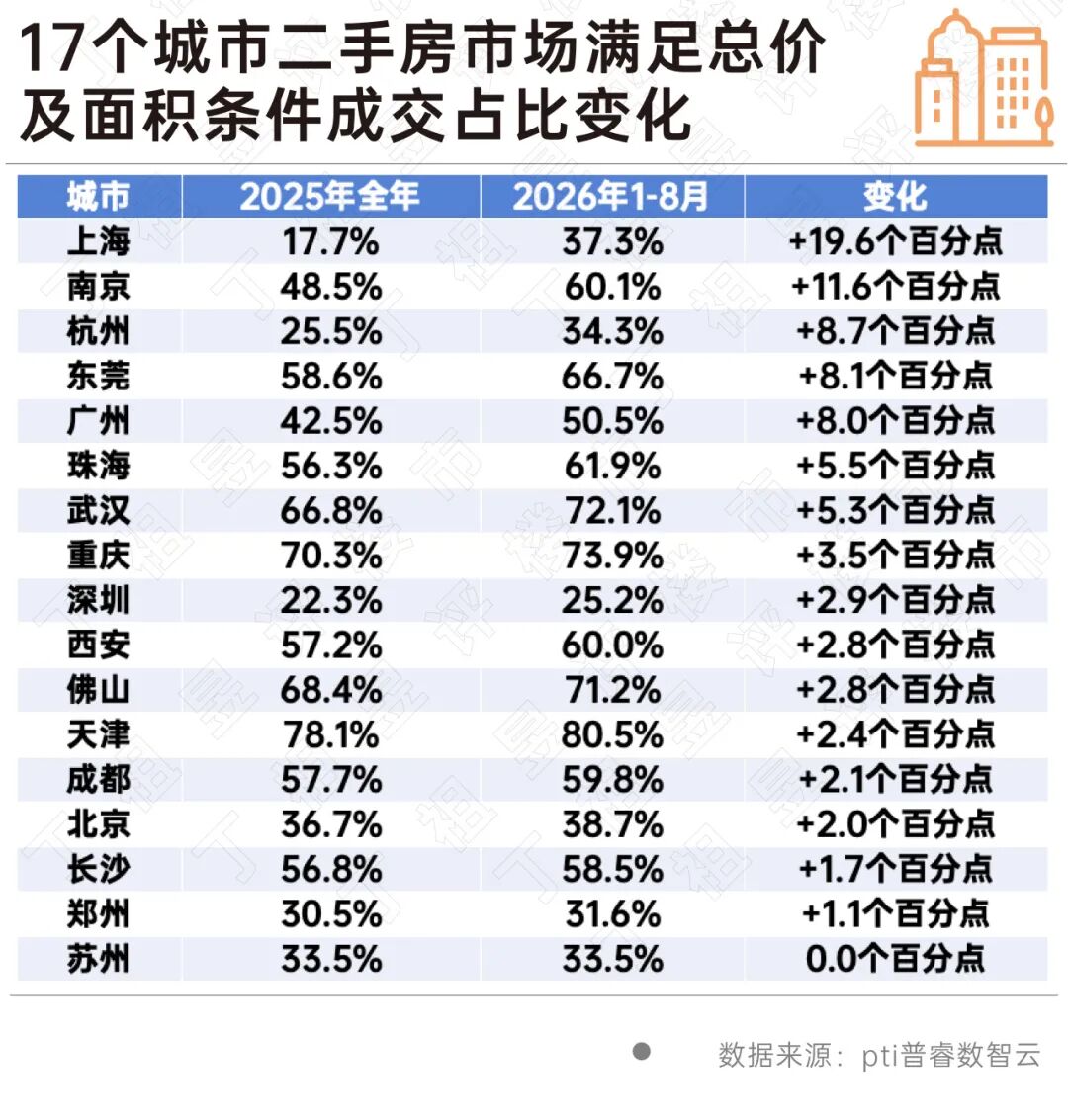
It is worth noting that, comparing the change in the proportion of transactions that meet both the total price and area conditions between the first 8 months of 2026 and the whole year of 2025, the proportion in all 17 cities has increased or remained flat.
Among them, Shanghai has the largest change, with the proportion rising from 17.7% to 37.3%, an increase of 19.6 percentage points in one year. This is mainly driven by Shanghai's policy of acquiring second-hand housing units for affordable rental housing.
This can be understood as a targeted interest rate cut that bypasses the general interest rate cut.
The LPR has remained unchanged for 16 consecutive months, with the over-5-year LPR staying at 3.5%. We have analyzed the reasons for not cutting interest rates before, and there are two main reasons. From the internal perspective, by the end of the second quarter of 2026, the net interest margin of commercial banks was 1.41%, only 1 basis point higher than that of the first quarter, still at a historically low level. Banks have little room to make concessions. From the international perspective, Europe, Japan and the United States are all in a rate hike cycle. Especially after the Federal Reserve raised interest rates on September 16, the Sino-US interest rate gap has further inverted, leaving little room for the central bank to cut interest rates (see "What Impact Does the Fed's Rate Hike Have on the Real Estate Market?" for details).
The 1 percentage point fiscal interest subsidy is equivalent to a targeted 100 basis point interest rate cut for specific groups without squeezing the net interest margin of banks or changing the monetary policy. Calculated based on the 3.0% interest rate for first-home mortgages, this is equivalent to cutting the interest rate by one third. Once this idea is implemented successfully, there will be much more room for subsequent policy reinforcement than general interest rate cuts.
From the perspective of home buyers' benefits, low housing price cities win in terms of coverage breadth, while high housing price cities win in terms of the amount of subsidy per household. The policy will take effect from October 1, with the implementation period tentatively set at 1 year, and it will expire at the end of September next year. For families with rigid housing needs who originally planned to buy homes in the coming year, it is possible that their housing purchase demands will be released in advance.
This article is from the WeChat official account "Ding Zuyu Reviews the Real Estate Market", author: Editorial Department, published with authorization from 36Kr.