The Harbin-Yichun High-speed Railway has been officially opened, and Northeast China is striving to achieve the goal of "high-speed rail access to every prefecture-level city".
The Harbin-Yichun High-Speed Railway has been officially opened to traffic, accelerating the densification of the high-speed rail network in Northeast China.
On September 28, the northernmost high-speed railway in China, the Harbin-Yichun High-Speed Railway, commenced operation. Stretching 318 kilometers with a designed speed of 250 km/h, this high-speed line cuts the rail travel time between Harbin and Yichun from around 7 hours to a minimum of 1 hour and 46 minutes.
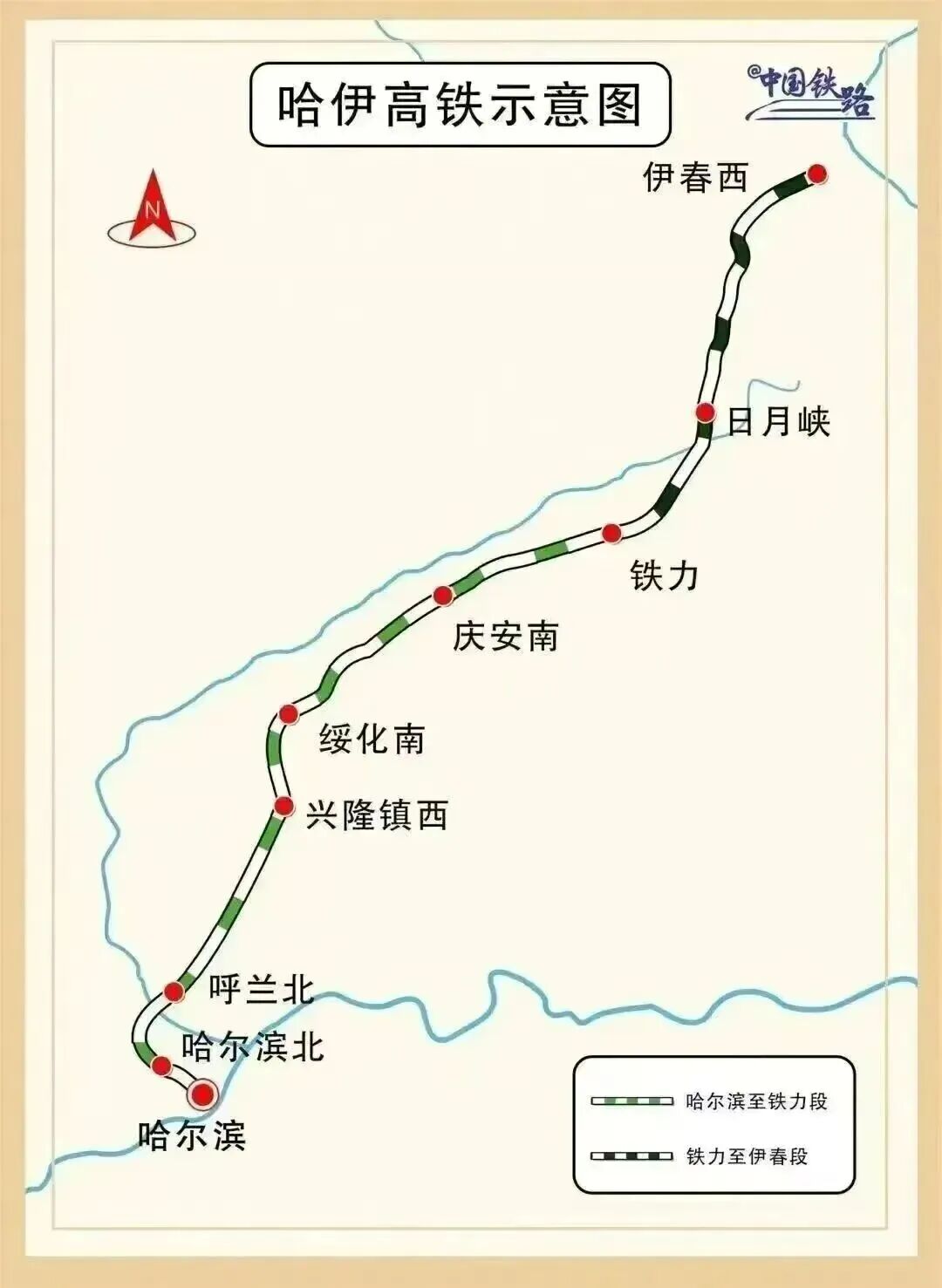
Schematic diagram of the Harbin-Yichun High-Speed Railway Source: China Railway
At the same time, cities along the line including Suihua and Tieli are also connected to the national high-speed rail network, with the fastest travel time from Harbin to Suihua being 42 minutes, and to Tieli 1 hour and 14 minutes, further shortening the spatiotemporal distance between cities along the route and Harbin.
For Xiao Zhi, a Yichun native who has worked in Beijing for years, this change is very tangible.
Several months ago, she had been keeping an eye on the opening date of the Harbin-Yichun High-Speed Railway. After confirming the line would open, she bought a high-speed rail ticket from Beijing to Yichun priced at 757 yuan, with a total journey time of over 9 hours. Compared with the past when the trip used to take 13 to 14 hours and required transfers, the journey home has become far more convenient.
But the high-speed railway has changed far more than just travel time.
For Yichun, the Harbin-Yichun High-Speed Railway has significantly shortened the spatiotemporal distance between this forest city located in the hinterland of the Lesser Khingan Range and Harbin. We are now in the Mid-Autumn Festival and National Day holiday period, which is also the peak autumn sightseeing season for the "Five-Colored Mountains" in Yichun. Tourists can travel here much more easily, and there are more options for family visits, tourism and business exchanges between cities along the route.
How much passenger flow a single high-speed railway can bring in, and how much of that flow can be retained along the route, is becoming another key challenge after the line opens to traffic.
China's northernmost high-speed railway opens to traffic
Yichun is located in the hinterland of the Lesser Khingan Range. As a forest city, it is known as the "Forest Capital" for its abundant forest resources.
At the end of 2025, Yichun had a permanent resident population of 802,000 and a GDP of 38.09 billion yuan. The industrial structure of its three sectors is 34.8 : 17.0 : 48.2. Calculated based on the permanent resident population, the per capita regional GDP reaches 47,316 yuan.
This city is not large in size, but it is rich in resources such as forests, wetlands and boundary rivers. Tangwang County is home to the 5A national tourist attraction Tangwang River Stone Forest Scenic Area in the Forest, while Jiayin County also has the Dinosaur National Geopark. Every autumn, when the Five-Colored Mountains enter their viewing period, Yichun welcomes its peak tourism season.
In the past, one of the biggest travel barriers for Yichun was its "far distance".
It used to take nearly 7 hours to travel from Harbin to Yichun by ordinary-speed train, and nearly 4 hours by self-driving. Now, the Harbin-Yichun High-Speed Railway shortens the travel time between the two places to a minimum of 1 hour and 46 minutes, making weekend trips and short-distance travel far more feasible. This year, seizing the opportunity brought by the opening of the Harbin-Yichun High-Speed Railway, Yichun has also built a one-stop tourism distribution center, opened shuttle buses to scenic spots, and customized "weekend tour" joint tickets and preferential packages for high-speed rail tourists.
Yichun itself already enjoys significant tourism popularity.
During the 2024 National Day holiday, Yichun received 1.167 million tourists in 7 days and generated 930 million yuan in tourism revenue. In 2025, the total number of tourists received by Yichun exceeded 20 million, and its tourism revenue surpassed 20 billion yuan, with tourist volume and tourism spending growing by 36% and 39% respectively.
This year, the Mid-Autumn Festival and National Day are only three days apart, coinciding with the autumn viewing period of the Five-Colored Mountains. It is worth observing whether the high-speed railway can convert passenger flow into consumption in accommodation, catering, tickets and shopping.
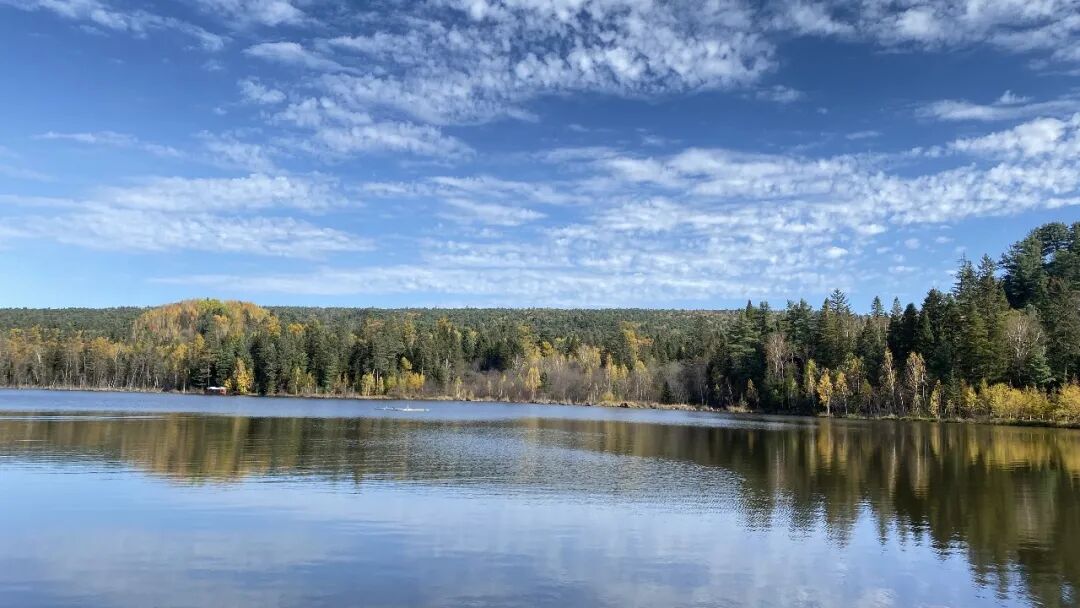
Yichun (Photo by Li Hang, Read City Notes Studio)
A homestay owner in Tangwang County, Yichun, told the Read City Notes Studio that the number of reservations for this year's National Day holiday has not changed significantly compared with last year, but the homestay is almost fully booked every day from September 26 to October 6. She said that from the perspective of the whole year, tourism in Yichun is still not easy to operate, as most tourists are very cost-sensitive, and tourist sources from southern China are also affected by factors such as weather.
From tourism to broader consumption and industries, the changes brought by the high-speed railway may take a longer time to show. For resource-based cities like Yichun, the increase in passenger flow is only the first step. It is equally important to convert the newly added population flow into more stable consumer demand, and even further drive industrial development and employment.
The high-speed railway has shortened the distance between Yichun and Harbin, which also means more frequent flow of people and production factors.
Zhang Lixin, professor at the Department of National Governance Teaching and Research of the Party School of Heilongjiang Provincial Committee, believes that the Harbin-Yichun High-Speed Railway will promote the cross-regional flow of people, business and information, and drive counties and cities along the line to transform from single-point resource development to cross-regional industrial collaboration.
However, the high-speed railway may also bring new competition. As large cities become more accessible, small cities may not only welcome more tourists and consumption, but also face the possibility of outflow of factors such as talents and consumption.
At present, apart from the tourism industry, Yichun's industries are mainly concentrated in forest food, northern Chinese herbal medicine, forest product processing, green mining and energy sectors.
In 2025, the tertiary industry accounted for 48.2% of Yichun's GDP, the primary industry 34.8%, and the secondary industry 17%. For this forest city with a population of less than one million, the real change brought by the Harbin-Yichun High-Speed Railway may not just be "faster access to Harbin", but whether it can rely on this new channel to attract more people to Yichun, and also help more local industries expand their markets outside the city.
Northeast China continues to expand its high-speed rail network
With the opening of the Harbin-Yichun High-Speed Railway, 10 prefecture-level cities in Heilongjiang Province now have access to high-speed rail, moving one step closer to the goal of "high-speed rail coverage in every prefecture-level city".
Looking at the three provinces in Northeast China, Liaoning has taken the lead in achieving high-speed rail coverage across all its prefecture-level cities. After the Shenyang-Baicheng High-Speed Railway opened in September 2025, all 14 prefecture-level cities in Liaoning are connected to the high-speed rail network, while Jilin and Heilongjiang are continuing to push forward the construction of relevant lines.
At present, Liaoyuan is the only city in Jilin that is not connected to high-speed rail.
Jilin's 15th Five-Year Plan for 2026 clearly proposes to build the high-speed railway from Changchun via Siping and Liaoyuan to Tonghua, and strive to achieve the goal of "high-speed rail coverage in every prefecture-level administrative region". In June this year, relevant departments of Jilin Province disclosed that the preliminary work for projects including the Changchun-Siping-Liaoyuan-Tonghua High-Speed Railway and the Dunhua-Mudanjiang High-Speed Railway is being accelerated. The Liaoyuan local government also stated that the route alignment of the Liaoyuan section of the Changchun-Siping-Liaoyuan-Tonghua High-Speed Railway and the site selection of the high-speed rail station have been determined, and the line is scheduled to open to traffic by the end of the 15th Five-Year Plan period.
In other words, Jilin is only one last section away from achieving the goal of high-speed rail coverage for all its prefecture-level administrative regions.
At present, Heihe in Heilongjiang is the only prefecture-level city not connected to high-speed rail, while Hegang is connected to the EMU network mainly via the Jiamusi-Hegang Express Railway. The Jiamusi-Hegang Railway has a designed speed of 160 km/h with a reserved condition for 200 km/h, which is different from high-speed railways with a designed speed of 250 km/h or above.
This is also one of the reasons why Heilongjiang is continuing to improve its high-speed rail network.
Heilongjiang proposed in its 15th Five-Year Plan to start the construction of the Mudanjiang-Dunhua High-Speed Railway, and plan and promote high-speed rail projects including Qiqihar-Hailar, Jiamusi-Hegang-Yichun, Yichun-Heihe and Shuangyashan-Fuyuan. It also proposes to form a 2.5-hour high-speed rail traffic circle centered on Harbin that connects 10 cities.
Among these projects, the Mudanjiang-Dunhua High-Speed Railway is particularly noteworthy.
The Mudanjiang-Dunhua High-Speed Railway is about 196 kilometers in total length with a designed speed of 250 km/h, connecting Mudanjiang in Heilongjiang and Dunhua in Jilin. The preliminary work for the project is currently advancing. After completion, cities in eastern Northeast China will have an additional southbound access to Changchun, Shenyang and regions inside the Shanhaiguan Pass, without needing to detour via Harbin, and the high-speed rail network in eastern Northeast China will be further connected.
This article is from the WeChat official account "Read City Notes Studio", written by Li Hang, and authorized for release by 36Kr.