Is Hengtong Optic-Electric still worth 49 times?
On September 28, Hengtong Optic-Electric hit the 10% daily price limit down.
The plan was announced on the evening of September 24, which included a private placement to raise 6.636 billion yuan, together with the employee stock ownership plan.
With a three-day Mid-Autumn Festival holiday in between, the market reopened on Monday and the stock closed at 60.64 yuan, with 16.6 billion yuan of market value evaporating in a single day. Yangtze Optical Fibre and Cable, Tongding Interconnection and Huamai Technology all slumped alongside it.
The decline was not over. On the 29th, the entire optical communication sector continued to face downward pressure, with the index seeking support at the 3800-point level.
This stock once rose by more than 400% within the year, and it hit the down limit abruptly. After the price limit drop, investors began to reflect, and friends asked me to talk about what exactly was going on?
......
To talk about Hengtong, we must first figure out what it does and how it makes money. The company was founded in Wujiang, Jiangsu, has been manufacturing optical fibers and cables for 30 years, and was listed on the A-share market in 2011.
You may see it as a leading optical fiber enterprise and a concept stock of AI computing power, but if you break down its revenue piece by piece, the picture is different.
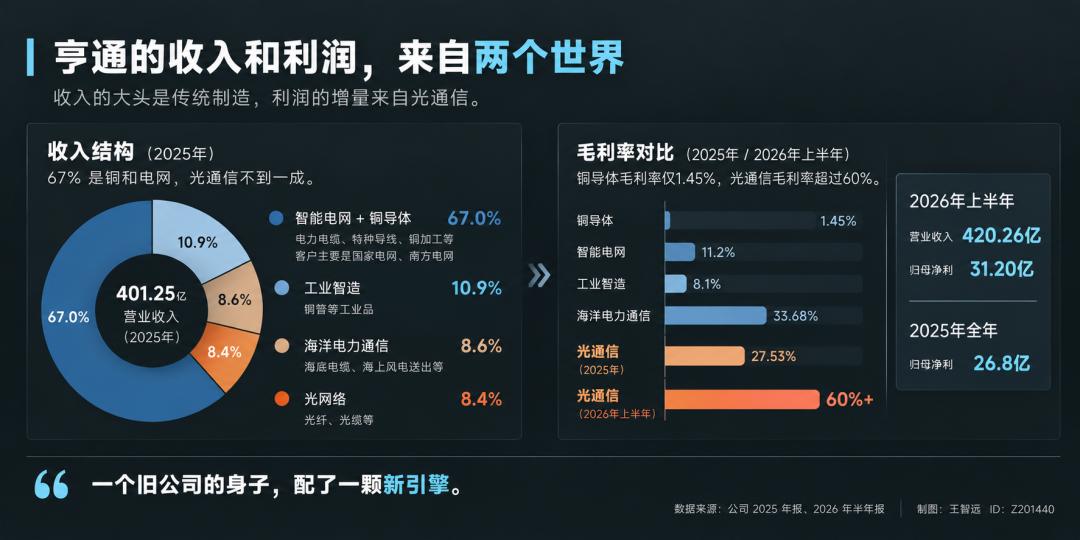
Smart grid plus copper conductors account for 67%, which is the largest proportion.
The 36% from the smart grid segment comes from products such as power cables and special wires, whose main customers are State Grid Corporation of China and China Southern Power Grid; the 31% from the copper conductor segment, simply put, refers to processing copper into copper wires for sale, priced by processing fee per ton, which is in the nature of processing with supplied materials.
The two segments together account for two-thirds of total revenue, and their gross profit margins are not high. The gross profit margin of copper conductors for the whole year of 2025 was only 1.45%. It is hard-earned money earned from moving copper products.
Intelligent industrial manufacturing accounts for 10.9%. Industrial products such as copper pipes also have the attribute of processing.
Marine power communication accounts for 8.6%. This segment covers submarine cables, the chain connecting submarine cables and offshore wind power transmission; this part has high technical content. There are only four enterprises in the world capable of manufacturing intercontinental submarine optical cables, and Hengtong is the only one in China. However, this is the exact proportion of its revenue.
Optical network accounts for 8.4%. Optical fibers and optical cables, the Hengtong in your impression, actually only accounts for this small part; moreover, the most valuable link in optical communication lies in optical fiber preforms, which are drawn into filaments to make optical cables. Hengtong operates the whole industrial chain, but it only accounts for 8.4% in its financial statements.
After breaking down the revenue structure this way, 67% comes from copper and power grid businesses, while the real optical communication business accounts for less than 10%. Judging from the revenue structure, this is a traditional manufacturing company.
The bulk of revenue comes from traditional businesses, then what about profits? Are the profits also taken away by traditional businesses? On the contrary.
For the copper conductor segment, you earn 1.5 yuan out of a 100-yuan transaction. With revenue of more than 20 billion yuan, very little of it falls to net profit; the gross profit margin of submarine cables is 33.68%, which is decent. The annual average gross profit margin of optical communication is 27.53%, which is also reasonable.
Then in the first half of 2026, the gross profit margin of optical communication jumped to over 60%.
This is interesting. Copper, which accounts for two-thirds of revenue, has a gross profit margin of less than 2 percentage points. The optical communication business, which accounts for less than 10% of revenue, has a gross profit margin of more than 60 percentage points. The bulk of revenue and the bulk of profits do not come from the same business at all.
Besides, this 8.4% revenue business started to rally only in the past six months.
In the whole year of 2025, Hengtong's optical communication revenue was still declining, down 14.53% year on year. At that time, no one regarded it as an AI stock, and it was indeed not one.
Six months later, in the first half of 2026, the revenue of optical communication increased by more than 130% year on year.
In the same period, the company's total revenue in the first half of the year was 42.026 billion yuan, and the attributable net profit was 3.12 billion yuan. What is the concept of 3.12 billion yuan? The total attributable net profit for the whole year of 2025 was only 2.68 billion yuan. The profit earned in half a year exceeded that of the whole of last year. Where does the increment come from? Basically from that 8.4% business segment.
Therefore, Hengtong's revenue structure still presents as a copper processing and power grid company, but its profits are being rewritten by the optical communication business. In other words, an old traditional company is equipped with a brand new engine.
......
I checked that the company's current price-earnings ratio is around 49 times.
This figure was fixed on August 25, and I did not calculate it based on the price after the daily limit drop on September 28. Since September, institutional research reports have been released for several rounds, and the comparable caliber still stays here: the TTM P/E ratio is 49.4 times, and the price-to-book ratio is 5 times.
Is 49 times high? If measured purely as a copper processing and power grid company, the market gives an average P/E ratio of around 10 times for this type of business, so 49 times is 4 times higher.
It is not hard to find among peers that ZTT, which is in the same sector and manufactures optical fibers and cables with almost the same business structure, has a P/E ratio of 36.2 times, and Hengtong's valuation is 35% higher than that; UBS's first coverage of Yangtze Optical Fibre and Cable this year gave a buy rating, and the converted target price corresponds to a 2027 expected P/E ratio of only 16 times.
By the way, we make a rough calculation: based on the market value of around 149 billion yuan after the price limit drop, the 3.12 billion yuan net profit in the first half of the year is simply annualized, and the dynamic P/E ratio is around 24 times.
The 49 times is TTM, which includes the poor performance in the second half of last year. If measured by the ruler of traditional businesses, the valuation seems too high no matter how you calculate it, and the market obviously does not value it with this ruler. What on earth does it hold that makes investors dare to give such a valuation?
First, optical fiber prices are rising, which has lasted for 15 months.
The price once rose from less than 20 yuan per core-kilometer to 83.4 yuan. Back in 2025, optical fibers were hard to sell, with prices hovering around the cost line, and the annual optical communication revenue dropped by 14.53%. No one expected the reversal to come so quickly.
The buyers have changed. In China Mobile's latest ordinary optical fiber centralized procurement, the price was about 90% higher than the previous round, and the spot price of special optical fibers rose by 650%. An AI computing center consumes several times more optical fibers than a traditional computer room.
The sellers control the supply more strictly, and the bottleneck lies in the optical preform, the base material of optical fiber, a quartz glass rod weighing several tons, which is drawn into filaments and coiled to make optical cables.
It takes 18 to 24 months to expand the production capacity of preforms, and the deposition process has been accumulated for more than ten years to form a well-known reputation. The number of manufacturers in the world that can achieve independent mass production can be counted on one hand. Some manufacturers even went bankrupt in the last round of price war, and there are not many players left in the industry after the market clearance up to now.
Every round of optical fiber shortage is essentially a shortage of optical preforms, and this shortage cannot be solved in the short term.
Second, look at where the company places its bets.
The funds raised from the private placement will be mainly allocated to the optical communication business. To put it simply, private placement means that the company issues a new batch of new shares to specific investors to raise a sum of money.
Imagine the company as an existing pizza, with each old shareholder holding a slice. Private placement is like baking a large new pizza, which is cut to new investors according to the money they invest. The share held by old shareholders remains the same, but the proportion of their holdings is diluted after the total number of shares expands.
In the 6.636 billion yuan plan, five optical communication projects received a total of 3.148 billion yuan, covering optical fiber preforms, new-generation optical fibers, all the way to AI advanced optical interconnection and CPO advanced packaging.
1.498 billion yuan will be allocated to energy interconnection, and the remaining 1.99 billion yuan will be used to supplement working capital. 47% of the funds are directly invested in the optical communication business. Excluding the part for working capital supplement, optical communication accounts for two-thirds of the total project funds.
The maximum number of shares to be issued is 739 million, which is equivalent to 30% of the current total share capital; where the money goes shows the company's intention. No additional fund is allocated to the copper business, and all chips are pressed on the optical communication business, as the company wants to transform itself into an optical communication enterprise.
Third, there is one more card hidden outside the financial statements.
For submarine cables, there are only four enterprises in the world that can manufacture intercontinental submarine optical cables, namely SubCom from the United States, NEC from Japan, ASN from France, plus Hengtong, the only one in China. The company's hand-held orders are 31 billion yuan.
This type of business depends on qualifications and delivery records. New players cannot even enter the door in front of security reviews such as the FCC's. After the FCC tightened submarine cable regulation in June this year, the door was even more tightly locked.
Hengtong's marine communication business covers 78 countries. Even if it cannot enter the US landing point, US buyers cannot find a fifth supplier. This new regulation has instead raised the cost of submarine cable construction in the United States.
With the three points combined, the logic of 49 times P/E ratio makes sense. The market is betting on the prosperity of the optical communication industry, pricing Hengtong as a growth stock in the optical communication sector, and valuing its submarine cable business as a scarce asset at a discounted price.
Conversely, it is clearer: once the optical communication story is interrupted, the 49 times valuation will immediately fall back to the valuation system of traditional copper processing business, which is around 10 times; whether this valuation can hold up depends on one thing: how long can the optical fiber price increase last?
The current market believes that the price increase will last. In the report "AI Infrastructure: Materials Supercycle" released by Morgan Stanley in mid-September, optical fiber is listed as one of the four most scarce materials in the AI industry. The global optical fiber quotation is still rising, and the 400% rally of the stock within the year is the realization of this confidence.
The market's valuation of Hengtong is betting on the optical communication business, and the premise of the bet is that the optical fiber price increase is not a flash in the pan.
......
In that case, the profit earned in half a year is more than that of the whole last year, why did the stock hit the down limit?
It was the stock that hit the down limit on September 28, it was the same company that announced the private placement on the evening of September 24, and it was also the same company that reported 3.12 billion yuan of attributable net profit in the half-year report, doubling year on year.
The performance did not collapse, and the orders were still strong. The company stated that "the orders are still very full, and the industry capacity utilization rate is at a high level". The orders of leading enterprises in the whole industry have been scheduled to 2027. But the down limit still came, which cannot be explained by fundamentals.
Then we can only find the reason from the distribution of interests.
Dilution is a real problem. A maximum of 739 million new shares will be issued in this round, the total number of shares in the market increases, and the proportion of original shareholders' holdings will be diluted by 23.1% once the issuance is completed in full.
These new shares are issued at a discount, and the issue price shall not be lower than 80% of the average price of the 20 trading days before the issuance. A maximum of 35 specific investors can participate, which means they can buy shares at a group purchase discount.
Looking back at history, the company launched a private placement of 3.061 billion yuan in 2017, and another private placement of 5.004 billion yuan in 2020, with an issue price of 12.31 yuan. Together with this 6.636 billion yuan private placement, the company raised nearly 14.7 billion yuan from the market in less than ten years.
At the same time, the Hengtong group controls five listed companies, and is pushing the sixth company for IPO. Its submarine cable subsidiary Hengtong Huaihai is also going to be spun off and listed on the STAR Market, and the proposal was approved with 99.99% of votes in the shareholders' meeting.
Investors' original words are very straightforward: "It raises money when it makes no profit, and it still raises money when it makes huge profits".
The employee stock ownership plan is announced alongside the private placement plan, covering 222 employees, with a maximum fundraising of 289 million yuan, at a price of 34.27 yuan per share, which is almost half of the current market price.
The assessment conditions sound very strict, requiring 15% revenue growth and 90% net profit growth in 2026, but actually the two targets are optional, meeting any one of them can meet the requirement. The 3.12 billion yuan net profit in the first half of the year has already been recorded in the account, the full-year target is 5.092 billion yuan, and the target can be achieved as long as there is no major mistake in the second half of the year.
The unlocking rule is that the full shares will be unlocked if the target is met, and no share will be unlocked if the completion rate is lower than the trigger value. According to the current momentum, the shares will most likely be fully unlocked. The market's complaint is that "there is almost no suspense in meeting the full-year target".
Then look at the cash in the company's pocket. The operating cash flow in the first half of the year was -865 million yuan, turning from positive to negative. The profit is recorded in the financial statements, but the cash is still in other parties' pockets; the accounts receivable increased by 4.4 billion yuan, and the inventory increased by 1.4 billion yuan.
The interest-bearing liabilities increased by 3.7 billion yuan in half a year, and the capital expenditure for purchasing equipment and building production lines increased from 1.224 billion yuan to 1.968 billion yuan. Therefore, the 1.99 billion yuan for working capital supplement is not greedy, but a rigid demand, and the controlling shareholder has pledged more than half of its shares.
At this point, the cost of the private placement is very clear.
If we say Hengtong is blindly expanding production, the direction of this round is indeed different. The new production capacity of 9.53 million core-kilometers, as