Earning 77.6 billion yuan in half a year, Changxin has placed another 34.9 billion yuan bet on the next-generation DRAM.
A track known for its deep cycles, where the amplitude of sharp price surges and crashes far exceeds that of the general manufacturing industry
On the evening of September 28, Changxin Technology (688825.SH) released two consecutive investment announcements: a RMB 24.1 billion technology R&D project, plus a RMB 10.8 billion second-phase memory wafer post-test base, totaling RMB 34.9 billion in a single day. Of this amount, RMB 18 billion comes directly from IPO over-raised funds, and the remaining part will be supplemented through capital increase and loans.
A company that just posted a rare profit figure on the A-share market in its half-year report immediately plowed its profits and over-raised funds back into production lines. How should we interpret this move?
What is the quality of the RMB 77.6 billion profit
In the first half of 2026, Changxin Technology achieved operating revenue of RMB 150.31 billion, a year-on-year increase of 873.64%; the net profit attributable to shareholders was RMB 77.605 billion, while the company still recorded a loss of RMB 2.332 billion in the same period last year. The gross profit margin of its core business reached 84.84%, and the net operating cash flow was RMB 131.156 billion.
It is extremely profitable.
The 84.84% gross profit margin of the core business is also quite prominent among all large A-share manufacturing enterprises. The demand for AI computing power has led to a global shortage of DRAM supply. Samsung, SK Hynix, and Micron have tilted their production capacity towards HBM and server DDR5, leaving a structural gap in general-purpose memory products, which Changxin has exactly captured.
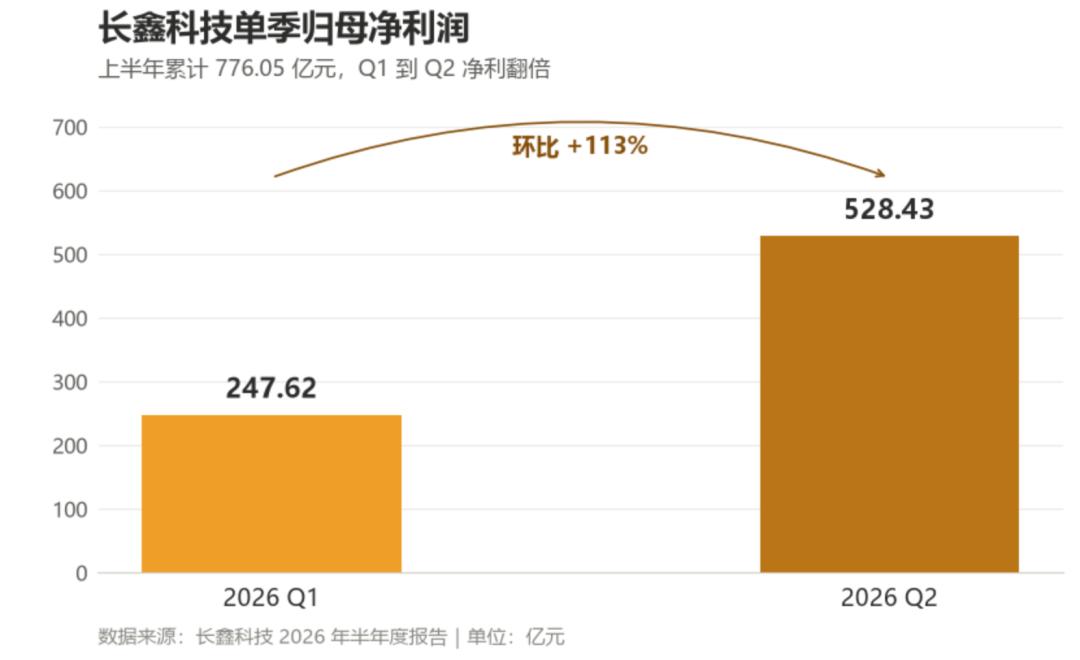
What is more noteworthy is the quarter-on-quarter curve. The net profit attributable to shareholders in the first quarter was RMB 24.762 billion, and that in the second quarter was RMB 52.843 billion, representing a 113% quarter-on-quarter increase. That means by the middle of this year, the profit brought by price increases is still accelerating instead of peaking and declining.
Market share has also climbed to a new level simultaneously. According to data from CFM Flash Memory Market, the global DRAM market size in the second quarter of 2026 was USD 147.024 billion, up 55.9% quarter-on-quarter and hitting a record high; after Samsung, SK Hynix and Micron, Changxin Memory's market share has approached 10%, firmly ranking fourth in the world, and its quarterly revenue growth rate ranks first globally.
Where the RMB 34.9 billion is spent: IDM completes the last link
Half of the huge fixed investment goes to R&D, and the other half to testing.
The total investment in the R&D project is RMB 24.1 billion, with a construction period of 30 months, focusing on DRAM process technology iteration. The background of this investment is that Changxin has just made a key leap: in September, the company's fifth-generation DRAM process technology platform was officially mass-produced. Using quadruple patterning technology, the half-pitch of the active area of the memory array was shrunk to 11.95 nanometers, making it among the world's top mass production processes. The R&D investment in the first half of this year was RMB 6.859 billion, a year-on-year increase of 87.38%, and RMB 24.1 billion is equivalent to 3.5 times the R&D investment in the first half of the year.
The second phase of the test base answers a more practical question. The statement in the announcement is quite straightforward: with the continuous release of production capacity and the continuous enrichment of product matrix, the insufficient external packaging and testing capacity and limited supporting resources have begun to restrict the release of production capacity. This test factory with a total investment of RMB 10.8 billion and a construction period of 37 months will undertake DRAM wafer testing and module assembly after completion, further strengthening the post-test capability under the IDM model.
It should be noted that RMB 34.9 billion is the total planned investment of the two projects, of which RMB 18 billion is planned to use over-raised funds. The funds the market gave Changxin when it went public have not been spent yet. Now the company invests back into the production line without adding new debt or diluting shareholders. Exchanging profits for production capacity and cash flow for time, this business approach is very traditional and very solid.
GigaDevice increases its stake: the amount of related party transactions has increased significantly
On the same day, the downstream of the industrial chain gave a more straightforward proof.
On the evening of September 29, GigaDevice announced that it would raise the estimated annual daily related party transaction amount with Changxin Group in 2026 from RMB 5.711 billion to RMB 7.854 billion. The reason for the increase is clearly stated: the OEM price of DRAM products rises with the market trend. At the same time, the company expects the related party transaction amount from January to April 2027 to reach RMB 4.411 billion.
The weight of this set of figures needs to be converted: RMB 4.411 billion is only the estimated amount for 4 months, which has exceeded GigaDevice's total revenue in the first quarter of 2026 (RMB 4.188 billion) and is close to half of its total revenue in 2025 (RMB 9.203 billion). The actual related party transactions between the two parties in 2025 were only about RMB 1.18 billion. In one year, the amount has expanded to 6.7 times.
There is another layer of signal hidden in the execution progress. From January to August 2026, the actual transaction amount was RMB 3.596 billion, leaving a space of RMB 4.258 billion below the upper limit of RMB 7.854 billion, which means that the procurement pace is likely to accelerate further in the second half of the fourth quarter.
Light-asset design companies are raising prices to grab OEM production capacity, which is the most typical micro form of a seller's market. Fabless manufacturers can do without their own fabs, but they cannot do without DRAM production capacity. At present, there are only a few production lines in the world that can undertake large-scale niche DRAM OEM.
Price on the other side: US stock memory chain plummeted overnight
On the other side of the boom, the global capital market gave another quotation for this industry.
Around the release of Changxin's announcement, the US stock memory sector fell collectively: Micron closed down 2.61%, SK Hynix closed down 5.03%, SanDisk closed down 3.65%, and the Philadelphia Semiconductor Index closed down 1.61% (it once fell 3% during the session). The background is that the 10-year US Treasury yield rose to 5.27% during the session, a new high since 2007, and the 30-year yield rose to 5.57%, a new high since 2002. High-valuation growth assets are generally under pressure in a high interest rate environment.
On the A-share side, Changxin Technology closed down 4.27% on September 28, with a total market value of RMB 3.65 trillion, still ranking first in the A-share market by market capitalization. On the one hand, local leading enterprises are heavily expanding production against the trend, on the other hand, the valuation of overseas memory assets is shrinking. In the same industry, the two markets have given opposite pricing directions.
Signals on the fundamental side are also worth recording: as memory original manufacturers and some server customers have locked the upper limit of long-term agreement prices, the price increase space for non-long-term agreement orders is shrinking quarter by quarter. Institutions generally expect DRAM prices to continue rising in the third quarter but with a narrower increase. The sharp price surge phase is most likely coming to an end.
So, is investing RMB 34.9 billion to expand production when the price increase momentum is slowing down a counter-trend gamble or a textbook operation?
The reference from the history of the DRAM industry is the latter. This is a track known for its deep cycles, where the amplitude of sharp price surges and crashes far exceeds that of the general manufacturing industry. The reshuffling of the industry pattern almost all occurs in the production expansion decisions during the downward cycle: whoever continues to invest in production lines when they are most short of money will take the largest share in the next boom. Samsung relied on counter-cyclical investment in several consecutive downward cycles to squeeze Japanese competitors out of the memory market.
Put Changxin's schedule into this framework. The second phase of the test base has a construction period of 37 months, and the production launch node is around 2029, which exactly corresponds to the window when the current round of supply shortage eases and supply and demand find a new balance. At that time, companies that have new production capacity, fifth-generation and even sixth-generation processes, and self-built testing systems will be in a completely different situation from companies that only made profits from one round of price increases.
What's more, Changxin's production expansion is not a homogeneous increase in volume. The structural gap in general-purpose DRAM left by giants, the world's first commercial mass production of LPDDR6 (debuted on Xiaomi 18 Fold, with a peak rate of 12800Mbps and a maximum capacity of 16GB), and Changxin's 10667Mbps LPDDR5X launched on Nubia NaviX Ultra (the first mass production application of domestic products at this rate level), these product-level positions show that the RMB 34.9 billion is not just for production capacity, but for a differentiated position.
Conclusion
The mid-term judgment of the memory super cycle has not changed, and what has changed is the focus of observation. What is worth paying attention to next is no longer how many percentage points DRAM rises each quarter, but three slower variables: when the sixth-generation process after 11.95 nanometers will be lit up, at what speed the RMB 7.854 billion related transaction amount will be executed next year, and where the industry is in the cycle when the test base is put into operation in 2029.
For the secondary market, it is necessary to stay sober: the valuation peak of cyclical stocks always appears before the profit margin peaks. RMB 34.9 billion is the bet of industrial capital on the future, while financial capital prices the slope of current profits. The time difference between the two is exactly the entire game space of this business.
(This article is compiled based on public information and does not constitute investment advice.)
This article is from the WeChat official account "Laika Think Tank" (ID: laikazk), author: AA, editor: G3007, published by 36Kr with authorization.