The Whisper of Muse: We are already standing on the eve of the collapse and reconstruction of the Internet business model
In Greek mythology, there are nine Muses presiding over the arts, looked up to by mortals. Today, humanity's ambition is to mass-produce them: one for every person, not in charge of the arts, but of daily chores, booking flights, negotiating bills, selling used cars, and replying to emails.
Over the past three decades, the prosperity of the internet has been built on one thing: you go online in person, browse in person, choose in person, and pay in person. The entire foundation of the attention economy is the human eye.
Now, "Personal Agents" like Muse, Cue and Dots are arriving. Eyes step back, footprints disappear, pages lose their audience, and advertisements lose their viewers. The internet is evolving from "being viewed by people" to "handling things for people". This will be more brutal than any previous portal war in history, because what it replaces is not the portal itself, but the "person" behind the portal.
The era of internet manpower where two eyes are fixed on the screen is coming to an end. From now on, sitting on the other side of the screen will be a Bot that is figuratively "fluffy" but actually a string of code, running errands for you in a virtual machine.
It does not view advertisements. This is exactly where all the problems begin.
The End of the Internet Manpower Era
On September 8, 2026, Meta launched Muse. In 12 days, it recorded 2.8 million downloads, with 642,000 daily active users in the US region, nearly three times the figure for ChatGPT's mobile app launch in the same period; it received a 4.9-star rating on iOS with 36,000 reviews.
I opened it and tried it. The interface features a fluffy virtual pet that talks like a friend sending WeChat messages. But users do not give it questions, they give it goals.
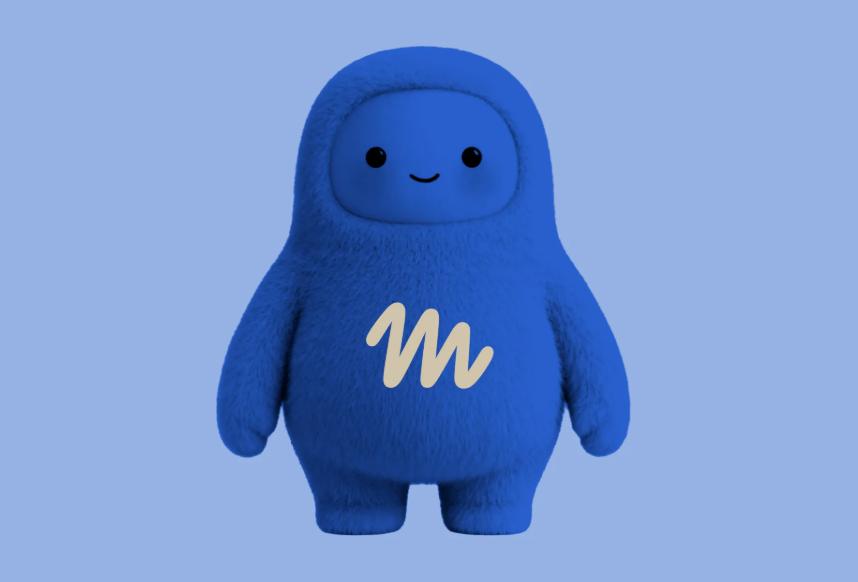
Figure: Muse's virtual avatar
When you say "book a restaurant for four people to have dinner this weekend", it first reads your calendar to find free slots, then checks if the restaurant has available seats, and lists options based on your preferences. Once you nod, it places the order. When you say "help me sell my car", it will post the listing on second-hand platforms, reply to inquiries, negotiate prices, and arrange handover. You can close the app and go to sleep, and it will keep working on the cloud server, report back when it finishes, and confirm with you once before making payment.
Looking at the technical logs, each user is assigned an independent cloud Linux computer, officially named Muse Secure VM, which is equipped with a browser, storage and computing power; there is a supervisor program called Sentinel in the system, and every action of the Agent must pass through it; the wallet is powered by Stripe, which generates a one-time card number when making payment. The underlying model is Meta's self-developed Spark 1.3, trained specifically for multi-step, long-cycle agent tasks.
Understanding this configuration helps you make sense of the market trend on September 22: the Philadelphia Semiconductor Index surged 4.29% in a single day, AMD's market cap exceeded 1 trillion US dollars for the first time in history, Meta itself rose 22.5%, with its market value increasing by more than 300 billion US dollars. The download volume of one single application pushed a chip company into the trillion-dollar club in just over ten days.
The market interpreted this trend as a positive sign for the chip sector, and the media viewed it as the birth of a hit product. Both views are too narrow.
Over the past three decades, the main subject that actually does the work on the internet has been humans. The browser is the client for humans; no matter how powerful the search engine is, it only helps you find directions; no matter how convenient e-commerce is, every step of comparing prices, placing orders and making payments is clicked by you personally. Pages are made for people to view, advertisements are made for people to view. From web portals to information feeds, the entire internet is designed around the same premise: you are present in person.
How present are you? According to DataReportal, there are 6.1 billion internet users worldwide, who spend an average of 6 hours and 37 minutes online per day. Each person devotes more than a thousand waking hours every year to viewing pages, scrolling through feeds, and clicking on ads. The attention economy is never a metaphor: it is the largest scale of unpaid labor in human history, and the trillions of annual revenue of the global advertising industry are all extracted from these pairs of eyes.
Muse breaks down this premise. It reads your calendar for you, browses web pages for you, and negotiates prices and places orders for you. In 1993, the browser brought the internet to people; in 2026, Muse takes people away from the front of the internet.
The subject surfing the internet has changed. Google's search box, Meta's information feed, and Amazon's shelves are all serving an invisible user overnight. This user does not view ads, does not browse pages, goes straight to the target, and leaves once the task is done. This "subject replacement" has actually already begun. According to statistics from Imperva, 51.8% of global web traffic has already come from Bots; what Muse does is to hand over the last category of traffic that requires human presence as well.
The industry's response is surprisingly fast. According to multiple media sources, ByteDance's Doubao team received a six-day urgent task during the Mid-Autumn Festival holiday, and is required to deliver the internal test version benchmarked against Muse on September 30 (is it today?). Tencent is conducting gray-scale tests on WeChat Xiaowei, and Alibaba's Qwen has been deployed in more than 20 fields; in the early hours of today, OpenAI also couldn't wait to release its similar product Bots. Historically, portal wars have lasted for about ten years, but this time, all players have entered the market within six weeks.
Meta's capability has its origin. In December 2025, Manus announced that it would join Meta, but the move was stopped by a ban issued by the National Development and Reform Commission in April 2026. Manus, which just restored its independence in September, subsequently released the similar product Cue, where each Agent has its own phone number, email, wallet and computer. Meta failed to acquire that company, so it built a Muse according to its model. There are no patents in this competition, only time difference.
Figure: Manus Cue's virtual avatars are a group of sprites
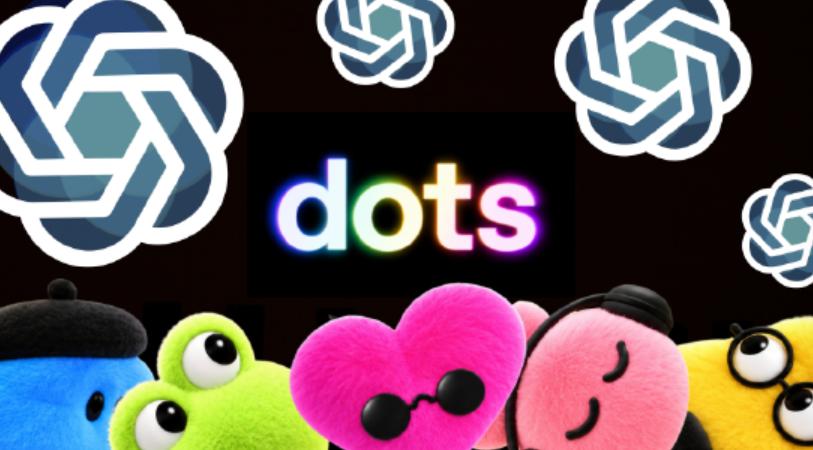
Figure: OpenAI Bots' virtual avatars share the same design philosophy as Manus Cue
Everyone's urgency points to the same thing: whoever controls this new subject will take charge of the portal of the next generation of the internet.
After the subject is replaced, the first thing to change is the computing power accounting. When humans surf the internet, they are billed by the hour: you open the page, the server renders it, you close it, and the resources are released. When Agents surf the internet, you pay "rent" monthly: each Agent is a 7×24-hour resident cloud computer, GPU is responsible for thinking, and CPU, memory and storage are responsible for keeping it running. Thinking takes a split second, but keeping it running takes every hour.
This calculation is astonishing. Muse had 2.8 million users 12 days after its launch, even if only one in ten is active, that means hundreds of thousands of cloud computers are running at the same time; if it really achieves Mark Zuckerberg's vision of "one for everyone", there will be billions of such units worldwide. The funds buying AMD and Arm are betting on this expectation: the increment of GPU follows the number of dialogues and is linear; the increment of resident virtual machines follows the number of users and expands with the scale.
All parties are already rushing to reduce costs. Muse's underlying model Spark 1.3 uses 20% fewer tool calls and 25% fewer tokens than the previous generation; Manus 2.0 cuts operating costs by 32%, and Anthropic reduces cache reading prices by 75%. The goal is the same: to bring the monthly cost of "supporting a digital employee" down to an affordable level for ordinary people. The price list for "rent" has also been released: Muse is free for most daily needs, with two tiers of heavy subscriptions at $20 and $100 per month. The maintenance cost of digital employees has been put on the shelf for the first time.
If Helen's beauty is a gift from nature, then Muse's beauty is all about the cost sheet. If the cost cannot be brought down, the myth will remain nothing but a myth.
The Collapse and Reconstruction of the Internet Business Model
In 2026, the global advertising market will exceed 1 trillion US dollars for the first time (according to Dentsu), 74% of which flows to digital channels (according to DataReportal). How concentrated is the market? Emarketer predicts: Meta alone will take $243.46 billion, accounting for 26.8% of global digital advertising spending, surpassing Google's $239.54 billion for the first time in history; plus Amazon's $82.07 billion, the top three players take 62.3% of the total.
This is the core size of the thing that is about to collapse.
The way it collapses starts with the pricing unit of advertising. Digital advertising has been sold for 30 years, and what it sells has always been the same thing: exposure. It is priced per thousand impressions and settled by clicks, everything is converted back to eyeballs and duration. Global advertisers spend 1 trillion US dollars a year to buy 6.1 billion pairs of eyes and 6 hours and 37 minutes of gaze every day.
When Agents surf the internet, this pricing unit becomes invalid. Without browsing, there is no exposure; without exposure, the business priced by exposure loses its foundation immediately. The Agent compares prices, places orders and makes payments for you, and no ad slot is viewed in the whole process. Traffic is the footprint left by human attention, and Agents leave no footprints when surfing the internet.
The first ring collapses on the transaction side, and the second ring collapses on the fiscal side. The default price of the internet for the past 30 years is zero, and behind the zero price is the accounting method: you don't pay for the content, your attention pays for it. News is free to read, videos are free to watch, search is free to use, and the cost is converted into ad slot inventory. When attention exits, there is no corresponding account item for this book. The source of revenue for free services is removed, so content, tools and platforms all have to start charging cash, and the paying party is often the Agent that runs errands for you.
The third ring collapses on the content side. The monetization of global media and creators has long relied heavily on advertising; 70% of the advertising budget is deposited in digital channels. When the main subject of reading changes from humans to bots, pages lose their audience, and content producers lose their buyers before platforms do.
The first to collapse is Meta's own position. Its official blog clearly states: user conversations and data in virtual machines will not enter Meta's advertising system; users can opt out of using their data for model training with one click. A company with more than 240 billion US dollars in annual advertising revenue has drawn a quarantine zone for its old business by itself. When the world's largest advertising company no longer talks about advertising, this shift itself is more convincing than any research report.

Figure: Comparison between the attention economy and the agency economy
The attention economy measures eyeballs, and the new accounting measures agency rights. Eyeballs are consumables, and each view consumes one of them; agency rights are cumulative, and each authorization deepens them. The former competes with people for time, while the latter saves time for people. For the first time in 30 years of the internet, the revenue base has been changed from traffic to agency rights.
New Business Model Narrative and New Capital Market Logic
The collapsed old business model needs to be replaced by a new one. What the new model looks like is most simply described by Xiao Hong, the founder of Manus: "Manus is quite like a business of selling computers." The subscription fee is the rent, and the transaction commission is the property fee. Both revenues have nothing to do with the token price; the cheaper the token, the higher the gross profit. The deadlock of "the more powerful the model, the more losses it makes" that has plagued the large model industry for two years has its key actually been in the hands of the client all along.
The key has been found, but the structure of the lock still needs to be disassembled.
The portal business has changed owners three times in 30 years, and each time it changed its taxation method. The first time was the browser, Netscape set the portal on the homepage, and Yahoo charged display fees through its web portal; the second time was search, Google put the portal in a search box and charged bidding fees by clicks; the third time was information feed, Meta split the portal into every piece of content and charged advertising fees by exposure. All three taxation methods share the same premise: humans are present, and eyes are fixed on the screen.
Muse and its kind are about to break this premise, and the taxation logic will be rewritten accordingly. They charge action fees instead of exposure fees: transactions are completed in their hands, money flows out through them, and the fees are naturally collected on their side. This is the fourth portal war, where the tax base changes from traffic to transaction volume, and from a probability-based business to a certainty-based business.
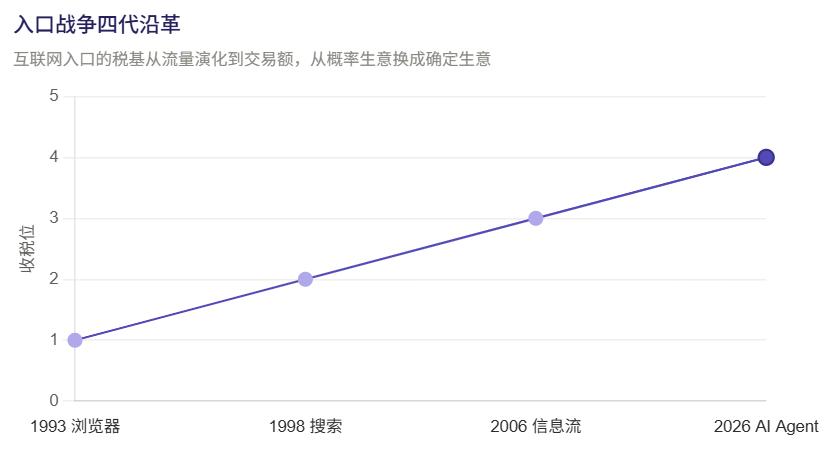

Figure: Four generations of evolution of portal wars
Advertising is a probability-based business: a hundred exposures lead to one click, and a hundred clicks lead to one transaction. Commission is a certainty-based business: when the transaction happens, the revenue is credited. In history, certainty-based businesses always beat probability-based businesses: credit card networks have collected transaction channel fees for a hundred years, and the combined market value of Visa and Mastercard exceeds 1 trillion US dollars; the App Store takes a 30% commission, making Apple one of the companies with the highest market value in the world.
Where is the moat? As the saying goes: Muse/Cue stand at the last step of the transaction, they compare prices, select products, and make payments. Whoever controls Muse/Cue is equivalent to setting up a toll booth on the only way of every transaction, which others cannot bypass,