Fiscal and monetary policies are making concerted efforts: providing interest subsidies for first-home mortgages and rolling out targeted interest rate cuts to support the development of the "six networks".
The interest subsidy policy is designed to help households with relatively low incomes that plan to purchase ordinary homes "reduce their monthly mortgage payments". The targeted recipients include new citizens such as migrant workers, young people including newly employed college graduates, and urban salaried families and other groups with rigid housing purchase demands.
As the National Day holiday approaches, fiscal and monetary policies are rolled out on the same day.
On September 29, the Ministry of Finance, together with the People's Bank of China (hereinafter referred to as "the central bank") and the State Administration of Financial Regulation, issued the Notice on Implementing the Interest Subsidy Policy for Residents' Home Purchase Loans (hereinafter referred to as "the Notice").
The Notice states that starting from October 1, the financial authorities will provide interest subsidies for new commercial personal housing loans for first homes with a total price of 1.5 million yuan or less and a floor area of 120 square meters or less. The implementation period is tentatively set at 1 year. According to official estimates, the interest subsidy policy can help borrowers reduce their total interest payments by nearly 50,000 yuan at most.
Relevant officials from the Ministry of Finance, the central bank, and the State Administration of Financial Regulation stated in a press interview that the interest subsidy policy aims to help households with relatively low incomes preparing to buy ordinary homes "reduce their monthly mortgage payments". The targeted groups include new citizens such as migrant workers, young people including newly employed college graduates, and urban salaried families and other families with rigid housing purchase demands.
According to the Notice, 90% of the fiscal funds for this round of interest subsidies come from the central government. This is the first time that the central fiscal authority has provided interest subsidies for commercial personal housing loans.
According to calculations by Ming Ming, chief economist of CITIC Securities, the scale of housing loans that meet the interest subsidy requirements is about 5.6 trillion yuan, and the fiscal funds corresponding to a 1 percentage point interest subsidy are approximately 560 billion yuan.
On the same day, the central bank announced four measures to adjust and improve several monetary policy tools, two of which involve the Pledged Supplemental Lending (PSL).
The central bank decided to cut the PSL interest rate by 0.25 percentage points, bringing the one-year PSL interest rate down to 1.5%; at the same time, the construction of the "six networks" including the water network, new-type power grid, computing power network, new-generation communication network, urban underground pipeline network, and logistics network will be included in the PSL support scope.
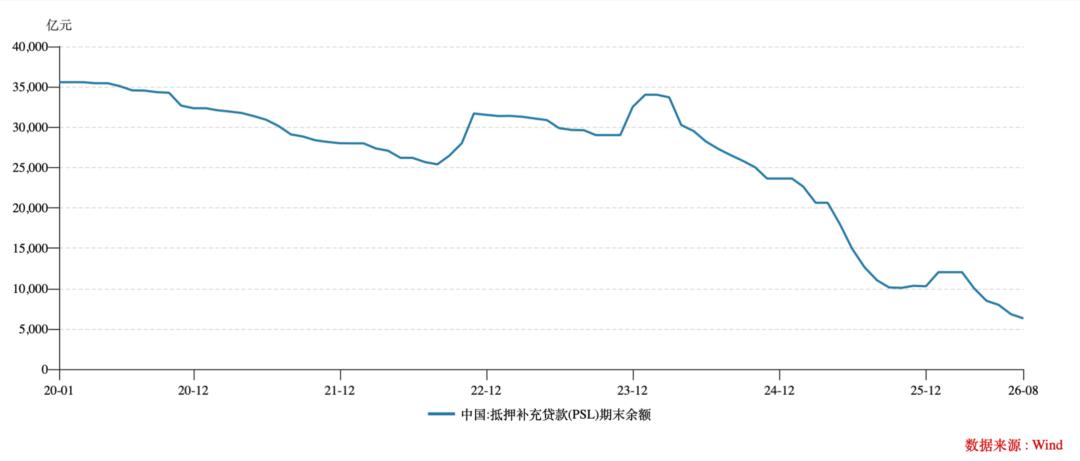
PSL is a structural monetary policy tool created by the central bank in 2014, which made outstanding contributions to the "monetized resettlement of shantytown renovation" around 2015. In recent years, the market has maintained high attention to the use of the PSL tool, and many economists have also suggested using the PSL tool to support the expansion of public investment.
The central bank stated that this adjustment aims to implement the spirit of the meeting of the Political Bureau of the CPC Central Committee and the deployment of the executive meeting of the State Council, and implement a moderately loose monetary policy well.
The executive meeting of the State Council held on September 28 pointed out that it is necessary to increase the counter-cyclical adjustment of macro policies. It was specifically mentioned that monetary policy tools should be comprehensively applied and adjusted in due course, the quota of re-lending for scientific and technological innovation and technological transformation, as well as for supporting agriculture and small and micro enterprises, should be increased, and policy measures to stabilize the real estate market and promote employment and income growth should be studied and introduced.
"This round of adjustment implements the deployment of the meeting of the Political Bureau of the CPC Central Committee and the State Council executive meeting, which is an intensified move under the tone of 'moderate looseness', and forms a combined policy to stabilize domestic demand together with the fiscal home purchase interest subsidy on the same day," Ming Ming said. However, the intensification of structural tools may mean that the window for aggregate easing has not yet opened, and it is difficult to see a cut in the LPR (Loan Prime Rate) for a long time.
Housing Loan Interest Subsidy: Maximum Subsidy of Nearly 50,000 Yuan
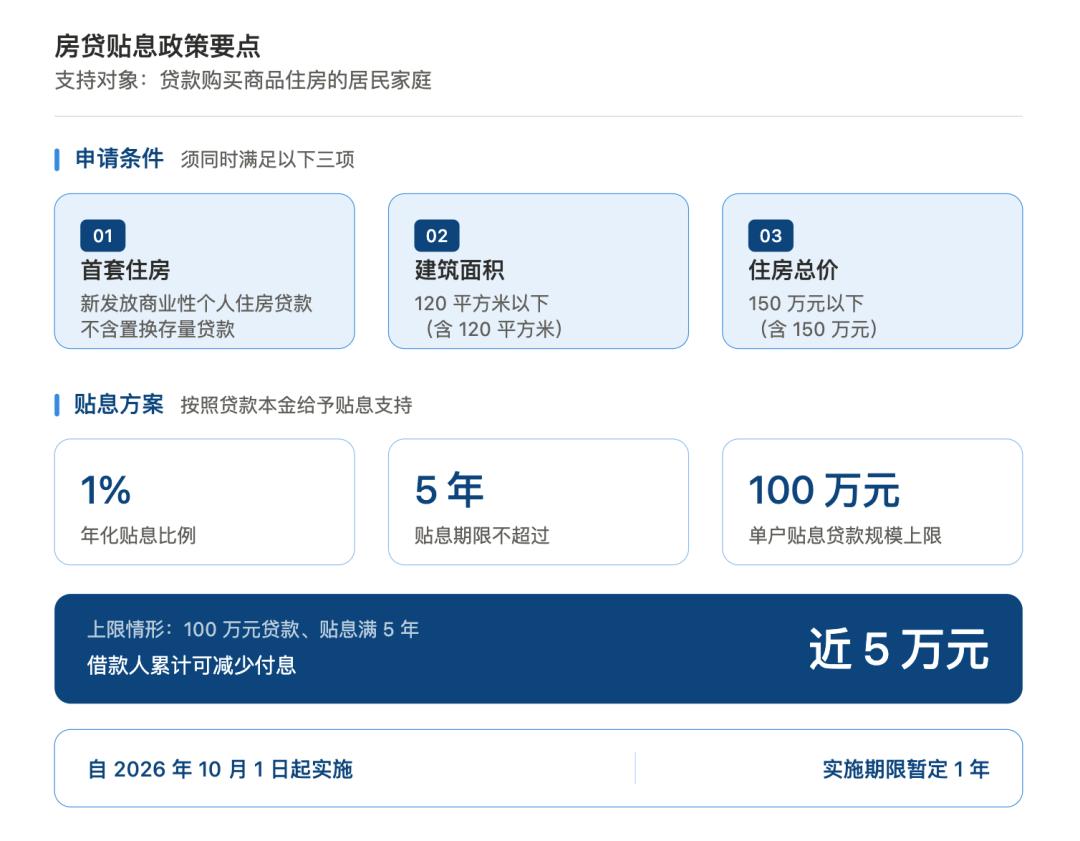
According to the Notice, the targeted recipients of this housing loan interest subsidy policy are resident families that purchase commercial housing with loans, and three conditions must be met at the same time:
First, the new commercial personal housing loan is used to purchase the first home, excluding the use of new commercial personal housing loans to replace existing loans;
Second, the floor area of the purchased housing is 120 square meters or less (including 120 square meters);
Third, the price of the purchased housing is 1.5 million yuan or less (including 1.5 million yuan).
"The above conditions are set mainly to focus on supporting the basic housing purchase demand of rigid demand groups. Considering that residents' income, housing area, and price levels vary in different cities, the central level coordinates the goals of improving people's livelihood, ensuring basic needs, achieving wide coverage, promoting fairness, and taking into account fiscal capacity, to seek a balance across the country," relevant officials from the Ministry of Finance, the central bank, and the State Administration of Financial Regulation said. By defining the total housing price, housing area, and loan type, the policy can benefit the target groups as accurately as possible, and help households with relatively low incomes that plan to buy ordinary homes "reduce their monthly mortgage payments".
The specific interest subsidy scheme is as follows: provide annualized 1 percentage point interest subsidy support based on the loan principal for a period of no more than 5 years, and the maximum loan amount eligible for interest subsidy per household is 1 million yuan. The policy will be implemented on October 1, 2026, and the implementation period is tentatively set at 1 year.
Source: Compiled by reporters of *Caijing* based on official information; Charting: Tang Jun (assisted by AI tools)
According to Ming Ming's calculation, the annual transaction volume of new residential housing and second-hand housing across the country is about 14 trillion yuan, 90% of which are first homes, with a down payment ratio of about 34% and provident fund loans accounting for 20%. This means that 6.6 trillion yuan of new mortgage loans are issued every year. Among them, the total price of about 85% of the houses is less than 1.5 million yuan, which means that the scale of loans eligible for interest subsidies is 5.6 trillion yuan, and the fiscal funds corresponding to a 1 percentage point interest subsidy are about 560 billion yuan.
According to the Notice, the interest subsidy funds will be borne by the central finance and local finance at 90% and 10% respectively. All banks that carry out commercial personal housing loan business can handle the home purchase loan interest subsidy business for residents in accordance with the policy provisions.
This is the first time that the central finance has provided interest subsidies for commercial personal housing loans of some groups with relatively low incomes. The aforementioned official said that this move further expands the space for policy efforts on the demand side: by strengthening the coordination of fiscal and financial policies, giving full play to the role of fiscal guidance, financial amplification, and market operation mechanisms, it can better support and release the rigid housing demand of urban and rural residents, effectively help new citizens such as migrant workers, young people including newly employed college graduates, and urban salaried families and other rigid housing purchase families reduce costs and burdens, and help more people have access to housing.
Among them, the regulation that the total housing price is 1.5 million yuan or less has aroused heated discussions in the market. Yan Yuejin, vice president of the E-House China R&D Institute, said that judging from the current housing price adjustments, the total price of small-sized second-hand housing in some large cities is basically at this level, and the interest subsidy policy will help boost the transaction activity of such low-priced second-hand housing. In other cities, 1.5 million yuan can also buy good new homes. "Objectively speaking, it should have a very good circulation effect on the real estate market of all cities and counties," Yan Yuejin said.
According to the current level of commercial personal housing loan interest rates for first homes, a 1 percentage point interest subsidy is equivalent to a one-third discount on the interest rate. According to official estimates, for a long-term commercial personal housing loan of 1 million yuan, considering that most housing loans pay interest and repay principal on a monthly basis and the loan balance decreases month by month, the interest subsidy policy can help borrowers reduce their total interest payments by nearly 50,000 yuan at most.
At the same time, the aforementioned official said that the specific amount of interest subsidy that resident families can enjoy varies depending on the loan scale, term, repayment method and other conditions.
"Previous home purchase subsidies were mostly 10,000 to 30,000 yuan. This round of fiscal interest subsidies is significantly more intensive, and more funds are borne by the central government, which is different from local home purchase subsidies and helps ease the pressure on local fiscal support," Yan Yuejin said.
Central Bank: PSL Supports the Construction of "Six Networks"
On the same day when the housing loan interest subsidy policy was released, the central bank announced further adjustments and improvements to several monetary policy tools, specifically involving four measures.
First, cut the PSL interest rate by 0.25 percentage points. The one-year PSL interest rate is reduced from 1.75% to 1.5%, to better incentivize policy banks to support the real economy and serve national strategies.
Second, expand the support scope of Pledged Supplemental Lending. The construction of the "six networks" including the water network, new-type power grid, computing power network, new-generation communication network, urban underground pipeline network, and logistics network will be included in the support scope of Pledged Supplemental Lending, guiding policy banks to increase financial support for the construction of the "six networks", helping expand effective investment, and fully tapping the potential of domestic demand.
Third, increase the quota of re-lending for scientific and technological innovation and technological transformation by 200 billion yuan, and unify the support ratio of this re-lending from 60% to 100%. After the adjustment, the quota of re-lending for scientific and technological innovation and technological transformation will increase from 1.2 trillion yuan to 1.4 trillion yuan, and the higher support ratio will help guide banks to increase loan supply to small and medium-sized technology enterprises, and better support enterprises to expand investment in equipment renewal in key fields.
Fourth, increase the quota of re-lending for supporting agriculture and small and micro enterprises by 500 billion yuan, of which the quota of re-lending for private enterprises will increase by 300 billion yuan. After the adjustment, the total quota of re-lending for supporting agriculture and small and micro enterprises and rediscount will increase from 4.35 trillion yuan to 4.85 trillion yuan, of which the quota of re-lending for private enterprises will increase from 1 trillion yuan to 1.3 trillion yuan, which will further incentivize local corporate banks to increase credit support for agriculture-related fields, small and micro enterprises, especially small, medium and micro private enterprises.
Among them, the two measures involving PSL have attracted high market attention.
The official website of the central bank shows that PSL is mainly designed to provide long-term, stable and appropriately low-cost funds for development finance to support shantytown renovation. Its main function is to provide long-term large-scale financing to financial institutions to support the development of key and weak links of the national economy and social undertakings.
In April 2014, to support the China Development Bank to increase credit support for key "shantytown renovation" projects, the central bank created PSL. In the "monetized resettlement of shantytown renovation" around 2015, PSL was considered to have played a key supporting role. Therefore, the use of the PSL tool has always attracted much attention.
Ming Ming said that the last PSL interest rate cut was in January this year, and this is the second cut within the year; compared with the trend of the 10-year treasury bond interest rate, the effect of PSL interest rate cut driving the decline of broad interest rates is relatively obvious.
"Essentially, it is still structural easing, but the transmission effect is not weak," Ming Ming said. However, the intensification of structural tools may mean that the window for aggregate easing has not yet opened, and it is difficult to see a cut in the LPR for a long time.
Regarding the inclusion of the construction of the "six networks" into the scope of the PSL tool, Ming Ming believes that it will help better support the construction of major projects and promote the stabilization of investment after its decline, and help the economy pick up and improve.
According to data from the National Development and Reform Commission, CITIC Securities estimates that in 2026, investment in the "six networks" and related key fields will exceed 7 trillion yuan. Looking ahead to the "15th Five-Year Plan" period, CITIC Securities estimates that the direct investment in the "six networks" will reach 30 trillion yuan, driving upstream and downstream investment of 86 trillion yuan, with an investment-driven leverage ratio of 2.8 times.
Wang Qing, chief macro analyst of Golden Credit Rating, said that this round of structural monetary policy tools featuring lower interest rates, increased quotas and expanded scope is designed to promote effective investment, strengthen support for key fields and weak links of the national economy such as scientific and technological innovation and small and medium-sized enterprises, help promote the stabilization of investment, continuously promote the transformation of old and new growth drivers, and stabilize the overall employment situation.
In addition, the executive meeting of the State Council on September 28 required that "we will continue to study and reserve policy measures to boost domestic demand." Wang Qing expects that according to the needs of the economic and financial situation, the central bank may also implement interest rate cuts and RRR cuts in the next step, and aggregate monetary policy tools also have room to play a role in stabilizing growth. "We judge that there may be a 10 basis point interest rate cut and a 0.5 percentage point RRR cut in the later period."
This article is from the WeChat official account "Caijing May Flower" (ID: Caijing-MayFlower), written by Tang Jun, edited by Zhang Wei, and authorized to be released by 36Kr.