GPT has dismantled the "embodied brain", will Embodied PhyStack be the next stop for embodied intelligence?
Over the past two years, one of the most compelling stories in embodied intelligence has centered on the "brain".
Overseas, from the π series of Physical Intelligence, to Figure's Helix, and Google DeepMind's Gemini Robotics, a group of globally highly anticipated embodied brain models are all attempting to integrate vision, language and motion into a single learning framework.
Domestic startups have also flooded into this direction. According to data from IT Juzi, in the first half of 2026, the domestic embodied intelligence track saw 322 financing deals with a total amount of 935 billion yuan, a 5-fold increase over the same period in 2025. More than half of the capital flowed to VLA models, world models and data infrastructure, making the "brain-cerebellum-body" the mainstream technical path.
But after two years of development on this path, the industry has found that the "brain" remains an extremely hard nut to crack. However, the release of GPT-6 Astra on September 3, 2026, has brought new variables to the development of embodied intelligence.
OpenAI's official positioning for it is still a general-purpose model, with no direct mention of robots. But when researchers connected GPT-6 Astra to a humanoid robot, it instantly ignited the entire embodied intelligence industry. In the evaluation report GPT-6 Astra as an Embodied Policy on GitHub on September 12, GPT-6 Astra surpassed all other contenders with a crushing score, landing straight at the top of the RoboDojo ranking.
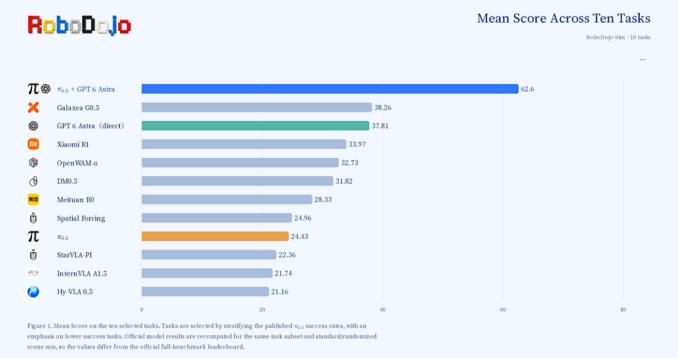
In GPT-6 Astra as an Embodied Policy, GPT-6 Astra ranks far ahead in ten robot tests with a dominant lead
Are general large models really about to return to the "main table" of embodied intelligence?
1. General large models are making a comeback to the "main table"
To truly understand the magnitude of the impact GPT-6 Astra has brought to the entire embodied intelligence industry, we must first clarify two fundamental questions: What exactly is embodied intelligence trying to solve? And why is it so difficult?
The ultimate goal of embodied intelligence has always been unmanned operation, that is, to enable robots to achieve "autonomy". Making robots move is only the starting point of this path.
Over the past decade, the fastest-progressing segments of the entire robotics industry have been the "body" and "control". Robotic arms have solved repetitive operations in deterministic environments, and wheeled chassis have expanded the operating radius from individual workstations to entire workshops... The diversification of body forms has enabled robots to reach more scenarios; the improvement of control capabilities has allowed robots to perform tasks stably in these scenarios. The combination of the two has gradually expanded the autonomy boundary of robots.
However, the autonomy boundary of wheeled chassis and robotic arms has an upper limit — they rely on relatively structured environments. Among various body forms, bipedal humanoid robots have more potential to approach a more complete and broader autonomy boundary. Because human environments are built around the bipedal form: door handles, stairs, tools and workstations are all designed for humans. After the industry realized this, humanoid robots have continued to iterate on their body hardware for many years.
The control layer has also evolved in parallel. In the era of embodied intelligence, reinforcement learning and simulation training have promoted the motion control of humanoid robots. Walking, running, climbing up and down stairs, and getting up after falling have gradually become the basic capabilities of the industry. Dexterous hands, motors, reducers and force sensors are still improving, and the availability of the body hardware is also continuously increasing.
The two layers of body and control are gradually maturing. But the real difficulty has also emerged accordingly: cognition and decision-making, that is, how to enable robots to independently judge what to do and how to do it in open environments, or in other words, to give robots a "brain".
PhyMotion Tech, a startup spun out of Tsinghua University in China, has developed the bipedal humanoid robot PHYBOT C2, which can be regarded as a typical case.
At the end of 2025, the PhyMotion Tech team was the first in the world to realize the capability of autonomous badminton playing between a bipedal humanoid robot and a human; at the Canton Fair in April this year, this 1.35-meter-tall bipedal humanoid robot held a racket to play badminton intelligently with the audience on site, catching forehand, backhand and lift shots without any engineer intervention throughout the whole process.
(PhyMotion Tech's bipedal humanoid robot plays badminton autonomously with a human)
The difficulty of enabling a bipedal humanoid robot to play badminton autonomously with a human lies in the extremely narrow time window: the time from when the ball leaves the opponent's racket to when it reaches the robot's hitting point is usually less than one second. The robot needs to complete the whole chain of observation, judgment, striding, racket drawing and hitting within this period, and any delay in any link will lead to failure. The success of PHYBOT C2 proves one thing: in a closed loop of tens of milliseconds, embodied intelligence can already complete high-dynamic real-time interaction in autonomous state, separated from remote control and preset settings, relying on an end-to-end perception and decision-making model.
But we should also note that badminton playing is a task with a relatively single goal and closed rules, and the robot does not need to think about what to do after finishing the game. PHYBOT C2 has broken through the real-time decision-making barrier of humanoid robots, but the long-horizon task and multi-task planning capabilities of embodied intelligence have not yet achieved breakthroughs; what the latter requires is the understanding ability to model the physical world, and the understanding ability to interpret human intentions and logical sequences.
In other words, it is really difficult to give robots a "brain".
In the early days of the large language model (LLM) boom, researchers did try to transplant large language models to embodied intelligent robots in parallel, but the effect was far from satisfactory. In the Long Act benchmark test, which specifically examines the planning-level autonomy in long-horizon household tasks, GPT-5 under the HoloMind framework has a target completion rate of 59% and a full-task success rate of only 16%; Qwen3-VL-32B has 51.2% and 15% respectively. The success rate of the human subjects in the same group is 93%.
As LLM failed to meet expectations, paths such as VLA and world models gradually became the darlings of the industry. This was followed by large-scale data collection, larger VLA models, larger world models, and stronger model architectures.
It is worth noting that VLA did not appear later than LLM. In 2023, Google RT-2 encoded robot actions into text tokens, allowing the model to generate actions just like generating text, laying the foundation for the VLA path. Since then, driven by massive industry financing, the "embodied brain" has become the hottest topic. Some industry insiders even joked that "no one would dare to develop robots without a base model".
However, after the money was poured in, the problems did not disappear. In the RoboDojo evaluation in July this year, the average success rate of 30 mainstream robot policies was only 12.8%, and the official evaluation described them as "most of them are still at the foot of the mountain, getting used to the altitude sickness". The "camera-base coupling" problem of VLA has not been solved yet: a slight change in the camera perspective will cause the task success rate to drop sharply. The capabilities of long-horizon task and multi-task planning are even more difficult to achieve.
Before that, the common solution in the industry was — collect data, collect more data, and use the Scaling Law to force the "intelligence emergence" moment of the embodied intelligence industry.
It was not until large models began to show new possibilities.
On September 3, 2026, OpenAI officially released GPT-6 Astra, which is officially claimed to be "oriented to complex reasoning, software engineering, computer usage, scientific research and professional documents", with a context window of 1.05 million tokens and a maximum output of 128,000 tokens. The entire release report did not mention embodied intelligence at all.
In the official RoboDojo evaluation, GPT-6 Astra achieved an average success rate of 22.48% and a score of 28.97 across 42 robot tasks and 2100 tests, ranking higher than all 40 public robot policies at that time, and also higher than the original top public policy DM0.5 which had 19.34% success rate and 24.90 points.
2. The landscape of embodied intelligence is changing
An architectural judgment that was previously regarded as the "endgame" has begun to loosen.
In the past few years, the most common division in the industry was "brain — cerebellum — body": the upper layer is responsible for cognition and decision-making, the middle layer is responsible for motion control, and the body is responsible for execution. With the rise of VLA and world models, the industry has invested a lot of resources in trying to make the "brain" handle everything: make it understand the world, disassemble tasks, and directly command the body.
But GPT-6 Astra has demonstrated a new possibility: the general large model itself can take over the hardest part of the past "brain" — deep thinking.
The PhyMotion Tech team believes that robotics companies no longer need to build a centralized all-powerful "brain" on their own. Deep thinking can be handed over to general large models, and what robotics companies need to supplement is the layer of shallow thinking and real-time decision-making. The future embodied intelligence technology stack may evolve from three layers to four layers, which are, from top to bottom, general large model, physical agent PhyAgents, motion control system PhyCore and body PHYBOT. PhyMotion Tech names it: Embodied PhyStack.
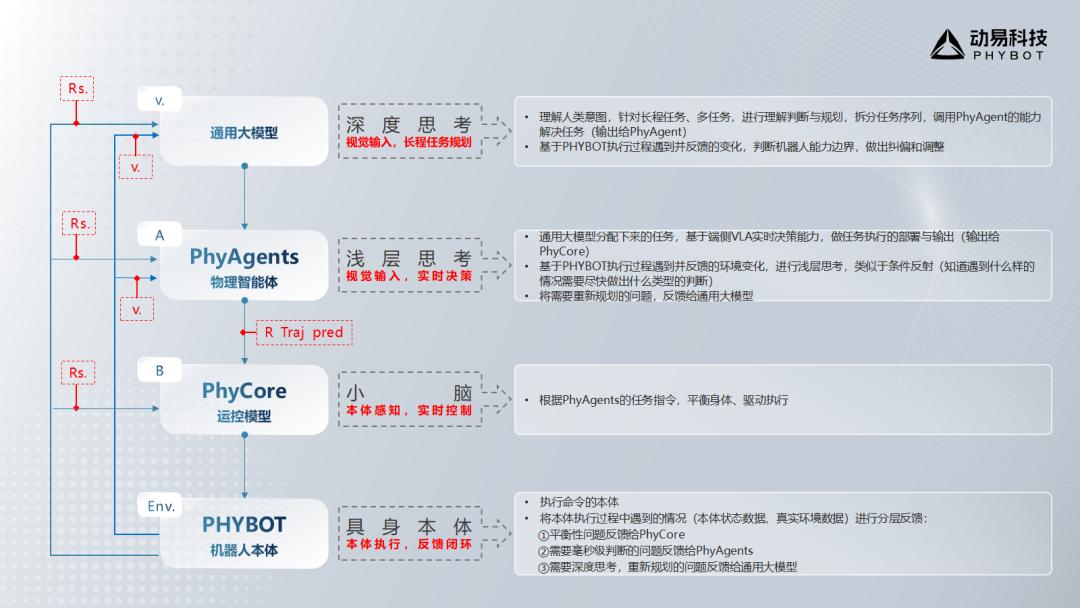
Schematic diagram of PhyMotion Tech's Embodied PhyStack
The first layer, general large model: takes visual input, performs long-horizon task and multi-task planning, understands human intentions through deep thinking, splits the task sequences of long-horizon tasks and multi-tasks, judges the logical order, and then calls the capabilities of the physical agent PhyAgents to solve tasks; at the same time, the problem of slow response of this cloud-based large model is also supplemented by PhyAgents.
The second layer, physical agent: takes visual input, performs real-time decision-making, with end-to-end VLA capability as the core. Through shallow thinking, PhyAgents translates the subtasks assigned by the large model into instructions that the robot can execute in real time.
The third layer, motion control model: body perception, real-time control, which is equivalent to the human "cerebellum". PhyCore balances the body and drives the robot body to complete execution according to the task instructions of PhyAgents.
The fourth layer, robot body: the PHYBOT body is responsible for execution, and based on the changes of the real environment and body state, it feeds back to the above three layers in a targeted manner for correction, re-planning and re-execution: the balance control problem of gait and movement is fed back to PhyCore for correction; feedback on environmental changes is sent to PhyAgents to make millisecond-level real-time decisions; the overall execution rhythm and the arrival of capability boundaries are fed back to the first layer — the signal sent by the body when touching the boundary allows the general large model to perform re-planning accordingly.
The significance of the Embodied PhyStack technology stack is not just adding an extra layer. It splits the "embodied brain" from something that a single company must take full charge of into a division of labor and collaboration between general large model providers and robotics companies: general large models are responsible for deep thinking, reasoning and planning, which they are best at, and robotics companies are responsible for real-time decision-making, physical closed-loop and stable execution, which they are best at. For the embodied intelligence industry, this is a more realistic and more economical path judgment — there is no need to build a super "brain" that does everything by itself, but let professionals do what they are good at.
PhyMotion Tech, which proposed this path, verified it with three sets of experiments.
3. Three sets of experiments by PhyMotion Tech
The first set of experiments uses a general large model as the brain, cooperating with PhyMotion Tech's PhyCore motion control system to drive the robot to perform long-horizon tasks.
In this set of experiments, the general large model acts as the deep thinking layer, pushing the end-to-end VLA directly to long-horizon tasks, without fine-tuning the model for specific tasks, and achieves a sufficiently high completion rate. In the part storage task, the combination of "general large model + PhyCore" can run through the complete task chain. Whether in the simulation environment or real machine verification, the robot can understand human intentions, combine the state of the real environment, execute and complete long-horizon tasks and multi-tasks.
For example, in the simulation environment of battery installation, the robot directly feeds back the wrong behavior to the general large model, uses the large model's understanding of human intentions to think, actively finds the installation position, and completes the training task.
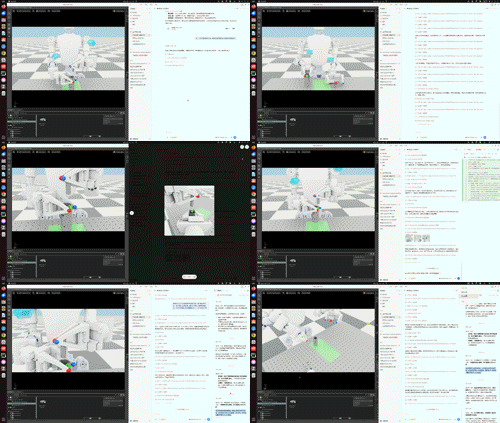
In the simulation environment, the robot uses the general large model to complete battery installation training
In the execution of real machine tasks, the robot will feedback on wrong behaviors based on its deep understanding of semantics and environment, and the general large model will perform re-thinking and re-planning to complete the task. In the experiment below, PHYBOT made two mistakes when grasping the silver workpiece. Based on the general large model's understanding and judgment of deep intentions and environment, it successfully completed the task on the third attempt.

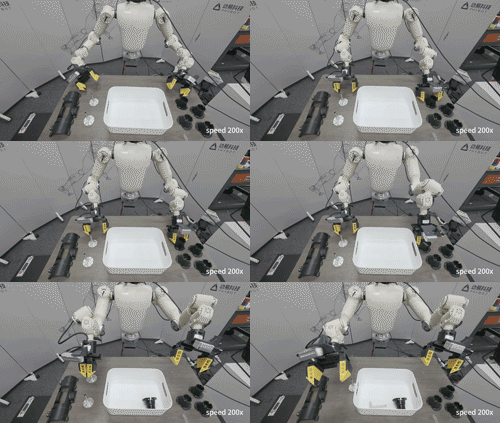
The upper part shows the reasoning process of the general large model, the lower part shows the real machine completing the workpiece grasping process, at 200x speed
The first set of experiments verified the feasibility of large models in long-horizon tasks, but also exposed a problem: general large models are sufficient for deep thinking, but too slow for millisecond-level real-time decision-making