Latest developments on the overseas fraudulent unauthorized transaction of Mastercard credit card
Recently, multiple cardholders posted on social media platforms stating that their credit cards had been fraudulently swiped overseas, and most of the involved cards belong to the Bank of China Great Wall Zhuojun Mastercard series. Some Mastercard holders of other banks also reported unauthorized card swiping, and it is not yet clear whether there is any connection between these cases.
At present, some cardholders said they have received SMS notifications from the bank that the fraudulently processed transactions have been reversed. A person close to the incident handling team told China News Service Finance that The vulnerability was fixed last Sunday (September 27), all relevant cardholders have been contacted, and this fraud incident will not cause any losses to cardholders.
Card in Hand, Money Stolen via Unauthorized Swiping
On September 26, a netizen with an IP location in Zhejiang posted on a social platform saying that his Bank of China credit card had two transactions in Brazilian Real in the morning, with a stolen amount equivalent to more than 6,000 RMB.
On September 27, a netizen with IP location in Hubei reported that his Bank of China credit card also suffered overseas unauthorized swiping. The unbilled transactions posted by this user show that two Brazilian Real consumption transactions occurred on September 26, totaling 9,400 Brazilian Real (equivalent to about 12,000 RMB). The netizen said that he had called the police after the incident and went to the issuing bank to submit relevant supporting documents.
A number of involved cardholders shared follow-up progress on social platforms, saying that they have received notifications from Bank of China customer service, confirming that the relevant transactions are fraudulent, the abnormal transactions will be automatically reversed, and no relevant operations are required from cardholders. Another user posted a bank SMS to confirm that the involved fraud transactions had been fully reversed on September 28.
On September 29, China News Service Finance called the customer service number of Bank of China Credit Card Center as a user to consult how to deal with credit card fraud. The staff responded that after a user encounters credit card fraud, the bank will freeze the involved card and follow up on subsequent handling work.
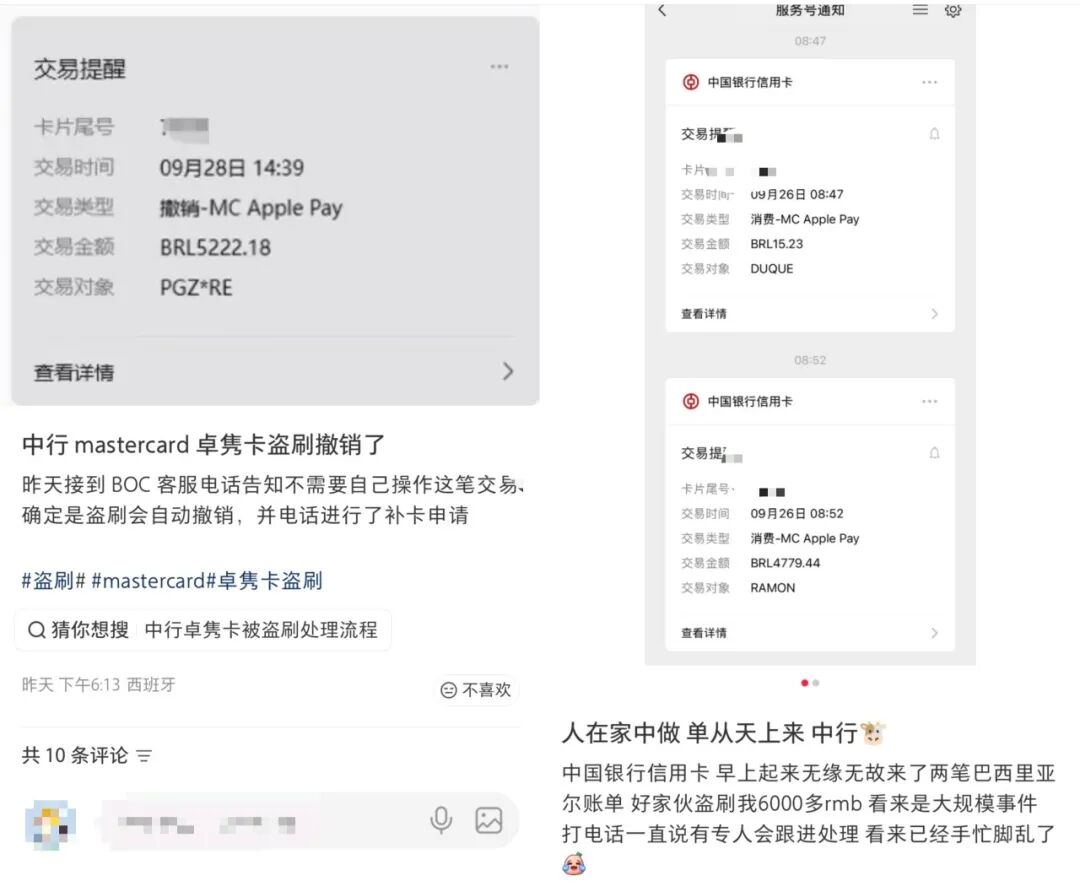
Screenshot from a social platform
In this batch of overseas fraud swiping incidents, many cardholders, while complaining to the bank, also pointed the finger at Mastercard.
On the 29th, China News Service Finance contacted relevant persons from Bank of China and Mastercard regarding the fraud incident, and no relevant reply was received as of press time.
The specific cause of this incident remains to be investigated by banks, card organizations and payment institutions.
A person from a bank's credit card center analyzed to China News Service Finance that criminals made false transaction messages in Brazil, and some card organizations directly rejected such messages without sending them to the issuing banks; while Mastercard marked such messages as high-risk and sent them to the issuing banks for their own judgment. Different issuing banks have different handling of such messages, some issuing banks rejected them directly, but the involved bank did not take corresponding measures.
After the incident, some banks also launched self-inspection. A person from the credit card center of a large state-owned bank said that no similar situation has occurred in the bank after investigation. Another person from a bank's credit card center also said that they are maintaining communication with the card organization to understand the situation, and no similar situation has occurred to the bank's customers.
Who Shall Bear the Responsibility for Unauthorized Credit Card Swiping?
In recent years, cases of online credit card fraud have occurred from time to time, and the disputes between cardholders and financial institutions arising therefrom are also common.
In December 2025, Shanghai Pudong New Area People's Court (hereinafter referred to as Pudong Court) announced 10 typical commercial cases involving digital finance, including a credit card fraud dispute.
The case shows that on December 26, 2023, Li reported to the public security organ that the involved credit card had been fraudulently swiped. After investigation by the public security organ, Li's four bank credit cards were fraudulently swiped in Hong Kong in the form of purchasing mobile phones. During the period when the credit cards were fraudulently swiped, Li had no exit records, no activity tracks in Hong Kong, and the credit cards were kept by himself.
Li believed that a certain credit card center failed to fulfill the obligation of secure payment, so he sued to the court, requesting not to bear the obligation to return the fraudulently swiped amount and corresponding interest and fees, and requiring the credit card center to cancel the relevant bad credit records.
Pudong Court pointed out that the involved transactions occurred at 3 a.m., and four similar transactions occurred on Li's relevant credit cards in the same time period, with large transaction amounts, and the transaction stores and receiving locations are in Hong Kong. The transaction method, frequency and amount are inconsistent with Li's previous small, intermittent consumption habits. In addition, during the transaction period, Li had no exit records, no activity tracks in Hong Kong, and the credit cards were kept by Li. After Li reported the case, the public security organ characterized it as fraud and filed a case for investigation. Combined with the evidence in the case and transaction habits, according to the proof standard of high probability, the involved transactions should be determined as online fraud. Finally, the court supported Li's litigation request.
Pudong Court stated that as a dispute arising from cross-border card-not-present fraud, this case involves multiple parties such as cardholders, issuing banks, and third-party payment institutions, showing the complexity of defining rights and responsibilities under the new payment mode. As professional providers of payment services, issuing banks and payment institutions should assume safety and security responsibilities matching their professional and technical capabilities. In the case that the cardholder has no imputable fault, relevant financial institutions shall promptly perform the responsibility of ensuring fund safety.
Reference picture of bank card, source: China News Service Finance
Li Min, senior partner of Shanghai Hansheng Law Firm and Doctor of Law, told China News Service Finance that a bank card contract relationship is established between the issuing bank and the cardholder. According to Article 7 of the Provisions of the Supreme People's Court on Several Issues Concerning the Trial of Civil Cases Involving Bank Cards (hereinafter referred to as the "Bank Card Provisions"), As long as the cardholder has fulfilled the obligation of properly keeping the identity identification information and transaction verification information such as bank card, password and verification code, the issuing bank must return the principal and interest of the overdrawn amount deducted, the penalty for breach of contract and compensate for the losses, and shall not request the cardholder to repay the part of the amount.
Li Min pointed out that according to Article 4, Paragraph 2 of the Bank Card Provisions, the issuing bank shall bear the burden of proof that the disputed transaction is the cardholder's own transaction or a transaction authorized by the cardholder, and shall submit supporting documents such as transaction receipts, statements, surveillance videos, transaction identity identification information, and transaction verification information for proof. In short, the issuing bank is the first responsible entity that the cardholder can directly claim against.
What to Do When Encountering Credit Card Fraud?
The National Day holiday is approaching, many people plan to travel abroad, and the demand for credit card use increases accordingly. Once abnormal overseas transactions are found on the credit card, how should cardholders deal with it?
Dong Ximiao, Chief Economist of China Merchants Union Finance, said in an interview with China News Service Finance that when cardholders find abnormal overseas transactions, they should follow the sequence of "stop loss - collect evidence - appeal": immediately freeze and report the loss of the card through customer service or the App; as soon as possible query, withdraw cash at an ATM in the mainland or make a POS consumption and keep the receipt to prove that the card is not away from the person; then submit a fraud investigation application to the bank and report to the public security organ. Transaction receipts, screenshots of bills and reminders, customer service communication records, police report receipts and entry-exit or travel documents should be kept.
"People who have no overseas consumption needs can turn off the overseas transaction function, enable the security locks for overseas, night and off-site transactions, set a low transaction limit, and activate multi-channel reminders such as SMS, App and WeChat." Dong Ximiao said.
Mastercard and Mastercard Nets Union also reminded cardholders on their official websites to check transactions regularly through the issuing bank's App, SMS notifications or bills (focusing on non-self-consumption and abnormal small deductions), activate real-time reminders for each transaction as soon as possible, keep the card within sight when using it offline, and protect the security of card number and verification code during online transactions; if unauthorized transactions are found, immediately call the issuing bank's customer service to verify the situation and freeze the account.
The views in this article are for reference only and do not constitute investment advice. Investment is risky, and you need to be cautious when entering the market.
This article is from the WeChat official account "China News Service Finance" (ID: jwview), author: Wei Wei, editor: Lin Wansi, chief copy editor: Yan Shuxin, Luo Kun, published by 36Kr with authorization.