Foreign investors staged a record-breaking massive buying spree in US stocks.
Latest data released last Friday show that in the 12 months ending in July, the net purchase of U.S. stocks and investment fund shares by foreign investors reached a record $942 billion, partially reflecting the trend of overseas capital shifting from the U.S. bond market to U.S. stocks.
According to data from the U.S. Department of the Treasury dating back to 1985, this capital inflow has set a new all-time high for any rolling 12-month period in history.
In fact, strategists at Deutsche Bank noted this phenomenon in a report earlier this month. The bank pointed out that as overseas investors' interest in U.S. sovereign debt appears to be waning, they now favor U.S. stocks over U.S. Treasuries, marking a historic shift.
Data from the U.S. Bureau of Economic Analysis shows that the net purchase of U.S. stocks and investment fund shares by foreign investors in the second quarter jumped to $426 billion, a sharp 62% increase over the same period in 2025, and breaking the previous all-time quarterly high of $299 billion set in 2022.
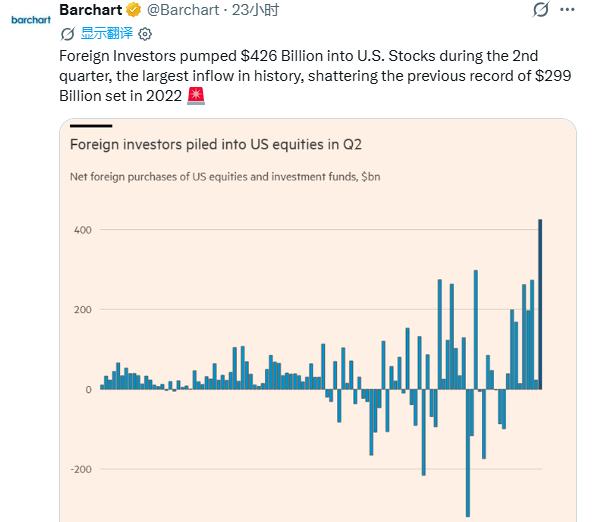
The massive inflow of overseas capital coincided with a roughly 20% rise in the S&P 500 Index in the year through July, with tech stocks such as SanDisk, Western Digital and Intel delivering the most prominent performance.
The S&P 500 Index rose 14.9% in the second quarter, marking its best performance since the same period in 2020.
Even compared to the already strong overseas demand last year, the surge in the second quarter is extremely rare. Foreign investors made net purchases of $263 billion in U.S. stocks and related funds in the second quarter of 2025, and bought $274 billion in the last three months of last year.
Why Are Foreign Investors Rushing to Buy U.S. Stocks?
Data shows that corresponding to the buying spree in U.S. stocks, foreign investors' demand for U.S. bonds has cooled significantly — in the second quarter, overseas investors only made a net purchase of $188 billion in U.S. bonds, down from $314 billion in the first quarter.
Against the backdrop of high U.S. fiscal deficits, overseas demand for U.S. Treasuries has weakened markedly. George Saravelos, Global Head of FX Research at Deutsche Bank, pointed out that the share of U.S. Treasuries held by overseas investors has plummeted from a peak of over 50% to around 30% currently. In contrast, their holdings of U.S. stocks have risen.
"Why do foreign investors favor U.S. stocks but are bearish on U.S. bonds? Because the balance sheet of the U.S. private sector is booming — artificial intelligence, record-high profit margins; but the public sector's balance sheet continues to deteriorate — the fiscal deficit ratio will remain above 6% for the long term as far as the eye can see," Saravelos wrote.
Norges Bank Investment Management, which manages the world's largest sovereign wealth fund, the Norwegian Government Pension Fund Global, has recently proposed lowering the share of U.S. Treasuries in the fund's fixed income benchmark. If the proposal is approved, the proportion of U.S. Treasuries in its bond portfolio will drop from about 34.1% to 21.9%. Other major U.S. Treasury buyers have also scaled back their purchases this year.
In addition, Brad Setser, Senior Fellow at the Council on Foreign Relations, pointed out that the surge in foreign demand for U.S. stocks in the second quarter may partly stem from delayed buying orders accumulated during the slump in the first quarter, but it is undeniable that the buying spree in U.S. stocks has become an unshakable major trend at present.
The unusual movements in stock markets in Asian regions including South Korea have also prompted local investors to seek investments in U.S. stocks to diversify concentration risks in a single market.
Setser pointed out, "The pattern of capital flows has shifted, which is highly consistent with the extraordinary scale of capital inflows into the U.S. dollar... It feels like the whole world is very bullish on the U.S. stock market."
This article is from the WeChat Official Account "CLS", Author: Xiaoxiang, published by 36Kr with authorization.