Drawing Lessons from History: With the Sharp Surge in US Treasury Yields, Where Is the US Stock Market Heading?
To many market observers, the recent movements of U.S. stocks and U.S. Treasuries appear rather anomalous: the bond market is undergoing a brutal sell-off that has pushed yields to highs not seen for nearly two decades; yet the stock market has remained remarkably steady with barely any major fluctuations.
During the transition to a higher interest rate environment, the resilience demonstrated by the stock market is not only unexpected, but also widely welcomed by market participants. However, what investors are most eager to know right now is: how much longer can this momentum last?
Rising bond yields will impact the stock market through several channels. First, they push up borrowing costs across the whole society, which in turn drags down economic growth. Second, it means investors can lock in higher returns by holding newly issued bonds to maturity, making them more cautious when allocating capital to high-risk equity assets.
In the current cycle where yields are rising as the Federal Reserve is raising interest rates or gearing up to do so, the potential damage of bond market sell-offs tends to be particularly severe.
Of course, if we look back at historical trends, the patterns have always been intricate — the rise in U.S. Treasury yields does not necessarily mean that U.S. stocks will be impacted. With careful screening, both bulls and bears can actually find arguments supporting their own positions from the long history.
Below, let's take a look back at how U.S. stocks actually performed during the last five similar episodes of sharp spikes in U.S. Treasury yields?
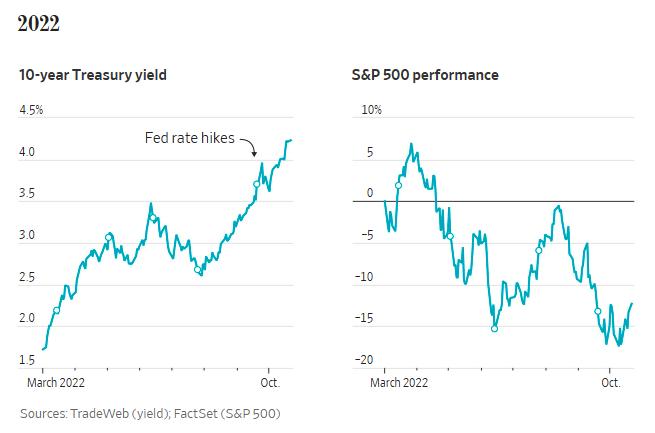
2022: U.S. Stocks Plunged Sharply
By some metrics, the 2022 bond sell-off, the most recent episode from the present, ranks as the most severe in U.S. history, and its "damage" to U.S. stocks is also the worst among the five U.S. Treasury sell-off experiences in the past.
Although inflation triggered by the COVID-19 pandemic emerged in 2021, investors at the time agreed with the Federal Reserve's assessment that the price increase was only temporary. Therefore, when the Fed shifted its stance and began aggressive interest rate hikes, many people were caught off guard. As the 10-year U.S. Treasury yield more than doubled in a short period of time, the S&P 500 index once entered a technical bear market that year, and the market value of constituent companies in the MSCI ACWI index evaporated by about 18 trillion U.S. dollars within one year.
2016: U.S. Stocks Rallied Sharply
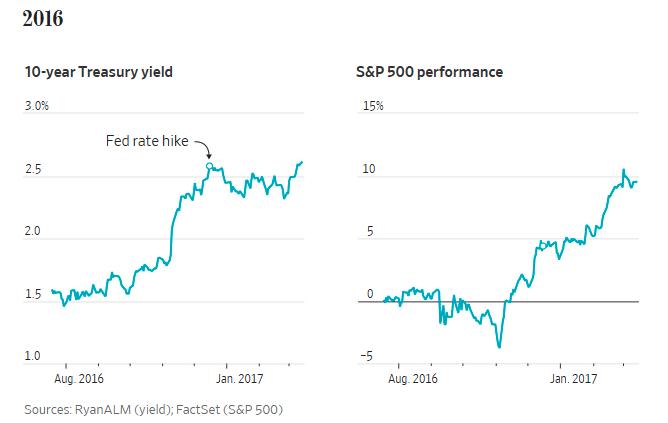
Contrary to 2022, the 2016 bond sell-off is a textbook classic case where bond yields and the stock market sometimes rise in tandem.
Back then, the rising yields were not seen as a threat to economic growth, but were instead welcomed — it was taken as a signal that the economy, after years of sluggish growth following the 2008-09 financial crisis, was finally likely to get back on track. The surprise sweeping victory of the Republican Party in the November general election that year further boosted yields and the stock market, as investors bet that Trump and the new Congress would pass tax cuts and deregulation to stimulate economic growth and inflation.
2006: U.S. Stocks Trended Downward Amid Volatility
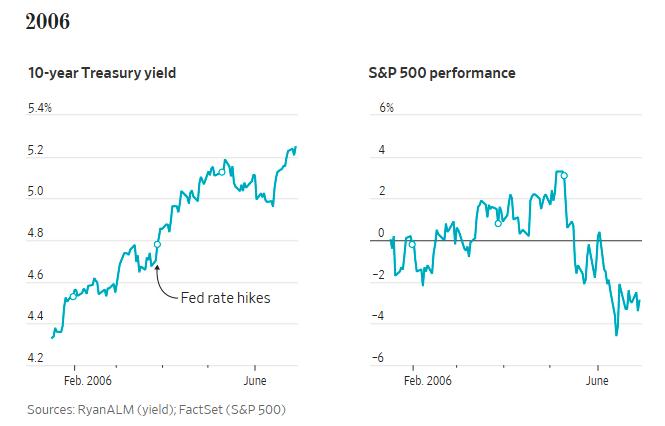
In early 2006, soaring oil prices intensified inflationary pressures. U.S. Treasury yields spiked, and the Fed raised interest rates accordingly, but U.S. stocks generally remained strong initially, until investors began to grow increasingly worried about the economic outlook in May that year.
These concerns once caused stock prices and bond yields to fall in tandem. Then in June, U.S. Treasury yields started to rise again, which eventually became the catalyst for U.S. stocks to give up resistance and accelerate their decline.
1999: U.S. Stocks Showed Resilience Against Pressure
In the second half of 1999, U.S. Treasury yields saw a sharp surge. This time, the bond market moved ahead of Alan Greenspan — in the few months before a round of preemptive interest rate hikes began, the 10-year U.S. Treasury yield rose by about 100 basis points in advance.
U.S. stocks fluctuated violently for several months — however, as the dot-com boom swept Wall Street at the time and overshadowed the market's concerns over rising borrowing costs, U.S. stocks withstood the pressure and finally trended higher at the end of 1999.
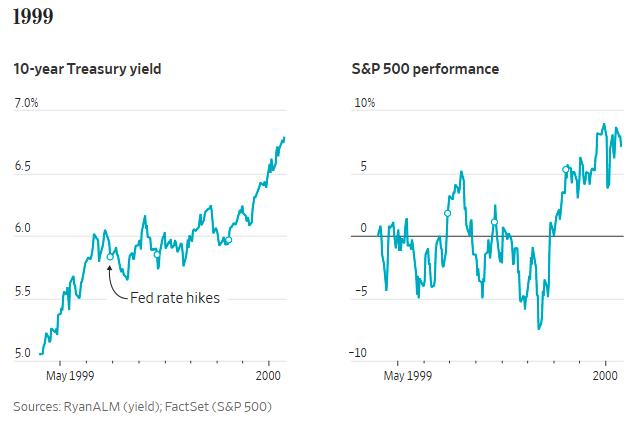
Of course, if we extend the timeline further, the "story" did not have a happy ending afterwards — the S&P 500 hit its dot-com bubble peak on March 24, 2000, before plunging 49% and hitting its bear market low at the end of 2002.
1994: U.S. Stocks Tumbled First Then Rallied
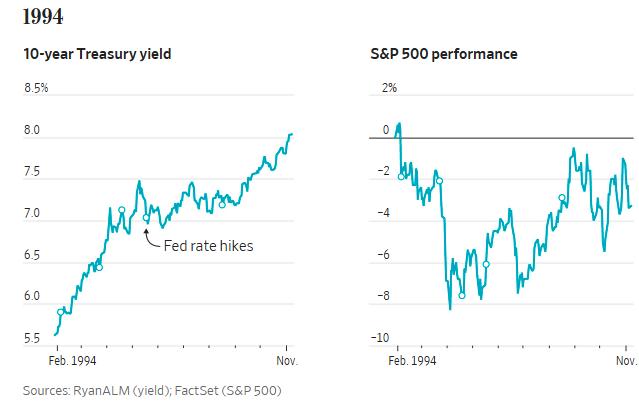
The 1994 bond sell-off is one of the most famous events in history, which began in February that year with the interest rate hike by the Federal Reserve led by then-Chairman Alan Greenspan.
This rate hike caught investors by surprise, as U.S. inflation was then considered to be at a moderate level; the Fed only took action because it believed that a stronger economy could trigger inflation in the future. Instead of waiting and seeing, investors frantically bet on a series of interest rate hikes, causing the 10-year U.S. Treasury yield to surge by more than 100 basis points in just 40 trading days.
This rapid adjustment also dragged down the stock market. Since the start of the bond sell-off, the S&P 500 once fell by 8%. However, even as yields continued to climb afterwards, the stock market gradually began to rebound, reflecting the market's belief that the rate hikes would not trigger a recession, and that a strong economy would continue to support corporate earnings.
Same Bond Market Patterns Year After Year, But the Stock Market Always Tells a Different Story?
Overall, during the above five cycles of continuous rise in U.S. Treasury yields, the performance of U.S. stocks can be described as totally different — the stock market has not failed to withstand the impact of soaring yields in the past, especially when the economy is doing well and yields are only rising moderately due to market expectations of higher long-term interest rates — even though the pain brought by the U.S. Treasury storm just four years ago still makes some investors shudder to this day.
And right now, investors will face a choice once again.
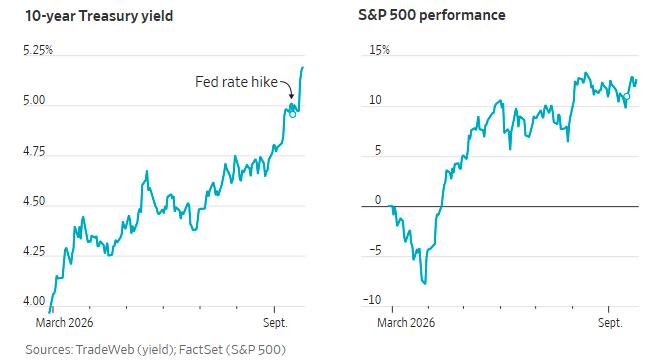
Although yields have climbed and the Fed has raised interest rates once, U.S. economic growth remains highly resilient — thanks to the historic investment by technology companies in artificial intelligence infrastructure, which seem to be completely immune to rising borrowing costs.
This strong momentum has underpinned the stock market, and many people see no reason why it won't continue — especially if a deal can be reached between the U.S. and Iran to lower oil prices and ease inflationary pressures.
But at the same time, some people hold a more pessimistic view, arguing that the Fed may have to continue raising interest rates until the stock market is eventually impacted, because the overheated market itself may become an obstacle to defeating inflation.
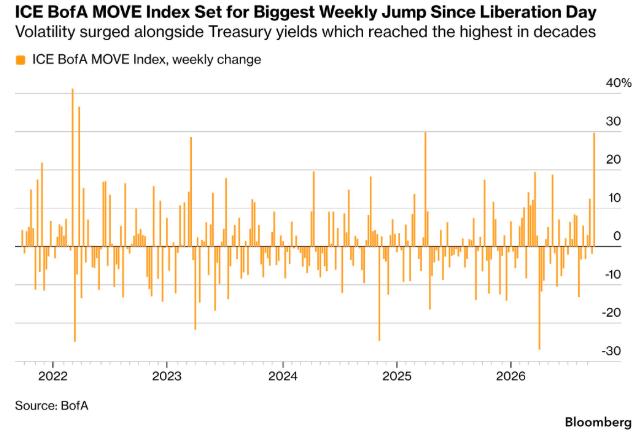
The experience of the past few months has actually shown that rising yields alone do not necessarily lead to a stock market crash. The greater risk lies in excessively fast and disorderly market volatility. What is worth alerting at the moment is that the ICE BofA MOVE Index, known as the "fear gauge" of the U.S. Treasury market, surged by about 29% last week. This is the largest increase since April 2025...
Historical experience shows that the stock market can withstand a steady rise in borrowing costs, but it can hardly digest the valuation repricing brought by severe disorder in the capital market. In the current tug-of-war between market euphoria and monetary tightening, is U.S. stocks repeating the story of 1999, when they defied all odds amid the tech boom, or is it sliding step by step into a 2006-style scenario that starts with gradual erosion and ends with an accelerated plunge?
The answer may no longer depend on how attractive the corporate earnings growth story is, but on where the end point of the U.S. Treasury yield surge lies. Before the storm hits, any blind complacency could cost investors dearly.
This article is from the WeChat Official Account "CLS.cn", written by Xiao Xiang, and published with authorization from 36Kr.