Roundtable Theme: "The Significance of Scenarios to Product Innovation" | SmallRig 3rd Global Imaging Scenario Industry Conference (2026)
From "maxing out all parameters" to "digging deep into all scenarios" — as competition in the imaging industry shifts from rivalry between individual products to rivalry between innovation systems, the term "scenario" has been mentioned over and over, yet rarely broken down and explained clearly. On the morning of September 22, the 3rd Global Imaging Scenario Industry Conference (2026) kicked off in Shenzhen. After the keynote speeches and the first roundtable session, the second themed roundtable of this conference turned the topic back to "product" itself: what on earth does scenario mean to product innovation? This session was hosted by Liu Chen, Co-founder of Ebrun and CEO of Mati Club.
The lineup of guests for this dialogue is itself a cross-border experiment: Liu Yi, Senior Manager of Customer Experience Department, Marketing Headquarters of Nikon Imaging (China) Co., Ltd.; Pang Chao, Vice President of Sigma (China); Wang Yihui, Head of Brand Content of LandSpace; Zhou Jiong, Director of Imaging Product Line of Malanshan Audio and Video Laboratory; Jiang Cong, Creator of LANDCLUB. Five different positions, five different interpretations of "scenario".
Liu Chen gave a straightforward division at the opening: product innovation falls into two categories. One is to create user demand, "just like DJI developing consumer aerial drones, if they had not done this, none of us would have realized such demand exists"; the other is to meet user demand, which is what the vast majority of enterprises are doing. The uniqueness of this roundtable lies in the fact that there is an extreme scenario on the stage that almost no one can access: aerospace. The camera mounted on the Zhuque-3 rocket provides the most direct sample for the entire discussion.
Four questions strung together this dialogue. On "how to identify real demand", Jiang Cong's judgment is the most plain — "Real demand is what people actually take action on after hearing it, while pseudo demand is what people do nothing about after hearing it"; Nikon's solution is to combine global research with trade-offs, acknowledging that there is no single product that can satisfy all users around the world. On "making trade-offs", Sigma's answer is to never compromise on image quality, while weight and price can give way. On "who verifies the finished product", Nikon rolled out firmware updates and external fan solutions to users together, while the Malanshan Laboratory compressed the control bandwidth time of gimbal follow shooting by 60% to 70%.
As Liu Chen summarized at the end: in the past, product innovation was made based on parameters, you built whatever you had; scenario-based innovation means you build whatever users need, by working backwards from their demands. Everything is user-driven, and whoever gets closest to users is more likely to get product innovation right.
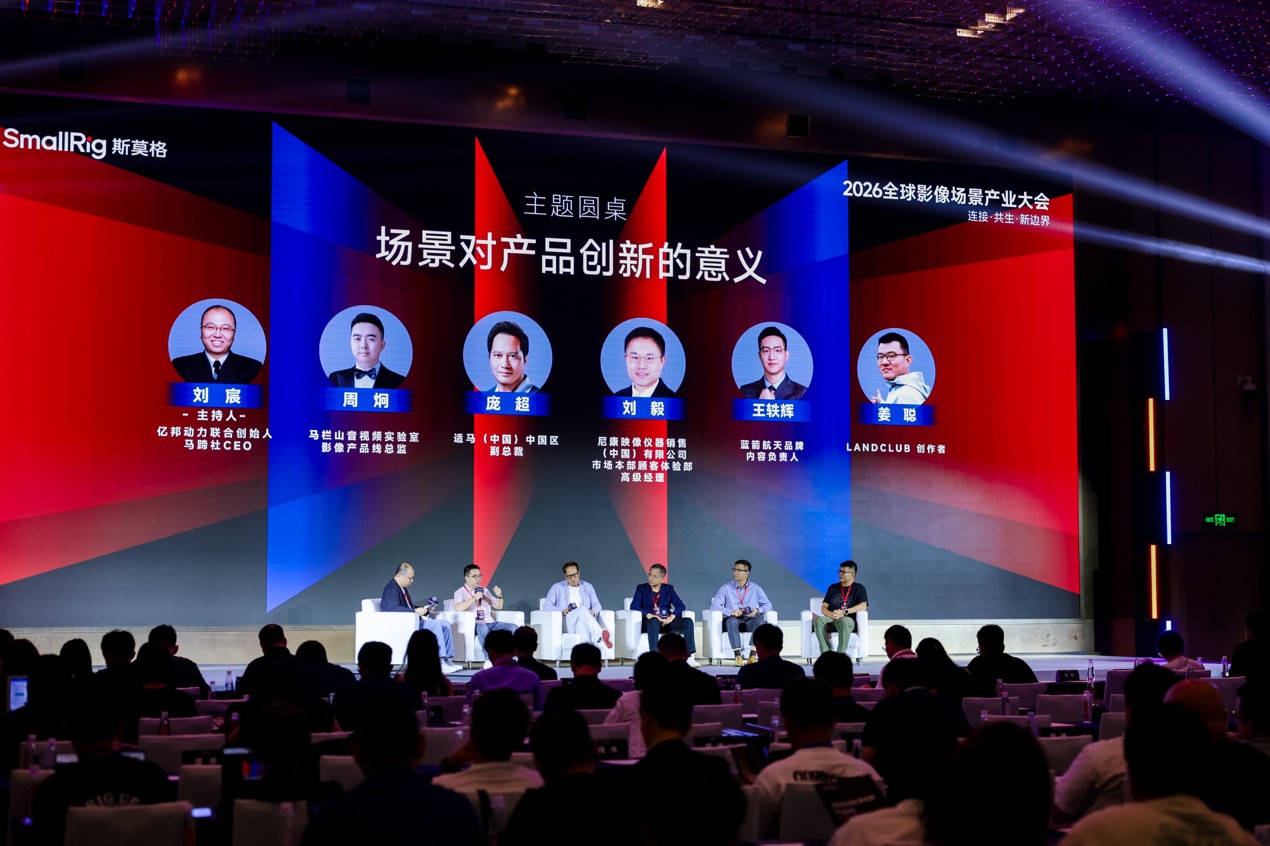
The following is the edited and organized content of the dialogue:
Liu Chen, Co-founder of Ebrun and CEO of Mati Club (Host)
Liu Yi, Senior Manager of Customer Experience Department, Marketing Headquarters of Nikon Imaging (China) Co., Ltd.
Pang Chao, Vice President of Sigma (China)
Zhou Jiong, Director of Imaging Product Line of Malanshan Audio and Video Laboratory
Jiang Cong, Creator of LANDCLUB
I. The first thing scenarios change is "what matters most" for a product
Liu Chen: The meaning of scenario to product innovation. I divide it into two categories: one is to create user demand, just like DJI making consumer aerial drones, if they had not done this, none of us would have known such demand exists; the other is to meet user demand, which is what the vast majority of enterprises pursue. Some of our scenarios are almost unavailable to other manufacturers, such as aerospace that almost no one can access, which is a very extreme scenario. I would like to ask that Nikon has cooperated with NASA for a very long time, what different demands do cameras in space have compared with ground cameras? Is it image quality, or something else?
Liu Yi: Nikon started cooperating with NASA very early, to complete shooting missions in outer space and space stations. The most critical point is reliability. The space environment is extremely harsh, with cosmic ray radiation, ultra-low temperature environment, and weightlessness. In such cases, ensuring the reliability of imaging equipment is of great importance. Every gram of equipment carried into space by spacecraft costs far more than the equipment itself — with such huge manpower and resources invested, even gold carried into space is not worth mentioning, so reliability must be guaranteed. Nikon's corporate vision is "Trust and Creation", and we even put trust before creation. We attach great importance to product reliability, and keep communicating with NASA about their demands during the R&D process.
Liu Chen: Next I would like to ask Pang Chao, Sigma's telephoto lens is not designed for rockets, but it has become the main choice for photography enthusiasts to shoot rockets. Which point leads to this result?
Pang Chao: For Sigma, on the communication platform of today's industry conference, combining products with practical applications is a very important point. When it comes to shooting rockets, it is a very practical application case that perfectly integrates application demands and focal length coverage. When shooting rocket themes, several problems need to be solved first: first, the camera position must be within reach — people cannot stand right next to the rocket, they may stand several kilometers away, so to shoot a rocket, you must first "be able to capture it", the focal length must be long enough; second, the rocket body and the flame tail must be fully captured; finally, speed and focusing must be kept online. The three are indispensable.
In this field, telephoto and zoom lenses are very important sharp tools, depending on whether you can capture the results you want. From the perspective of scenario application results, telephoto and zoom lenses are very good choices, while shooting rockets often requires waiting for a long time before the second opportunity comes. In addition to the telephoto field, Sigma also has a large number of products that can be widely adapted to other application scenarios.
Liu Chen: The first two guests talked about pre-scenarios — we already have clear tasks to complete; Mr. Pang talked about post-scenarios, which are important scenarios developed by users, and these factors were not considered before. What meaning does scenario bring to product innovation? Perhaps the most important meaning is to truly make high-quality products.
II. How to identify real demand: Only the demand that people actually take action on counts
Liu Chen: Everyone is talking about scenarios, how to identify the real demand in scenarios? Before releasing a new product, Nikon will conduct global market research. How do you judge that a demand is real and worth working on? Have you ever encountered a situation where users in one region say a demand is very important, but it does not hold when viewed from a global perspective?
Liu Yi: There is no true or false for user demand. Since users put forward a demand, there must be such a need, the only difference is the number of people who have the demand. Just as the CTO of Leqi also feedbacks, for an enterprise — no matter how large the enterprise is — it is impossible to develop a product that meets the needs of all consumers around the world, even meeting the needs of all consumers in China is impossible, you must meet the needs of a specific scenario.
In this case, we must make trade-offs.
In the process of making trade-offs, we will conduct global research: what do users really need in a certain scenario? What kind of functions do they need? Through product managers, local marketing departments, and real first-hand feedback from local users, we can distinguish which demands are the most urgent and must be solved for users immediately, and which can be put aside — after the product is launched, if the demand is still very strong, we will solve this problem through subsequent updates and iterations.
Nikon does not insist on relying entirely on its own resources to meet the needs of a certain user or a certain group of users. Phones and robots can take pictures, cameras can also take pictures, everyone is shooting, but with different focuses. In the past, Nikon cameras and Sony cameras, the main purpose of us developing a camera was to record; now some products do not even need the recording function — live streaming does not require recording, it only serves for dissemination, no content is recorded during live streaming, only the picture is transmitted. The scenarios where products are used are undergoing earth-shaking changes, and Nikon has also noticed such changes.
Let me give you a small example. A recently launched product is the Nikon Z2 mirrorless camera, and there is a group of users using it in live streaming scenarios. We found that the live streaming scenario is not for recording, but for dissemination, but there is a very important application demand, that is, it needs to last for a long time: a live streaming session is not like taking a photo that you can put down after shooting, nor like recording a meeting that ends after two or three hours. Live streaming marketing may last for 8 hours, or even 24 hours non-stop. In this case, a problem arises: can the machine output stable pictures for a long time without overheating.
To solve this problem, we established cooperation with the SmallRig team during the R&D process. In addition to the heat dissipation design adopted by the camera itself, the Leqi team also developed an external fan product, which can extend the live streaming time of Z2 by 3 to 5 times. Nikon is user-oriented. This product may not be designed by Nikon, we regard it as one of the links, and we deliver the solution to users together with SmallRig to solve users' problems in a specific scenario.
Liu Chen: How does Nikon judge the adoption criteria for user demands?
Liu Yi: We conduct a lot of user research, through comments in the comment section, feedback from KOLs, and go to the front line to communicate with users. Users on Xiaohongshu and Douyin also mentioned this problem, and users' messages on official accounts also mentioned this problem. We will record all the demands that are mentioned many times, and even if a demand is mentioned only once, we will record it. There is an internal reporting channel in the company, we will listen to the voice of customers — as I said when I came to the forum to communicate with everyone last time, Nikon's corporate philosophy is to keep getting close to customers. We do not work behind closed doors, we need to get close to front-line users in specific scenarios and understand their actual needs.
Research is ongoing throughout the entire product R&D cycle: before R&D, we need to get close to customers and understand their demands. After the product is released, we still need to understand their demands to complete firmware updates and iterations of the product. From R&D, sales to the end of the product life cycle, we have been listening to the voice of customers, understanding their problems, and promoting related functions according to their priorities.
Liu Chen: How do you judge a demand? After judging that a demand is valuable, when should the camera manufacturer do it, and when should the accessory manufacturer do it?
Jiang Cong: How do users judge? Every product manager, every time you put forward a suggestion, he says it is very good and writes it down in his notebook. Real demand is what he actually takes action on after hearing it, while pseudo demand is what he does nothing about after hearing it.
Higher frame rate, higher resolution, higher definition, all performance parameters are maxed out, what about overheating? There are many ways to prevent it from overheating. The manufacturer pushes the performance to the peak, and the accessory manufacturer can solve this problem through other means. If the camera manufacturer solves all the problems, the product will definitely be very expensive, I cannot afford it — a product must take price into consideration, make one of its functions the strongest within an affordable range, and we can use other methods to solve other problems.
Liu Chen: Next I would like to ask Mr. Zhou Jiong. He comes from the Malanshan Audio and Video Laboratory, which is a R&D institution jointly built by Hunan Provincial Government and Changsha Municipal Government. From the perspective of the industry, do you have internal judgment criteria for whether a demand is worth working on?
Zhou Jiong: From the nature of the laboratory, we are backed by government investment. Whether a demand or a technology is worth working on is not like an enterprise that only looks at the current dimension, we look at the future — stretching to five or ten years, whether this technology can benefit the industry, this is the point that as a government-led laboratory we should make special breakthroughs in. Our laboratory has done a lot of work that cannot be converted in the short term from the market perspective. For example, we want to benchmark Dolby Laboratory and Dolby sound effects, there is still a certain gap at present, but this is what we need to do at the strategic level.
We have spent a lot of energy studying the applications of 3D Gaussian and 4D Gaussian. The laboratory team can achieve almost top level in the industry in the operation and solution time of 3D Gaussian, with a speed 10 to 100 times faster than competing products. In the short term, there are not many scenarios that can be implemented, and there is no general display platform for 3D and 4D Gaussian — for example, the shot content can be placed on Douyin and WeChat Channels. From the era of text and Weibo, to the era of pictures and short videos in audio and video field, what we value is what the next era will be: a more immersive experience, that is 3D Gaussian and 4D Gaussian. Therefore, we carry out relevant technology layout, use the support given by the government to make long-term layout, see that there may be an outbreak at a certain point three to five years later, and can empower the industry — it is not about how much money a product can be sold for, but that this technology can empower more customers and manufacturers of photographic equipment, which is more meaningful to us.
From the dimension of the industry, the cycle is relatively long, the technical points we study are relatively precise and in-depth, and we have done a lot of work around the entire process of audio and video collection, editing, storage, transmission and broadcasting. Another example: the price of storage has risen sharply, which makes mobile phone manufacturers very troubled, the cost of memory accounts for 60% to 70%, and profits decline sharply. Two or three years ago, we did a lot of research on the video codec compression algorithm, which can store the same image quality with less space — the same video can save 50% of storage space, which means that the mobile phone storage can be reduced by half. Users are very happy, and immediately talked to us: can this technology be used in mobile phones. This is the industrial perspective for us, and it is also the goal and requirement of the government for us.
Back to the customer perspective: we do not make end products, we serve customers, and we will also make some judgments on customer demands. Leqi's conference is of great benefit to us, everyone gives us feedback, from the perspective of the enterprise, what our demands are, and what we need in the next three to five years. Enterprises pursue short-term profit goals, these points can be completely handed over to us — we will not pursue short-term commercial conversion value, but focus more on long-term industrial empowerment.
III. Making trade-offs: Never compromise on image quality, and "only 100 points and 0 points"
Liu Chen: Turning scenario demands into products, I would like to ask Mr. Pang Chao. From SLR to mirrorless, cameras are getting smaller and smaller, and lenses are getting lighter and lighter. How do you make trade-offs? Image quality, weight, price, which one gives way first?
Pang Chao: Sigma gives priority to image quality, and never compromises on image quality; with 60 years of accumulated optical experience, we can achieve different performances and cover different scenarios and users through different product lines. Without compromising on image quality, we achieve the ultimate balance between weight and price — small, light, cost-effective, suitable for photographers who hang cameras and lenses for seven or eight hours a day to take pictures.
We use the Art series, with the largest number of special lenses, the best motor, to represent the black technology of lens stacking; for photographers who shoot rockets, birds and landscapes, we have the top telephoto and zoom lenses in the Sports series to cover current scenario applications. Now the application scenarios are constantly changing, regarding the problem of weight, we continue to invest in more high-precision equipment — we have the world's top aspheric processing equipment and technology, and modern manufacturing technology is also a very large investment, the proportion of this investment is at the forefront of the entire industry. On the premise of absolute guarantee of image quality, plus the balance of product line setting and R&D investment, among these three aspects, we give priority to image quality.
Liu Chen: Mr. Zhou, you mentioned the gimbal solution last time. DJI and Insta360 both make gimbals, and you are also researching gimbals. What trade-offs have you made?
Zhou Jiong: This is very much in line with the theme of today — the relationship between scenario and innovation. We do not target general scenarios, nor do we make a product that is the same as a certain brand: there are already giants like Insta360 and DJI in this field. What customers want is the most stable and fastest follow shooting scenario: parents taking pictures of children, or taking pictures of pets. They have experienced