Roundtable Theme: Who is Defining the Next-Generation Imaging Scenarios? | SmallRig The 3rd Global Imaging Scenario Industry Conference (2026)
When host devices have expanded from professional cameras to smartphones, panoramic cameras, gimbal cameras, drones and non-handheld smart devices, and when creators have expanded from professional teams to hundreds of millions of ordinary users, "who is defining the next-generation imaging scenarios" is no longer a rhetorical question, but a realistic proposition about the ownership of definition rights. On the morning of September 22, the 3rd Global Imaging Scenario Industry Conference (2026) was held in Shenzhen. Zou Ping, Dean of 36Kr Research Institute, hosted the first thematic roundtable of the conference, and had an in-depth discussion with five guests from the front lines of host devices, accessories and algorithms.
The special feature of this dialogue is that the positions of the five guests almost do not overlap: Sony represents the traditional imaging giant that has expanded all the way from mirrorless cameras to VLOG cameras; vivo represents the mobile imaging faction that has taken imaging as its core track and invested in it for more than ten years; Insta360 is the leading player in panoramic and handheld smart imaging; OBSBOT focuses on "non-handheld" and imaging automation, while SmallRig is the only imaging scenario ecosystem manufacturer on the stage.
Three questions form the main line of this dialogue. On the topic of "what to stick to", the answers of the five companies are surprisingly consistent, all pointing to users: vivo developed an external teleconverter for the concert scenario, which is said to occupy 70%-80% of the market share in this scenario; Sony launched a remote debugging service for Chinese live streaming studios, connecting 300-500 live streaming rooms in the Shanghai Live Streaming Center; Insta360 regards "authentic recording" as the bottom line in the AI era; OBSBOT adheres to the non-handheld automation route; SmallRig simply gives up part of the product definition rights, and announces that it will set up an industrial fund this year, taking out part of its profits every year to give back to users. On the topic of "what to give up", the consensus is to hand over the physical labor of intermediate links such as photo selection, video editing, beat matching and composition to AI.
However, on the question of "who is the connector of the next-generation imaging ecosystem", there is no standard answer on the stage: OBSBOT believes it is the system and AI; Sony bets on network interconnection and IP-based operation; Insta360 advocates the integration of hardware, AI and content ecosystem; vivo judges that the imaging ecosystem is moving from a single center to a multi-center and decentralized structure; SmallRig has the most plain answer - whoever can solve the pain points of scenarios can connect the entire imaging industry. The multi-center pattern is also confirmed by data: IDC's Q1 data this year shows that Insta360 has a 71% market share in the panoramic camera segment, ranking first in the world for eight consecutive years, 37% in the generalized action camera segment, 57% in the thumb camera segment, and its overseas revenue accounts for nearly 70%; OBSBOT's products have been sold to more than 150 countries around the world, and more than 500 devices were deployed at one time at the Paris Esports World Cup, with 60 devices controllable by one person.
As Zou Ping summed up at the end of the roundtable: There is no standard answer today, but there is a very clear consensus - whoever is user-centered and helps users solve difficulties and pain points in different application scenarios will win the initiative in the next-generation imaging era.
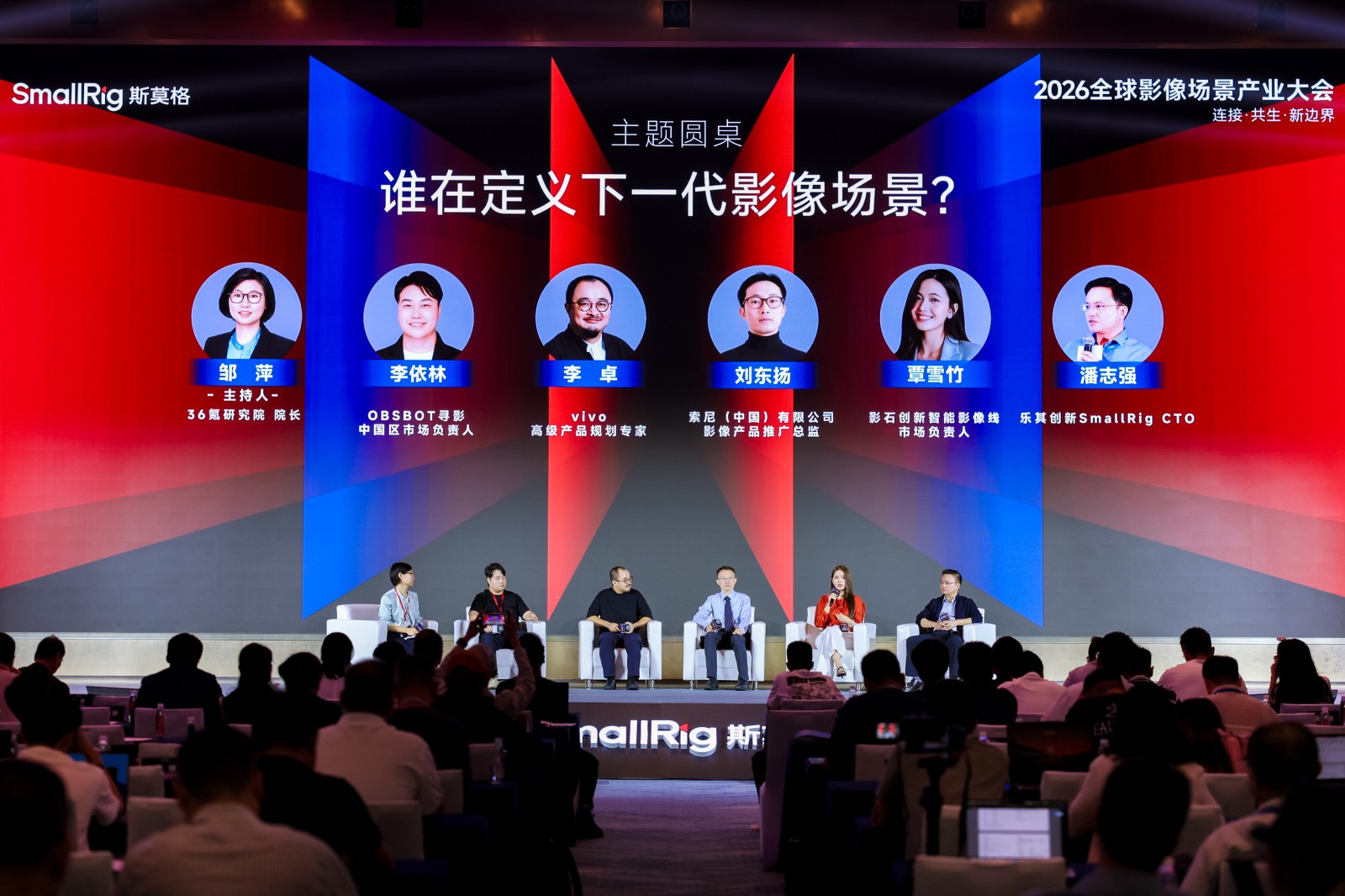
The following is the edited content of the dialogue:
Zou Ping, Dean of 36Kr Research Institute (Host)
Li Zhuo, Senior Product Planning Expert of vivo
Qin Xuezhu, Head of Marketing for Smart Imaging Line of Insta360
Li Yilin, Head of Marketing Department of OBSBOT China
Liu Dongyang, Director of Imaging Product Promotion of Sony (China) Co., Ltd.
Pan Zhiqiang, CTO of SmallRig
I. Five Companies, Five Distinct Positions
Zou Ping: It is my great honor to host the first roundtable. In the previous sharing sessions, I also felt a key word - cross-border integration. Imaging is no longer a single piece of hardware, but an important foundation that can be integrated into thousands of industries, which means that the boundary of the industry is continuously expanding, and the definition group will shift accordingly. This is the core topic of this roundtable: Who defines the scenarios of next-generation imaging and how? Where is the new growth point of the imaging industry? It is my great honor to invite five guests who are deeply engaged in the imaging industry to discuss this proposition from their respective positions.
Please introduce your main business and your position in the industry.
Li Yilin: OBSBOT is a system company aiming at imaging automation. We have been adhering to R&D in three directions: AI algorithm, motion control, and optical coordination. With our R&D capabilities, we hope to make the cumbersome and complex equipment tasks lighter, so that people can truly get rid of trivial operations, focus more on content and creation itself, and create more freely. OBSBOT has been developing in this direction, and has always been the leader of "non-handheld" products, with pioneering gesture control and AI tracking, enabling more systematic and convenient interaction with machines. We created the first PDCR three-axis gimbal camera, and our products have been sold to more than 150 countries around the world, recognized by global users, industries and media.
Li Zhuo: vivo is a smartphone manufacturing brand, and imaging is the core track of vivo. We have invested huge scientific research resources in imaging for more than ten years. At present, we have published more than 100 papers in top global academic conferences, and our imaging team has more than 2,000 R&D personnel. As a global leader in imaging, vivo adheres to the concept of creating humanized professional imaging: we hope our imaging performance in hardware, software, basic capabilities and effects is professional-grade, and the operation is humanized, the simplest and most convenient. We attach great importance to the research of imaging scenarios, and also attach great importance to the cooperation with SmallRig.
Liu Dongyang: Sony's vision is to use technology and creativity to move the world. In the consumer field, Sony's mirrorless cameras and VLOG cameras have taken the lead in being developed for various industries to serve the next generation of creators. Through different imaging products combined with Sony's core technologies, Sony finds the most suitable imaging scenarios for them.
In the business development of Sony in recent years, there are many business scenarios that we did not plan in advance. For example, during the epidemic, the outbreak of live streaming drove the overall business growth from 2019 to 2022 and 2023. After 2022 and 2023, vertical screen dramas emerged, and now AI short dramas are becoming more and more popular. The outbreak of vertical screen dramas was also unexpected for us, and people can use cameras and professional shooting equipment to do more things. Robot is a new field and new growth point now, and embodied intelligence training also requires imaging equipment, so the scenarios are getting wider and wider. From Sony's own product system, many applications are beyond our expectation - end users and creators use such equipment to achieve many amazing results. Today is a great opportunity, and I would like to have more exchanges with everyone through the platform of SmallRig.
Qin Xuezhu: I am the head of marketing for the smart imaging line of Insta360. Let me briefly introduce Insta360: Insta360 is a smart imaging technology company founded in Shenzhen in 2015, and was listed on the Sci-Tech Innovation Board in 2025. We first became the global No.1 seller of panoramic cameras, and we are also the first smart imaging company to make this category rank first in the world.
Up to now, Insta360 not only has the X series of panoramic cameras, but also has expanded a rich product line, including the Luna series of gimbal cameras, the Go series of thumb cameras, the Ace series of action cameras, the A1 drone, magnetic selfie sticks and lapel microphones. At present, we are no longer limited to a single-track player, but one of the leading enterprises with the most complete multi-product layout.
To help you better understand Insta360, I can share several sets of intuitive data. Data from IDC, a global authoritative data agency, in Q1 of this year shows that Insta360's panoramic camera market share is as high as 71%, ranking first in the global market for eight consecutive years - now 7 out of every 10 panoramic cameras sold are from Insta360. We also occupy 37% of the generalized action camera market share, ranking second in the world. In the thumb camera track, we rank first in the world with a 57% market share. We have developed from leading a single track at the beginning to being among the top global players in multiple product lines, and our market position has been firmly established.
From the perspective of globalization process, Insta360 is a very successful company that has expanded its business overseas. Overseas revenue accounts for nearly 70% of our total revenue, and overseas markets are the core pillar of our revenue. We have nearly 300 offline stores around the world, from Asakusa in Tokyo to Times Square in New York, which proves that we have moved from the simple narrative of product export to the in-depth penetration of brand localization. We have been selected into the BrandZ Top 50 Chinese Global Brands for four consecutive years, and ranked 18th this year, which is a high recognition of Chinese global brands. In addition to the above two points, our technical strength is also outstanding: we won the Engineering Technology Award at the Emmy Awards in 2025, which makes us one of the few Chinese representative enterprises to receive this honor. At the just-concluded Berlin IFA, Luna won three innovation awards: Content Creation Technology of the Year, Technology Master of the Year and Best Design. No matter in terms of market scale, globalization process or top technical strength, I can confidently tell you that Insta360 has now stood in the first echelon of the smart imaging industry.
Pan Zhiqiang: I am responsible for the product and R&D of SmallRig. SmallRig is a global manufacturer of innovative products for imaging scenarios, and our company mainly provides innovative products and solutions for global imaging creators. Our company can be summed up in one sentence - "Three Alls and Three Quickness": All scenarios, full compatibility, full ecosystem, quick innovation, quick manufacturing, quick launch. We have a large number of products, and users have given us positive evaluations: rich categories, fast iteration, reliable quality, compact size, light weight, and exquisite design.
II. What to Stick to, What to Give Up, What to Strive for
Zou Ping: From the sharing of the guests, we can see that the industry has evolved from manufacturers defining products, to platforms and algorithms defining content, and then to scenarios and creators jointly defining demands. Next, please combine your respective businesses - we have just introduced everyone's core business direction - to discuss this question: as imaging enterprises in this highly competitive era, what should we stick to? We need to stabilize our hardware, build our algorithms and community ecosystem, and it is impossible to innovate in all directions, so what should we give up? What should we fight for? Please share with us in combination with recent specific actions and judgments.
Li Yilin: OBSBOT has been established for ten years. For ten years, we have been adhering to one thing, whether it is product or technology innovation. Based on this concept, we have always focused on non-handheld products, and always taken non-handheld product form as the key direction of R&D. We hope that non-handheld products are people-centered, recording what is happening at the moment, so that people can create and show more, which is the R&D path we have been adhering to. We focus on non-handheld products - handheld products are already very mature, there are many excellent enterprises and excellent products, which is not our focus, and we will continue to work hard in the direction of non-handheld products.
From the perspective of the whole scenario, we can find that many application scenarios use non-handheld products. The first partner we cooperated with for esports events is the world's top ESL. At the live broadcast and director control site of the Esports World Cup - this year we deployed more than 500 devices at the Paris Esports World Cup. Through OBSBOT's intelligent solution, one person can control 60 devices to carry out high-quality live broadcast, which is a relatively automated solution. This is the core pain point we need to solve. These scenarios exist, but they are rarely defined at present. Automation capability is the direction we focus on and strive to develop. The global competition of PUBG Mobile also uses our products for live broadcast, and the CS Major - the world's top esports events and sports events all use our products for automatic capture and live broadcast, which is what we will insist on doing for a long time.
Zou Ping: Adhering to the long-term vision of non-handheld products and in-depth R&D of automation, is this what we insist on very much?
Li Yilin: Yes.
Zou Ping: What trade-offs has vivo made?
Li Zhuo: vivo adheres to long-termism, and vivo emphasizes user orientation. All our directions and actions come from user demands. In 2012, our company insighted that the core application direction of smartphones in the future should be imaging, and at that time we began to carry out technical reserve and investment in imaging, which continues to this day. That's why vivo can carry out concentrated investment and long-term R&D. You may know our innovations: we first developed the first mobile micro gimbal in the industry, transplanting the complex mechanism of the handheld gimbal to the mobile phone; we pioneered the portrait mode in mobile phones; we cooperated with Zeiss to create a 200-megapixel APO super telephoto lens for mobile phones. We have done a lot of work in this area. All these are rooted in the traction of user demands. vivo attaches great importance to combining user demands with technical capabilities, rather than emphasizing pure engineer culture - "whether it is the real demand of users" is what we always emphasize.
Zou Ping: The core insistence is to take the real application scenarios of users as the guidance, to drive the direction of our technological breakthroughs, is this what we insist on?
Li Zhuo: Yes. I can give you an example: In 2022 and 2023, we found an interesting phenomenon. Under the background of the epidemic, many people did not go out for a long time, and many young people began to pay attention to concert scenarios, and concerts were likely to become a very important scenario. At that time, we began to study concerts: what kind of people like to go to concerts? What demands do they have at concerts? What kind of photos do they want to take of their favorite stars? In 2024, we began to focus on the concert scenario. There is a advertising slogan now that "even at the top of the stadium, you can enjoy VIP-level experience", and we began to research and accumulate relevant technologies at that time.
We found that in the concert scenario, users want to record the whole process of the concert and the highlight moments of the stars very clearly and realistically. Most people can't buy the infield tickets, and even the infield seats are far away from the stars. We observed many concerts on site, and the closest distance between the infield seats and the stars is more than ten meters. The conventional focal length can't meet the shooting demand, so we must make a good telephoto lens. On this basis, combined with other user demands, we applied the 200-megapixel photosensitive element that has existed in the industry for a long time to the telephoto lens instead of the main camera.
We jointly developed a telephoto camera with Zeiss and installed it in the mobile phone, which can shoot concerts clearly, even people watching the concert at the top or middle of the stadium can take good photos. We also developed an external teleconverter, which is very successful, opening up an unexpected market - the mobile phone rental market and equipment rental market. Vivo mobile phones with teleconverters are the absolute leader in the concert scenario, and we account for 70% to 80% of the market share.
Zou Ping: You will adjust the product matrix and the direction of technical breakthrough according to the change of demands. Mr. Liu from Sony, what is the direction that Sony adheres to?
Liu Dongyang: Sony is creator-centered. Like vivo, all our product development and imaging services are based on the demands of creative users. Everyone is familiar with our products, and the imaging equipment for taking photos and videos comes from end consumers.
For example, during the epidemic, there was a big outbreak of imaging demand driven by the boom of live streaming. You can see a variety of online live streaming rooms, whether for product sales, entertainment live streaming or group live streaming, which is a great development trend.
In this process,