Just now, six IPOs collectively rang the listing bell.
The secondary market has once again staged a bustling scene.
On September 29, the Hong Kong Stock Exchange welcomed four companies for collective IPO: Kinwong Electronic (03228.HK), Roboteck (03757.HK), Tongcheng New Materials (09607.HK), and Benwo Technology (06731.HK). Coincidentally, Hongfucheng (301716.SZ) and Anda Co., Ltd. (920202.BJ) also rang the listing bell on the ChiNext of Shenzhen Stock Exchange and the Beijing Stock Exchange respectively on the same day.
Among them, Kinwong Electronic opened lower at HK$65 per share, with a market value of about HK$70 billion; Roboteck opened lower at HK$419.6 per share, with a market value of about HK$75 billion; Tongcheng New Materials opened lower at HK$40 per share, with a market value of about HK$26 billion; Benwo Technology opened higher at HK$22.48 per share, with a market value of HK$8.5 billion; Hongfucheng surged 680.64% at the opening to 600 yuan per share, with a total market value of 45 billion yuan; Anda Co., Ltd. opened at 21 yuan per share, with a total market value of 2.352 billion yuan.
So far, a total of 6 IPOs were born on that day.
It is by no means a coincidence that the 6 companies chose to list on the same day. Behind this is not only a microcosm of the continuing hot Hong Kong stock IPO market since the beginning of this year, but also the result of the continuous release of the "A+H" policy dividend. According to Deloitte's statistics, in the first three quarters of this year, 116 new share issuances have been completed in the Hong Kong market, with a total financing amount of HK$387.9 billion. The number of new shares and financing amount increased by 76% and 112% year-on-year respectively. The Hong Kong Stock Exchange ranked second in the global exchange IPO financing ranking, second only to Nasdaq.
And such a bustling scene is just a concrete manifestation of the booming secondary market this year.
Six IPOs in One Day
In today's wave of IPOs, Roboteck, which is transforming into silicon photonic equipment, is the largest one in terms of scale.
This enterprise, which originally started with photovoltaic automation equipment, shifted its business focus after acquiring the German company ficonTEC in full in June 2025. Because ficonTEC is the only supplier in the world that can provide end-to-end solutions covering the entire manufacturing process of silicon photonic devices, Roboteck's business focus quickly shifted to silicon photonic device packaging and testing equipment.
The company's transformation effect has been reflected in the financial report figures — in the first half of 2026, the company's revenue was 608 million yuan, a year-on-year increase of 144.82%, and the attributable net profit was 6.5568 million yuan, turning losses into profits. Among them, the revenue of the optoelectronics sector was 488 million yuan, with a year-on-year growth rate of 952.17%, and the on-hand orders were 3.386 billion yuan, of which optoelectronics-related orders accounted for 2.452 billion yuan. However, the company's goodwill on the book is as high as 1.661 billion yuan, equivalent to 1.75 times of the full-year revenue in 2025. Whether ficonTEC's subsequent performance commitments can be fulfilled remains an open question.
In this Hong Kong stock IPO, Roboteck's net proceeds are about HK$5 billion. Coincidentally, Kinwong Electronic is also targeting a financing scale of HK$5 billion.
Headquartered in Shenzhen, this enterprise's main business covers rigid printed circuit boards, flexible printed circuit boards, metal-based printed circuit boards and HDI products, which are widely used in automotive electronics, communication infrastructure, AI servers and other fields. Calculated based on the revenue in 2025, Kinwong Electronic is the world's largest PCB supplier for automotive electronics. Financial data shows that in 2025, the company achieved a revenue of 15.308 billion yuan, and the attributable net profit was 1.231 billion yuan; in the first half of 2026, the revenue was 8.611 billion yuan, and the attributable net profit was 602 million yuan.
Like Roboteck and Kinwong Electronic, Tongcheng New Materials is also an "A+H" enterprise already listed on A-shares. In addition, Tongcheng New Materials, a Shanghai-based enterprise founded in 1999, is also the one with the most complex business structure among the four new Hong Kong listed companies. The company's main business is new chemical materials, spanning three major sectors: rubber additives for tires, electronic materials (including semiconductor photoresist) and fully biodegradable materials. In the first half of 2026, the company achieved a revenue of 2.133 billion yuan, a year-on-year increase of 29.2%, and the profit during the period was 389 million yuan.
The youngest of the four new Hong Kong listed companies is Benwo Technology, which has just met the listing conditions under Chapter 18C. This robot power enterprise led by CEO Zhang Di, its core product is the direct drive force module applied to humanoid robots and wheel-footed robots. The prospectus shows that the company's revenue increased from 17.54 million yuan to 282 million yuan from 2023 to 2025, and the revenue in the first half of 2026 exceeded 200 million yuan, with the gross profit margin rising to 20.7%. However, the company's dependence on major customers continues to rise, the proportion of revenue from the top five customers rose from 67% in 2023 to 85.7% in 2025, and the single largest customer once contributed 62.1% of the revenue in 2024.
Listed on the same day as the four new Hong Kong listed companies are Hongfucheng, which landed on the ChiNext of Shenzhen Stock Exchange, and Anda Co., Ltd., which was listed on the Beijing Stock Exchange.
Among them, Hongfucheng is an enterprise focusing on electronic functional materials, whose core products include thermal management materials such as graphene thermal conductive gaskets and metal matrix composite materials, as well as electromagnetic shielding materials and wave-absorbing materials, which are mainly used in data center AI chips, smart vehicles, 5G communications and other fields. The company's revenue in 2025 was 707 million yuan, a year-on-year increase of 114.34%, the non-recurring net profit was 264 million yuan, a year-on-year increase of 276.99%, and the revenue in the first half of 2026 was 435 million yuan. Anda Co., Ltd. is an auto parts manufacturer from Huzhou, whose main business is automotive aluminum alloy die castings.
So far, six IPOs in one day have arrived.
Who Is Paying for These 6 Companies?
Behind the four new Hong Kong listed companies, there is a list of cornerstone investors with impressive strength.
Kinwong Electronic has introduced 14 cornerstone investors this time, with a total subscription of about HK$2.431 billion, accounting for 47.7% of the global offering shares, including industrial capital CPE Redwood, Zhongji Innolight, Hong Kong Maxon under Han's CNC, as well as public fund institutions such as E Fund Management, Bosera International, Tianhong Fund and so on. The participation of Zhongji Innolight, a downstream customer of the company, in the subscription also indirectly confirms Kinwong Electronic's industrial position in the AI server PCB field.
In Roboteck's cornerstone lineup, Temasek is the one that made the largest move, with a subscription amount of 45 million US dollars. Industrial capital such as Shengtian Industrial and Shanghai Cambridge Industries, as well as asset management institutions such as E Fund Management and E Fund Asset Management (Hong Kong) also participated. The 17 cornerstone investors subscribed for a total of about 232.4 million US dollars, equivalent to HK$1.823 billion.
Tongcheng New Materials has introduced 8 cornerstone investors, with a total subscription of about 126.4 million US dollars (about HK$909 million), accounting for about 35.1% of the offered shares. Among them are financial institutions such as CITIC (Hong Kong) Investment, as well as industrial capital such as Full Truck Alliance and Prinx Chengshan (Hong Kong) Tire. As a tire manufacturer, Prinx Chengshan is exactly the downstream customer of Tongcheng New Materials' rubber additives business.
The cornerstone list of Benwo Technology is relatively simple, two institutions, Hong Kong Innovation and Technology Fund and JSC International, subscribed for a total of HK$472 million. Among them, Hong Kong Innovation and Technology Fund is a local Hong Kong sci-tech investment platform, focusing on equity investment in the fields of technology, hard technology and advanced manufacturing. It is a relevant investment entity in Hong Kong that supports the development of sci-tech enterprises, and has participated in cornerstone investments in Hong Kong stock IPOs of many technology enterprises, preferring strategic long-term investment.
In contrast, the shareholder structure of the two companies from the A-share and Beijing Stock Exchange systems is more concentrated. Hongfucheng is jointly controlled by two concert actors, Sun Aixiang and Zhao Jianping, with 67.86% of the voting rights, which is a typical family business governance structure. However, Hongfucheng has completed multiple rounds of financing since 2022, with well-known investors such as Hubble Investment and Shenzhen Venture Capital Group standing behind it. At the same time, in the strategic placement list of Anda Co., Ltd., there are institutions such as Caitong Innovation Investment and SAIC Motor Industrial Investment Holding. As a downstream customer of auto parts, SAIC's participation also implies industrial synergy.
It is not difficult to see a common feature from the above list of cornerstone investors: whether it is financial investors such as E Fund Management and Temasek, or industrial capital such as Zhongji Innolight, Prinx Chengshan and SAIC Motor, they are using real money to support companies in their respective industrial chains upstream and downstream, which is also an increasingly common capital allocation logic in the current secondary market.
Taking Kinwong Electronic and Roboteck as examples, the financing scale of both companies is close to HK$5 billion. If it is simply supported by public offering, the subscription sentiment will be easily affected by market fluctuations, and the cornerstone investors lock in nearly 30% to 50% of the offering shares in advance, which is equivalent to adding a layer of insurance to the entire issuance process.
More IPOs Are on the Way
The 6 companies listed collectively today are just a microcosm of the IPO boom since the beginning of this year.
The latest statistics from Deloitte show that in the first three quarters of this year, 116 new share issuances have been completed in the Hong Kong market, with a total financing amount of HK$387.9 billion. The number of new shares and financing amount increased by 76% and 112% year-on-year respectively. This result makes the Hong Kong Stock Exchange rank second in the global exchange IPO financing ranking, second only to Nasdaq. Three new shares have been among the top ten IPOs in the world within the year. Nine super-large new shares and 20 large new shares contributed 73% of the total financing, and the total financing of the top five IPOs reached HK$135.3 billion.
Deloitte predicts that the Hong Kong market is expected to record about 160 new shares for the whole year, with a total financing amount of at least HK$480 billion, which is expected to hit the historical financing record set in 2010.
Some analysts said that an important variable supporting this boom is the continuous expansion of the "A-share first, then H-share" model. In the first three quarters, the total financing amount of 38 "A-share first, then H-share" projects accounted for nearly 70% of the total Hong Kong IPO amount, a proportion that was almost unimaginable in the past few years.
The policy turning point dates back to October 2024, when the Securities and Futures Commission of Hong Kong and the Hong Kong Stock Exchange jointly announced the optimization of the new share listing approval process, shortening the review cycle for A-share companies to list in Hong Kong after listing on A-shares from 100 days to 40 days, and qualified A-share companies with a market value of more than HK$10 billion can even complete a round of review within 30 working days. Kinwong Electronic, Roboteck and Tongcheng New Materials are all beneficiaries of this fast track.
The queue list of the Hong Kong Stock Exchange is also continuously lengthening. Up to now, more than 100 companies have completed their listings on the Hong Kong Stock Exchange within the year, and hundreds of listing applications are being processed. According to incomplete market statistics, more than 100 A-share listed companies are queuing up to apply for listing in Hong Kong, including industry leaders with a market value of over 100 billion yuan such as Shenzhen Dianyuan, TFC Optical Communication and Shanghai Wusheng.
However, the Hong Kong stock IPO feast is not without hidden worries.
According to the statistics of Zhongrong Finance, since 2026, the number of Hong Kong new shares that broke their offering price on the first day of listing accounts for about 20% of all new shares. Among them, the proportion of broken shares has risen rapidly since the second half of the year, and many new shares have fallen below their listing price. Among the four new shares listed today, 3 have broken their offering price, which means that the market's enthusiasm for newly listed companies is not as hot as it was at the beginning of the year, which also makes many queuing enterprises start to rebalance their pricing strategies and listing rhythms.
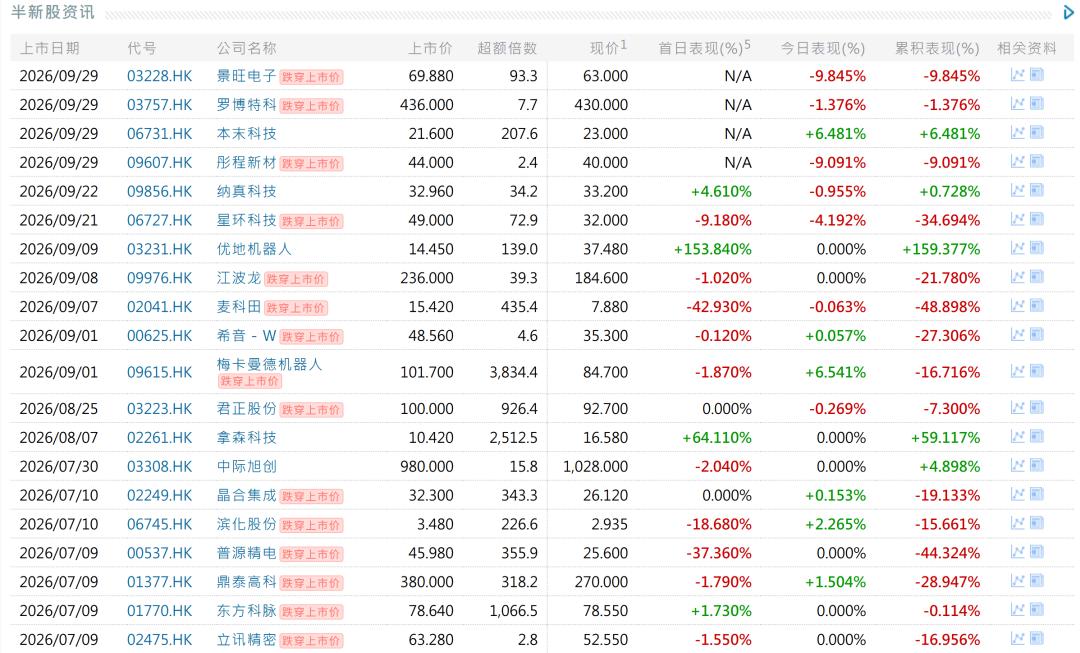
Recent Secondary Market Share Information (Excerpt)
However, for the primary market, this IPO boom has another meaning.
According to the data from IT Juzi, in the ten years from 2015 to 2025, the number of institutions that actually made investments in the market decreased from 1661 to 737, a decrease of 55.6%, which means that only half of the institutions still have money and are still making investments. What is even more shocking is that from 2020 to now, 1500 institutions have not made any investments at all, accounting for 23%. By the end of 2025, there are countless funds in China's equity investment market that are in the exit period or extension period, which means that many VC/PE institutions hold projects that are about to expire or are approaching their maturity, and these projects also need a place to realize cash.
The larger the IPO exit window, the more likely it is for investment institutions that have been waiting behind the projects for five to eight or even ten years to successfully achieve exit and cash realization.
This article is from WeChat official account "Zhongrong Finance" (ID: thecapital), written by Feng Xiaoting, edited by Wu Ren, and authorized for release by 36Kr.