13 Billion Yuan, a New Unicorn Emerges in Wuhan
A new unicorn has emerged out of nowhere.
It is learned from the investment circle that Wuhan Xinrongguang Technology Co., Ltd. was recently registered and established in Guanggu, with a registered capital of 13.2 billion yuan — it already holds tens of billions of capital as soon as it debuts.
Dozens of shareholders are gathered behind it, including Wuhan Xinxin, Guanggu Industrial Investment, SMIC PE, Shenzhen Venture Capital, Yuanhe Puhua, GF Xinde, HSG, Tongchuang Weiye, JZ Capital, China Merchants Capital, Yangtze River Industry Fund, China Internet Investment Fund, Chengtong Kechuang Fund..... The list is so long that it is amazing.
The timing of this move is thought-provoking.
The day after Xinrongguang completed its registration, the IPO review status of Yangtze Memory Holding on the Sci-Tech Innovation Board was updated to "Inquired", with a planned fundraising of 33 billion yuan. The development from Yangtze Memory to Xinrongguang is exactly the epitome of the rise of Wuhan's semiconductor industry.
The most promising new unicorn gathers a luxury capital lineup
Specifically, Wuhan Xinrongguang is located at Guanggu 5th Road, Wuhan East Lake High-tech Development Zone. Its business scope covers core businesses such as integrated circuit design, chip manufacturing, power electronic component manufacturing, and technology import and export.
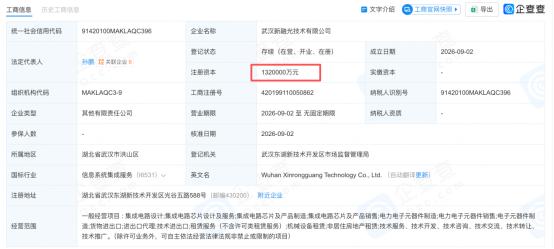
The legal representative of Xinrongguang is Sun Peng, who is also the director and general manager of Wuhan Xinxin Integrated Circuit Co., Ltd.
Looking through the shareholder list, there are 38 shareholders in total, almost gathering all the mainstream capital forces in China's semiconductor field.
The first thing that catches the eye is that Wuhan Xinxin is the largest shareholder, holding 30.30% of the shares of Xinrongguang. Yangtze Memory was established on the basis of Wuhan Xinxin through integration back then; the second largest shareholder, Wuhan Guanggu Semiconductor Industry Investment Co., Ltd., holds about 15.15% of the shares, and Guanggu Industrial Investment is a professional industrial investment platform under Wuhan East Lake High-tech Development Zone.
Industrial capitals have also joined in. Among them, Ju Yuan Guanggu Xinxin (Wuhan) Electronic Information Technology Partnership (SMIC PE) holds 12.1212% of the shares. SMIC PE is an investment institution initiated by SMIC in cooperation with a professional team.
The lineup of market-oriented investment institutions is particularly strong — Shenzhen Hongtu Baichuan No. 6 under Shenzhen Venture Capital holds 7.5758% of the shares; Yuanhe Puhua, GF Xinde, Xinding Capital, HSG, Tongchuang Weiye, JZ Capital, China Merchants Capital are all on the list, and Xienuo Investment, Hongyi Asset Management, Zhongqing Henghui, Yushan Investment, Gaoyu Fund, Hengxu Capital, Zhaorong Capital, Sunac Investment, CEC Health Fund are also gathered here.
The return cycle of semiconductor wafer manufacturing often lasts for ten years. The entry of these institutions not only provides funds, but also introduces upstream and downstream supply chains and technical talent networks, helping the new company avoid detours in industrialization and jointly bet on the domestic substitution dividend of the silicon photonics track under the wave of AI computing power.
In addition, national and provincial industrial funds such as Yangtze River Industry Fund, China Internet Investment Fund, Chengtong Kechuang Fund, Chuchang Investment, Wuhan Kechuang Investment, Yangtze River Capital have also contributed capital one after another.
Among them, Chengtong Kechuang Fund is the first batch of central SOE venture capital parent funds guided by the State-owned Assets Supervision and Administration Commission and led by China Chengtong, whose core mission is to invest in hard technology and serve the national strategy of self-reliance and self-improvement in science and technology; as a provincial parent fund of Hubei Province, Yangtze River Industry Fund follows the main line of the local semiconductor industry, taking into account both strategic tasks and industrial landing goals.
In addition, Shanghai SAIC Xinju Venture Capital Partnership (managed by Shangqi Capital) under the SAIC Group system and Hubei Changfei Angel Venture Capital Fund Partnership under the Yangtze Optical Fibre and Cable system rely on Changfei's accumulation in the optical communication industry chain to target the downstream demand for silicon photonics and high-speed optical modules.
Such a top-tier lineup reflects the current financing paradigm of heavy-asset projects — it is difficult for a single party to bear the financial pressure and operational risks brought by the 10-billion-level production line investment alone. The grouping of multiple capitals can not only disperse the risk of huge investment, but also pave the way for subsequent large-scale capacity expansion.
A little-known history
Tracing back, Xinrongguang has a deep connection with Yangtze Memory, which is about to go public.
The context behind this can be traced back to a 20-year history of Wuhan Xinxin. Back in 2006, Wuhan Xinxin was funded and established by the state-owned assets of Hubei Province and East Lake High-tech Development Zone, planning to build the first 12-inch wafer fab in China, focusing on DRAM chips in the initial stage.
In 2016, the National Memory Base settled in Guanggu, and Yangtze Memory Technologies Co., Ltd. was officially established — it started with the existing production lines, equipment and process teams of Wuhan Xinxin as the foundation. At that time, Wuhan Xinxin was incorporated into Yangtze Memory. In terms of capital structure, Yangtze Memory Holding, as the top holding platform of the group, holds 100% of Yangtze Memory Technologies, and has long held controlling shares in Wuhan Xinxin.
In May 2023, Yangtze Memory Holding completed the internal equity transfer, and Yangtze Memory transferred all the shares of Wuhan Xinxin it held to its parent company Yangtze Memory Holding, making the two brother entities under the same group.
The important turning point came in 2026.
On May 19, Yangtze Memory Holding officially launched the IPO counseling and filing; on the same day, Wuhan Xinxin voluntarily withdrew its Sci-Tech Innovation Board IPO application materials. Under the A-share IPO regulatory rules, if Yangtze Memory Holding still firmly controls Wuhan Xinxin, the related transactions, business boundaries and potential horizontal competition between the two entities will all become unavoidable red lines in the listing review.
The equity separation is imperative. In June, a landmark equity transaction was publicly announced: Guanggu Semiconductor Industrial Investment and its persons acting in concert acquired 39% of the shares of Wuhan Xinxin held by Yangtze Memory Holding; in July, the transaction received unconditional anti-monopoly approval, and Guanggu state-owned assets obtained the sole control of Wuhan Xinxin, with the shareholding of Yangtze Memory Holding diluted to 29.19%, and Wuhan Xinxin is no longer included in the consolidated statements.
So far, Wuhan Xinxin has officially separated from the Yangtze Memory Holding system and become an independent characteristic process wafer enterprise led by Guanggu state-owned assets.
Clarifying this relationship, we can understand the origin of Xinrongguang — Xinrongguang is a brand new platform led by Wuhan Xinxin after the equity transfer is completed.
However, the separation of equity does not mean that the technological and industrial ties are completely cut off. Over the past years, Wuhan Xinxin has helped Yangtze Memory tackle 3D storage, and accumulated a complete set of 3D heterogeneous integration process capabilities such as TSV through-silicon via, hybrid bonding, and multi-wafer stacking, and built the first domestically independent and controllable 3D heterogeneous integration production line in China. This technical foundation is now completely left to Wuhan Xinxin, and has become the core technical confidence for Xinrongguang to enter the silicon photonics and optoelectronic integration track.
Yangtze Memory focuses on solving the problem of large-capacity data storage, while Xinrongguang aims to solve the problem of high-speed data transmission. Both are located in the Guanggu industrial zone, and talents, supply chains and equipment resources can still flow to each other.
It is worth noting that on August 28, Wuhan Xinxin officially released the "Xinguang Plan" at its official conference. The official debut of Xinrongguang a few days later is widely regarded by the market as the undertaking of the industrialization implementation task of the ten-year strategic "Xinguang Plan".
The underrated power of Wuhan is breaking out
After decades of "chasing light and pursuing chips", Wuhan's semiconductor industry is ushering in an outbreak.
Many people are used to simply associating the label of Wuhan's semiconductor industry with Yangtze Memory, but the spark of chips on this land was lit as early as when Wuhan Xinxin was established. When that 12-inch wafer fab was settled back then, the state-owned assets of Wuhan at the provincial and municipal levels continued to support it with patient capital, and survived the difficult years of consecutive losses.
The arrival of the AI computing power wave has allowed Wuhan's hard technology assets that have been accumulated for many years to realize their value.
The most intuitive manifestation is that a number of locally grown enterprises have successively hit new market value highs: Huagong Technology, which originated from Huazhong University of Science and Technology, is the first 100-billion-yuan listed company in Hubei; Accelink Technologies, which has been deeply engaged in optical communications for half a century, also has a market value of over 100 billion yuan; Yangtze Optical Fibre and Cable has achieved strong growth with its main optical fiber and cable business, with a market value exceeding 360 billion yuan.
And all of them are located in Wuhan Guanggu.
Here, the "Seven Stars of Guanggu" are rising — Yangtze Memory, Yangtze Optical Fibre and Cable, Huagong Technology, Accelink Technologies, FiberHome, Guide Infrared, and CICT Mobile, covering multiple hard-core tracks such as storage, optical communications, infrared, and mobile communications. Once Yangtze Memory completes its Sci-Tech Innovation Board IPO, the overall market value here will directly reach the trillion-yuan level.
Behind this glory is a long period of industrial dormancy in Wuhan.
Tracing back to the source, in 1976, Academician Zhao Zisen drew the first practical optical fiber in China at Wuhan Research Institute of Posts and Telecommunications, laying the foundation for Wuhan's optoelectronic industry. However, for a long time after that, this inland city did not have a prominent presence in the national industrial map.
With a large number of university resources, it has long faced the dilemma of brain drain; when the Internet wave swept across the country, many Hubei-born entrepreneurial celebrities became famous outside, but no heavyweight Internet giants grew up locally, and it was even once evaluated as a city lacking unicorns.
Until the arrival of the AI era. The explosive growth of computing power has made optical modules, optical chips, optical fibers and storage chips the rigid demand of computing infrastructure, and these tracks are exactly the advantageous fields that Wuhan has been deeply engaged in for decades.
Data shows that Guanggu currently gathers 16,000 optoelectronic information enterprises, and has the world's leading optical fiber and cable, optoelectronic devices and advanced storage industrial bases; the total scale of Wuhan's optoelectronic information industry has exceeded 850 billion yuan, which is only one step away from becoming a trillion-yuan pillar industry.
Starting from a single optical fiber, breaking through in storage chips, and then expanding new boundaries towards silicon photonics and optoelectronic integration. Looking back, Wuhan has survived the loss cycle in the early stage of the chip industry, ushered in the AI computing power era, and Guanggu is playing the role of a technology creator.
There is no shortcut in the hard technology industry, and what matters is long-termism.
For Xinrongguang, capital is only the starting point. The yield improvement, process iteration and customer development of wafer manufacturing are all realistic challenges ahead, and the real test is still on the way.
The new story has just begun.
This article is from the WeChat official account "Investment Circle" (ID: pedaily2012), written by Yang Jiyun, authorized by 36Kr to release.