The detailed rules for Shanghai have officially taken effect! Compared with the policies in Beijing, they add an extra lock while also opening an additional window.
The "August 28 New Policy" has just been in effect for a full month. On September 28, 2026, four departments of Shanghai Municipality, including the Shanghai Municipal Commission of Housing and Urban-Rural Development, the Municipal Housing Administration Bureau, the Municipal Planning and Natural Resources Bureau, and the Shanghai Municipal Financial Regulatory Bureau, jointly issued the *Implementation Opinions on Implementing the Notice on Improving the Commodity Housing Sales System*, which came into effect on the same day.
Four days earlier, on September 24, four departments including the Beijing Municipal Commission of Housing and Urban-Rural Development jointly issued the *Implementation Opinions on Issuing the Municipality's Implementation of the Notice on Improving the Commodity Housing Sales System*.
By comparison, both documents consist of six parts, each corresponding item by item to the central document. However, Shanghai's rules are not a copy of Beijing's, and the two cities have made two sets of trade-offs under the same central framework.
Beijing spreads the pressure over the timeline, while Shanghai concentrates the pressure on the first cash window after land acquisition, and opens wider access than Beijing at the same time.
01
On September 28, the detailed rules for Shanghai's "August 28 New Policy" were officially released.
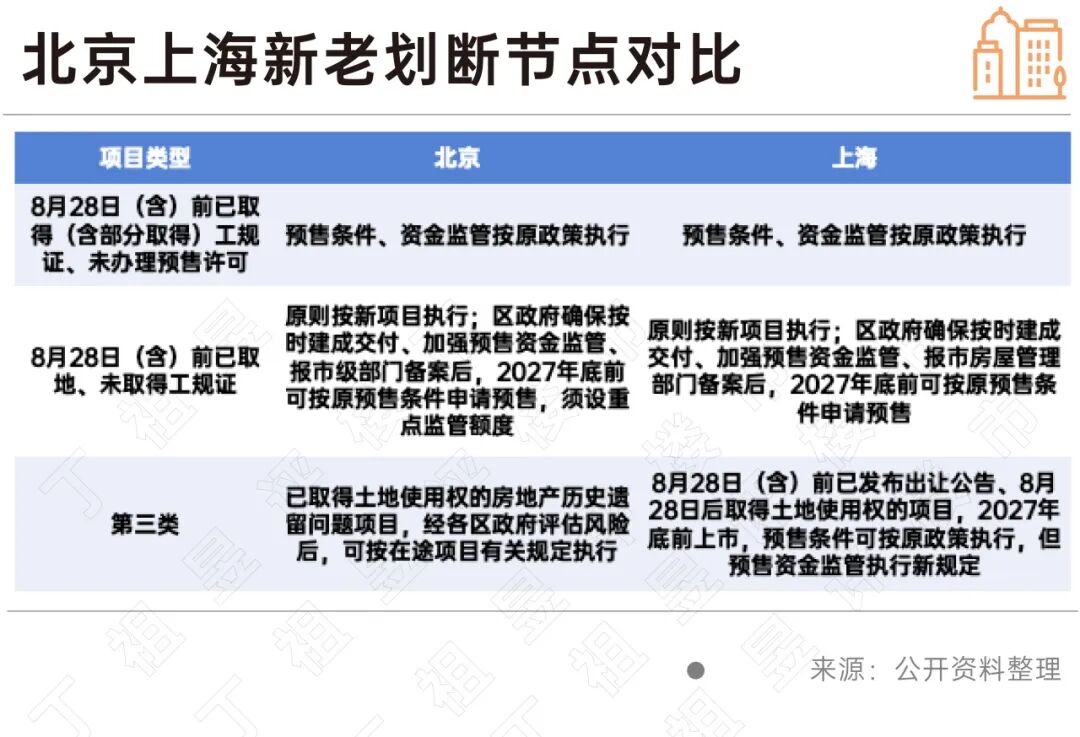
Comparing with the original text, it can be found that Shanghai is consistent with Beijing at the three most critical risk control points. (For the interpretation of Beijing's policies, please refer to *Beijing's Existing Home Sales Detailed Rules Give Real Estate Enterprises a Buffer Schedule*).
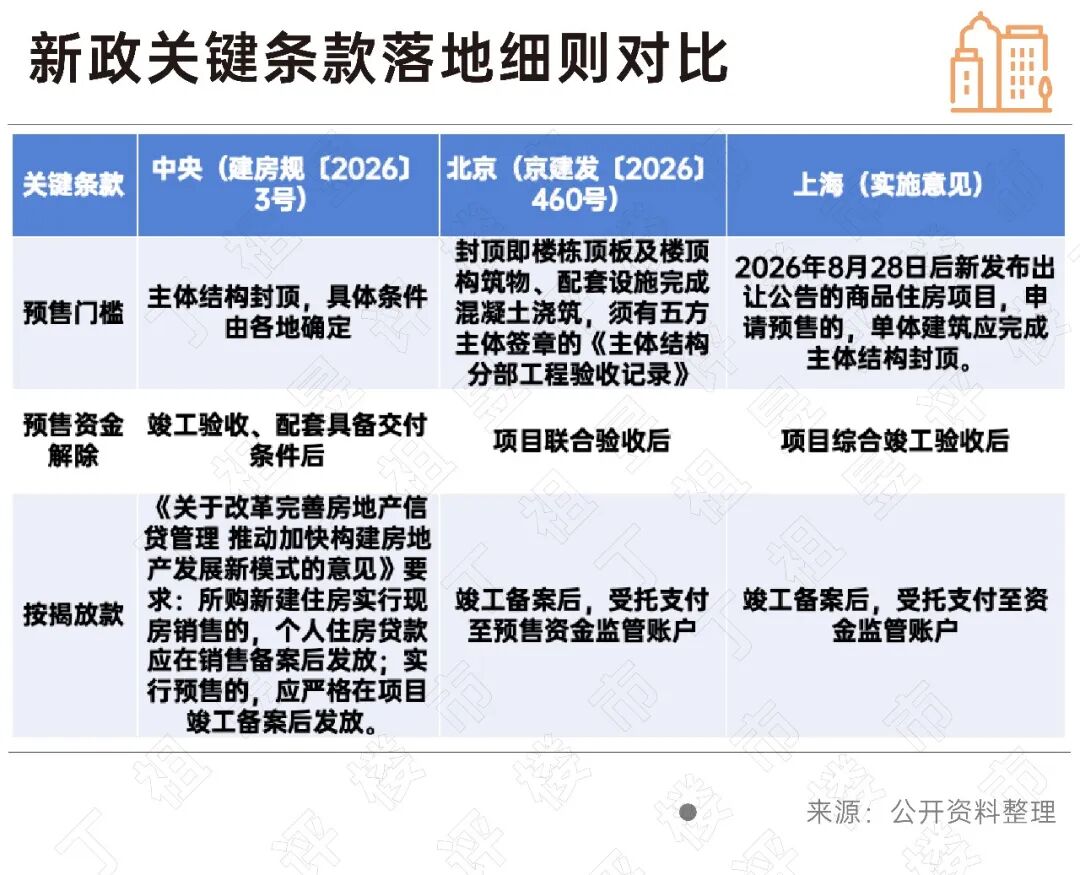
The first is the pre-sale threshold. The central document states that "the main structure of a single building shall be capped, and the specific conditions shall be determined by local governments according to actual conditions". Shanghai's implementation opinions stipulate that for commodity housing projects with new transfer announcements issued after August 28, 2026, if they apply for pre-sale, the main structure of the single building shall be capped.
Both Beijing and Shanghai set the judgment anchor point at whether a new state-owned construction land use right transfer announcement is issued after August 28, 2026, moving the judgment link to the forefront of the development chain. But at the same time, Beijing leaves a leeway for projects with historical legacy problems to solve the disposal of existing stock risks. Shanghai's leeway is open to projects that "have been announced but land not yet acquired", solving the mismatch between the transfer rhythm and the policy time point.
This leeway has special significance in Shanghai. Shanghai's land transfer adopts centralized batch-based transfer, and there is usually an interval of several weeks between the release of the official transfer announcement and the on-site transaction. The 9th batch of residential-related land in 2026 released the transfer announcement on August 17, and completed the transaction on September 21. The total transaction price of the 3 plots reached 12.911 billion yuan. The announcement time of this batch of plots was earlier than August 28, and the land acquisition time was later than August 28, which exactly falls into the third type of channel in Shanghai. They can follow the original pre-sale conditions before the end of 2027, but the new regulations shall be implemented for capital supervision.
Without this provision, the three plots of the 9th batch will directly apply the management policies for newly acquired land projects. With one regulation, Shanghai has secured the transition period for the 9th batch of land auctions.
The second is the lifting node of capital supervision. The central document states that "after the commodity housing project is completed and accepted, and the supporting facilities such as water, electricity, gas and heat meet the delivery conditions, the capital supervision shall be lifted". Shanghai stipulates that "the capital supervision can be lifted only after the comprehensive completion and acceptance of the project", pushing the lifting time point to the overall acceptance link after the completion and acceptance.
The third is the disbursement of individual mortgage loans. The credit documents of the People's Bank of China and the State Administration of Financial Regulation clearly stipulate that the mortgage loans for pre-sale projects shall be disbursed after the completion filing. Beijing took the lead in implementing this requirement in its local detailed rules that "loans shall be disbursed after completion filing, and be paid to the pre-sale capital supervision account through entrusted payment". This time, Shanghai's detailed rules are aligned with Beijing's, requiring that "for projects that obtain pre-sale permits from August 28, 2026, individual housing mortgage loans (including provident fund loans) can only be disbursed after completion filing, and the loan funds shall be paid to the capital supervision account through entrusted payment."
For real estate enterprises, this means that the sales return of pre-sale projects can only be actually received after the project is completed and accepted for filing, and the cash flow model of real estate enterprises may be rewritten.
02
Shanghai's detailed rules are not a copy of Beijing's. In addition to the above three bottom lines, there are many differences between Shanghai and Beijing.
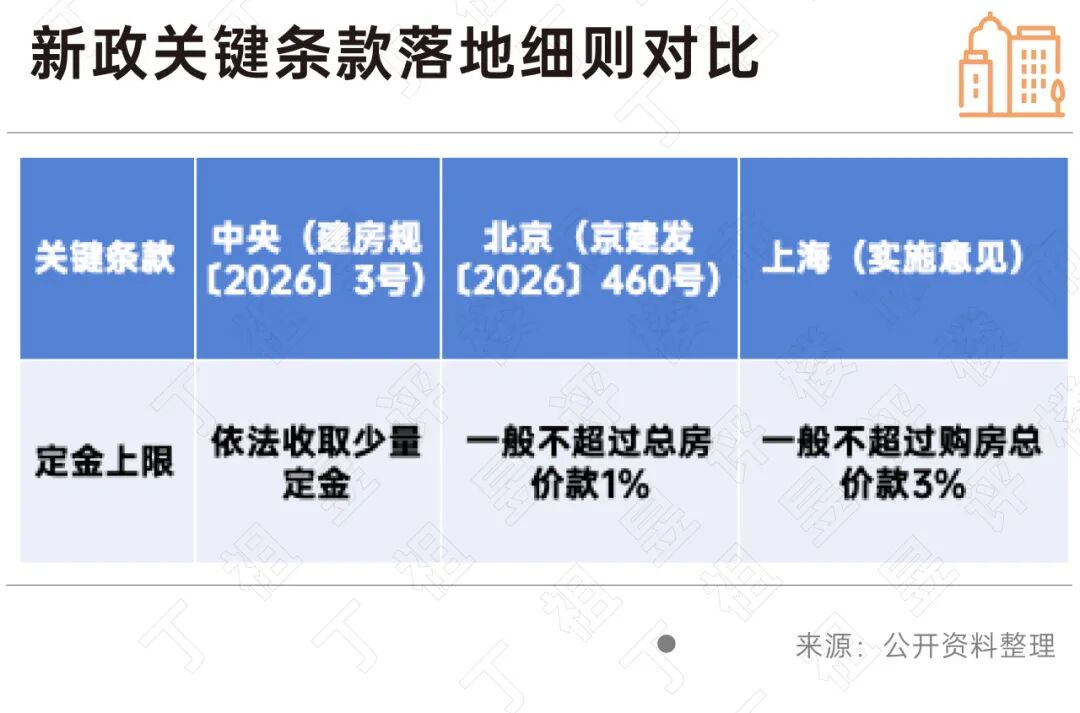
First, the maximum deposit is 3%, while that in Beijing is 1%.
The central document only has one sentence for the deposit of existing home sales that "a small amount of deposit shall be collected in accordance with the law", leaving the proportion to local governments. Beijing quantifies "a small amount" as no more than 1% of the total housing price, while Shanghai stipulates it as no more than 3% of the total purchase price.
Although it seems that there is only a 2 percentage point difference, the deposit is one of the few legally collectible purchase funds for real estate enterprises under the existing home sales system after obtaining the construction permit for construction projects and before the completion and delivery. Taking a house with a total price of 6 million yuan as an example, the upper limit in Shanghai is 180,000 yuan, and that in Beijing is 60,000 yuan, a difference of 120,000 yuan per unit. For a project with a total value of 2 billion yuan, if the maximum limit is fully collected, the early return of funds in Shanghai is 60 million yuan, and that in Beijing is 20 million yuan.
According to estimates, under the existing home sales system, the capital return cycle of real estate enterprises is extended from 6 to 12 months in the pre-sale period to 24 months or even longer after the completion filing, and the financial cost will increase accordingly. After the return cycle is systematically extended, as a small amount of real money that enterprises can get in advance in the long cycle, the difference between 3% and 1% is directly reflected in the internal rate of return of the project.
Secondly, the land payment adopts the "1+1" mode, which is the toughest point in Shanghai's detailed rules and the core difference from Beijing.
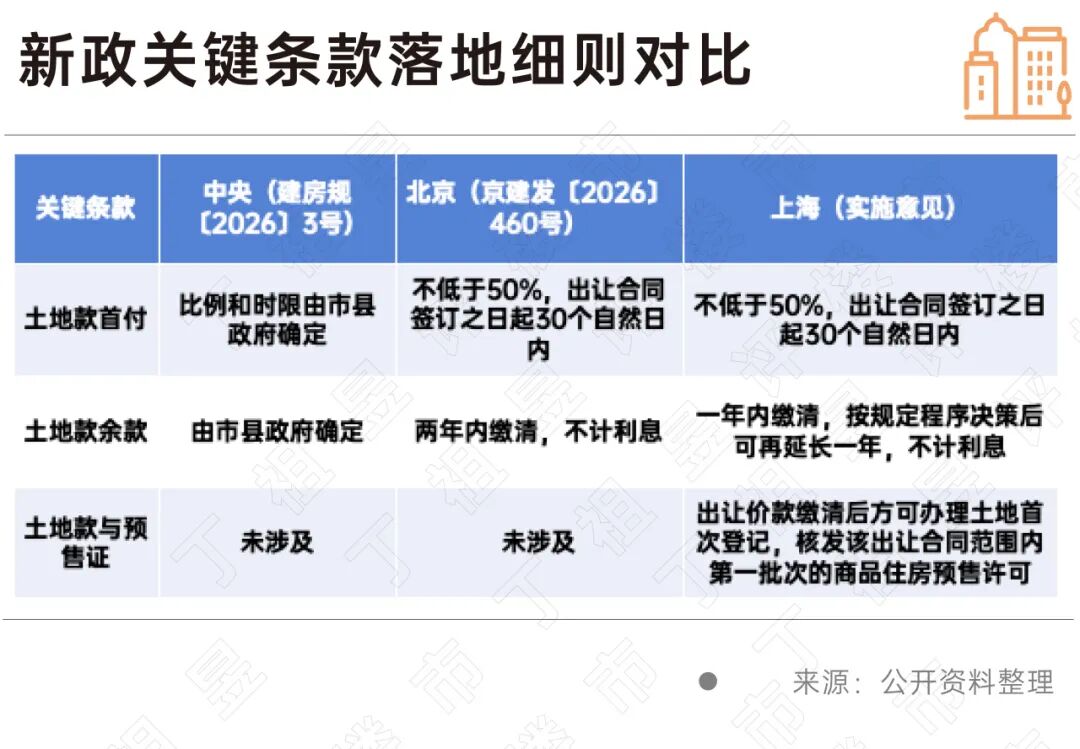
The down payment clauses of the two cities are completely the same: the down payment of the land transfer price shall not be less than 50% of the total price, and shall be paid within 30 natural days from the date of signing the transfer contract. The difference lies in the balance. Beijing stipulates that "the balance can be extended to be paid off within two years after the signing of the transfer contract, without interest". Two years is a definite period written into the document. Shanghai stipulates that "the balance can be extended to be paid off within one year after the signing of the transfer contract; to meet the needs of the market and projects, after decision-making in accordance with the prescribed procedures, it can be extended for another year; no interest will be charged for installment payment".
On the surface, the maximum period of the two cities is two years, but the nature is completely different. The two-year period in Beijing is the legal upper limit, and enterprises can arrange their capital accordingly. The one-year period in Shanghai is the legal period, and the second year is a flexible period that can only be obtained after "decision-making in accordance with the prescribed procedures", which is not a predictable right. Shanghai also stipulates that the specific payment method of the transfer price shall be clarified in the land transfer announcement after collective decision-making by the local land transfer coordination and decision-making institution, which means that the payment rhythm of each plot may be different, and one plot has one policy.
More critically, the following sentence: for projects with installment payment, the first registration of state-owned construction land use right can be handled and the first batch of commodity housing pre-sale permits within the scope of the transfer contract can be issued only after the full transfer price is paid off. There is no such clause in Beijing.
The essence of this regulation is that if an enterprise wants to get the first sales return in Shanghai, it must first pay off all the land transfer price. The original significance of installment payment is to leverage the project with a small amount of self-owned funds, and use the sales return to cover the land price in a rolling manner. Shanghai retains the first half of this path and cuts off the second half. The extended one year is the final deadline for full payment, not the space for sales return to cover the land price.
As compensation, Shanghai provides another convenience: projects with installment payment can apply for the construction land planning permit and construction project planning permit with the state-owned construction land use right transfer contract. Enterprises can immediately enter the construction reporting process after acquiring the land, without waiting for the full payment of the land price, which shortens the preliminary time.
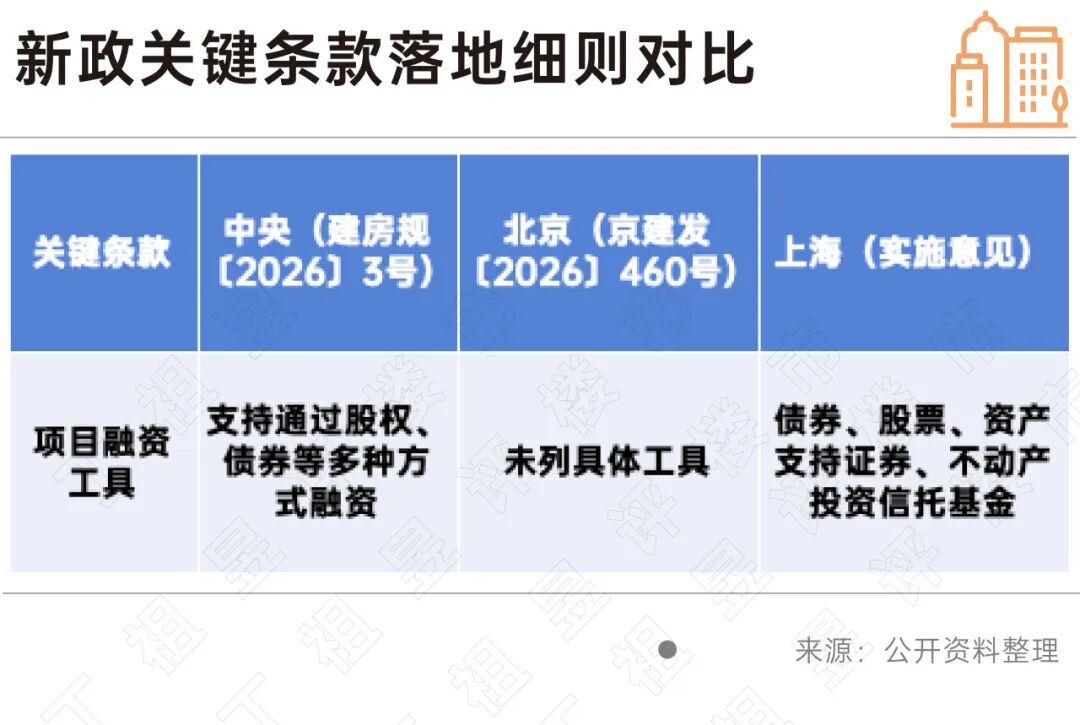
Finally, Shanghai has opened four financing channels. Shanghai clearly supports qualified real estate development enterprises to carry out project-based financing through bonds, stocks, asset-backed securities and real estate investment trusts, etc., and meet the reasonable financing needs of real estate development enterprises under different ownership systems without discrimination.
The expression of Beijing's detailed rules on the financing side only covers development loans, requiring banks to reasonably determine the disbursement node and amount according to the construction progress, issue development loans in batches, and the funds shall be paid to the account of the project company's counterparty through entrusted payment and be fully used for project construction. Shanghai's expression on the development loan part is consistent with Beijing's, but it additionally adds project-based direct financing channels, and clearly states that "no discrimination" covers enterprises under different ownership systems.
The weight of this clause should be considered in the context of the tightening on the land side. Shanghai reduces the legal full payment period of land price to one year, and stipulates that the first batch of pre-sale permits can be issued only after full payment, which significantly increases the occupation of self-owned funds of real estate enterprises. The expansion of financing channels is a hedge, enabling enterprises that are capable of issuing bonds, stocks, asset-backed securities or real estate investment trusts to obtain alternative capital sources.
Overall, Beijing and Shanghai have formed two sets of cash flow plans based on the same institutional framework.
Beijing is strict with standards and loose with time, specifying the definition of capping, the caliber of key supervision quota, and the period of land payment one by one, while giving a two-year buffer period for full payment.
Shanghai is strict with the front-end cash flow and loose with financing channels. The legal full payment period of land price is only one year, and it is stipulated that the first batch of pre-sale permits can be issued only after full payment, which is equivalent to taking back half of the dividend of installment payment. The compensation method is to raise the upper limit of deposit for existing home sales from 1% in Beijing to 3%, and open four project-based financing channels for real estate enterprises, including bonds, stocks, asset-backed securities, and real estate investment trusts.
Enterprises that can quickly pay off the land price, enter the bond and real estate investment trust markets, and collect the deposit up to the 3% upper limit will get an accelerated channel under Shanghai's new system.
We believe that the period from the fourth quarter of 2026 to the end of 2027 is an extremely important observation period.
This article is from the WeChat Official Account "Ding Zuyu Comments on the Real Estate Market", written by the Editorial Department, and published with authorization from 36Kr.