How does the U.S. midterm election affect Chinese enterprises going global?
A battery material plant planned to invest about 2.4 billion US dollars received state government support, but faced a setback after a recall election in the small town government; a battery enterprise that was originally scheduled to receive 200 million US dollars in federal subsidies finally failed to get the subsidies after continuous questioning by members of Congress.
Not all of these cases are directly caused by elections, but they point to a problem that Chinese enterprises tend to underestimate when investing in the United States: The fact that the plant is located in the local area does not mean that the political risk assessment has been completed. Officials who supported the project when the agreement was signed may leave their posts, the originally promised subsidies may be questioned by Congress, and the already negotiated transactions may also be re-attached with new conditions after the government changes.
What enterprises face is never just a single "U.S. government", but federal, state and local political forces with different authorities and inconsistent interests.
Lu Xiongwen, Party Secretary of Fudan University School of Management, once emphasized that when enterprises integrate into the local community, in addition to building a localized team, they should also maintain good relations with local governments, communities, media and non-governmental organizations. He also reminded that one should not equate the current friendly attitude of a country with long-term political security.
In the context of local investment, this means enterprises need to build a broader support base than the investment promotion agreement, so that the benefits of employment, procurement and public investment can be understood by the local society. Of course, community integration cannot guarantee that the project will be free from political shocks, but the support of only a few officials is not enough to prove that the enterprise has been accepted by the local community.
The 2026 U.S. midterm elections in November will readjust the relationship between these forces again. For entrepreneurs, what is worth paying attention to is not only whether the Republican Party can hold Congress, but also several specific business accounts: who can still fulfill the investment promotion commitments, who has the right to block the progress of the project, which subsidies and permits need to be re-evaluated, and whether the members of Congress who were not originally in the enterprise's field of vision will become key figures affecting investment.
Focusing on these issues, "Fudan Business Knowledge" had a discussion with Lu Xinxu and Su Yuxiang, policy analysts of Policy Nexus, starting from the different logics of congressional and gubernatorial elections, discussing how changes in U.S. political power will be transmitted to enterprise operations, and which regions and seats in this U.S. midterm election Chinese enterprises expanding overseas should pay attention to.
Policy Nexus is a policy and management consulting institution founded in Washington, which has long been deeply engaged in the North American market. The founding team of the company has both academic background in international relations and practical policy experience, analyzes the problems faced by Chinese enterprises going global from the perspectives of policy, industry and culture, provides consulting services in policy communication, public narration and legal compliance, and assists enterprises in evaluating overseas business strategies and related risks.
This article is the first in the series, and its viewpoints combine the content of the discussion and the sorting out of relevant policies and enterprise cases by the editors of Management Vision.
The U.S. midterm elections are held in the middle of the four-year presidential term, which will not re-elect the president, but will change the congressional power structure that the president will face in the next two years. The main voting day in 2026 is November 3. At the federal level, all 435 seats in the House of Representatives will be up for re-election, and 35 of the 100 seats in the Senate will be up for re-election; the latter includes 33 seats with normal expiring terms, as well as two special elections in Florida and Ohio.
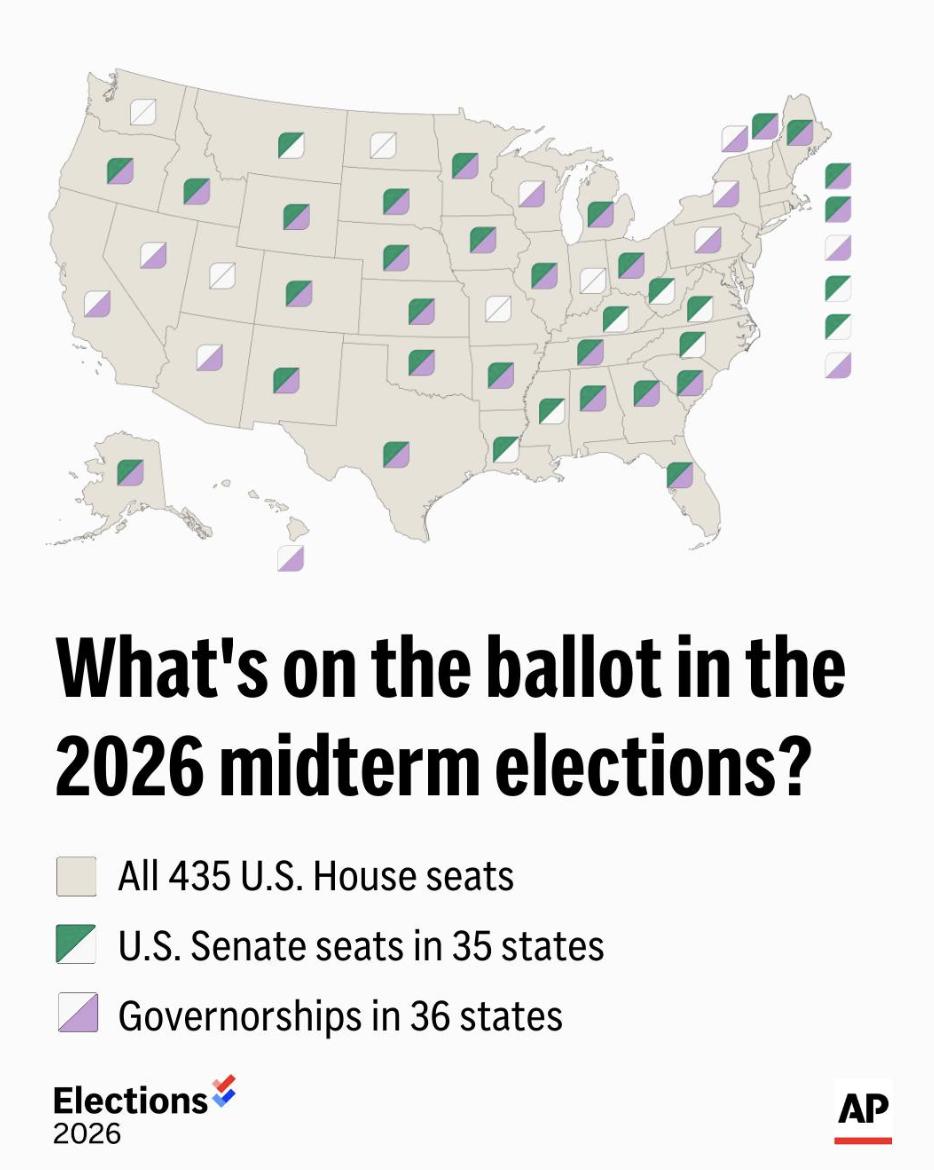
Source: Associated Press
Under the federal level, 36 states will elect governors, including California, Texas, Michigan, Ohio, Georgia, Tennessee and South Carolina, which are of great concern to Chinese enterprises' investment; Guam, the Northern Mariana Islands and the U.S. Virgin Islands will also hold chief executive elections. In addition, many localities will also elect state legislators, attorneys general and local officials. The same ballot may involve federal legislation, state government supervision and local public affairs at the same time, and these powers at different levels may all affect whether an enterprise can obtain permits, receive subsidies or promote plant construction.
Up to now, the overall political environment of the 2026 midterm elections is obviously unfavorable to the Republican Party, but the trends of the three major battlefields of the House of Representatives, the Senate and the governor are not consistent. The probability of the House of Representatives changing hands is relatively high, and the Democratic Party is in a more favorable position to compete for the majority of seats; the Senate has evolved from a Republican advantage at the beginning of the year to a highly stalwart situation, and the Republican Party only maintains a weak structural advantage; the gubernatorial elections are more inclined to local games, and the Democratic Party does have a non-negligible offensive momentum, but it is not enough to form a nationwide "blue wave".
In essence, the midterm election is a public opinion referendum on the ruling party in power, which is equivalent to the "mid-term exam" for the president's party. The election results will also redistribute the power within the U.S. political system: The majority party in the House of Representatives controls the leading power of the committees and determines the direction of investigation and the legislative agenda; the Senate influences the implementation of bills and the appointment of senior officials; the governors of each state directly lead the local industrial orientation, investment environment and regulatory rules.
Therefore, when looking at the 2026 midterm elections, we should not only focus on how many seats the two parties finally get, but also pay more attention to how the power structure of U.S. policy formulation and implementation will be reconstructed in the two years after the election.
Two easily overlooked variables that may affect the final result
The first variable is the abnormally large "mid-cycle redistricting". The so-called redistricting refers to the re-delineation of the boundaries of congressional districts after the decennial census. In essence, it is to concentrate or dilute the voter base of a specific party by adjusting the geographical boundaries, which has always been the core tool for the two parties to compete for control of the House of Representatives. In this round, many states did not actively redraw the maps before the midterm elections due to population changes, but due to court rulings and partisan games. Texas took the lead in redrawing the congressional map, California fought back by passing Proposition 50, and then many states followed suit in a chain reaction, covering 10 states and nearly 40% of the seats in the House of Representatives. It has changed the "conversion rate" of national public opinion into seats — roughly estimated that the Republican Party may gain a net of about 5 seats as a result. Even if it lags slightly in the national popular vote, it may rely on a more favorable district structure to hold the House of Representatives.
The second variable is "split ticket voting" under the anxiety of people's livelihood. The loosening of some Trump supporters is manifested in the decline of voting willingness or "split ticket voting" (they still identify with Trump, but vote for Democratic candidates with strong personal brands in congressional and local elections). This is also why states such as Iowa, Texas, Alaska and even Ohio, where Trump won significantly in 2024, may still have close races this year. Trump's net approval rating among rural voters has dropped from +20 in early 2025 to -14 in May this year; in marginal seats where the gap is only one or two percentage points, this loosening is enough to change the result.
In addition to the two chambers, the gubernatorial races also deserve attention
All 435 seats in the House of Representatives are re-elected every two years. The constituencies are small, and the personal recognition of members of Congress is limited. Many voters do not vote for the candidate himself, but express their attitude towards the overall performance of the president and his party. This makes the House of Representatives much more sensitive to short-term economic and political environment changes than the Senate. Combined with the current situation, the overall macro trend is favorable to the Democratic Party. If there is no major black swan event, we currently predict that the Democratic Party has a very high probability of winning the House of Representatives.
The competition logic of the Senate is completely different. Senators have a term of six years, and only one third of them are re-elected each time. The institutional design has a natural buffer for the transmission of short-term political trends. The election situation depends to a large extent on the strength of the candidates, the inherent partisan background of the state and the results of the party's primary elections. From the perspective of practical thresholds, the Republican Party currently controls the Senate by 53:47. The Democratic Party not only needs to hold all its key seats, but also needs to gain a net of four seats to obtain the majority.
If a 50:50 seat distribution is finally formed, Vice President Vance can help the Republican Party maintain control of the Senate with his decisive vote, but this majority is extremely fragile, and any Republican senator may become a key variable affecting the direction of policy. Compared with the current 53:47 pattern, the 50:50 pattern will bring great differences to the promotion of government policies, especially in the links of personnel appointment, cross-party negotiations and seeking support from individual members of Congress.
Gubernatorial elections are more easily affected by local issues and the personal prestige of candidates, and the public opinion trend will not be transmitted as directly and drastically as in House of Representatives elections. This round of gubernatorial elections also has a long-term impact: the term of the new governor will cover the 2030 census. After the census, the United States will re-divide congressional seats and district boundaries, and the district plans of most states need to be signed and approved by the governor. This round of competition for governors is not only about the local policies in the next four years, but also may affect the congressional map in the 2030s.
The impact of gubernatorial elections on specific landing projects is often more direct than that of Congress. Congress determines the macro policy boundary, while state governments master tax reductions, cash subsidies, industrial loans, supporting facilities for parks, road networks, water and electricity, labor training relying on state universities and community colleges, and dominate the vast majority of examination and approval permits and regulatory rhythms. Different governors will redefine "what investments are worth supporting, to what extent they are supported, and what conditions enterprises need to undertake". In addition to the governor, the authority for zoning, permits, water, electricity and road supporting facilities required for project implementation is further decentralized to the town council and county board of supervisors, which are also locally elected. The logic of "employment + tax revenue" has been sinking to the county and town level.
This is why enterprises cannot attribute all the risks faced by project implementation to a single election, but it clearly shows that the investment promotion commitments of state governments cannot replace the continuous cooperation of local governments that hold specific examination and approval powers. The decision-making power for whether a project can be implemented is scattered in multiple subjects at multiple levels. The state government can provide subsidies and tax incentives, but land zoning is under the town council, water use permits are under the river basin management authority, environmental protection examination and approval may be at the county level, and road access needs to be approved by the county transportation committee; most members of these institutions are locally elected and have their own voter pressure, and are not responsible to the governor. Therefore, due diligence must sink to the county and town level, and prejudge at the site selection stage — if the project becomes a local political issue, who will lead, who will mobilize, what thresholds need to be crossed, who will oppose, and what legal tools the opponents have.
The direction of China strategy has been legislated
The impact of the midterm elections on the U.S. economic policy toward China needs to be viewed at different levels. The overall strategic direction is very little affected, but three aspects including policy tools, implementation rhythm and key personnel need special attention.
In the past few years, the United States has fully incorporated key technologies, sensitive supply chains, capital flows and data security into the economic security framework. This general direction has formed a solid cross-party consensus and cannot be reversed by a single midterm election. What will be rewritten by the election results is the form in which tariffs are implemented, the direction of congressional investigations, and who between Congress and the White House will dominate the policy rhythm.
U.S. economic restrictions on China have gradually precipitated into written laws from administrative discretion in the past few years. The 2026 National Defense Authorization Act is a typical carrier, which incorporates the Bio-Security Act and the National Security Overseas Investment Review Act: the former establishes a statutory restriction framework for cooperation between federal agencies and specific Chinese biotechnology enterprises, and the latter fixes the China investment review system in the form of legislation for the first time. Both clauses were passed by a cross-party majority.
Coupled with the existing frameworks such as the CHIPS and Science Act, we can see a policy entity with statutory law as its skeleton. No matter which party controls Congress in November, the idea of putting the core issues of China-U.S. economy and trade under the "national security" framework for handling will not have a strategic reversal. This does not mean that restrictions will continue to increase, nor does it mean that there is no room for adjustment in all industries. What is stable is the risk perception and the overall framework, and there is still room for fluctuation in the specific scope of restrictions, industry priorities and implementation flexibility.
The national security framework does not mean that all transactions will be rejected without exception, but the transactions that are allowed to proceed may be different from the original plan envisioned by the enterprise. In 2018, when COSCO Shipping acquired Orient Overseas International, its U.S. Long Beach Container Terminal business became a key matter in the review of the Committee on Foreign Investment in the United States (CFIUS). To address national security concerns in the review, the relevant parties to the transaction signed an agreement, committing to sell the terminal business to an unrelated third party recognized by the relevant U.S. authorities, and entrust the relevant assets to an independent trust for management before the sale is completed. The acquisition was then approved by CFIUS.
In 2019, Orient Overseas sold the Long Beach terminal business for a consideration of 1.78 billion U.S. dollars, and at the same time arranged a 20-year terminal service agreement. The enterprise retained the commercial connection to use the terminal services and gave up the ownership of the relevant assets. This case shows that the review result is not only two options of "approval" or "prohibition", but also can redefine the scope that enterprises can participate in through divestment, independent management and continuous operation arrangements. For enterprises expanding overseas, the fact that there is room for negotiation in policies does not mean that national security requirements have been relaxed, but it may mean that enterprises can achieve part of their business goals by adjusting the transaction structure and other methods.
The differences between the two parties are more reflected in the choice of tools
The general direction will not change, but the two parties have great differences in preferences for what tools to implement, and the most prominent one is tariffs. The differences mainly focus on who should be targeted, for what reasons tariffs should be used, and how much unilateral discretion the president should have.
There is also a strong tough consensus on China trade within the Democratic Party, especially in strategic industries such as semiconductors, key minerals, batteries and automobiles. Targeted tariffs on China will not be automatically loosened just because the Democratic Party controls Congress. The real difference is that the Democratic Party as a whole is more opposed to Trump-style "broad-spectrum tariffs", that is, using tariffs as a broad tool for negotiation and pressure, and imposing large-scale tax increases on China, Canada, Mexico and other allies at the same time. They prefer to link tariffs with specific unfair trade practices, industrial security and supply chain risks, and coordinate with allies to jointly exert pressure on China.
Not all Republicans agree with broad-spectrum tariffs. Traditional free-trade Republicans in agricultural and manufacturing states have long worried that tariffs will drive up input costs, trigger retaliation and harm their state's exports. However, Trump still has strong influence on the party primaries and the voter base, and many members of Congress are unwilling to openly oppose the White House even if they have differences.
If the Democratic Party wins the House of Representatives, what is more likely to happen is not that the United States will lower tariffs on China, but that Congress will strengthen restrictions on the president's broad use of tariff powers, distinguish between China and allies, strategic industries and ordinary commodities in terms of tax rates,