Roundtable: "Embodied Intelligence" Bridges the Last Mile from Technology to Scenarios | 36Kr 2026 Industry Future Conference
In 2026, industrial investment has entered a deep-water zone, where capital, technology and industry are accelerating integration. Old investment logic no longer applies, and new consensus is taking shape. The 2026 Industrial Future Conference focuses on opportunities in the new cycle, to jointly explore the future of the industry and the birth of the "Light of China". From September 9 to 10, the 2026 Industrial Future Conference hosted by 36Kr was held in Yizhuang, Beijing, with the theme of "Above Deep Waters, Resonate for New Birth". Representatives from state-owned capital platforms, industrial investment funds, corporate CVCs, innovative enterprises, experts and scholars gathered together to focus on the industrialization of future industries such as quantum technology. The conference conducted in-depth discussions on current cutting-edge technologies and industrial perspectives, showcased breakthroughs in technical routes including superconductivity, photonic quantum, and ion trap, and shared a large number of specific industrial scenarios, industrial system construction, and heterogeneous computing prospects, to jointly explore the future of sci-tech industrial investment.
The following dialogue is organized and edited by 36Kr:
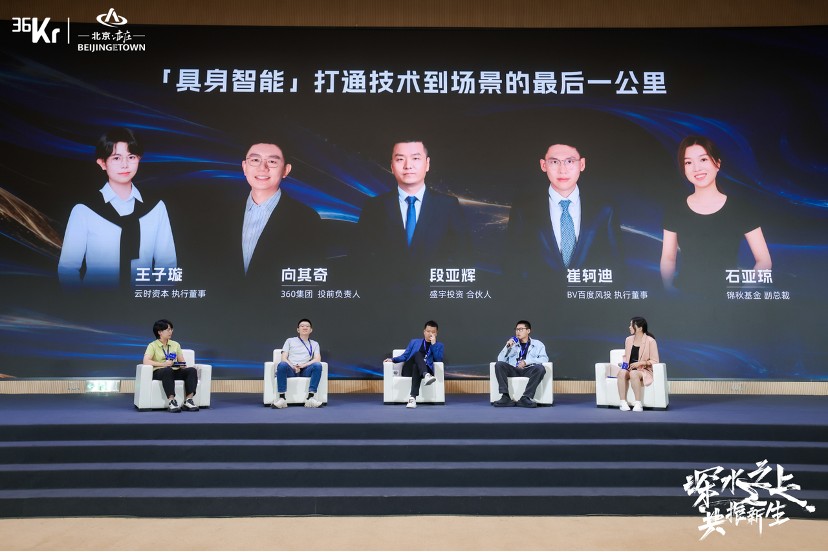
Wang Zixuan | Executive Director of CloudTime Capital
Xiang Qiqi | Pre-Investment Head of 360 Group
Duan Yahui | Partner of Shengyu Investment
Cui Kedi | Executive Director of BV Baidu Venture
Shi Yaqiong | Vice President of Jinqiu Fund
Wang Zixuan: Hello everyone, this is the last roundtable discussion today. The topic we are discussing is also very interesting — how embodied intelligence can get through the last mile from technology to scenarios. Over the past year, the entire embodied intelligence market has been really booming. I am Wang Zixuan from CloudTime Capital. It is a great honor for me to discuss this topic with you as the host today, because most of the time I also sit on the guest seat to discuss with everyone.
First of all, before we officially start, starting from Qiqi, please briefly introduce yourselves and your respective institutions in turn.
Xiang Qiqi: Hello everyone, I am Xiang Qiqi from 360, and I have been focusing on the AI sector in the past few years.
Duan Yahui: Hello everyone, I am Duan Yahui from Shengyu Investment. Shengyu Investment is a fund with profound industrial background. It has been focusing on the hard technology sector for more than 20 years since its establishment. At present, we focus on three major tracks: semiconductors, commercial aerospace and embodied intelligence. We always take the mindset of an industrial partner to accompany and empower outstanding startup teams.
Cui Kedi: Hello everyone, I am Kedi from Baidu Venture. We are a dual-currency early-stage investment fund initiated by Baidu Group, and I am mainly responsible for cutting-edge technology investment. In fact, many topics today are related to our investment directions. For example, in the field of brain-computer interface, we are very early shareholders of BrainCo and NeuroX; in the field of commercial aerospace, we have invested in companies such as Orbit Dawn, which are also located in Yizhuang and Haidian. We are also one of the earlier institutions that invested in embodied intelligence. We have been focusing on this industry since 2023, and it has been almost 4 years now, and we have participated in WRC for 4 or 5 consecutive sessions.
Shi Yaqiong: I am Shi Yaqiong from Jinqiu Fund. Jinqiu Fund was established in 2022. At that time, we observed the industrial transformation brought by large language models, so we made systematic investments around the next-generation intelligent systems, covering directions including AI chips, embodied intelligence, AI applications, AI hardware and hard core technology. Embodied intelligence is a direction we focus on systematically. We have continued to invest since 2023, basically covering all links of the embodied intelligence industrial chain, from the brain, cerebellum, ontology, to dexterous hands, tactile perception, sensors, facial interaction, etc. Representative invested companies include Unitree Robotics, Manifold Space, Octopus Dynamics, and the recently listed Momenta.
Wang Zixuan: Thank you very much all. In fact, Unitree went public last month, with a peak market value of more than 400 billion yuan. Although it has retreated a little now, it is still a very excellent company. In the past two years, embodied intelligence has basically been one of the tracks with the highest financing amount in the primary market. Today, we might as well look beyond this report card and see the situation behind the achievements.
Now a problem that people generally pay attention to is that there is indeed a last mile between the "being able to do it" of embodied intelligence in the laboratory and the "being usable" in the workshop, including reliability, cost, scenario definition and data flywheel. So let's start the discussion with the first question.
I would like to ask everyone, if we only look at the perspective of "getting work done", how old is today's embodied intelligent robot equivalent to in human age? Here is a general scale for you: a 3-year-old child can walk, but needs to be watched; a 5-year-old child can understand instructions and help get things; a 7-year-old child can already complete some simple tasks, but complex tasks are still relatively difficult. In the embodied intelligence scenario, how old do you think the robot's reliability and continuous operation capability are roughly equivalent to a child? In addition, will the robot's capability grow linearly, or will it experience a sudden leap? Among the current "organs" such as hands, brains and eyes, which link is lagging behind the most or needs the most development? You can talk about it freely.
Shi Yaqiong: I will break this problem down. Based on my own observation, what we are talking about today is "getting work done", but the working capability does not correspond 100% to human age. In fact, in the field of relatively dedicated robots, robots have already done a lot of work and have been working for a long time. What we are really discussing today is what age the general-purpose humanoid robot is equivalent to, which is controversial in itself. From an industrial perspective, I think there are several different values today.
One type of value is the "upper limit". For example, today's general-purpose humanoid robots more reflect the value of capability upper limit, much like athletes or child stars, solving the problem of scarcity. If this scarcity is strong enough, for example, it can jump high enough, far enough, or complete things that humans cannot do, it can generate value. So today it may already be like a child star or athlete that can "get work done".
But what people usually imagine is the "going to work" scenario, which requires the lower limit of the robot's capability: no matter what problems are encountered, it can work stably for 8 hours at a reasonable pace, and can recover by itself if something goes wrong. For some dedicated robots, the previous generation of products have solved many similar scenarios. But I still doubt whether today's general-purpose humanoid robots are suitable for entering such scenarios. That is my point of view.
Cui Kedi: Just like we have been sharing before, we may not start from this perspective. When we invested in embodied intelligence since 2023, we rarely discussed the issue of robots "getting work done". At that time, we separated the embodied intelligence and humanoid robot industry, and understood this industry more from the perspective of "intelligence". If you understand it from the perspective of intelligence, it is more in line with the Power Law, that is, the logic of power-law development: the progress in the early stage is very slow, but after reaching a certain critical point, the capability will accelerate at a very high speed.
Therefore, we pay more attention to the development speed of "intelligence" in the whole industry. Further down, we pay more attention to the training investment of different embodied companies and the development of basic models. We believe that when the basic model reaches a certain critical point, it may be more valuable for us to discuss the issue of "getting work done". This is our way of thinking, which may be different from some peers.
Duan Yahui: First of all, my point of view is slightly different from the host's setting. We will not directly make a linear comparison with human age. No matter 3-year-old, 5-year-old or 7-year-old children, they all have the ability of autonomous exploration. For example, a 3-year-old child who wants to eat candy will peel the candy wrapper by himself; if he wants to drink water, he will take the cup by himself; if the cup is relatively heavy, he will take the initiative to exert more force.
But for robots, at present, they are still mainly based on imitation learning. They can only do what you teach them. So from this perspective, it is not completely appropriate to directly make a linear analogy with human age. But according to what we know, since Q4 of last year, some robots have entered structured scenarios to truly "get work done", and the ROI can also be calculated.
Second, as for whether the future capability will grow linearly or explosively, I think with the increase of data and the implementation of more segmented scenarios, the robot's skills may experience explosive improvement. As for the "organ" development bottleneck mentioned earlier, I think it may still be mainly on the brain side at present. We hope to further improve the potential and capability upper limit of the basic model, so as to promote the entire embodied intelligence industry to achieve a qualitative leap.
Cui Kedi: In fact, just like what several guests shared just now, I think this question is really difficult to answer. We have not even really found the application scenarios suitable for this generation of embodied intelligence. If we have to compare it with the previous generation of industrial robots or the previous household robots, I think the current capability may still be in a very early stage, approximately in the "embryo" stage. The brain has not really grown up basically, and the hand is only equivalent to just growing two fingers.
Therefore, it is still a little far to discuss "getting work done" now, and it is difficult to make a very accurate judgment. There will definitely be a stage of leapfrog growth. The core of embodied intelligence is still intelligence, and the core of intelligence is the model. When the model architecture has not been determined yet, there must be room for leapfrog growth; if only scaling is done after the architecture is determined, it may be closer to linear growth. Now we have not found a model that is really suitable for the direction of embodied intelligence, and everyone is still exploring, so there is still a lot of room to look forward to in this field.
Wang Zixuan: It seems that everyone still has a certain consensus that the current "brain" still has a relatively large gap compared with human beings. The next question, let's go back to the discussion of specific scenarios and benefits. In the past, embodied intelligence talked more about family scenarios, but at present, the scenarios that are actually implemented more are still industrial scenarios. Although many embodied intelligent robot companies now have revenue, having revenue does not mean that the industry really has economic benefits. After entering specific scenarios, everyone will finally calculate an account: in a certain production link, whether replacing manpower with robots is really cheaper than hiring people.
At present, the scenarios that people see more include industrial handling, quality inspection, sorting or 3C assembly, etc. I would like to invite everyone to share a solid and real scenario that you have seen recently, that is, it does not rely on subsidies or other non-market factors, but in real business relationships, embodied intelligence has been able to undertake part of the work. At the same time, please talk about what are the commonalities of the scenarios that have crossed the economic benefit line, and where will the next batch of scenarios that may cross the benefit line be? Will everyone invest around such scenarios?
Xiang Qiqi: I think this question essentially discusses commercialization. Commercialization can be simply divided into two parts: hardware and software. In the past five years, especially the growth rate of hardware related to embodied intelligence has been very fast. In just five years, we have seen many core components develop from completely unusable to basically usable today, which is already a very fast progress in itself.
At the same time, we can also see that many ontology companies and component companies have indeed obtained some real orders. Although some people will question that everyone is just turning inventory into cash flow and then turning cash flow into inventory, I think at least there is still a part of real commercial demand.
Therefore, the development of hardware in recent years is actually faster than I expected. As for software, that is, the model, my understanding of model commercialization is: the essence of commercialization should be the spillover of model capability, not the goal. At this stage, I also communicate with many founders of embodied intelligence companies. They are mostly from technical backgrounds, but they always tell me a lot of commercialization stories. Frankly speaking, I think both sides are very hard. I even suggest that all embodied model companies directly delete the word "commercialization" from the BP, otherwise you will feel uncomfortable talking about it, and I will feel uncomfortable listening to it.
Therefore, I don't think it is necessary to torture each other at this stage. The only thing that really needs to be done and should be heavily invested now is to make models and raise the upper limit of model capability. This is the foundation of the entire embodied intelligence track. Without models, this track should not exist in itself.
Therefore, I have no expectation for model commercialization at this stage. I just hope that the model can really take a step forward.
Duan Yahui: I have witnessed two specific scenarios. The first one is that since Q4 of last year, some enterprises have realized the unmanned deployment of O2O front warehouses in structured scenarios: one end is connected to online platforms such as Taobao and Meituan, and the other end is robots on duty and working in unmanned front warehouses. The other scenario is logistics sorting. This year, whether at WAIC or WRC, we can see logistics parcel sorting robots. Last year, they could process about 400 pieces per hour, and in the first half of this year, it has reached 1000 to 1200 pieces. Recently, at WRC, some enterprises can even achieve 1800 pieces. We can clearly see that the products are iterating rapidly, and we can also see their real implementation in specific scenarios.
The common feature of these two scenarios is that the tasks are relatively clear, and the operation objects have a certain degree of generalization. For example, the express delivery scenario faces parcels of different shapes, and the front warehouse faces different bottles and cans, but the whole operation is still carried out in a structured environment. As for the next batch of scenarios that may cross the benefit line, we have also done some preliminary thinking. They may appear in the fields of general services, To C, light operation, etc., and will gradually start to explore and implement in the future. Thank you!
Cui Kedi: We have actually summarized the changes in investment strategies internally. From 2023 to 2025, our strategy has experienced changes from "Ontology + Intelligence" to "Data + Intelligence", and then to "Scenario + Intelligence". From the perspective of scenarios, at that time, we only drew several general directions: a group of companies do industry, a group of companies do general life or retail scenarios. But by the end of 2025, we basically overturned this set of investment strategies that had been implemented for three years.
We found that some of the earliest supported companies initially did industrial scenarios, and then gradually entered retail; companies that originally did retail scenarios also began to talk about family scenarios and explore household products; companies that do basic models, ontologies or data are also expanding upstream or downstream. Combined with our past experience in investing in autonomous driving, this is actually a very normal state in the early stage of the industry. So later, we rarely insisted on a specific scenario.
As of 2026, if we only discuss those scenarios that already have a commercialization closed loop, I will pay attention to two types. One type is entertainment scenarios such as fighting and performance; the other type is scenarios that can really get work done. For example, a friend of mine makes coffee robots. In many commercial places, you can see robots making latte art coffee and latte, and they can really make money, which is not completely traditional pure automation equipment.
Therefore, as of 2026, if we do not discuss the basic model capability for the time being, these specific scenarios have been able to form a relatively clear commercialization closed loop. But on the whole, my judgment on the industry is very close to that of Xiang. I pay more attention to the basic model and intelligent capability. Whether a specific scenario can form a commercialization closed loop is not the most concerned issue for me as an early-stage investor and early-stage VC.
Shi Yaqiong: Our point of view is relatively consistent with the previous three. Embodied intelligence investment can be roughly divided into three stages: the first stage invests in hardware, ontology technology improvement and upstream industrial chain; the second stage, which we think is the real current focus, is the model capability and large model opportunities; the third stage will enter the scenarios. So I think it is still a little early to talk about large-scale commercialization at this stage, and it is difficult to really see clearly.
I very much