Why is strategic thinking so important for CEOs?
In 2021, the domestic new consumption trend was hyped to an unprecedented height by capital, countless entrepreneurs plunged into the consumer brand track and enjoyed a glorious moment. Back then, several such entrepreneurs were in my WeChat Moments. One of them posted a photo showing she won the first prize in the "Entrepreneurship Competition" organized by a business school in Shanghai, China, her face brimming with confidence and calmness. On a whim, I asked her: "Shall we have a chat and see how we can help you scale up your company?" Her answer was very straightforward: "What can you do to help me? What problems do we have in our company?" For a moment, I was left speechless. Indeed, I was just a stranger on her WeChat friend list with no idea of the actual situation of her company, but her answer made me think deeply. What I understood from her implication was:
1. "What problems does my company have right now? How come I don't realize any of them myself?"
2. "Do you even know what problems my company has? Even if you do, are you capable of solving them?"
I fully understood that she had no idea of my capabilities, and why she asked me that way. But from her answer, I sensed a hint of crisis: it seemed that she was not clear about her current state at all, nor did she know the problems existing in her company.
One year later, her company shut down.
Another founder came to me and sent a brief, roughly saying that the enterprise was stuck in tangled problems with brand strategy and wanted to find a consulting firm to sort things out. I replied to her: This is not a brand strategy problem, but an overall corporate strategy problem. Similarly, as a graduate of media studies, she did not get my point. Later, when I followed up to ask about her situation, she told me that she had invited the McKinsey team in Shanghai to take charge of the work, and all problems had been solved. I asked out of curiosity: How did they solve it?
She said: The McKinsey team suggested that they create a completely new brand, and told me the new brand would be launched in July.
I: ... Looking forward to it.
Later on, I checked the previous brand and found its sales were dismal, and it had been almost squeezed out of the market by subsequent emerging brands, while the other new brand was never seen to be launched.
I have no intention of judging McKinsey's practices, but I have doubts about this founder's way of thinking.
Some people may think this is no big deal, but I believe it is essentially a problem with the strategic thinking of CEOs and founders.
Many of us treat strategic thinking as a simple scoring game: as if strategic thinking is an exam paper, the higher the score, the more capable the manager is. However, an empirical research released in 2026 provides us with a different perspective. Strategic thinking is not simply a matter of high or low capability, but a cognitive combination composed of five sets of opposing preferences. There is no single standard answer in the world, and outstanding managers only have completely distinct thinking profiles.
This research has done solid work: sorting out relevant literature, conducting in-depth interviews with 18 corporate founders and senior executives, and then using a sample of 184 business operators for scale testing, to extract five bipolar continuous dimensions of strategic thinking. It does not judge which end is more superior, but helps us clearly see how managers' cognitive preferences will affect the way they perceive the market, obtain information, and make strategic choices.
I. Competition View: Treat competitors as enemies, or as industry participants?
Competitive ↔ Cooperative
When facing peers, entrepreneurs will naturally generate two completely different logics in their minds.
People who lean towards the competitive type regard the business world as a game field, just like waging a war, whose core goal is to defeat opponents and seize market share. People who lean towards the cooperative type will not treat all peers as enemies to be eliminated, they attach more importance to the industrial ecology, are willing to seek win-win results, build alliances, link upstream and downstream industries, regard some peers as participants in the ecosystem, and work together to expand the entire market pie.
In the real business world, this dimension can explain many familiar phenomena. Many domestic enterprises plunge into involution-style price wars, compete for production capacity and marketing, and focus all their efforts on crushing their opponents; there are also enterprises like Huawei, which repeatedly cut into the advantageous territories of competitors, with a strong competitive trait in their bones.
This brings up a thought-provoking question: For excellent strategic thinking, should it lean towards competition, or towards cooperation?
From the framework of this research, it is difficult to simply determine which side is absolutely better. In a mature stock market, brutal competition is unavoidable; in emerging tracks, co-building the ecosystem is often more important. This is my practical observation, not the empirical conclusion of the paper. As a manager, you can lean towards one side, but you must know how to keep the boundary, and cannot apply the same logic to all business scenarios.
II. Generation View: Is strategy conceived by one person thinking hard, or generated by group brainstorming?
Individual-oriented ↔ Collective-oriented
We have seen far too many of the two strategic scenarios in enterprises.
The first scenario: the boss locks himself in to think through the whole situation, comes up with a complete blueprint, and then assigns strategies to the team at the meeting, the entire organization is responsible for execution. The source of strategy is controlled by a very small number of decision-makers, which is the individual-oriented strategy generation mode.
The other scenario: leaders do not rush to put forward the final answer, but raise real questions, and encourage senior executives, middle managers, and even front-line core staff to participate. Different perspectives interrogate and complement each other, and gradually polish out the direction in the process of collision, which is the collective-oriented mode.
This is my extended experience along this dimension: many enterprises have deep misunderstandings of strategic consensus. They think that consensus means everyone nods and approves the conclusion that the boss has already made. But real consensus comes from the whole process of participating in thinking, rather than obeying the established results.
Of course, collective participation is not necessarily more brilliant than individual decision-making. At a critical moment that requires quick decision-making, individual decision-making is more efficient; when the business is complex and has numerous variables, multiple perspectives can fill the information blind spots at the top level. The individual mode is easy to fall into the cognitive trap of the decision-maker himself; the collective mode, on the other hand, is prone to endless discussions without final decisions, and loses the power of judgment. Both modes have their own trade-offs.
III. Growth View: Seek new opportunities externally, or polish existing business internally?
Exploration-oriented ↔ Exploitation-oriented
This is probably the most tangled set of thinking tendencies for business operators.
Managers who lean towards the exploration-oriented type focus their attention outside, chase new markets, new products and new technologies, embrace trial and error and uncertainty, and are willing to bear failures for breakthrough growth.
Managers who lean towards the exploitation-oriented type root their focus on the business in hand, spare no effort to improve processes, efficiency and cost, polish existing products and customer groups, and pursue steady and controllable growth.
From this dimension, growth bottlenecks may come from at least two completely different situations. For the same growth stagnation, it may be caused by sticking to the stock business all year round and failing to see external opportunities; or it may be caused by reckless expansion everywhere, while the potential of the basic business in hand has not been fully tapped.
Exploration consumes resources and is accompanied by risks; exploitation is stable, but it is easy to generate path dependence. There is no absolute right or wrong, and managers' cognitive preferences actually determine where the enterprise's resources are tilted.
IV. Information View: Trust intuitive insight, or trust data analysis?
Intuition-oriented ↔ Analysis-oriented
There is a popular prejudice in the public: advanced strategy is necessarily piled up by massive data and rigorous analysis, while intuition only relies on feelings and is unreliable.
This research reminds us that intuition and analysis are just two ends of the spectrum, and analysis is not inherently superior.
Managers who lean towards the analysis-oriented type are accustomed to collecting massive amounts of materials and deriving solutions based on data and models; managers who lean towards the intuition-oriented type rely on the insights accumulated from years of immersion in the industry to quickly grasp the core contradictions of complex situations.
With the popularization of AI, the cost of information sorting and statistical deduction has been reduced to a very low level. AI is making "analysis" cheaper and cheaper, which in turn makes "judgment" more and more valuable.
Data can tell us what has happened, but it will not automatically tell us what is the most important and what is worth investing in. In real strategic decision-making, intuition and analysis are often indispensable, and the only difference is that different managers have different degrees of tilt. Blindly believing in data will trap you in existing facts and make you unable to see the future that has not been recorded by data; completely relying on intuition will make you easily blinded by past experience.
V. Path View: Draw the blueprint in advance, or allow the strategy to emerge gradually?
Planning-oriented ↔ Emergence-oriented
This part just echoes the "planning worship" issue we have been discussing all the time.
Managers who lean towards the planning-oriented type believe that strategy needs to be thoroughly thought out in advance, with clear goals and complete paths, and the organization implements it step by step according to the preset blueprint.
Managers who lean towards the emergence-oriented type see the uncertainty of reality: no one can calculate all the changes at one time. The strategy does not have to be completely fixed at the beginning, but grows gradually in the process of action, feedback and iteration.
Thus there is an unavoidable debate for managers: Should we think thoroughly before taking action, or move forward while acting and finalize the strategy in practice?
Many people like to take an either-or stance, either completely denying planning, or blindly believing in a complete long-term plan. The enlightenment this dimension brings us is that the key is not to choose one of the two, but to figure out how much pre-planned part the enterprise should retain, and how much space should be reserved for the changes that grow out of practice. Excessive belief in planning will solidify outdated judgments into iron laws; if you only emphasize emergence, the organization will easily lose direction, and resources will be scattered everywhere.
Strategists are shaped by a complete set of cognitive preferences
The greatest value of this research is not to provide a checklist for cultivating strategists, but to break the inherent cognition that "the higher the score of strategic thinking, the more powerful the person is".
We can imagine strategic thinking as a five-axis radar chart, and the five axes correspond to five sets of bipolar preferences:
1. Competition ↔ Cooperation
2. Individual ↔ Collective
3. Exploration ↔ Exploitation
4. Intuition ↔ Analysis
5. Planning-oriented ↔ Emergence-oriented
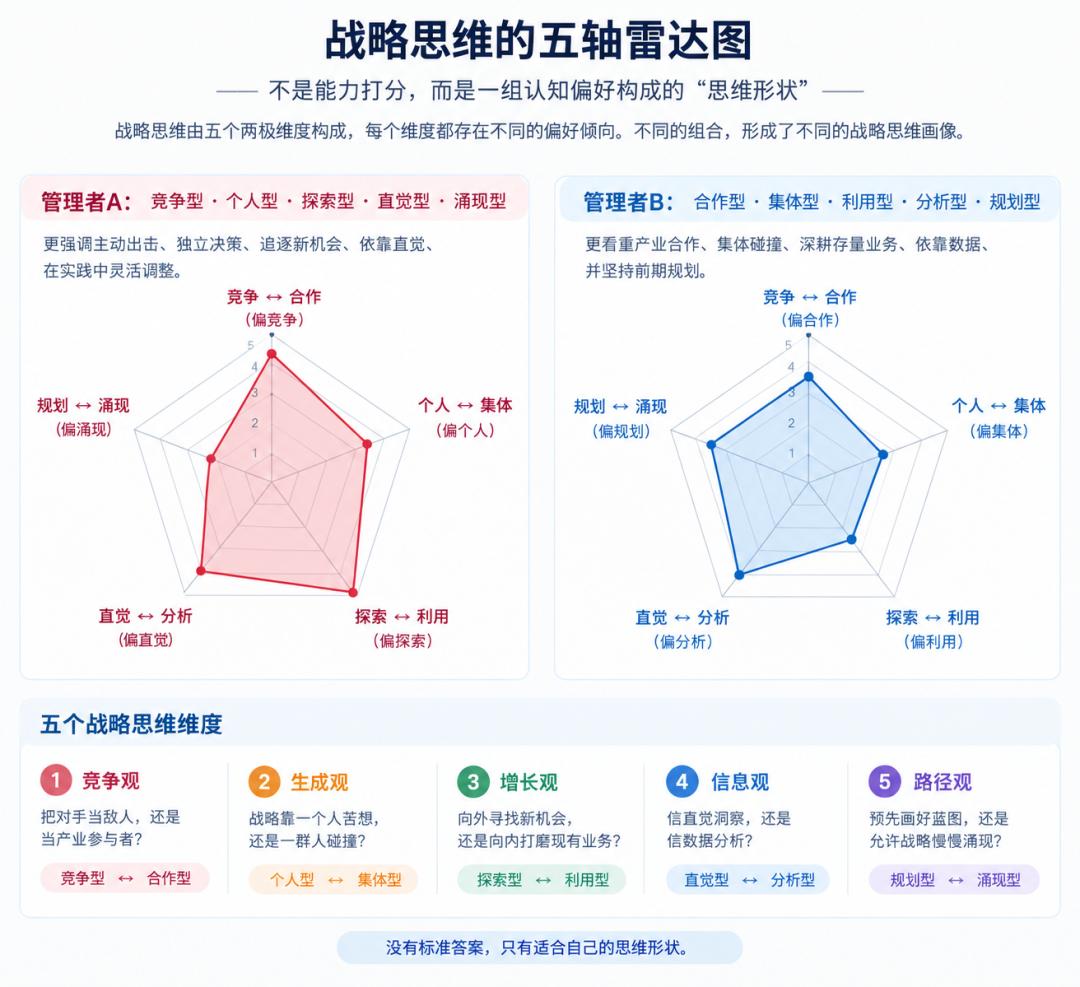
Radar chart illustration: The five axes extend outward from the center point, each axis represents a set of bipolar preferences, and a manager will leave different landing points on the five axes, combining to form his own unique strategic thinking profile.
This research at least reminds us that there may not be a unified standard profile for strategic thinking.
Let's imagine two completely different business operators. The first one is strongly competition-oriented, used to making decisions personally, keen on exploration, trusting intuition, and valuing emergence; the second one values industrial cooperation, is used to collective brainstorming, deeply cultivates the stock business, relies heavily on data analysis, and attaches importance to complete pre-planning.
The risk often does not lie in the fact that you lean towards one end, but that you are completely unaware of your own cognitive preferences, and take your own way of perceiving the world as the only operating rule of the world itself.
Managers who blindly believe in emergence tend to ignore the necessary direction and bottom line of the organization; managers who blindly believe in planning will turn a blind eye to the changes taking place in reality. If you have too much competitive thinking, you cannot see the possibility of win-win in the ecosystem; if you emphasize collective discussion for everything, you will lose the necessary decision-making power.
The real practice is not to force yourself to completely change your thinking mode, but to clearly see where you stand on each axis of the radar chart, and understand the blind spots brought by your own preferences. Figure out what you tend to do, and more importantly, see what you will miss, and rely on mechanisms, teams and processes to fill the cognitive shortcomings.
This also fits the practical value proposed by the research: this set of scales can be used for managers' self-diagnosis, identify their own thinking advantages and areas to be developed, and rely on a diversified senior management team to achieve complementarity of different cognitive methods.
For managers, the question really worth asking may never be "whether my strategic thinking is strong enough", but: What is my thinking habit making me see, and what is it making me fail to see?
This article is from WeChat official account "Zhu Yi", author: Zhu Yi, published with authorization from 36Kr.