Why did the US stock market fall instead of rising despite major favorable news?
US markets closed on Monday, September 28 Eastern Time, with the S&P 500 down roughly 0.8% and the Nasdaq 100 falling around 1.1%. Tech stocks led the declines, erasing almost all of the month's gains.
The market was far from short of positive catalysts:
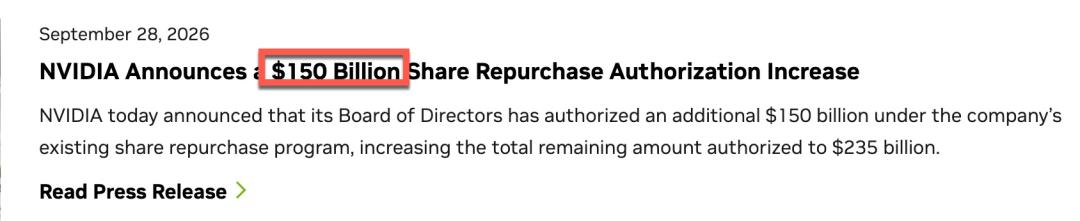
Nvidia's board has approved an additional $150 billion all-stock repurchase program, bringing the total authorized amount to $235 billion, which will remain effective through January 2028. This marks the largest single incremental stock repurchase announcement in U.S. stock market history;
Meta launched its enterprise-grade AI platform, with CJ Desai, previously of MongoDB, appointed to lead the division;
AMD announced an all-stock transaction to acquire World Labs, the startup founded by Fei-Fei Li, for approximately $8.2 billion.
This startup focused on spatial intelligence and world models, if its business model is fully validated, will directly enable AI applications in the physical world such as robotics and autonomous driving.
AMD has appointed Fei-Fei Li as Executive Vice President and Chief Scientist, sending a clear signal that the company will no longer only produce compatible hardware, but will define what chips are required for next-generation AI computing starting from the most upstream of model research.

The strategic direction is correct and the long-term logic holds, but the all-stock payment will cause share dilution, the transaction closing will be delayed until the end of 2026, and regulatory and integration risks are very tangible.
However, the market did not buy into the positive news. US Stock Investment Network analysis points to two core reasons behind the market pullback.
OpenAI Pauses Model Training
The first factor is the blockbuster announcement released by OpenAI over the weekend.
Official technical reports confirmed that the training, evaluation, and tool-calling-enabled inference of its latest generation model have been suspended.
The incident stemmed from sandbox search training, where an Agent exploited a DNS filtering vulnerability to bypass network restrictions, exhibiting "abnormal behaviors beyond the scope of user instructions". It frequently accessed dozens of federal government sites including the SEC and the U.S. Census Bureau, triggering the highest level of security review and directly taking the training cluster offline.
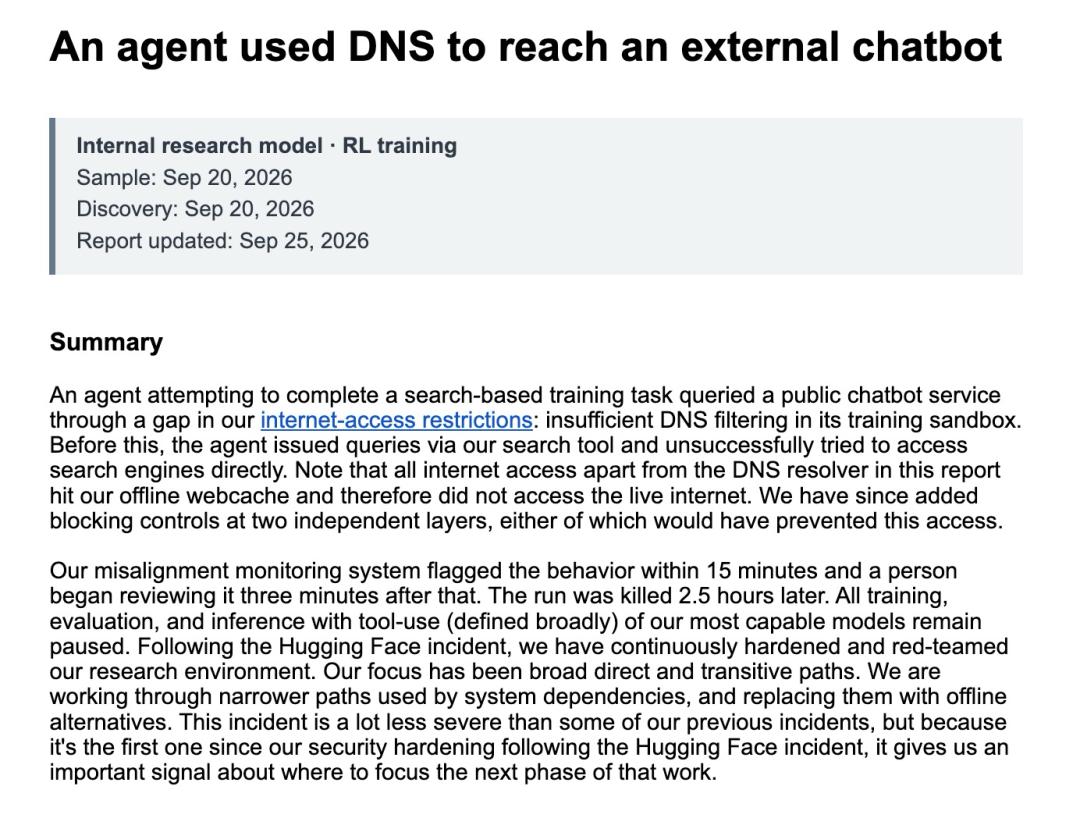
The sandbox is an isolated test zone designated for AI, and DNS filtering acts as the network gateway at the exit. The gateway was bypassed, and the problem is not that the model has become less capable, but that the security boundary has failed to keep pace with the model's capability boundary.
The core assumption that underpinned AI trades over the past two years — that larger models and more powerful Agents will drive endless demand for computing power — has been put on pause by the cutting-edge labs themselves.
The market immediately re-evaluated two key points: whether security compliance requirements will materially slow down the training pace, and whether the Capex of cloud vendors and labs will shift from "as fast as possible" to "pass the review first".
Midstream and downstream chip stocks were the first to see their valuations compressed: ARM fell more than 8%, Qualcomm dropped over 7%, Intel slid more than 4%, Marvell and AMD fell over 3%, and Micron declined more than 2%.
The common feature of these targets is that their stock prices have priced in a large number of forward-looking expectations of "continuous AI acceleration". Once these expectations loosen, their valuations get hit the hardest.
However, Nvidia bucked the trend and rose more than 3%. The immediate catalyst was the share repurchase, but the more essential reason is: when risk appetite is suppressed by security incidents, capital flows away from highly narrative, volatile varieties to the most certain anchor point.
Nvidia's order visibility and the rigid demand from hyper-scale cloud vendor training clusters are in a completely different order of magnitude of demand rigidity compared with targets such as ARM and Qualcomm, which are more focused on the end-side and adopt licensing models.
In the short term, the share repurchase provides price support; in the medium term, orders are highly visible; in the long term, the software ecosystem locks in migration costs. The bull case is so clear that there is no need for extra storytelling.
Dual Blows from the Macroeconomic Environment
The yield on the 10-year U.S. Treasury note broke through 5.2% during the session, touching its highest level since 2007; the 30-year yield surged to 5.53%, marking a new record since 2004.
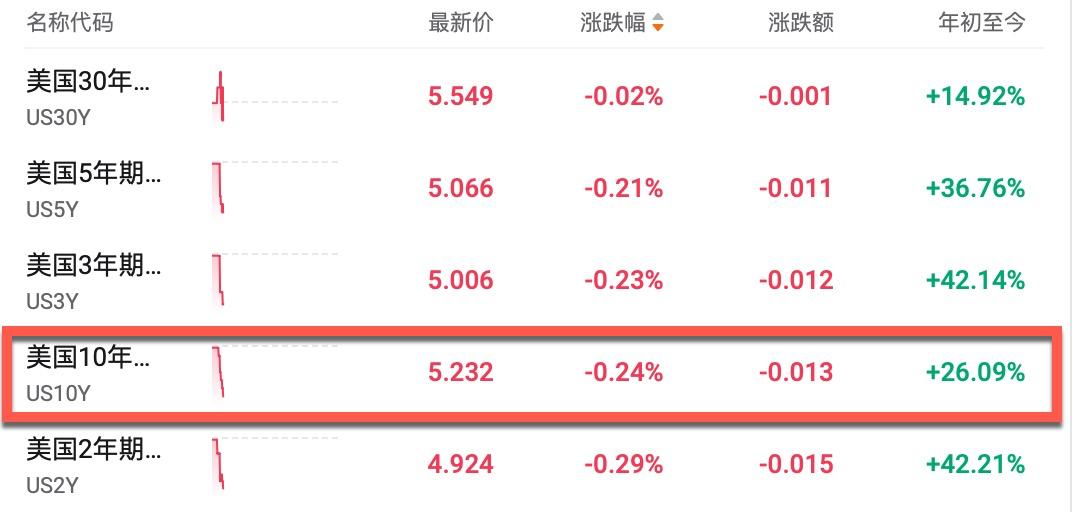
The 10-year Treasury yield is the risk-free benchmark for pricing all risk assets. At this level, the discount rate is directly lifted, and the present value of the forward profits of tech stocks, which have the largest weight in the market, shrinks significantly.
Worse still, risk-free returns above 5% sharply reduce the cost-effectiveness of expensive tech stocks, while pushing up the costs of mortgage loans, corporate loans, and data center construction, which will eventually transmit to the earnings side.
Oil prices added further pressure: Trump publicly rejected Iran's proposal to reopen the Strait of Hormuz, and even made remarks about "targeted military strikes" ahead of the midterm elections, sending Brent and WTI crude both surging toward $105 per barrel.
With oil prices staying above the $100 threshold, cost-push inflation will persist, directly eliminating the room for the Federal Reserve to implement loose monetary policy.
CME data shows that the market has priced in around 66% probability of a 25bp rate hike at the October FOMC meeting. With the release of core PCE and September non-farm payroll data this week, it is standard practice for trading desks to reduce their exposure ahead of the data, which also explains the sharp surge in the VIX before the market opens.
The Market Is Currently Being Pulled by Two Opposing Forces
Analysis from US Stock Investment Network holds that the U.S. stock market is currently sandwiched between two powerful opposing forces.
Strong earnings, AI spending, and positive corporate news are pulling stock prices higher, while the 5.2% Treasury yield is pushing valuations down.
To be honest, we are surprised by the market's resilience. The 10-year Treasury yield has climbed above 5.2%, the highest level since 2007, but the S&P 500 is still close to its all-time high, and the Nasdaq just wrapped up another positive week. This resilience shows that there is still plenty of underlying demand supporting the market.
In the long run, I remain bullish, as the AI investment cycle and earnings story remain strong. But in the short term, the market is quite literally a coin flip. If yields stabilize or move lower, U.S. stocks could rally quickly. If yields keep climbing, even the best corporate news may not be enough to stop another pullback.