Overseas giants are snapping up upstream isotopes. Are Chinese nuclear pharmaceutical enterprises not in a hurry?
Recently, Curium acquired Lantheus for 54 billion RMB, and Telix spent about 15.7 billion RMB to take over ITM — these two huge mergers and acquisitions have pushed the competition for medical isotopes in the upstream of nuclear medicine under the industry spotlight.
But this is just a microcosm of the industry. Multinational giants such as Novartis, Bayer, AstraZeneca, and Eli Lilly are firmly locking in isotope resources through mergers and acquisitions, long-term supply agreements, and strategic cooperation. The competition in the nuclear medicine industry has evolved from a simple pipeline competition to a comprehensive contest across the entire industrial chain.
Why are giants betting heavily on the upstream? How are domestic nuclear medicine enterprises making layouts?
Multinational Giants Expand Upstream Layout: Isotopes Have Become Core Resources for Competition
In the past two years, multinational giants including AstraZeneca, Telix, Curium, Bayer and others have been accelerating the layout of the core upstream of nuclear medicine — medical isotopes.
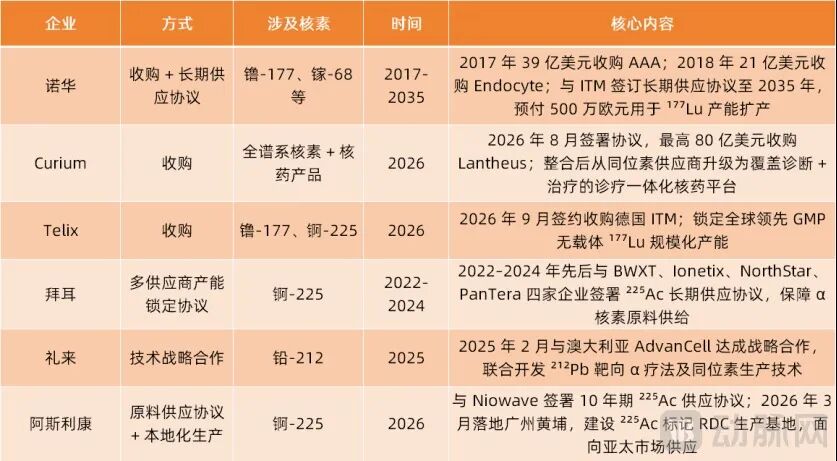
For example, in March 2026, AstraZeneca announced that it would build an actinium-225 radiopharmaceutical conjugate (RDC) production base in Guangzhou Development Zone, with products targeting the Asia-Pacific market. Prior to that, it had signed a 10-year actinium-225 raw material supply agreement with Niowave in the United States.
In February 2025, Eli Lilly announced a cooperation agreement with Australian biotechnology company AdvanCell: AdvanCell will provide lead-212 production technology and radionuclide development infrastructure, and combine with Eli Lilly's research pipeline of candidate drugs to jointly promote the R&D of multiple targeted alpha therapies.
The collective upstream expansion of multinational enterprises is rooted in the fact that the supply logic of medical isotopes is completely different from that of ordinary drugs, and isotopes have become the core competitiveness of the nuclear medicine industry.
First of all, radioisotopes undergo continuous decay with a fixed half-life, and their radioactivity continues to decrease from the moment they leave the factory. Molybdenum-99 has a half-life of 66 hours, lutetium-177 has a half-life of 6.6 days, and actinium-225 has a half-life of less than 10 days. After receiving the nuclides, hospitals must complete administration before the radioactivity decays to the lower limit of the effective dose, otherwise the drug will directly fail. This means that the whole chain of nuclear medicine production, storage and transportation is racing against time.
Secondly, the global medical therapeutic radioisotopes are facing a structural supply shortage. After the launch of Novartis's nuclear drug Pluvicto, its commercialized volume exceeded industry expectations, and this single blockbuster product consumed a large amount of upstream production capacity, directly making the global supply of no-carrier-added lutetium-177 shift from loose to tight.
At present, more than 400 clinical trials of therapeutic radioligand therapy (RLT) are being carried out around the world (excluding simple diagnostic imaging trials), covering multiple indications such as prostate cancer, neuroendocrine tumors, and solid tumors. As the pipelines gradually mature, some candidate drugs are approved for commercialization, and the market demand for medical therapeutic radioisotopes will continue to rise.
Finally, the capacity expansion cycle of medical radioisotopes is extremely long. Nuclide production mainly relies on reactors or accelerators. It usually takes 5-8 years from project initiation, approval, construction to commissioning for a new reactor. In addition to nuclear safety and environmental protection approvals, the back-end production lines also need to complete GMP drug compliance verification. Accelerator deployment is relatively flexible, but to achieve GMP-grade large-scale and stable commercial supply, it also takes two to three years of process debugging and full-process verification.
More critically, having reactor hardware alone does not mean that medical nuclides that meet clinical standards can be produced. Target material preparation, irradiation process, separation and purification in a strong radiation environment, and quality control all have extremely high technical barriers. Especially for medical-grade nuclides with high specific activity and no carrier, there are very few enterprises in the world that can achieve stable supply.
The superposition of three factors: rapid growth of downstream demand, slow expansion of upstream production capacity, and high technical barriers to production, make medical radioisotopes the scarcest resources in the nuclear medicine industry, which is also the core reason why overseas giants spare no effort to seize the upstream supply chain.
Domestic Nuclear Medicine Enterprises Cooperate with National Teams to Build Supply Chains
While overseas giants are busy integrating the upstream supply chain, Chinese nuclear medicine enterprises have not stopped their pace of layout.
However, the development path of domestic enterprises is different from that of overseas counterparts: domestic pharmaceutical companies mostly choose to cooperate deeply with the "national team" of the nuclear industry to jointly build an independent and controllable isotope supply chain.
For example, Dongcheng Pharmaceutical has reached strategic cooperation with SPIC, Jiangxi Nuclear Power and other enterprises to jointly invest in the construction of the Tianhong Medical Isotope Dedicated Reactor Project in Jiujiang, Jiangxi. After the project is completed and put into operation, it can produce medical radioisotopes such as ⁹⁹Mo, ¹⁷⁷Lu, and ¹³¹I. At the same time, the company cooperates with the Institute of Fluid Physics of the China Academy of Engineering Physics to jointly develop a high-power high-current 40MeV electron petal accelerator for medical isotope production. After the project is implemented, the fully independent supply of medical isotopes such as ²²⁵Ac and ⁶⁷Cu will be realized.
Sinotau Pharmaceutical cooperates with Atom Hi-Tech to ensure the stable supply of therapeutic nuclides and long-half-life nuclides; Vancure has signed a supply chain agreement with Qinshan Nuclear Power, and "Hefu No.1" provides it with nuclide raw materials.
It is not difficult to see that the development of China's nuclear medicine industry cannot be separated from the strong support of the national team of the nuclear industry.
In the past, China's key medical isotopes such as molybdenum-99, lutetium-177, yttrium-90, and radium-223 were almost entirely dependent on imports. The uncertainty on the supply side has restricted domestic nuclear medicine diagnosis, clinical treatment, and clinical trials of radiopharmaceuticals.
In June 2021, the China Atomic Energy Authority led eight ministries and commissions to issue the "Medium and Long-Term Development Plan for Medical Isotopes (2021-2035)", which clearly proposes to build a stable and independent medical isotope supply guarantee system, providing top-level policy guidance for the development of the domestic isotope industry.
Under the guidance of policies, the national team of the nuclear industry has made efforts in medical isotopes and quickly achieved results.
Among them, China National Nuclear Corporation relied on the commercial heavy water reactor of Qinshan Nuclear Power to complete the irradiation technology breakthrough after three years, creating an independent "Hefu No.1" isotope production technology platform, which has the large-scale production capacity of nuclides such as lutetium-177, yttrium-90, and strontium-89. In June 2025, the lutetium-177 produced by the commercial heavy water reactor of Qinshan Nuclear Power was officially supplied to the market, with an annual irradiation capacity of more than 10,000 curies, which can fully meet the domestic market demand.
China Isotope & Radiation has built the first domestic 10,000-curie-level no-carrier-added lutetium-177 and 1,000-set-level germanium-68/gallium-68 generator mass production line, breaking through the preparation processes of carbon-14, high-abundance ¹³CO, copper-64, zirconium-89, and palladium-103. The domestic molybdenum-technetium generator has a domestic market share of 90%, and commonly used clinical nuclides such as iodine-131, carbon-14, and fluorine-18 have achieved stable large-scale mass production.
At the same time, national team institutions such as the Nuclear Power Institute of China have built multiple medical isotope production lines for lutetium-177, yttrium-90, radium-223, iodine-125, phosphorus-32, rhenium-188, holmium-166, carbon-14, etc., achieving a series of breakthroughs in nuclide production technologies.
As the national team completes technological breakthroughs and realizes market-oriented supply, the procurement price of medical isotopes has dropped significantly. Taking lutetium-177 as an example, according to Sun Mingming, COO of Vancure, the unit price of lutetium-177 purchased by Vancure was originally about 320 RMB/mCi, and it dropped to about 120 RMB/mCi after the domestic nuclide was launched, a decrease of about 62%.
In addition, the stable and large-scale supply of domestic isotopes solves the pain point of unstable supply of imported nuclides in the past, fully supports the full-process needs of pharmaceutical companies from preclinical research to phase III clinical trials, and accelerates the advancement of domestic nuclear medicine R&D pipelines.
Alpha Nuclides: The Incremental Track for Next-Generation Nuclear Medicine
No matter the enclosure of overseas giants or the realization of independent supply of beta nuclides in China, the current competition in the global nuclear medicine industry mainly revolves around beta nuclides. However, many industry insiders point out that alpha nuclides are expected to open up a brand new incremental market for the nuclear medicine industry.
The root of the difference between the two types of nuclides comes from the physical properties of rays. Beta nuclides represented by ¹⁷⁷Lu have a longer ray tissue range and lower unit energy, which are suitable for achieving tumor reduction effect on large solid tumors; but in the face of tiny metastatic foci and circulating tumor cells, the beta ray range is too large, and the killing accuracy is insufficient. The alpha nuclides represented by ²²⁵Ac just make up for this shortcoming: the ray has a short range and high energy, which can precisely eliminate tiny tumor foci.
The beta nuclide RLT product Pluvicto has achieved annual sales of billions of US dollars, which has fully verified the commercial potential of radioligand therapy. Combining the physical characteristics of the two types of nuclides, the industry puts forward the development idea of sequential therapy: use beta nuclides to complete tumor reduction for large tumors, and then use alpha nuclides to eliminate tiny metastatic foci, so as to expand clinical application and market boundaries through layered therapy.
From an industrial perspective, alpha nuclides are not a substitute for beta nuclides, but a brand new incremental track built on the market base of beta nuclides.
At the 2026 ASCO Annual Meeting, a number of clinical results of alpha nuclides were disclosed intensively, making this track quickly the focus of the industry. Novartis pipeline Ac-PSMA (AAA817) announced the first-in-human clinical data, which initially confirmed the safety and preliminary effectiveness of alpha nuclide PSMA targeted therapy, and verified the clinical development path of radioligand therapy iterating from beta to alpha.
Domestic pipelines also delivered impressive data. The clinical study of Sinotau Pharmaceutical's XTR022 was presented as a poster at this ASCO, and the PSA50 response rate among evaluable subjects reached 76.9%. In addition, many domestic enterprises are accelerating the layout of alpha nuclide drug R&D. Dongcheng Pharmaceutical's ²²⁵Ac-LNC1011 is one of the earlier domestic alpha nuclide research pipelines that have obtained FDA IND permission.
Although the clinical prospects are promising, the production capacity constraints faced by alpha nuclides are far more severe than those of beta nuclides. BMS's experience is a valuable lesson for reference: in 2023, BMS spent 4.1 billion US dollars to acquire RayzeBio and obtained the actinium-225 PSMA pipeline that attracted much industry attention; but only a few months after the acquisition, affected by the insufficient supply of actinium-225 raw materials, the phase III clinical trial of this pipeline suspended the enrollment of new patients.
At present, dozens of ²²⁵Ac-TAT (targeted alpha therapy) clinical trials are being carried out around the world. However, the existing production capacity base of alpha therapeutic nuclides such as actinium-225 is limited, and the upstream production capacity construction cycle is very long. According to industry predictions, if the production capacity construction is not laid out in advance, the supply gap of alpha therapeutic nuclides in the future may be more prominent than the shortage of lutetium-177 in the past.
Global Layout of Alpha Nuclides: China Ranks in the First Echelon
Facing the considerable market prospects of alpha nuclides and superimposed with the severe production capacity gap, enterprises in the upstream and downstream of the global nuclear medicine industry are accelerating the layout of the alpha nuclide track.
Bayer adopts a multi-supplier decentralized guarantee strategy in the field of alpha nuclides. From 2022 to 2024, it successively signed ²²⁵Ac raw material supply agreements with four enterprises: BWXT, Ionetix, NorthStar, and PanTera, to hedge the supply risk of a single source.
Eli Lilly chose the development path of deep technical binding. In 2025, Eli Lilly reached a strategic cooperation with Australian AdvanCell Isotopes to jointly develop the production technology of ²¹²Pb (lead-212, an alpha nuclide). ²¹²Pb has a half-life of only 10.6 hours, and the finished product is difficult to store and transport over long distances, which needs to be prepared nearby, and the logistics constraints are more stringent than ¹⁷⁷Lu and ²²⁵Ac. Eli Lilly did not simply purchase the finished nuclide, but cooperated deeply from the production technology level to jointly build the next-generation alpha nuclide production capacity system.
Not only pharmaceutical companies, but also global professional isotope enterprises are vigorously promoting the construction of alpha nuclide production capacity.
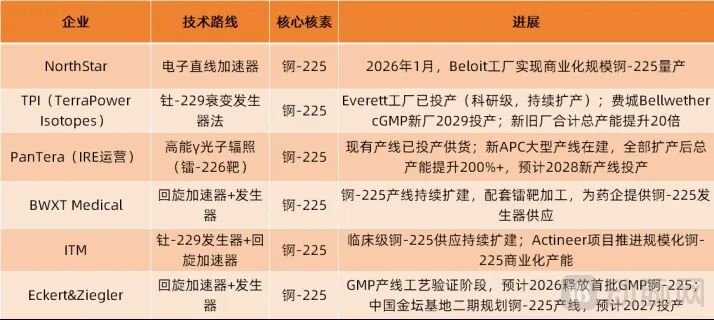
At present, there are four mainstream technical routes for the production of alpha nuclides: reactor irradiation method, thorium-229 generator method, accelerator method, and spallation neutron source method.
The reactor method has the most mature process, but it is highly dependent on reactor facilities; the thorium-229 generator method can produce high-purity nuclides, but it is limited by the global reserves of the parent nuclide; the accelerator method is flexible in deployment, but the separation and purification in a strong radiation environment is more difficult; the spallation neutron source method has considerable development potential, but the overall industrialization is still in the early stage. The four routes have their own advantages and disadvantages, and there is no technical solution that can dominate the entire market, which is the fundamental reason why the industrial pattern of alpha nuclides has not yet been finalized.
NorthStar is a representative enterprise of the accelerator route, which uses an electron linear accelerator to bombard a radium-226 target to produce actinium-225, and the production process does not rely on a reactor. The company achieved commercial production in January 2026, and is one of the first enterprises in the world to realize the commercial mass production of ²²⁵Ac.
TPI (TerraPower Isotopes) adopts the thorium-229 generator route, and the thorium-229 raw material is taken from the uranium-233 inventory of Oak Ridge National Laboratory in the United States. Its Everett factory has been put into operation, and the new GMP factory located in Philadelphia is planned to be put into operation in 2029. After commissioning, the total production capacity will increase by 20 times, and the enterprise's goal is to build the world's leading alpha nuclide supplier in scale.
PanTera is operated by Belgian IRE and chooses the reactor technology route. The existing production line has been put into operation, and the new production line is under construction. After the project is completed, the total production capacity will increase by more than 200%, which is an important pillar of alpha nuclide production capacity in Europe.
Back in China, China Isotope & Radiation relies on the China Spallation Neutron Source (CSNS) large scientific device to carry out R&D and preparation of ²²⁵Ac, has completed the process breakthrough