Priced at the lowest level ever, the Honor Magic9 series is pulling out all the stops for the IPO.
It turns out that the later the release, the more "targeted planning" it can deliver.
Following the successive debuts of the vivo X500 series, OPPO Find X10 series and Xiaomi 18 Pro series, the Honor Magic9 series finally joined the market competition on September 28.
As the latest mainstream domestic Android manufacturer to release new products, Honor has presented its utmost sincerity — it not only launched its first co-branded imaging system, fully upgraded all configurations, but also pushed the pricing to the lowest level.
Take the mainstream 16G+512G configuration as an example:
The price of vivo X500 Pro Max is 8499 yuan;
The price of OPPO Find X10 Pro Max is 7999 yuan;
The price of Xiaomi 18 Pro Max is 8999 yuan;
The price of Honor Magic9 Pro Max is 7499 yuan.
It is obvious that Honor is fully determined to go all out for performance.
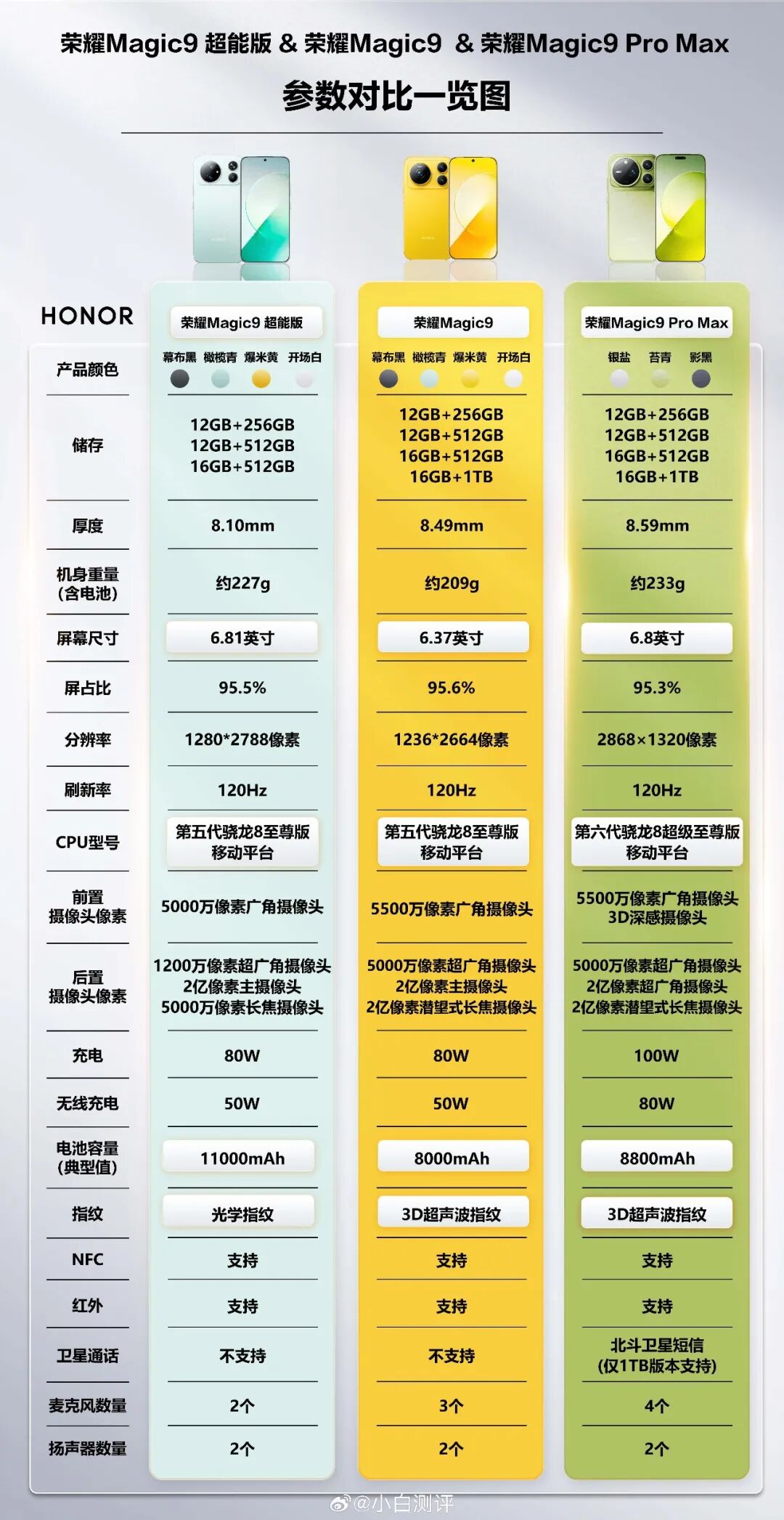
Source: Xiaobai Evaluation
IDC data shows that in the second quarter of 2026, Honor's smartphone shipment in the Chinese market dropped 9.5% year on year, with its market share falling to 11.3%, ranking sixth in the domestic market and falling into the "others" category.
Such sales performance is quite unfavorable for Honor which is advancing its IPO process. Will this generation of Honor Magic9 series become the secret weapon for it to turn the tide?
Competing in imaging, pricing and sales volume
This generation of flagship products is a critical generation that Honor must catch up with at full speed.
In terms of product specifications, Honor's flagships have never been poorly configured. Eye protection, battery life, communication performance and processing power are all fully covered, gradually forming the brand image of Honor's "all-rounder phone".
However, this image lacks distinct characteristics, making it hard to leave a deep impression on the public. The only relatively unique label is "eye protection", but this indicator can neither be quantified nor is a particularly rigid user pain point, and it varies from person to person, making it difficult to build a widely recognized unique competitive advantage.
While peer manufacturers are making great efforts to iterate imaging capabilities, Honor's imaging system has long been criticized for lagging behind.
The Magic6 Pro is equipped with a 1/1.3-inch large base, variable aperture and 180-megapixel periscope telephoto lens, but due to the algorithm failing to keep up with the hardware, it suffers from over-smoothing in night shots, stuttering during zooming and unstable photo output rate.
What is more awkward is the lack of unique image tone: vivo has Zeiss natural color, OPPO has Hasselblad image tone, and Xiaomi has Leica's classic and vivid styles, while the photos taken by Honor have no distinct recognizable style for the public.
Therefore, in this generation, the imaging co-branding of "Magic9 + ARRI" is officially launched.
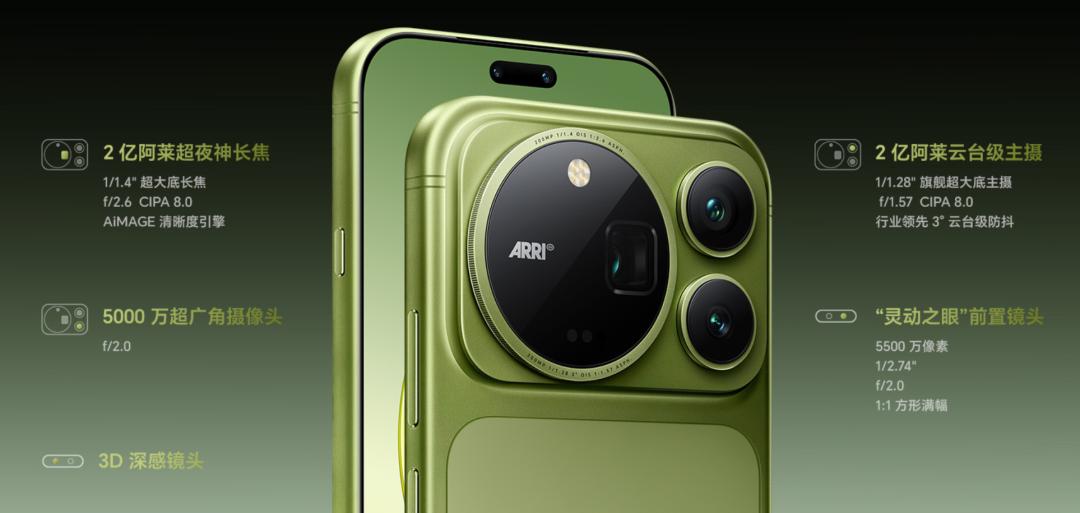
The rear camera module adopts a three-circle matrix design with one large lens and two small lenses, which Honor says refers to the classic ARRI cinema camera. The specific configuration is "dual 200-megapixel lenses + dual chips": it is equipped with a 200-megapixel ARRI gimbal-level main camera, a 200-megapixel ARRI super night vision telephoto lens, Honor's self-developed imaging chip Light Master H1, and Qualcomm's first 2nm flagship SoC, the 6th generation Snapdragon 8 Ultra Extreme Edition.
The 200-megapixel periscope telephoto lens has a sensor size of 1/1.4 inch, f/2.6 aperture, supports OIS, and the anti-shake level reaches CIPA 7.5, which is in the first tier of the industry this year. The high pixel also leaves more space for mid-to-long distance cropping.
Super strong hardware is the foundation, and the key is that Honor has finally built its own unique style label. According to the official statement:
In terms of tone style, Honor introduces ARRI's ARRI LogC3 curve which is closest to the film texture, enabling mobile phones to output cinema-level image quality and restore the classic Hollywood cinematic picture.
In terms of color performance, Honor Magic9 Pro Max supports importing the full set of 87 ARRI Looks into the phone, so that you can get the same style as Hollywood blockbusters with a casual shot.
However, the most anticipated ARRI color can only be used for video shooting at present. Although this is consistent with ARRI's status as a century-old giant in the film industry, as a mobile phone, it is reasonable for the Honor Magic9 series to apply ARRI color to more imaging functions such as photo taking, portrait shooting and professional mode.
From this functional limitation, it can be seen that Honor's imaging label still needs more polishing to be recognized in the market.
Apart from imaging, Honor has not lost its reputation of "all-rounder phone". Other important configurations and even peripheral experience configurations are almost fully upgraded.
For example, the newly upgraded screen is a 6.8-inch new generation of Ultimate Black Diamond screen, which has the industry's lowest reflectivity of 1.5% and the industry's highest peak brightness of 10000nits. It also supports 4320Hz high-frequency PWM dimming, circularly polarized light eye protection, and has passed the Rheinland Global Eye Protection 6.0 certification.
In addition, the external sound quality which was highly praised in the previous generation has been further strengthened this time: with dual 1216 speakers, the industry's maximum amplitude and the industry's largest sound cavity, Honor Magic9 Pro Max has become the only mobile phone in the industry that has obtained SGS directional high-sensitivity five-star radio certification and SGS spatial audio external playback certification.
Besides, configurations such as 3D face recognition, 3D ultrasonic fingerprint recognition, and full-level dust and water resistance of IP68/IP69/IP69K are all available, and no large-scale cuts have been made due to rising costs.
For this generation of Magic9 series, Honor has shown its utmost sincerity, aiming to compete for higher sales volume.
And this year is really a good opportunity — due to the sharp rise in the cost of memory and chips, flagship phones of this generation are all raising prices, leading to a collective slump in sales of "OPPO, vivo and Xiaomi".
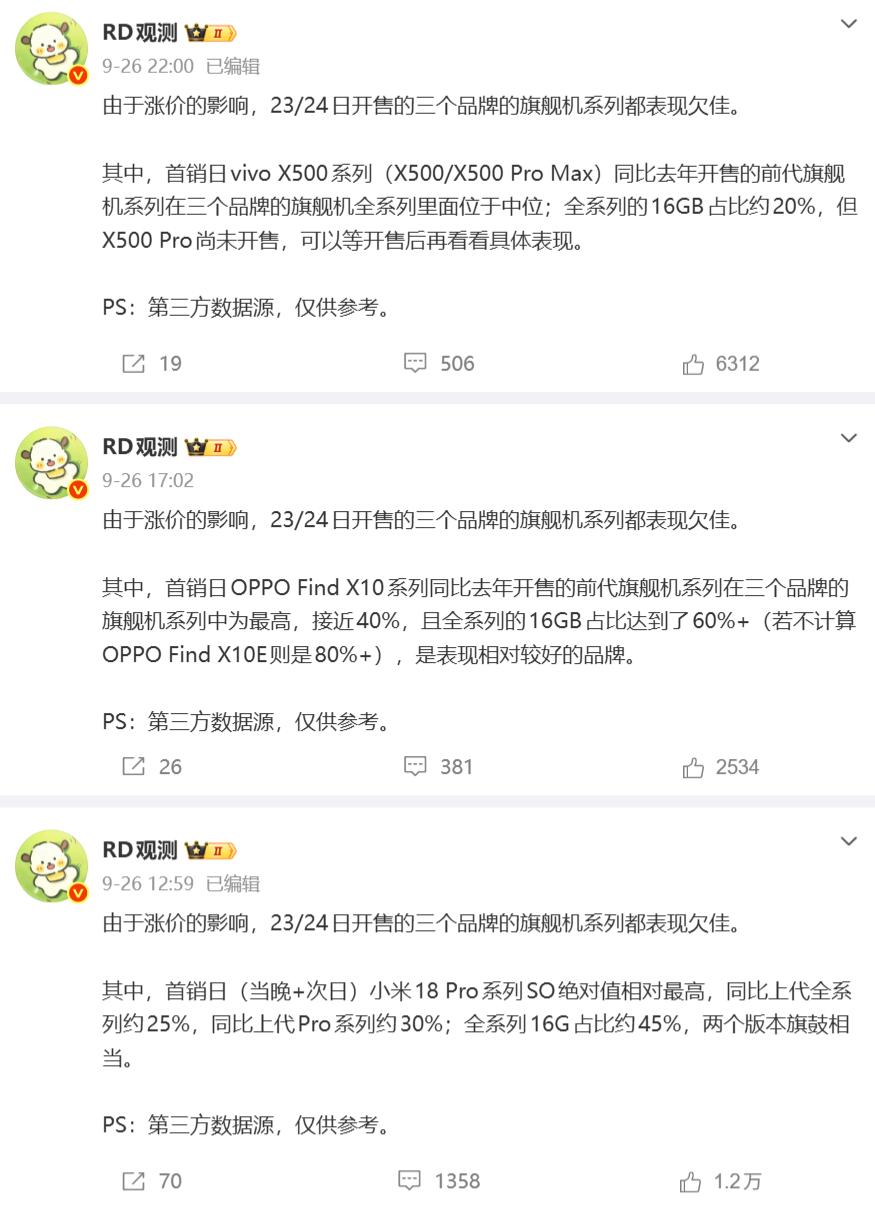
According to the disclosure of industry blogger "RD Observation", the sales volume of the new flagships of vivo, OPPO and Xiaomi after launch is only 25%-40% of that of the previous generation, with sales dropping by 60% to 70%.
AI Lanhui Media visited multiple direct-sale stores in the downtown area of Tianjin and found that: at present, the OPPO Find X10 series can get a 500-yuan discount online, and a direct-sale store can offer an immediate 700-yuan reduction with very strong preferential efforts, and the low-end version can enjoy the national subsidy; the vivo direct stores also offer an immediate 500-yuan discount; Xiaomi has no discounts at all.
As the last released mainstream brand in the domestic Android camp, Honor can compete for higher sales volume with targeted pricing and fully upgraded all-round configurations.
Can it reverse the situation for its IPO?
Honor cannot afford to lose this opportunity to raise its sales ranking, as the company is at a critical node of advancing its IPO process.
In November 2020, Huawei sold Honor as a whole. State-owned assets in Shenzhen took the lead, and more than 30 agents and distributors took over the brand together. Since then, IPO has been the only closed-loop exit for this reconstruction.
However, Honor's listing progress is not smooth.
At the end of 2023, there were rumors that Honor launched its IPO, and introduced heavyweight shareholders such as China Mobile, China Telecom, BOE, and funds under CICC Capital. In June 2025, it completed the listing counseling filing with the Shenzhen Securities Regulatory Bureau, with CITIC Securities as the counseling institution.
Originally, the counseling work should be completed and the acceptance application should be submitted to the Securities Regulatory Bureau by March 2026 at the latest, but the reality is that the schedule has been missed.
At the end of July this year, the fourth phase of counseling report disclosed by CITIC Securities showed that in the second quarter of 2026, Honor was still "continuously carrying out due diligence, improving corporate governance, and demonstrating the investment projects of raised funds", and the counseling institution also required to "carefully demonstrate the necessity and feasibility of the fundraising projects".
Simply put, Honor needs to figure out two things before submitting its listing application: clean accounts and a credible fundraising project story.
What is more thought-provoking is the actions at the shareholder level. In April this year, Honor canceled regular dividends to meet listing requirements; in May, the company denied the rumor of "IPO termination" at the internal employee stock ownership meeting, and at the same time opened the employee stock withdrawal channel, allowing employees to exit at the original price; by September, the refund has entered the actual implementation stage, and many former employees on social media confirmed that they have received the returned funds.
The original intention of providing liquidity arrangement for employee stock ownership is understandable, but it points to an unavoidable fact: Honor's internal team is no longer optimistic about the listing schedule.
The shrinking valuation also quantifies this pessimism. Hurun's 2026 Global Unicorn List values Honor at 180 billion yuan, while the market rumor figure in 2023 was 260 billion yuan, and the Pre-IPO round valuation rumor in 2025 was about 200 billion yuan. In three years, the valuation expectation has been discounted by 30%.
To reverse the situation, relying only on mobile phone sales is not enough, and it is necessary to catch up with the future trend — AI.
According to the official statement, the MagicOS 11 released earlier is the industry's first terminal operating system that realizes the commercial implementation of the system-level Agent Harness architecture, which is first carried by the Magic9 series.
The essential change is that Honor wants to combine the model capabilities with the terminal's perception, planning, tool invocation and execution capabilities, and adopt the large model solution of end-cloud collaboration, so as to upgrade YOYO from an AI assistant that only answers questions to a system Agent that can actively perform tasks.
Honor also provided a set of commendable data: YOYO has 160 million monthly active users, can perform complex tasks with more than 100 steps, supports 40 trigger conditions and 130 execution actions; after some devices are upgraded, the system upgrade can release more than 50GB of storage space at most.
According to the media evaluation results, Honor's new generation YOYO has done a good job in Agent long-chain task scheduling, and the interconnection with various software has better effect than products of similar positioning, and it can successfully complete tasks most of the time.
However, judging from the recent minor friction between the second-generation Doubao phone and Tencent's *Honor of Kings*, there is still a long way to go to make AI take over the mobile phone in depth.
Now Honor is still talking about robot phones, AI terminal ecosystem, and humanoid robots that win running races, but the commercial verification cycle of new businesses is longer. The investment plan of over 10 billion US dollars in five years means higher R&D pressure, and AI-related revenue cannot provide independent financial support in the short term.
Honor's core pillar, the underlying support for its IPO, is still smartphones. It is hoped that the sales performance of the Magic9 series this time will bring surprises to the market.
This article is from the WeChat official account "AI Lanhui Media", author: Feng Hua, editor: Wei Xiao, published with authorization from 36Kr.