The official representatives and front-line customer service have given contradictory accounts, and UBTech U1 is caught in a delivery-related "Rashomon".
Products from the same product line have two completely different delivery timelines. UBTech (9880.HK)'s U1 series super bionic robots are caught in a delivery "unresolved public dispute".
According to multiple media reports recently, the official cross-platform e-commerce flagship store of UBWorld, a subsidiary of UBTech, stated that the U1 series super bionic robots originally scheduled for first batch delivery on September 16 have now had their delivery time postponed to November 30; while UBTech responded to the media that "the above reports are inaccurate. The U1 series has already started delivery, and we are currently arranging production and shipping in batches in the order of customer reservations, steadily advancing order fulfillment."
The two conflicting statements from the company's official side and frontline customer service have drawn market attention to the actual delivery progress of the U1 series.
The U1 series super bionic robot is a flagship product launched by UBTech for the C-end household market, focusing on family emotional companionship and capable of daily interaction with users, but currently unable to perform housework.
The product line covers a very wide price range. The full series has three tiers: U1 Lite, U1 Pro and U1 Ultra; the prices of U1 Lite and U1 Pro are 119,800 yuan and 169,800 yuan respectively, while the female version of U1 Ultra is priced at 880,000 yuan and the male version at 990,000 yuan.
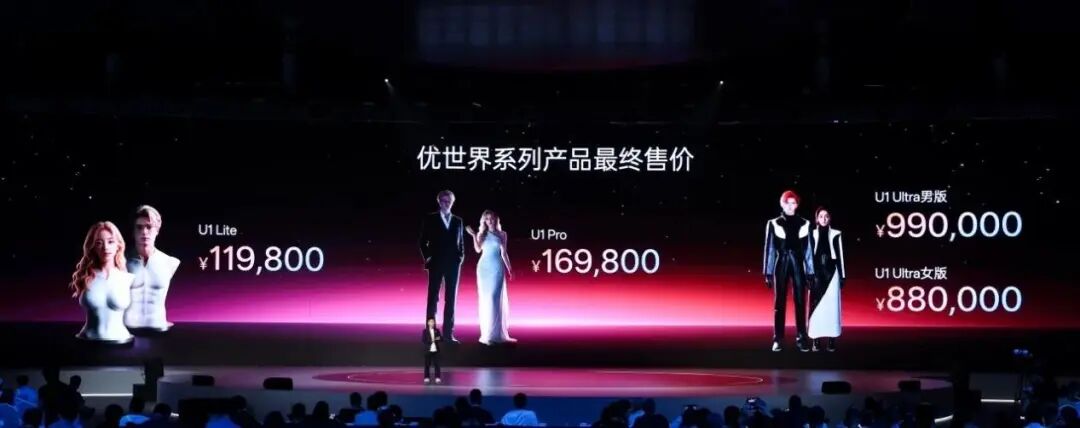
On June 2 this year, pre-sales of the U1 series products opened on e-commerce platforms. On June 30, Zhou Jian, CEO of the company, revealed at the global launch event in Shenzhen that the omni-channel orders for the U1 series had exceeded 13,361 units. This figure is 12 times the output of UBTech's full-size embodied intelligent humanoid robots last year. At that time, UBTech stated that the first batch of delivery would start on September 16, and strive to complete the delivery of all domestic orders within the year.
However, in just a few months, the target delivery volume of the U1 series products has been greatly reduced. At the earnings call in August, Zhang Ju, CFO of UBTech, lowered the annual delivery target to 1,500-2,000 units.
What is more noteworthy is that although the U1 series is positioned for the C-end, the first batch of resources was obtained by the company's B-end clients. According to the official Douyin account of UBTech, the series has been displayed at Shanghai Yongda Group, Beijing BOSS Group, and South Korea's Galaxy Robot Park. Both Shanghai Yongda Group and Beijing BOSS Group are large automobile sales and service enterprises.
The shrinkage of delivery volume has already eroded part of market expectations. If the delivery time to consumers is further delayed, market confidence may be damaged again, and the company's C-end performance within the year will face a major test.
Allottees Are Trapped in Unrealized Book Losses
Although UBTech is known as "the first humanoid robot stock on the Hong Kong Stock Exchange", due to the high rigid investment in the embodied intelligence industry and the high difficulty of commercial implementation, the company has been in a loss-making state since its listing at the end of 2023. It recorded net losses of 1.265 billion yuan, 1.16 billion yuan and 790 million yuan in 2023, 2024 and 2025 respectively; the net loss in the first half of this year was 339 million yuan, an increase of 22.99% year on year.
This "cash-burning" business model has also led to long-term negative operating cash flow for UBTech. To maintain normal operation and development of the company, UBTech has become increasingly dependent on financing.
Since 2024, the company has completed 6 rounds of placement in total, raising more than HK$7 billion in aggregate; among them, 3 placements were conducted in 2025, raising a total of up to HK$6.342 billion in three rounds.
The three placements took place in February, July and November 2025 respectively, with the placement price range of HK$82–HK$98.8, raising HK$876 million, HK$2.41 billion and HK$3.056 billion respectively in a single round; the financing amount is significantly higher than the single-round financing of less than HK$600 million in 2024.
In terms of the use of funds, UBTech's financing logic has gradually shifted from ensuring the company's daily operating activities to industrial expansion. The funds from the first two placements in 2024 and 2025 were mostly used to supplement cash flow and repay loans. By the sixth placement in November 2025, the use of funds changed significantly: the company plans to use 75% of the raised funds (about 2.3 billion yuan) to acquire or invest in upstream and downstream enterprises in the humanoid robot industry, while the funds for business operation and credit repayment only account for 15% and 10% of the total raised funds respectively.
Shortly after the completion of the sixth placement, UBTech adopted the combination of "agreed transfer + tender offer" to spend 1.665 billion yuan to acquire 43% equity of Fenghlong Co., Ltd. (002931.SZ), becoming the controlling shareholder of the company. Fenghlong Co., Ltd. is a manufacturing company mainly engaged in the production of components for garden machinery, automotive precision parts and other fields, which can not only fill the gap in UBTech's independent production of humanoid robot components, but also provide the company with part of the customer base.
While the industrial layout continues to be strengthened, UBTech's performance in the secondary market is not very satisfactory.
After being caught in the dispute over delivery date, UBTech's share price fell sharply on the first trading day after the Mid-Autumn Festival (September 28), touching HK$73.3 per share at one point during the session, hitting a new low in nearly a year. As of the close of September 28, the company's share price closed at HK$73.7 per share, with a total market value of HK$37.1 billion. Compared with the high of HK$156.4 per share in February this year, the company's share price has already halved.
If the institutions participating in the 2025 placement have not liquidated their holdings, they have recorded unrealized losses at present; the institutions allotted shares in November suffered the largest loss, when the placement price was HK$98.8, with a total of 31.468 million shares allotted; based on the closing price of HK$73.7 per share, the total unrealized book loss of these allottees amounted to HK$790 million.
B-end Business Supports the Core Fundamentals
As the embodied intelligence track booms, enterprises such as Zhifangzhou, Ziziliang Robot, and Xingdong Jiyuan have entered the market intensively, leading to increasingly fierce market competition. In this context, the market's evaluation criteria for embodied intelligent products are no longer limited to hyping technical concepts and robot demonstrations; instead, more attention is paid to the actual effect and quality of product commercialization, focusing on whether the company's products can truly enter actual scenarios such as factories and households, and whether stable sales channels have been formed.
As one of the earlier entrants in the humanoid robot industry, UBTech was founded in 2012, and mass-produced Alpha, its first small educational humanoid robot two years later, giving it a first-mover advantage in commercialization progress.
After listing, the company shifted its strategic focus from the previous education sector to the industrial manufacturing scenario, launched the industrial version of the humanoid robot Walker S series, and arranged this series of robots for practical training in factories of well-known enterprises such as BYD and Foxconn.
At present, UBTech has cooperated with many B-end companies including BYD, Geely Auto, and Foxconn, and the application scenarios of the Walker S series have covered automobiles, 3C, smart logistics, medical care and other fields. According to the financial report, in the first half of this year, the full-size humanoid robots of the company used in industrial scenarios generated revenue of 590 million yuan, accounting for 46.5% of the total revenue.
Compared with the well-developed industrial scenario robots, the U1 series focusing on emotional companionship is UBTech's new attempt to enter the consumer scenario and expand the C-end market. However, the news of reduced annual delivery volume and delayed delivery of the U1 series has precisely hit the core point of market attention.
At the same time, the emotional companionship robot track is facing tightening industry regulation. On July 4 this year, the China Humanoid Robot Hundred People Association and the China Machinery Industry Federation jointly released an initiative on standardizing and guiding the development of emotional companionship humanoid robots, proposing that the industry should integrate safety and ethical specification requirements into the whole process of product design, R&D, advertising and application. Meanwhile, quality management should be strengthened to ensure product safety in use and effectively prevent the risk of personal injury to users.
The release of this initiative came less than a week after the end of UBTech's U1 series launch event. Against the background of intensifying market competition and tightening industry regulation, it remains to be seen whether UBTech's C-end super bionic robot can gain a firm foothold in the future.
This article is from the WeChat official account "Damo Finance" (ID: damofinance), written by Damo Finance, and authorized for release by 36Kr.