Korean Manhwa Apocalypse: Chinese AI comic dramas going global are accumulating risks
Chinese enterprises are monopolizing the discourse power of the overseas short drama market, and AI manhua dramas have reinforced this process.
In August 2026, 9 of the top 10 global overseas short drama apps belong to Chinese companies; more than 90% of the AI manhua dramas streamed on these platforms are Made in China.
A system of "global distribution network + direct production of local content" has taken shape.
This dreamlike start is exactly the same as that of South Korean manhua enterprises ten years ago — both are cultural enterprises from East Asian countries that have for the first time occupied absolute advantages in the global channel and content sectors; neither is willing to share the cake, adhering to the model of local content production that supplies the whole world.
At its peak, South Korean webtoon platforms occupied over 60% of the global digital manhua market share, maintained the number one market share in more than 200 countries and regions around the world, and served as the most pivotal pillar of the K-pop cultural ecosystem.

However, with the development of the industry, this successful strategy that once helped seize market share in the early stage began to fail:
Since one set of stories is provided for the whole world, cross-cultural issues such as race, religion, gender, and local history keep emerging. One day this manhua is taken off the shelves in this country, the next day the author of that manhua is demanded by netizens of a certain country to make a public apology, making the expected global IP path full of obstacles.
During the expansion period, South Korean enterprises preferred to grow their territory through cross-border mergers and acquisitions, and the first thing they did after acquiring the original platforms was to promote Korean manhua while weakening local manhua content. This behavior also caused dissatisfaction among the original platform creators and fans, leading to incidents where creators and paying users collectively switched to rival platforms in multiple markets.
In September 2026, Kakao suddenly announced that it would shut down Tapas, which it had acquired for $510 million previously, and the independent international version of Kakao Webtoon. The failure to hold even the most affluent North American market marks the beginning of the decline of South Korean manhua platforms from prosperity.
The global journey of South Korean manhua tells us that the 90% channel monopoly and 90% content output of Chinese AI manhua dramas are not something to be delighted about, but a dangerous signal that risks have accumulated to a certain level. The cultural industry has never been an exclusive "winner-takes-all" game, but a state of mutual integration and balance; if localized operation cannot be well implemented and creators from other countries are not given opportunities, troubles and risks will soon come, eroding the profits of the platforms; the early market expansion will also become the cake that has to be spit out.
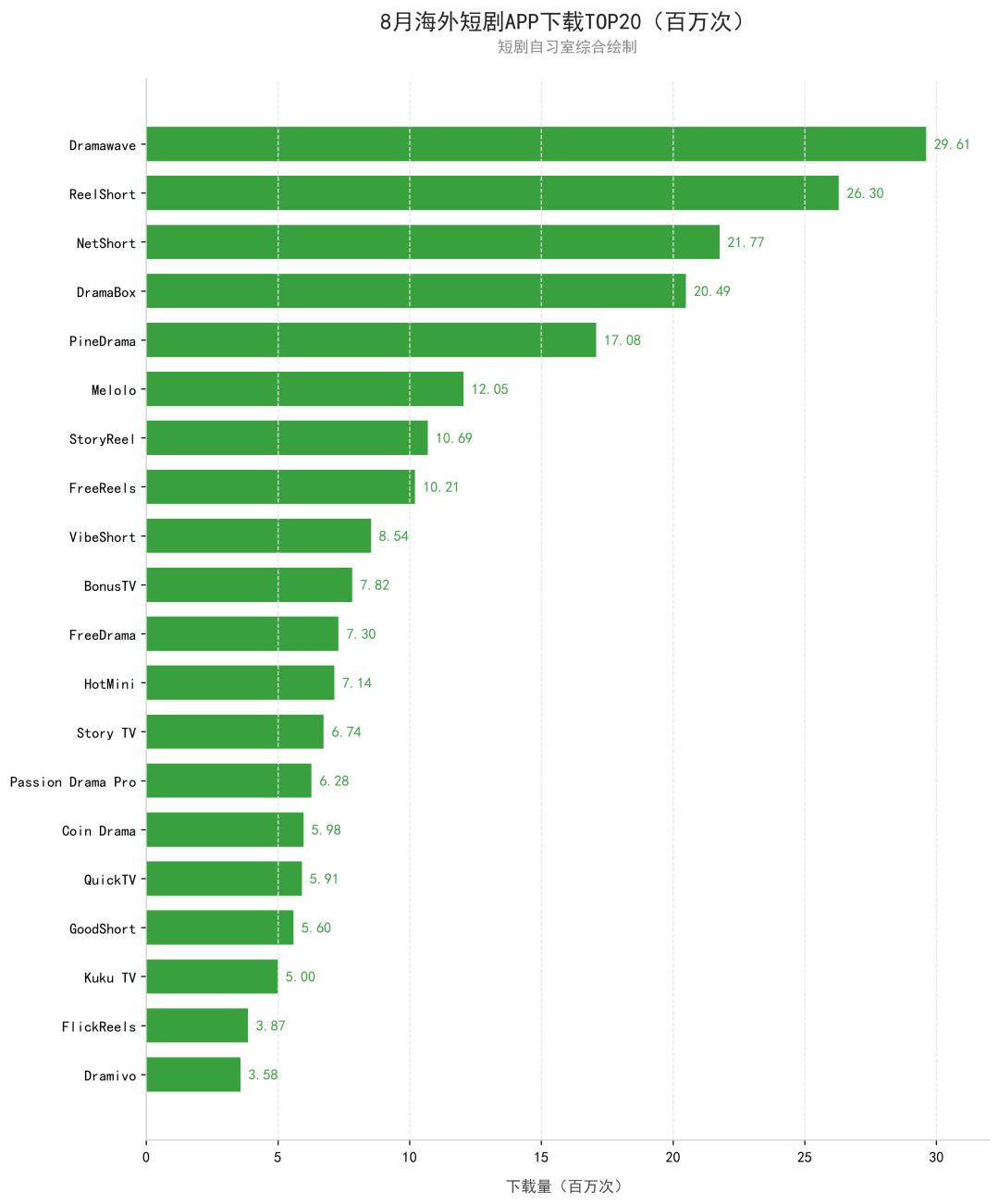
(9 out of 10, the dominance of Chinese overseas short drama platforms is evident. Illustration: Short Drama Study Room)
【 The Expansion Path of Korean Manhua 】
Just like the opening of AI manhua dramas, the starting point of South Korean manhua was also technology-driven.
Due to the weak local animation industry and low resistance, South Korea quickly popularized "vertical scroll manhua" adapted for mobile reading across the country. Japan, a major power of ACG culture, due to the strong position of its publishing industry, has always prevented creators from transforming to vertical scroll manhua, and stuck to the "page-turning manhua" that is more adapted for printed publications.
This gave South Korean manhua enterprises time to grow.
Then the 4G era came. South Korea was one of the countries with the fastest network speed in the world at that time, and completed the APP adaptation for mobile reading earlier. When other countries popularized 4G half a year to one year later, South Korean manhua enterprises had already completed the full set of solutions covering content and channels, and started to expand globally.
Naver Webtoon and Kakao Page are the two most representative ones.
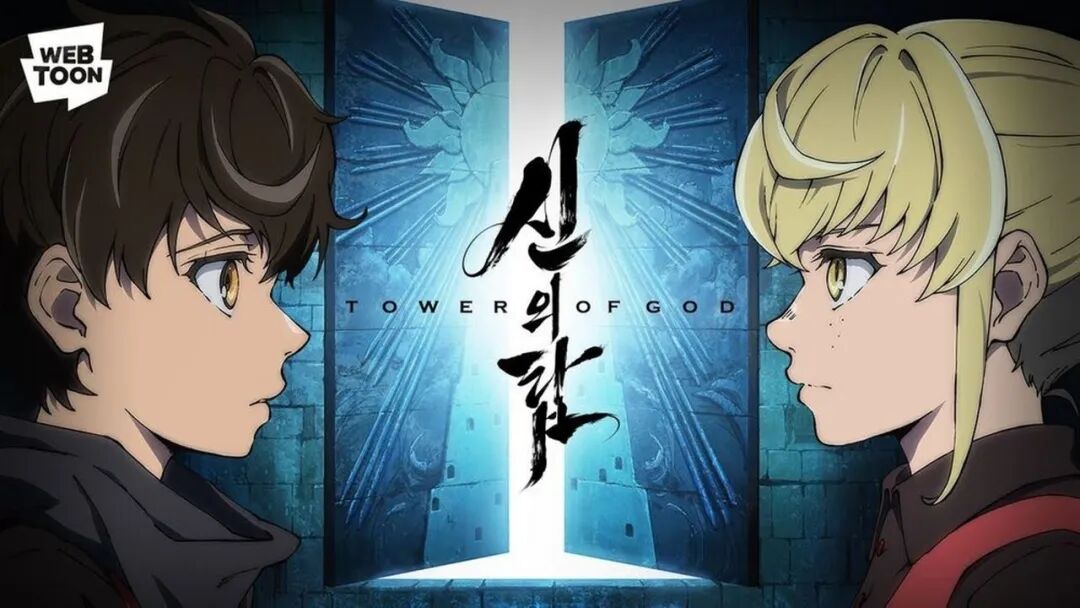
Webtoon is the inventor of vertical scroll manhua. It started its global expansion in 2014, taking Southeast Asia as the starting point in the initial stage, and later accelerated its expansion in Spanish and French speaking regions by merging Line Manga into a unified brand.
The characteristics of Webtoon are:
1. Good at IP linkage, connecting the "novel-manhua-film and television" IP chain, and rapidly seizing market share with the influence of the Korean Wave;
2. Extremely wide coverage. As of 2026, the main site covers more than 150 countries and regions, and the coverage exceeds 200 countries and regions after adding its invested platforms.
Kakao Page is good at cross-border operation and mergers and acquisitions. It not only broke the monopoly of traditional Japanese publishing giants, but also built Piccoma, the most profitable manhua platform in the world. Later, it expanded its territory through frequent capital mergers and acquisitions: in May 2021, it acquired the North American webtoon platform Tapas and the web fiction platform Radish to enter the North American market; in the second half of the year, it launched Kakao Webtoon in Chinese Taiwan and Thailand, which immediately topped the manhua category of local app stores after launch; in 2022, Piccoma entered the European market. Its multiple platforms in total cover more than 100 countries, forming the global coverage network of South Korean webtoons together with the Naver ecosystem.

The success of South Korean manhua companies lies in the construction of an effective three-tier system:
Core production layer — South Korea domestic market, the headquarters of content creation, responsible for producing hit IPs, verifying business models, and supplying standardized core content for global markets;
Key operation layer — Japan, North America and Europe, adopting the dual-track system of "Korean manhua as the mainstay + local content as supplement", to improve market penetration by acquiring local platforms, purchasing local copyrights, and customizing localized content.
Long-tail coverage layer (the remaining 100+ countries and regions): Directly export Korean manhua content translated by AI multilingual tools, without local content procurement and operation. Many countries do not even have local branches, achieving coverage at extremely low marginal cost, which is the key to quickly covering more than 200 countries.
【 Warning: Korean Manhua Failed Due to Excessive Greed 】
South Korean manhua companies arrived, bringing capital and a more comfortable reading experience, and made promises to creator communities: everything will stay the same.
But as soon as the parent company's accounting team calculated the accounts, they turned their back on their commitments.
To support global expansion, Naver Webtoon launched a fan translation product called Fan Translation in 2015. Its function was to grant copyrights, allowing global volunteers to translate works into dozens of languages for free, covering a large number of long-tail markets that the platform had not officially entered.
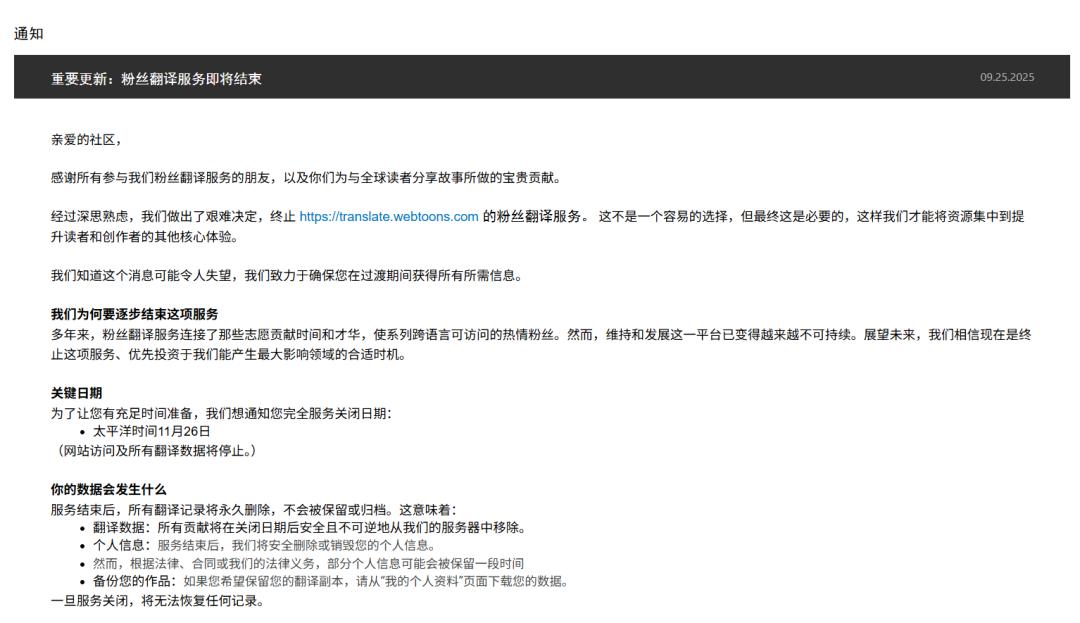
(Official announcement on Webtoon official website)
When AI translation technology matured, Naver suddenly announced the shutdown of the service, all historical translation data would be permanently deleted, and no alternative solution was provided. It was criticized by Korean manhua fan communities for "discarding people after using them", ignoring the ten years of free contributions from the community. The official explanation was "focusing on core business", with no further words besides polite remarks.
The decisive and ruthless style of South Korean enterprises is evident.
Kakao Page is a typical representative of taking all the benefits without giving back. Except for Piccoma in Japan, it adopted the "pure Korean manhua export" model in Southeast Asia, North America and Europe, completely cutting off the local creator cultivation links, including shutting down amateur submission channels, canceling new manhua contests, and no longer supporting local original works; it strongly promoted the assembly line content of "web fiction adapted into manhua" to replace the original original manhua, pursuing quick profits by all means.
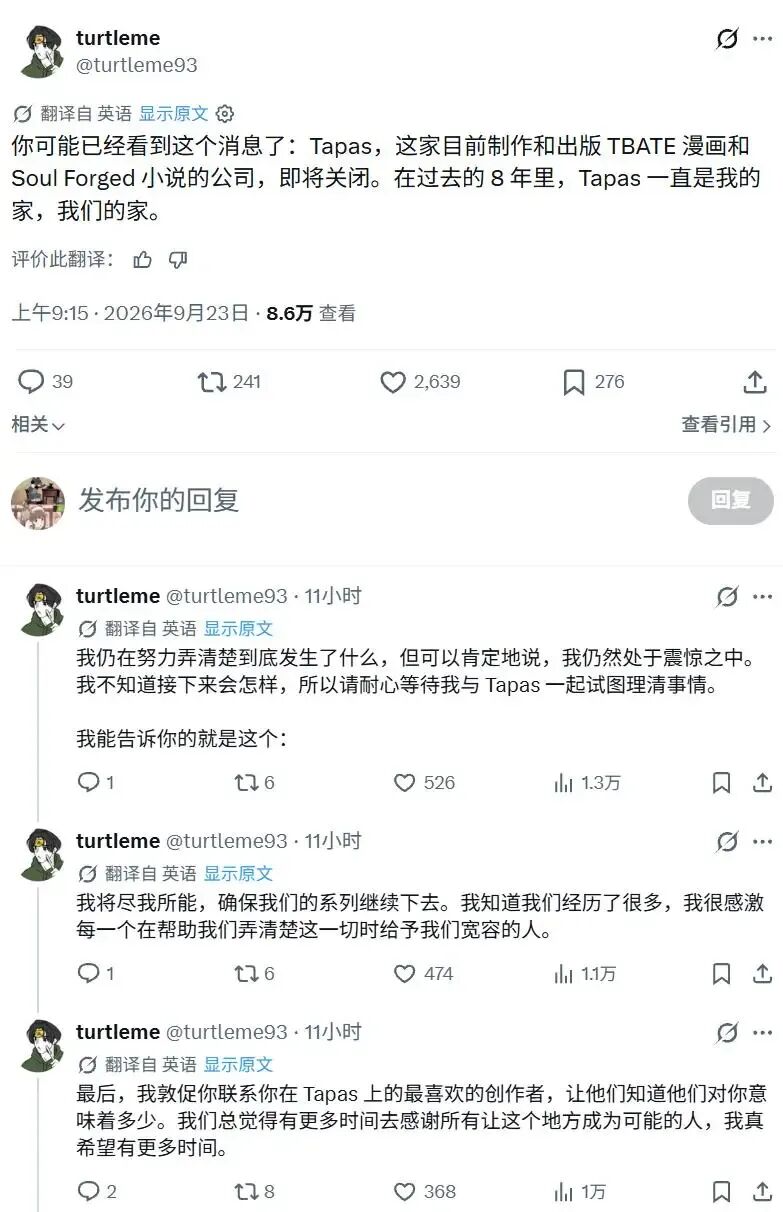
(
In the initial stage, the strategy of "turning the platform into a pure distribution channel" did make a quick profit, but the negative effects soon emerged — the content homogeneity was serious. Among so many apps, apart from the different language UI, 70% to 80% of the content inside overlapped after opening; after Kakao acquired Tapas, it deliberately reduced the recommendation resources and exposure positions for local original North American manhua, lowered the algorithm weight of American manhua creation, which drove away a group of American manhua creators and readers, and damaged the platform's growth potential.
In short, both Naver Webtoon and Kakao Page only wanted to reap benefits, but had no intention of cultivating local ecosystems.
In order to sell Korean manhua to the whole world, the two companies also made a lot of absurd mistakes of forcing unfair transactions. For example, the manhua *Get Schooled* is a male-oriented wish-fulfillment story that depicts violent acts against feminists, including plots of beating female teachers and values that support punitive violence, due to the severe gender conflict in South Korea. As soon as it landed in European and American markets, it was strongly reported and boycotted by readers. It ended with the permanent removal of the original work, the suspension of updates of the Korean domestic version, and a public apology from the author.

In addition, the two companies have made many inappropriate descriptions involving royal families and religions (which caused public disputes in Southeast Asian markets); simplified and beautified white slave owners in manhua set against the background of the American Civil War, and a series of other absurd operations.
So, are there any excellent cases of Korean manhua going global?
Yes, Piccoma, the Japanese manhua platform under Kakao Page, is a successful example. Contrary to other markets, Piccoma has signed a large number of Japanese manhua IPs. On its ranking list, the proportion of Korean manhua to Japanese manhua is about 6:4. Since there are still a large number of local platforms distributing Japanese manhua, it can be deduced that reserving 40% of the share for local content is a referable proportion.

In 2025, Piccoma's total annual transaction volume was about 140 billion yen (about 930 million US dollars), with cumulative downloads exceeding 50 million times; it is the highest-earning digital manhua platform in the world, contributing 55% of the total revenue and 80% of the operating profit of Kakao Entertainment's story business.
On the contrary, most of the global expansion businesses in other regions ended up in losses as of 2025 — the more eager for quick success, the more priority is given to Korean manhua, the less profitable the business becomes.
For Chinese short drama/AI manhua drama enterprises that are expanding globally, the ten-year global expansion journey of South Korean manhua industry is a good reference: it shows us that different localized strategies lead to different results in tapping market potential. Exhausting all resources for short-term outstanding financial data will eventually lead to losses in the long run; according to the case of Piccoma, controlling the proportion of local content at around 40% is a relatively balanced point, too much will reduce profits, too little will easily arouse conflicts.
For Chinese short drama/AI manhua drama companies, how to carry out future localized work, what is the appropriate proportion to control, and where is the break-even point? All these will be verified by actual results in the future.
This article is from the WeChat official account "Zhenjian", the author is Dou Jiaoshou, published with authorization from 36Kr.