a16z Directly "Runs a School": Partners with 10 Companies Including OpenAI and Google, Invests 42 Million U.S. Dollars
A venture capital institution renowned for investing in startups has now decided to launch its own school.
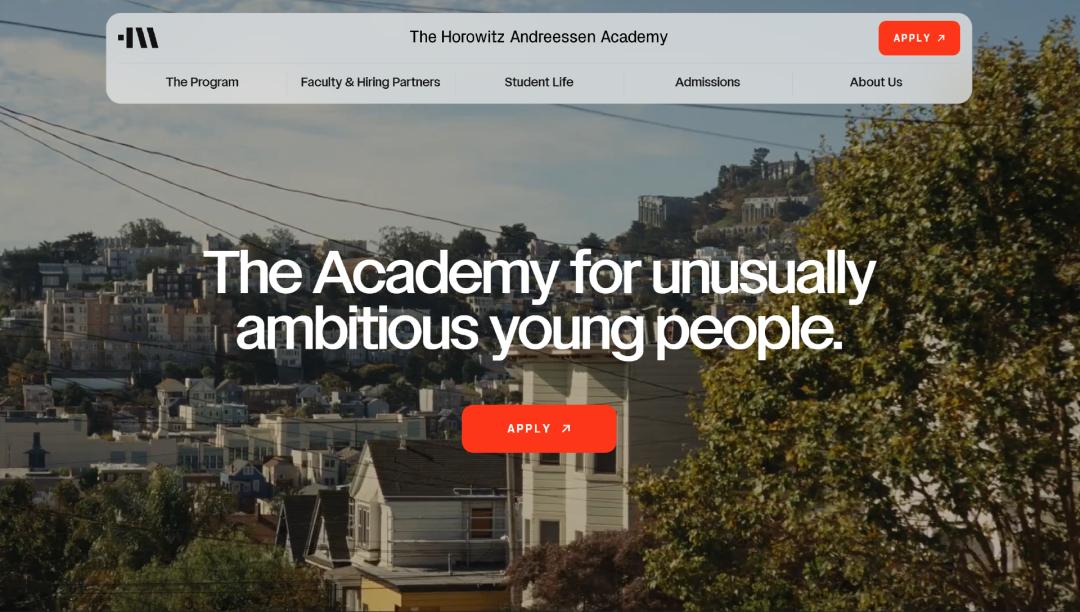
Recently, Andreessen Horowitz (a16z), a well-known Silicon Valley venture capital firm, announced the establishment of The Horowitz Andreessen Academy (HAA). Located in San Francisco, the school mainly recruits high school graduates, with priority given to fresh high school graduates. The first cohort is scheduled to start in September 2027, with only about 50 students enrolled for a one-year program, and tuition will be waived for the first session.
a16z has previously invested in tech companies including Facebook, Instagram and Skype. This time, it has set its sights on an earlier stage of talent cultivation. HAA is also unlike a traditional university: it does not issue degrees or offer college credits. Students will work on projects here, gain practical experience in enterprises, and get access to Silicon Valley tech companies and entrepreneurs.
Why does a top VC start to cultivate 18-year-old young people on its own?
No degrees awarded, students complete their own projects within one year
The most straightforward difference between HAA and traditional universities is that it does not take degrees as the cultivation outcome.
At present, HAA has not obtained university accreditation, does not confer degrees, and does not offer college credits that can be transferred to other higher education institutions. The first program is mainly targeted at high school graduates, with priority given to fresh high school graduates, and plans to recruit about 50 students. Students need to study full-time in San Francisco and arrange their own accommodation.
The admission criteria are also different. Applicants still need to submit transcripts and test scores, but HAA clearly takes "portfolio proof" as an important admission basis, that is, it focuses on examining what the applicants have already accomplished. In the application cases demonstrated by the school, some applicants developed an AI book indexing tool with an annual recurring revenue of six figures in US dollars, while others developed an AI dating coach product that received 1.7 million likes on social platforms.
After entering the school, the one-year study of students mainly consists of three parts: personal projects, courses and enterprise practice, among which personal projects are placed at the core position.
HAA calls personal projects "Pursuits", which can be a research, an entrepreneurial idea, or other projects that students have long wanted to advance. Students can carry out one or multiple projects at the same time, and discuss and improve them with mentors. Gagan Biyani, CEO of the school, said that teaching is not the most important part of the program, and the school prefers to give students time and resources to advance their own goals.

The courses cover different directions including technology, business and personal capabilities. The currently announced courses include AI reasoning engineering, modern software development, the development of digital computing, and sales, etc. HAA is also recruiting an education leader to design a learning mechanism different from traditional lectures, exams, grades and assignments, including student independent projects, peer evaluation and mentor guidance.
Enterprise practice is also directly incorporated into the cultivation process. According to the current arrangement, each student will spend at least 3 months working full-time in an enterprise. In addition, the school has also arranged 3 to 4 weeks of overseas independent research and travel programs.
Therefore, from admission to cultivation, HAA places the actual projects that students have completed and are advancing in a relatively important position. Applicants need to show their past works when applying, continue to advance their personal projects after entering the school, and supplement the required knowledge and experience through courses and enterprise practice.
For a school that does not offer degrees, this cultivation method is only the first layer. Another part of the resources HAA prepares for the first cohort of about 50 students comes from the tech companies and Silicon Valley network behind a16z.
10 tech companies participate, bringing Silicon Valley resources into the school
Without offering university degrees, HAA needs to use another set of resources to attract students. The first batch that a16z brought in is a group of Silicon Valley tech companies.
At present, HAA has confirmed 10 founding partner enterprises, including Anduril, Anthropic, Coinbase, Google, Meta, NVIDIA, OpenAI, Palantir, Replit and Stripe. They do not only provide brand endorsement for the school, but participate in the cultivation process in different ways, including participating in courses, providing computing power and hardware, as well as offering practice and Co-op opportunities.
These enterprise resources also extend beyond the classroom. HAA has also built a network of more than 200 industry practitioners including teachers, mentors and guest speakers. The announced candidates include OpenAI CEO Sam Altman, NVIDIA CEO Jensen Huang, Microsoft CEO Satya Nadella, Thinking Machines Lab CEO Mira Murati, Stripe co-founder Patrick Collison, and World Labs co-founder Li Feifei, etc. According to the currently disclosed information, they participate in different ways, including courses and lectures, as well as mentor exchanges, and not all of them will teach as full-time faculty.
In addition to enterprises and industry practitioners, HAA also directly provides part of the resources to students. Each student in the first cohort can get a computing power quota of more than 50,000 US dollars, as well as a travel and research budget of 5,000 US dollars. For students who need to develop software, train models or carry out research, these resources can be directly used to advance their own projects.
Next come the job opportunities.
In addition to the 10 founding partner enterprises, HAA has also attracted more than 40 enterprises to become recruitment partners. The school hopes that through this enterprise network, students can gain real work experience during their studies, and further connect with the recruitment of tech companies after the program ends.
However, this connection does not mean "graduating directly into tech companies". The 10 founding partner enterprises do not participate in the school in exactly the same way, and not every company will accept students to participate in Co-op; the recruitment partners also do not reserve definite job positions for HAA students. Enterprises can provide practice, interview and recruitment opportunities, but the school does not guarantee that students can definitely get internships or full-time jobs.
Thus, the resources that HAA can provide are gradually clear: tech companies participate in the cultivation process, industry practitioners participate in courses and exchanges, computing power and research budgets are directly allocated to students, and the enterprise network further connects practice and recruitment.
For a school that does not offer degrees, these resources constitute an important part that differentiates HAA from ordinary course programs. And in order to truly turn this model into a school, a16z has invested more than just its own enterprise network.
Free for the first cohort, the next step plans to charge an annual tuition of 60,000 to 90,000 US dollars
The first cohort of students do not need to pay tuition, but HAA is not a public welfare school.
HAA is backed by a for-profit company, which has currently raised 42 million US dollars in financing, of which a16z has invested 35 million US dollars. Other investors include tech industry entrepreneurs and investors such as Quora co-founder Adam D'Angelo, Shopify CEO Tobi Lütke, DoorDash CEO Tony Xu, and Y Combinator CEO Garry Tan.
After obtaining this fund, HAA has built a management team mainly composed of education entrepreneurs and investors. Gagan Biyani, CEO of HAA, is the co-founder of online education platform Udemy, and later co-founded the online learning platform Maven. Zelda Poem, a member of the founding team, once worked at a16z. After leaving French high school at the age of 15, she participated in non-traditional education programs for a long time, and later founded Nautilus to provide co-living and co-working residency programs for young artists, scientists and technicians. At present, she works at the venture capital institution 1517 Fund.
a16z also directly participates in school management. Co-founder Marc Andreessen and General Partner Erik Torenberg are both on the board of directors of HAA. From capital contribution to board seats, the relationship between a16z and HAA is more than an ordinary financial investment.
After the first free cohort, HAA already has a further commercialization plan. According to the current arrangement, after obtaining regulatory approval, the school plans to launch a two-year program in 2028 and expand the enrollment scale. Biyani revealed that the annual tuition fee is expected to reach 60,000 to 90,000 US dollars by then, which is in a similar range to some top private universities in the United States.
This pricing also corresponds to HAA's judgment on the higher education market. Biyani mentioned that higher education is a market of about 2 trillion US dollars. He made it clear that the team hopes to explore new education methods and also develop HAA into a successful business.
However, for a16z, running a school brings more than just a new education business.
a16z itself is a venture capital institution that focuses on identifying and investing in entrepreneurs. Torenberg once said that "venture capital is about discovering and cultivating talents", and mentioned that he believes a16z will invest in entrepreneurs who come out of HAA in the future. HAA directly recruits high school graduates, which also gives a16z the opportunity to reach a group of young people interested in entrepreneurship, technology and research at an earlier stage.
This model of directly connecting young talents with entrepreneurship has precedents in the United States. In 2011, tech investor Peter Thiel launched the Thiel Fellowship, targeting young people aged 22 and under who have not obtained university degrees. Selected recipients leave school to advance their entrepreneurship or research projects, and can get 250,000 US dollars in funding within two years. Startup accelerator Y Combinator directly selects early-stage startup teams, invests 500,000 US dollars in each company, and provides three months of entrepreneurship guidance and investor resources.
In recent years, similar explorations have also entered schools. The private American school Alpha School uses AI for personalized teaching, leaving more time for skill training such as entrepreneurship and public speaking; Forge Prep, which opened its first campus in 2026, emphasizes real projects, where students will try to start businesses, carry out research and design products.
HAA adds an extra layer beyond these models: a large venture capital institution directly establishes a school, which is operated by education entrepreneurs, and connected to tech enterprises and investment networks at the same time. After the free one-year program for about 50 students in the first cohort, the two-year paid program has been planned, and a16z has also clearly expressed the possibility of investing in the entrepreneurs among them.
For HAA, this is an education business that plans to charge fees; for a16z, it also advances the timeline of finding entrepreneurs to the period right after high school graduation.
This article is from the WeChat official account "Duojing" (ID: DJEDUINNO), author: Xie Qi, published by 36Kr with authorization.