The mysterious model "Space Rabbit" has gone viral, with performance nearly on par with GPT-6 Astra, drawing an audience of 100,000.
Reported by Zhidx on September 28, an anonymous model named Space Bunny has recently sparked heated discussions among netizens. Since its launch on September 23, it has consistently ranked second on the OpenCode call volume list, and once topped the OpenRouter call volume list. Netizens refer to it as the "Space Rabbit".
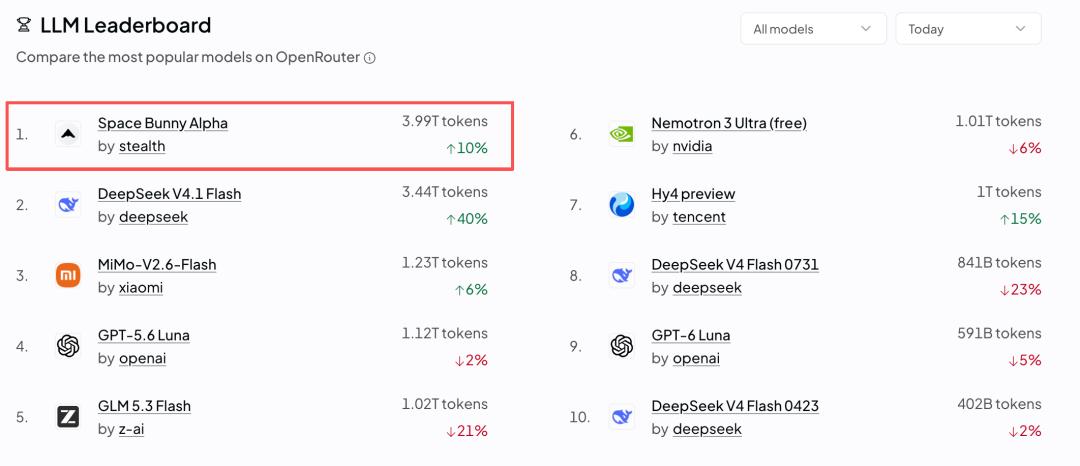
This model is free to use on OpenCode, with a 1 million-token context window and multi-modal capabilities, and it will not retain any user data during the anonymous usage period. Up to now, the official announcement post of OpenCode has accumulated over 1 million views.

According to tests conducted by developers, this model is most likely a Flash model. Most users report that the "Space Rabbit" runs extremely fast and has outstanding capabilities in 3D output.
A developer input a very simple prompt, and Space Bunny spent about 40 minutes generating a simplified version of Minecraft, in which users can break and place blocks, and switch items through the shortcut bar.
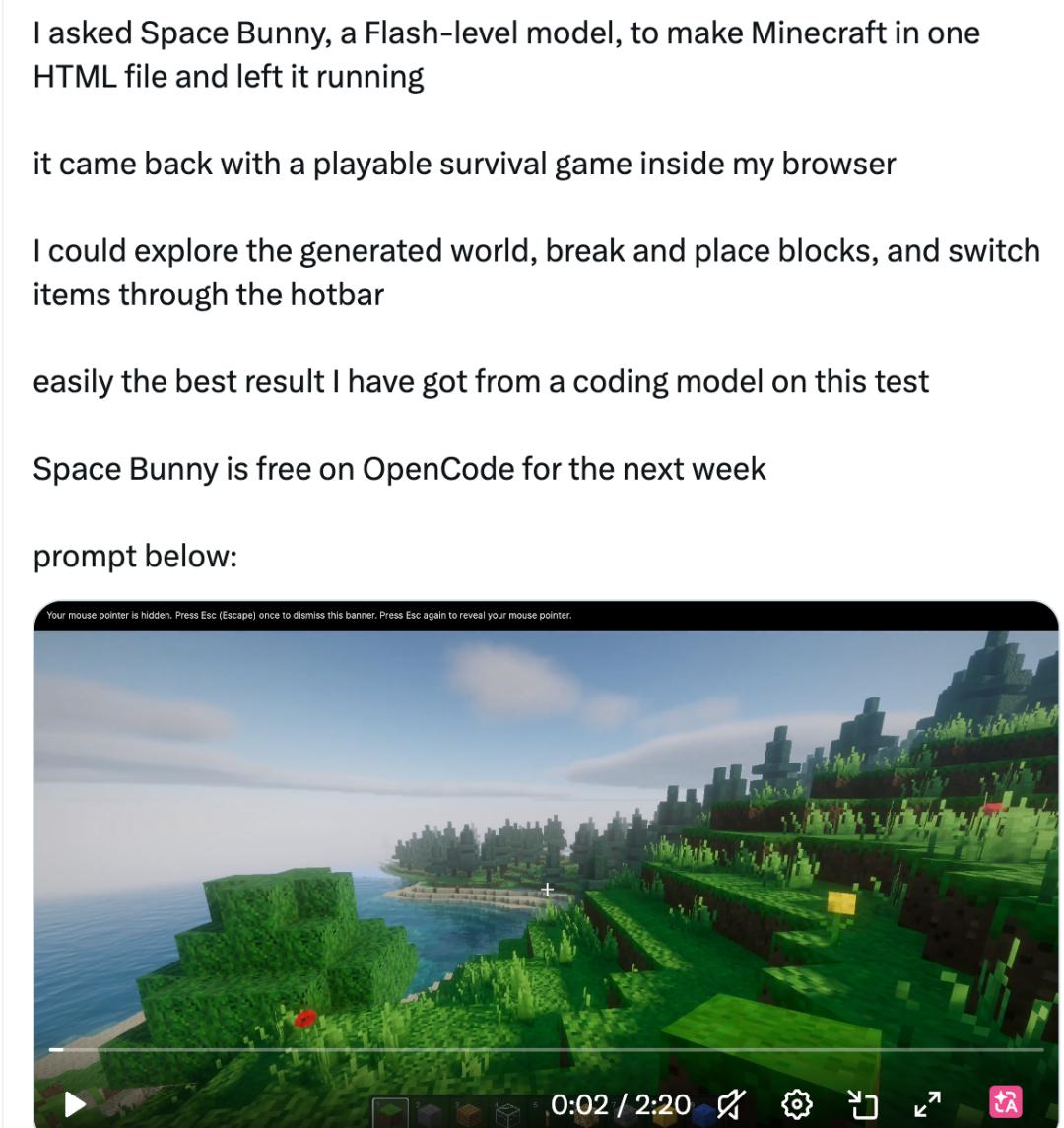
However, the developer revealed that the test was not completed in one go, and many revisions were made to achieve this effect. In this regard, this test of the "Space Rabbit" cannot fully represent the actual capability of the model itself.

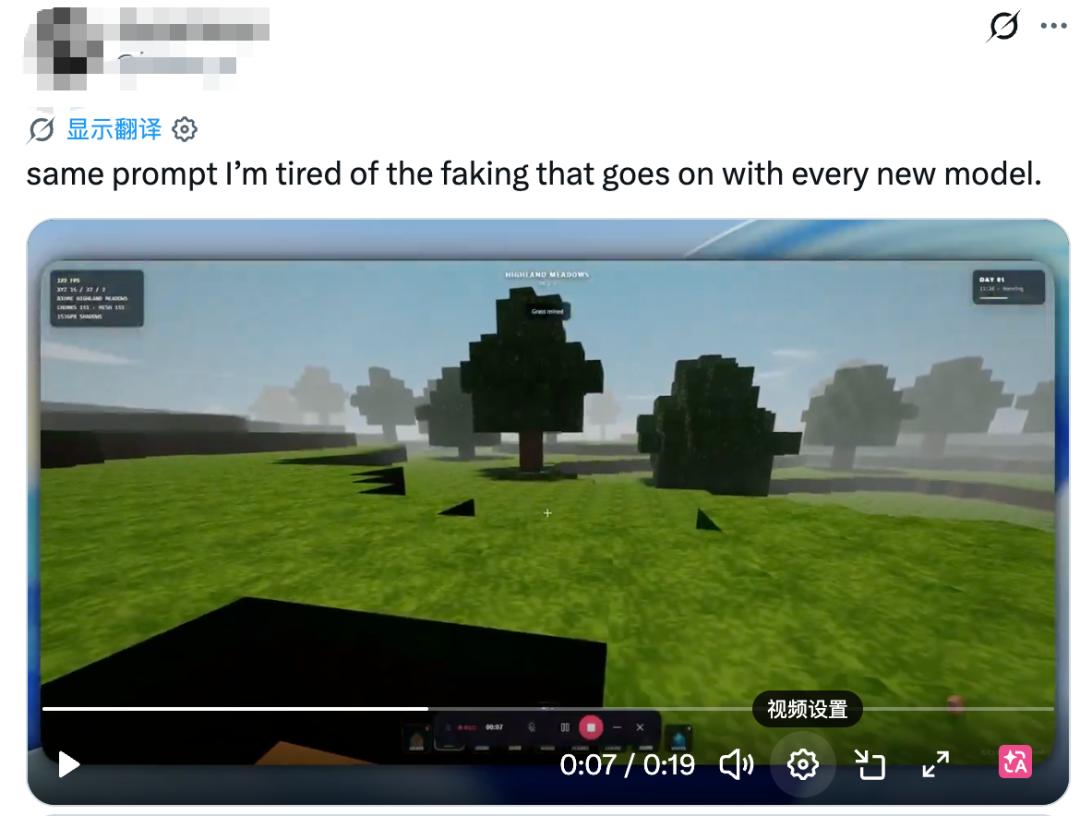
Some developers in the community pointed out that this model is not that easy to use. They used the same prompt as the above poster to conduct tests, and the generated results are quite different from those of the original poster.
Zhidx has collected many interesting real-world test cases from developers, and tested this rabbit through OpenCode to see its actual performance.
01. Rocket Launch and Voxel Garden, Performance Rivals Astra and Opus 5
Let's start with a comparison test. The netizen compared Space Bunny with Claude Opus 5, GPT-6 Sol and Gemini 3.8 Flash, using the highest thinking level to build a rocket launch scene.
The netizen said that Space Bunny only took 3 minutes, and the final presentation effect was comparable to Opus 5, and it significantly outperformed the other two models, with a far leading speed.
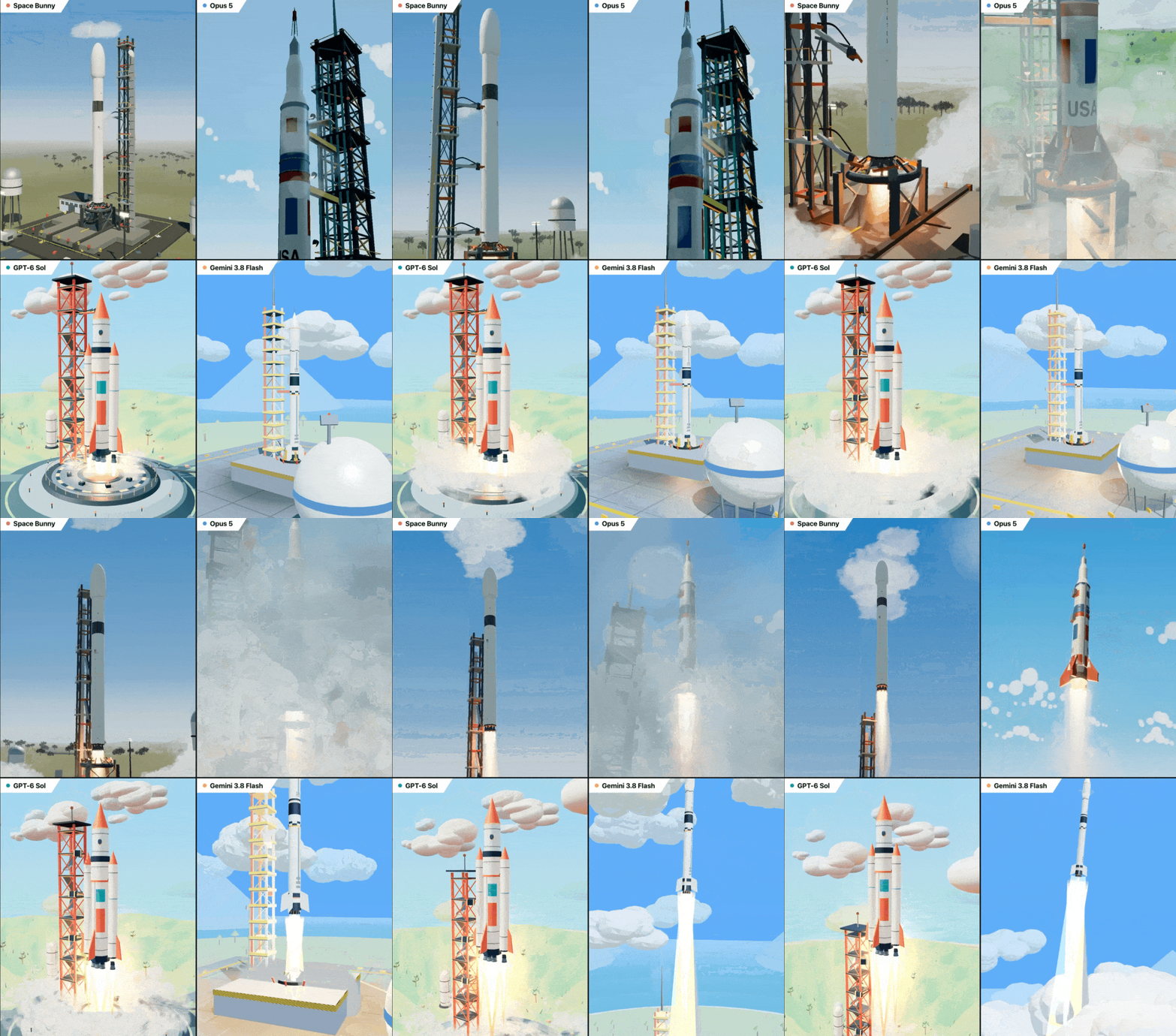
In terms of effect, the rocket color, clouds and flames in the rocket launch animation produced by Space Bunny are very realistic, and the process from launch to lift-off is relatively smooth. Although there are some problems such as the steam range and the insufficient connection of the support frame, the overall performance is quite good.
In another post that attracted as many as 100,000 viewers, a developer conducted a comparative test between GPT-6 Astra and Space Bunny, noting that the same prompt was used for one-time generation.
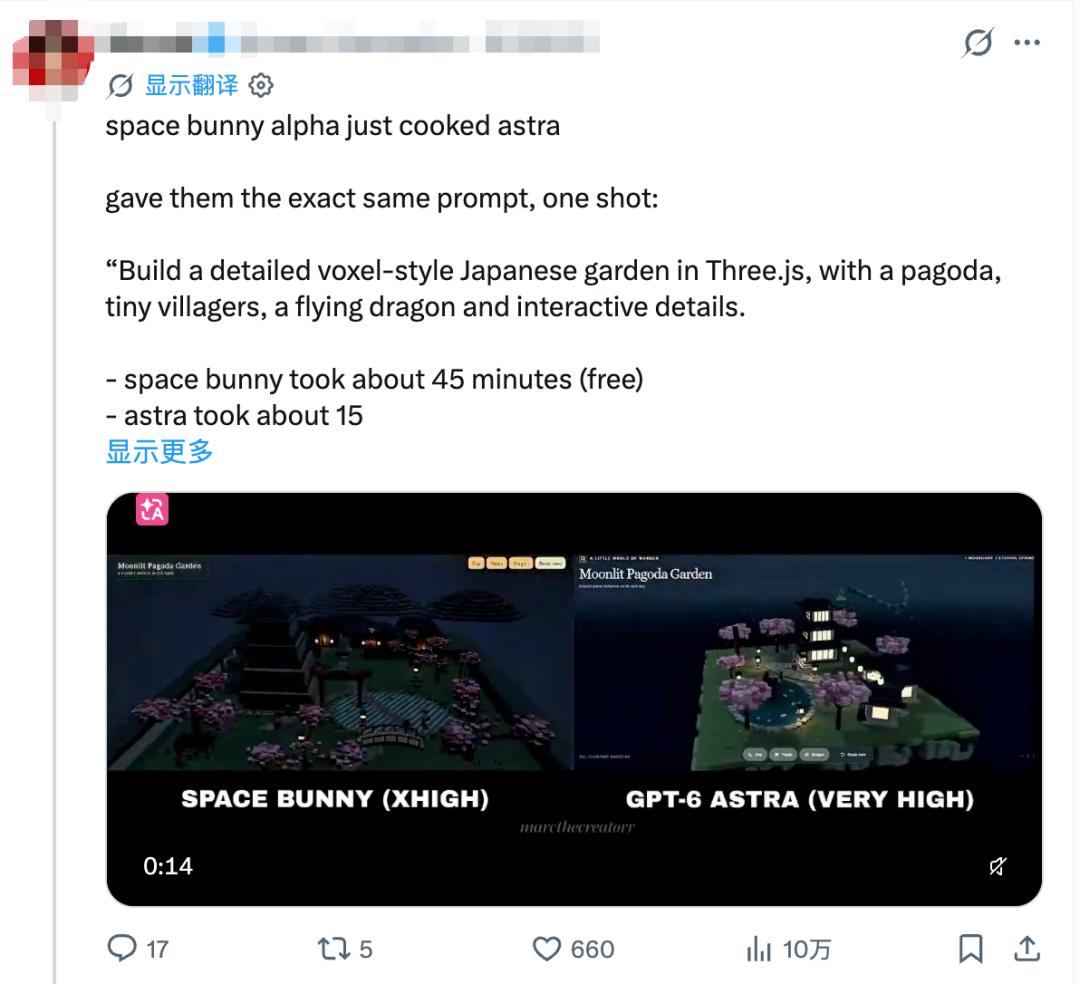
The following is the effect of GPT-6 Astra. As a top-tier model, the voxel garden created by GPT-6 Astra has excellent texture, the layout of pavilions and attics is very harmonious, and the fish swimming in the water and the flying dragon in the air are very natural.
When manually switching to night mode, the attics and street lamps will light up, the light and dark modes can switch smoothly, and the light and shadow effects conform to the laws of the real world.

Surprisingly, the generation effect of Space Bunny is also very good. When comparing the two, the gap from a distance is not obvious.
Open the voxel garden of Space Bunny, you can see that Space Bunny handles the swimming fish and falling petals in the water well, the street lamps will light up in dark mode, and the overall layout of the garden is also relatively harmonious.
However, compared with GPT-6 Astra, Space Bunny has obvious detail problems such as insufficiently exquisite peach blossom trees, unnatural pools, no doors and windows on the attic, and defects on the door head and flying dragon.
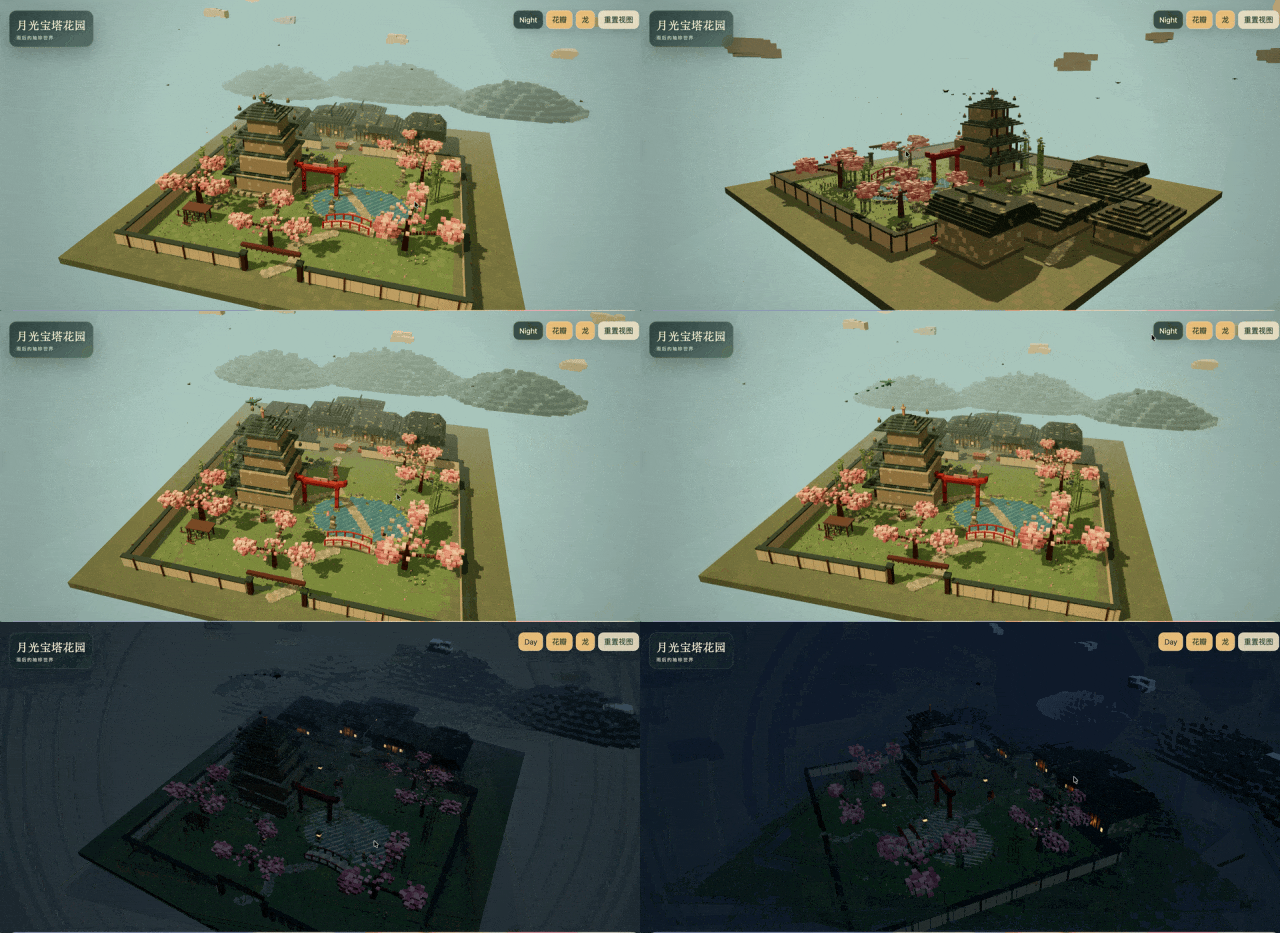
However, although there is a certain gap in the effect, it is a free model at present. From the positioning of Flash, its subsequent price will not be too high. As the netizen said, it is difficult to choose between the two works, but the Space Rabbit is free.

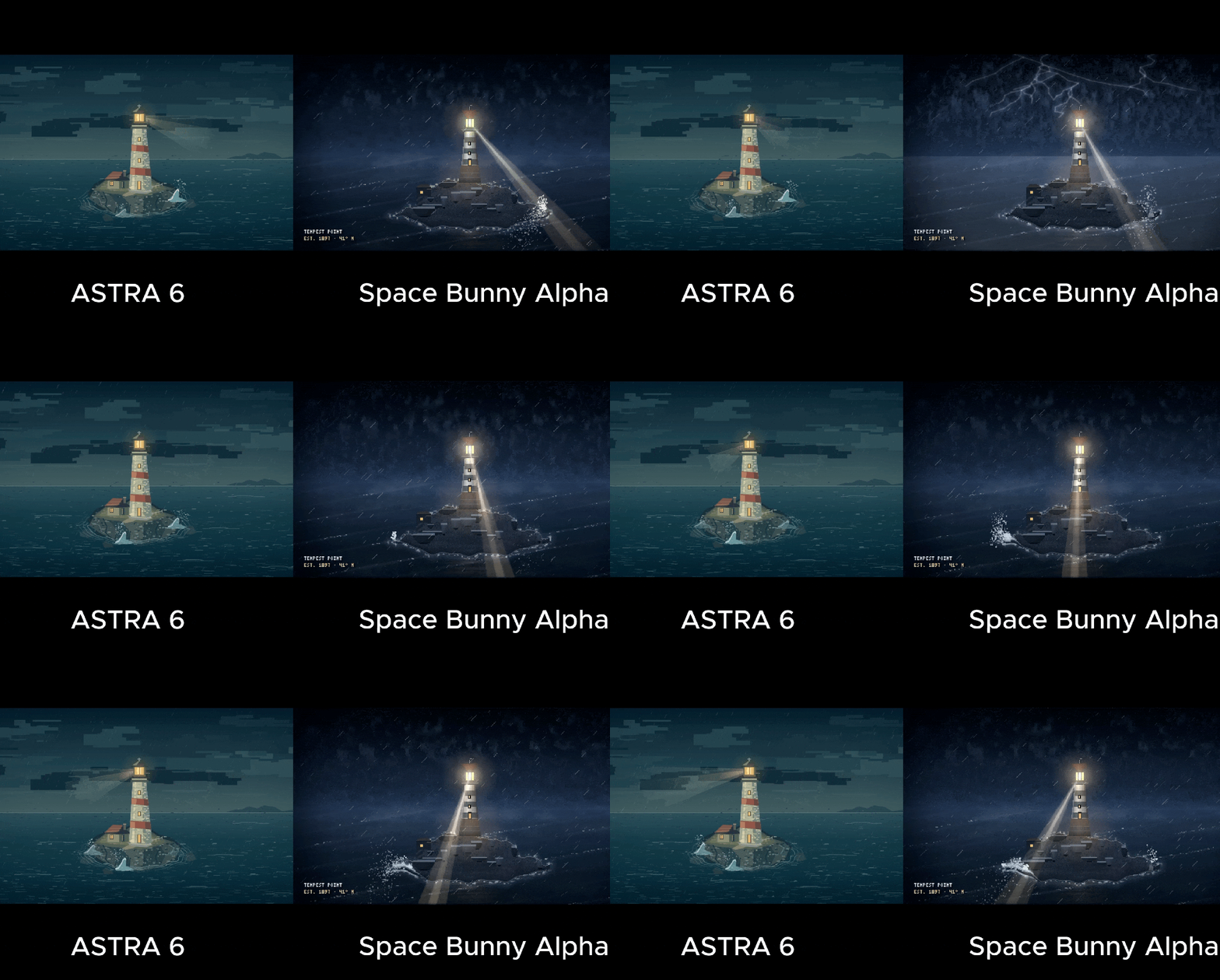
Another netizen also used GPT-6 Astra for a comparative test. They also input the same prompt to let the two models produce an animation of a lighthouse storm scene.
From the results, Space Bunny has a stronger sense of atmosphere, and the waves and lighthouse of Astra 6 are more in line with the laws of physics, but the actual effects of both are not very amazing. The prompt is as follows:
Build a delicate animated pixel art lighthouse storm scene on a small rocky island. Do not make a complete game, create a beautiful atmospheric pixel art display scene. Include: the lighthouse as the main focus; dark ocean waters around the island; waves crashing on the rocks; diagonal rainfall; moving storm clouds; rotating lighthouse beam; occasional lightning flashes that illuminate the whole scene; the warm lighthouse light contrasts with the cold storm. Style: cinematic pixel art; gloomy, beautiful and clean; like a high-level animated pixel art diorama; detailed but not cluttered; suitable for short video display. Use a fixed camera to clearly show the whole island. Focus on atmosphere, animation, lighting and delicacy. Do not add unnecessary game systems or complex mechanisms.
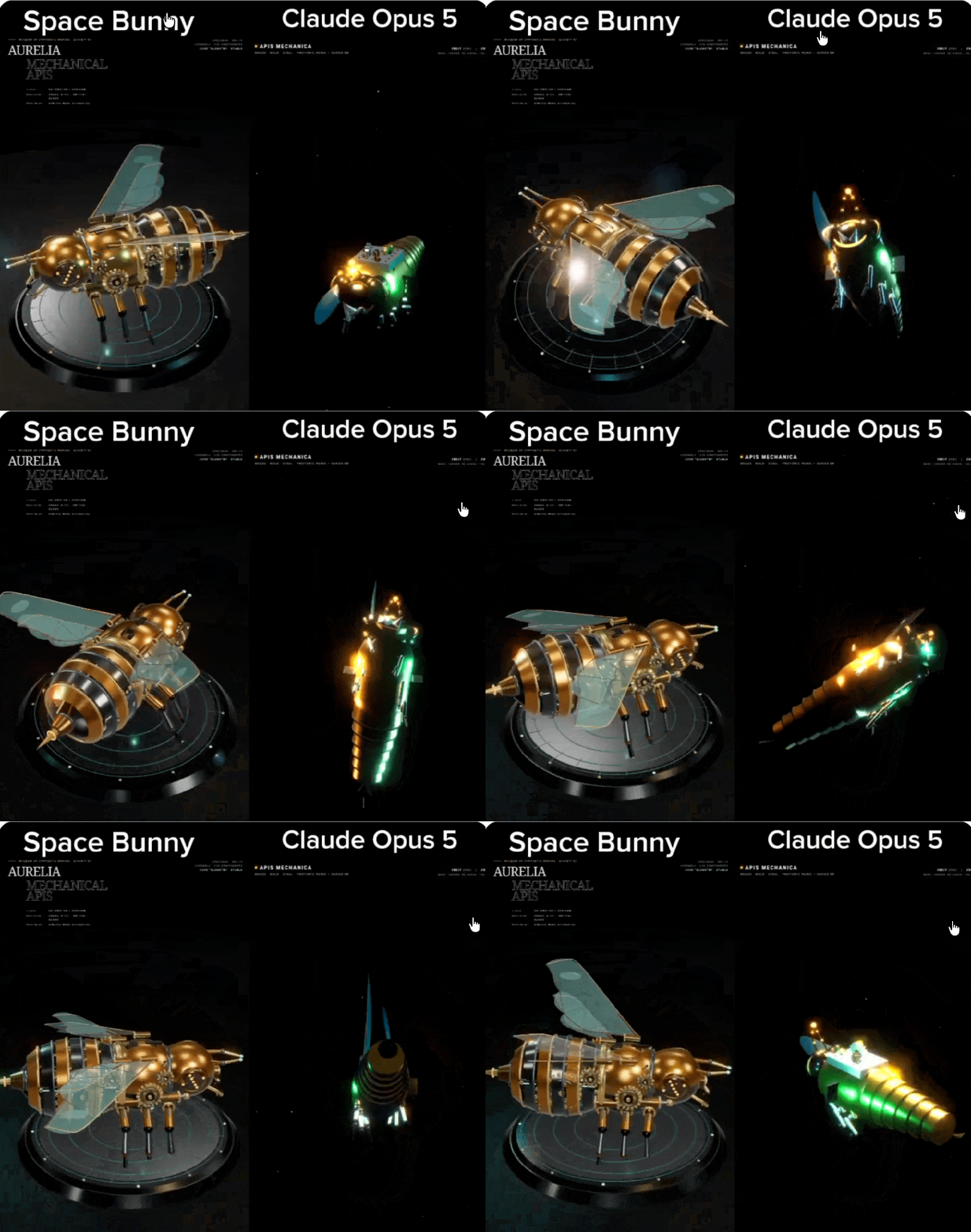
Some netizens directly used a complex Three.js project to test the programming and 3D understanding capabilities of Space Bunny, and compared it head-on with Opus 5. The prompt is as follows:
Build a beautiful interactive mechanical bee using Three.js. Create the bee entirely with 3D geometries and materials, including detailed mechanical components, metal body panels, gears, pistons, wires, transparent wings, glowing decorations, and articulated legs. Add realistic wing movements and subtle mechanical animations. Use a dark background, cinematic lighting, shadows, reflections and highlights for a futuristic aesthetic. Make the bee respond to mouse movement and allow users to orbit around it. Build everything in a single elegant web page using Three.js.
To be honest, the bee constructed by Space Bunny is indeed better than Opus 5. Whether in terms of mechanical precision or materials, the modeling of Space Bunny is more excellent.
02. Build an HTML Black Hole with One Sentence, Its Front-end Design Capability Is Extremely Outstanding
Among all kinds of cases, the most amazing part is the front-end design capability of Space Bunny. Let's first look at a very cool case:
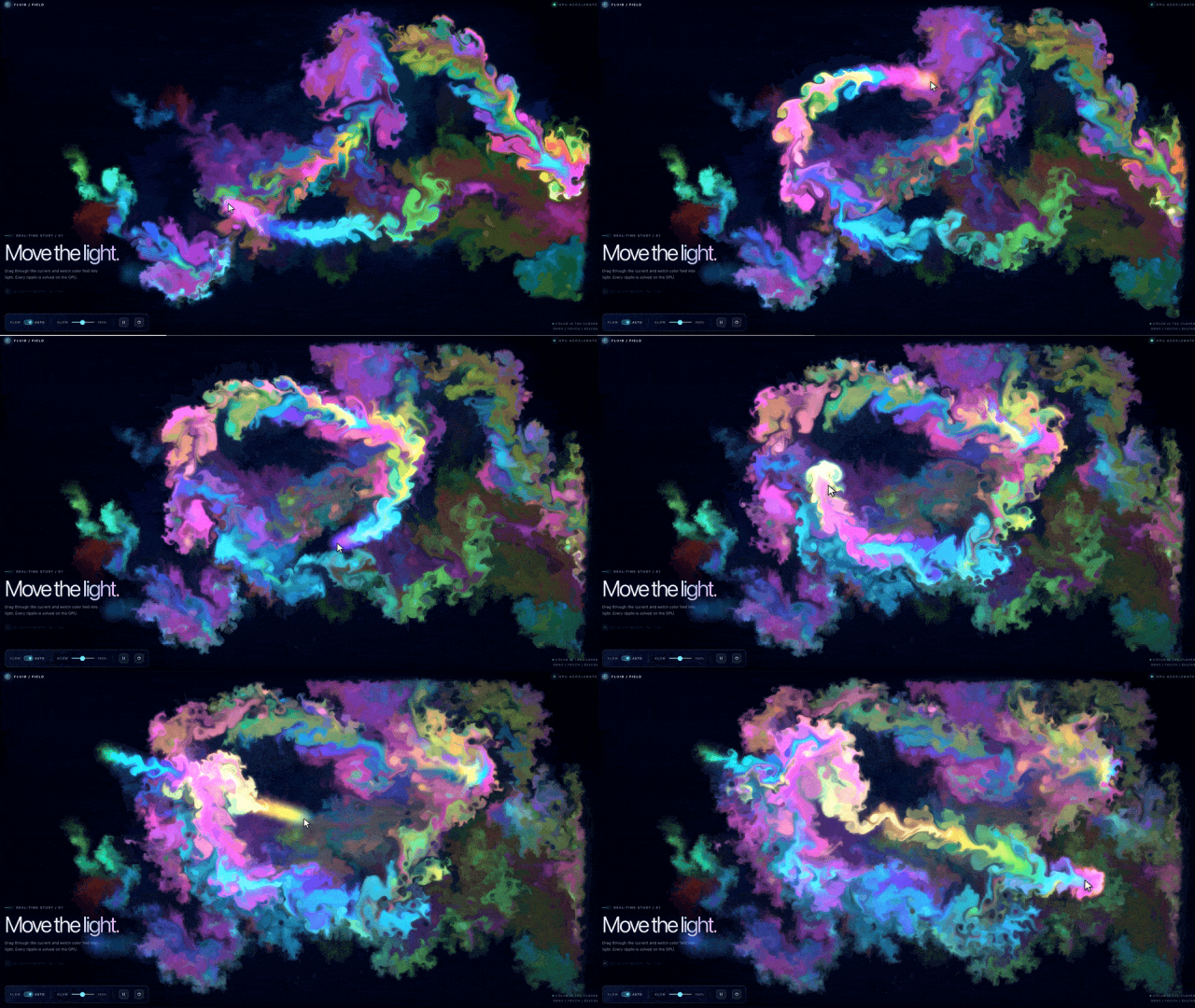
This is the GPU fluid simulation that the developer asked Space Bunny to make. The prompt is as follows:
Requirements: In a single HTML file, use WebGL to build a GPU-accelerated fluid simulation from scratch, without relying on any external libraries. Users can drag the mouse or finger to push the colored dye, and add a soft halo effect.
Finally, Space Bunny generated 1564 lines of code at one go. The whole process does not require writing a single line of code manually, and no third-party libraries are used.
The following case has a very amazing effect. The developer used Space Bunny to make a black hole display web page. In this web page, the black hole will change with the user's mouse click, and then naturally switch to the next page.
During the whole process, the black hole changes elastically, stretching and expanding according to different stages, bringing a very strong visual impact.
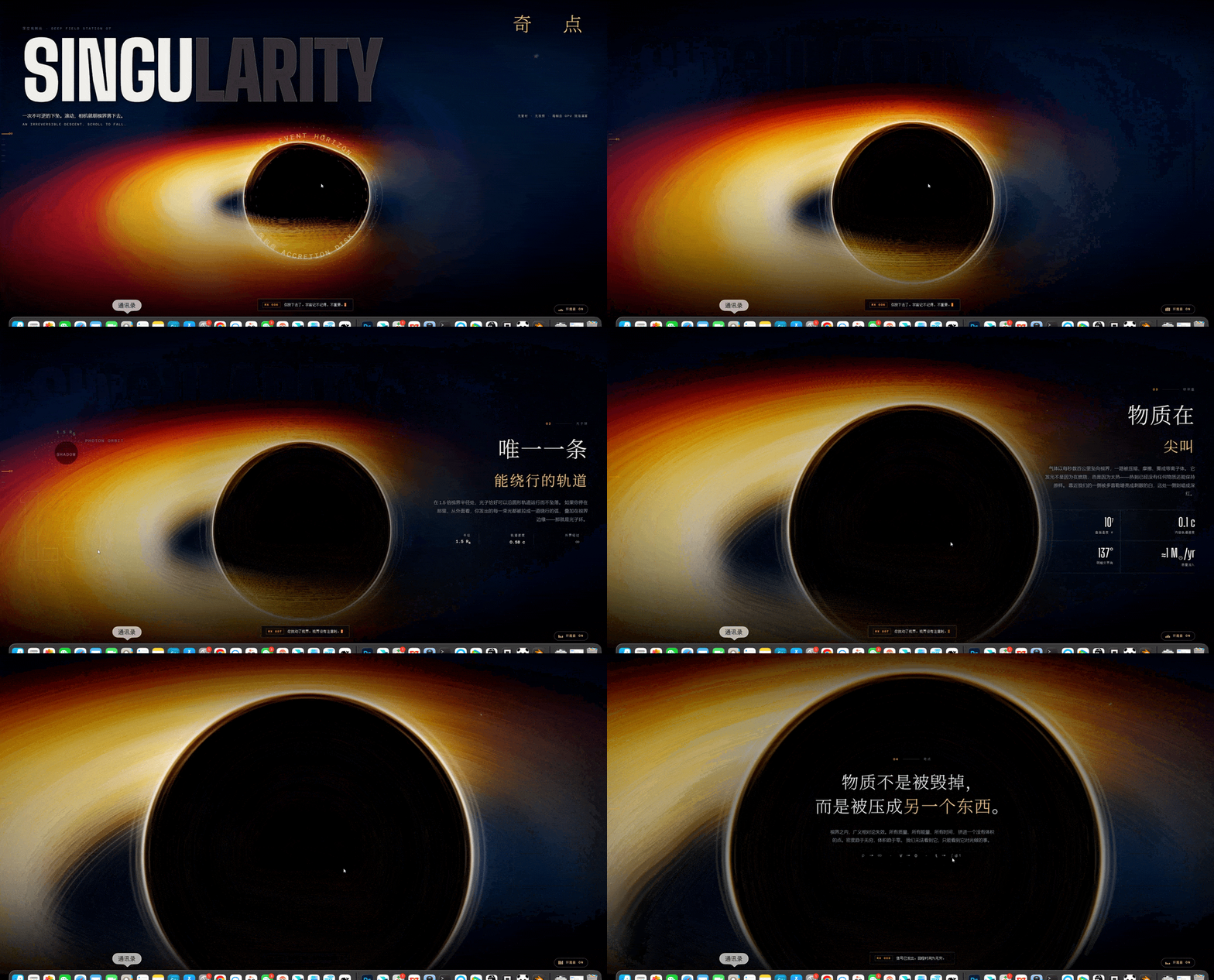
Space Bunny's performance in motion design has almost received universal praise. For example, for this web page design, the developer finished it in only a few minutes. The mouse-following motion effect is very smooth, and some elastic trembling states are very realistic.
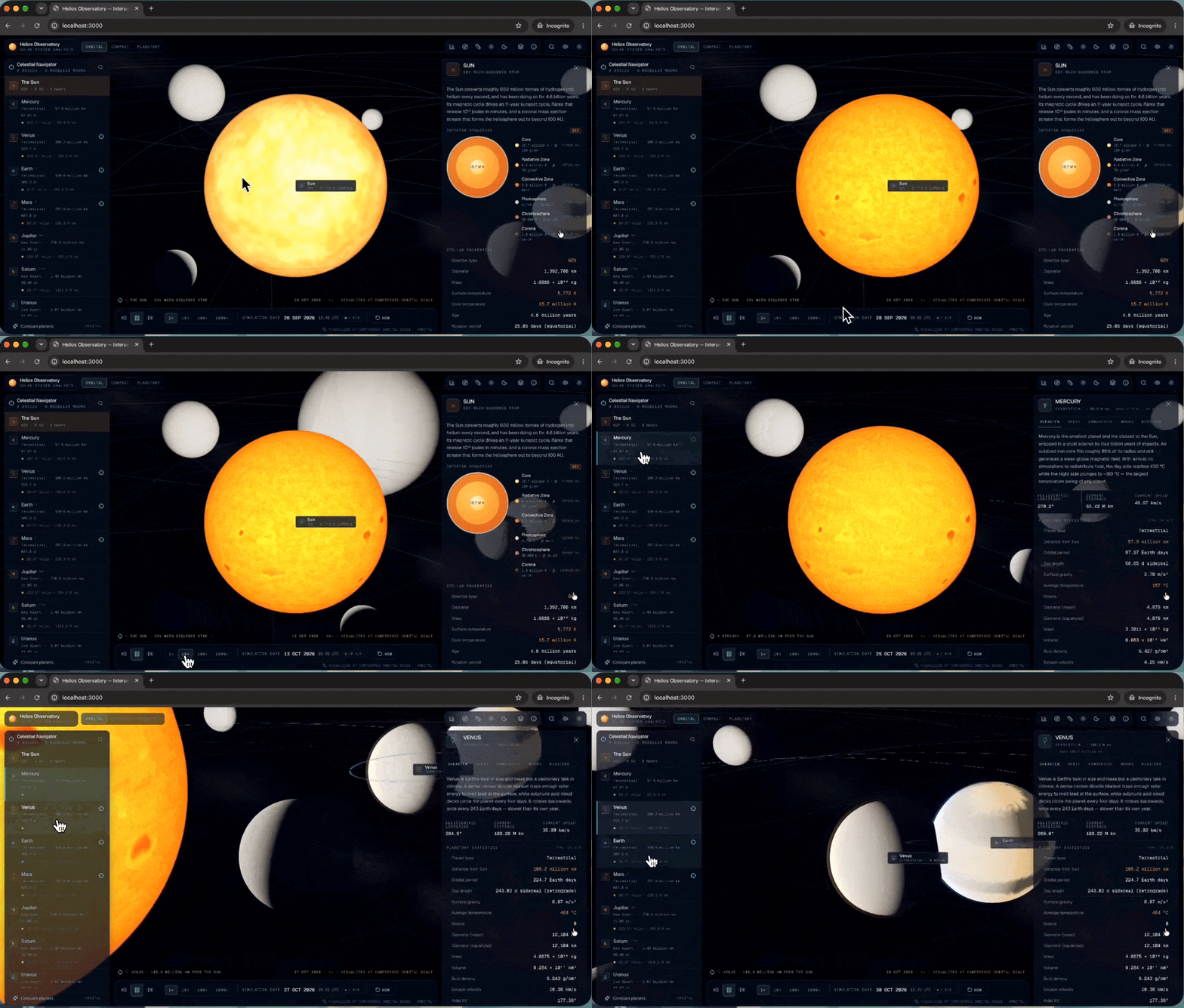
Some developers used Space Bunny to build a solar system observatory, which can not only observe the orbits of major planets, but also observe the irradiation range of the sun and the process of the moon orbiting the earth. The interaction process is very smooth.
03. Real-world Flight Simulation Test, With Some Surprises and Some Accidents
We conducted some tests with Space Bunny in OpenCode. The first one is the classic pelican cycling scenario. The prompt is as follows:
Create an HTML, which uses SVG to draw a 2D animation of a pelican riding a bicycle. You don't need any testing, and there are no restrictions.
The cycling effect is quite good. The pelican has a complete figure, and the cycling posture is also good. The leg movements match the forward trajectory of the bicycle. The only flaw is that the pelican's butt is not sitting on the seat, which deducts some points, but the overall effect is still very good.

Next, we input a prompt to let Space Bunny develop a flight simulation game. This type of game has very high requirements for control feel, and we also put forward requirements for the art style in our prompt:
Develop a third-person flight simulation game with a low-poly style, and the web page can be opened after completion. The player pilots a small propeller plane to fly freely in an open map composed of hills, rivers, forests, villages, lighthouses and airports. The plane can accelerate, decelerate, turn, climb and dive.