Notes from Exploring the Yunqi Conference Exhibition: Games and AI are colliding to generate more wonderful new sparks.
AI is one of the most high-profile keywords in the 2026 gaming industry.
Over the past few years, developers and players have repeatedly debated the pros and cons of AI penetration into the gaming industry, while some have felt anxious about the changes brought by AI, leading to a number of blind attempts across the industry for a period of time.
Today, the discussion trend around AI seems to have completely shifted. Practitioners have finally reached a consensus: AI has irreversibly rewritten the underlying logic of the entire gaming industry. The new question becomes, standing on the shoulders of AI, what tasks that used to rely heavily on manual labor can now be re-optimized, and what creativity of games as an interactive medium has not been fully unleashed before.
The premise of this change is that a number of pioneers have already taken the lead.
This year, the "Gaming and Interactive Entertainment" exhibition area at the Alibaba Cloud Apsara Conference is very lively, where a group of pioneers are presenting their latest achievements together with Alibaba Cloud.
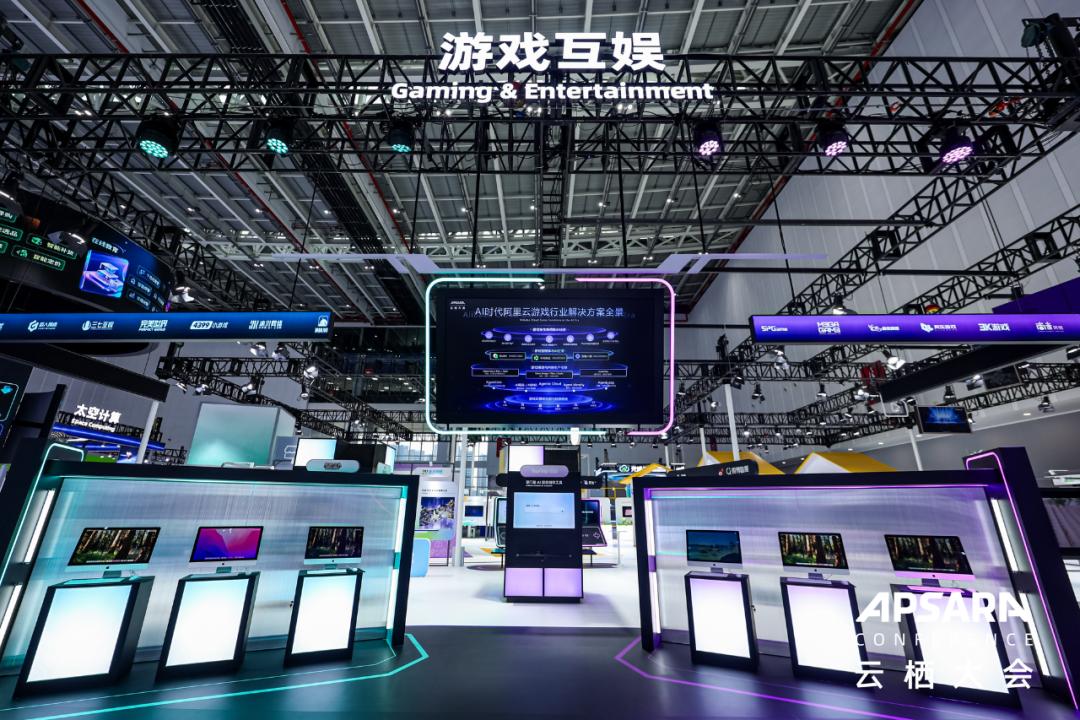
The gaming exhibition area at the Apsara Conference
After visiting the gaming exhibition area, my most intuitive feeling is that the transformation of the gaming industry by AI is evolving from scattered single-point attempts to more systematic penetration. This change is not limited to using AI to generate game assets or codes to cut costs and shorten development cycles, but covers the full link from technical infrastructure, game design, R&D to distribution.
Behind these explorations and innovations, Alibaba Cloud has ranked first in China's game cloud market for 5 consecutive years, serving hundreds of millions of players around the world, and also ranks first in China's game cloud model service market. This means that the current discussion on the relationship between AI and games is no longer a cloud vendor chasing a temporary trend, but a market leader systematically promoting AI as the next infrastructure direction.
The transformation of the gaming industry by AI seems to have reached the critical point from quantitative change to qualitative change.
AI That You Can Directly "Play"
The most intuitive changes come from the parts where you can directly "interact with AI".
The game products exhibited this time do not rashly build a completely different AI gameplay from scratch. Instead, based on the existing mature game mechanics and user demands, they convert the interactions that rely on fixed operations into dynamic AI gameplay based on natural language.
The AI-native game History Simulator: Chongzhen is a typical case. It is essentially a historical simulation strategy game, with familiar systems such as maps, quests, resources and characters on its interface. The difference is that players no longer only choose from the preset options made by designers, but can directly write imperial edicts in natural language to change the course of history. The Qwen large model will combine the historical background, character relationships and the current state of the game world to deduce the impact of the edict, and then make corresponding changes to the national treasury, people's livelihood, military and even NPC reactions.
For this type of game, what AI truly expands is not just the content volume of the game, but the boundary of player behavior. In the past, what a strategy game allows players to do largely depends on how many rules and branches the developers have written in advance; now, natural language has become the interface connecting players' intentions and the game world. Even without building a huge 3D scene, the natural language-based interaction method and dynamic changes of the world state can bring players an immersive sense of "holding power in their hands".
Similar changes are also taking place in AI game products of emotional companionship type.
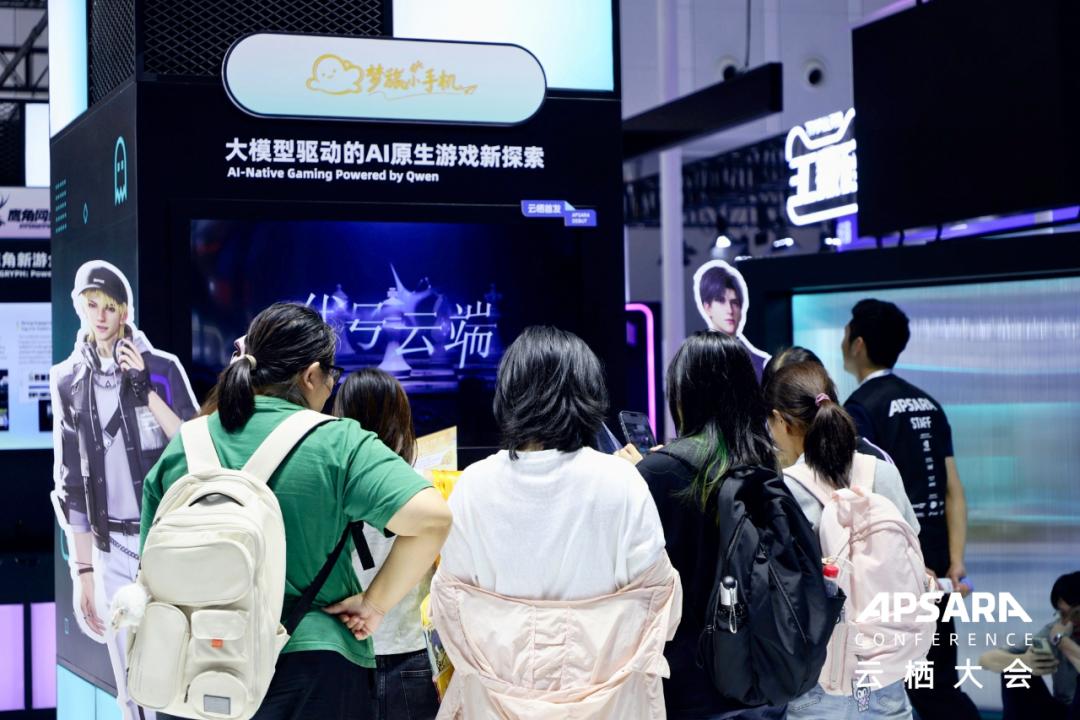
"Dream Travel Mini Phone" booth
The "Dream Travel Mini Phone" booth for Code: Cloud is almost the most popular spot in the entire gaming area, showcasing the early experience version of the AI chat function in the game. Players can chat, date and interact with characters, and also receive messages actively sent by the characters.
For otome games, content such as dating, chatting and companionship already have relatively mature design paradigms. The changes brought by AI are more reflected in the exclusivity and continuity of interaction: the product tries to make the words players have said and the experiences they have had with the characters affect subsequent interactions. The characters can also take the initiative to send messages, instead of only waiting for players to trigger fixed plots.
Another direction that has gradually matured is the in-game Agent similar to AI assistants or AI teammates.
Compared with pure text interaction, this type of application requires AI to understand multi-dimensional information: what the player said, where the player is currently located, what is happening around, what the current task is, and what game capabilities can be called next.
The intelligent partner system for Minecraft China Edition exactly demonstrates this capability. It can understand the natural language intentions of players, make judgments combined with the location, environment and tasks in the game, and then call the in-game capabilities to assist players in achieving their goals.
The technical difficulties of this type of in-game Agent are not limited to the model itself. It also requires a stable operating environment, context and memory, tool invocation, safety guardrails, as well as operation observation and quality control after launch.
All these transformations of AI on the game product side do not change the core structure of games, but seize and optimize the parts in traditional games that originally relied heavily on manual presets. In essence, what AI changes is how the game world responds to players, how characters get along with players, and when players put forward demands beyond the preset functions, whether AI can act as an assistant or partner to expand more possibilities for players.
Perhaps before more underlying technologies such as world models continue to mature, AI game products will still move forward along this line of thinking, continuing to explore which game links are most suitable for AI to take over, and how to convert the capabilities brought by AI into content that players are willing to experience.
Build a Solid Foundation to Let AI Run on It
To truly integrate AI into game products and R&D pipelines, a set of infrastructure that supports long-term model operation is required first.
What Alibaba Cloud's gaming industry solution presents is a full-stack capability map from bottom to top. The bottom layer is the game cloud infrastructure, including computing, storage, network, database, cloud native and cloud security, which is responsible for supporting the stable operation of games and AI applications. The upper layer is the Agent-oriented infrastructure, which provides operating environment, model routing, safety guardrails, identity and tool management, context memory and operation observation for game agents.
On the basis of these two layers of foundations, what supports the entire AI gaming capability is the upper-layer model and content production engine. Different large language models such as Qwen3.8-Max/Flash are responsible for text understanding, reasoning and generation; Qwen-Image-3.0, Qwen-Audio-3.0 and WAN3.0 cover multimodal production of images, videos and audios; the Qwen AI platform encapsulates these model capabilities into directly callable services.
The underlying model is no longer an isolated single point, but a capability matrix layered by scenarios and combined according to demands.
It is worth noting that the integration of AI into the gaming industry does not rely on a single model to solve all problems, but requires mutual support of four layers: infrastructure, model, Agent and application. The underlying cloud provides computing power and stable operating environment, the model layer provides understanding and generation capabilities, the Agent layer is responsible for assembling these capabilities into long-running and callable agents, so that the top application layer can truly land on products that players can perceive. This layered capability map evolves the penetration of AI in the gaming industry from a single-point tool to a system-level project.
With all-round technical support, corresponding technical footholds can be found from testing to operation.
The global launch of Arknights: Endfield is a direct reflection of the cloud support capabilities.
The highlight of the Hypergryph booth is Alibaba Cloud's support for the global launch of Arknights: Endfield. The cooperation value demonstrated by the exhibition includes access for players in multiple regions, elasticity at peak launch time, as well as basic capabilities of computing, network, data and security.
These basic capabilities are often not easily perceived by players, but they are related to the connection and service experience when the game is launched globally.
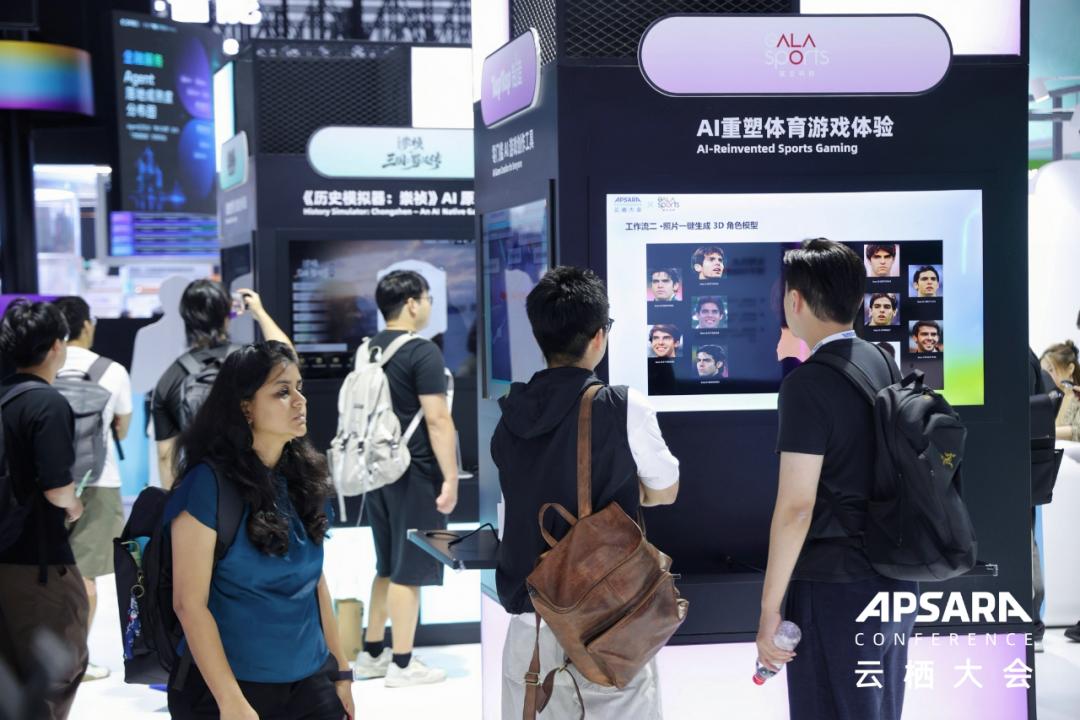
Galactic Sports booth
As a developer deeply engaged in the sports gaming track, Galactic Sports showcases two typical scenarios this time: taking multiple character photos as input to reconstruct facial features and generate 3D characters; extracting athletes' bone movements from real game videos to form motion materials. In the past, these tasks often required a lot of manual collection and adjustment; now AI undertakes the repetitive and tedious parts, accelerating the production of character and motion assets, while the generated results still need to be reviewed and refined by professional teams.
If what Galactic Sports demonstrates is how AI enters specific game production links, then what TapTap Creator demonstrates is how AI restrings these scattered capabilities into a complete production chain.
Starting from a one-sentence creative idea, the site demonstrates the full creation link from code, art, audio, dubbing, translation, promotion to final release. TapTap Creator connects natural language dialogue, game production, preview debugging and release. AI here is no longer just an efficiency tool for a single link, but also an interface that connects the entire game creation process.
The Apsara Conference site showcases a lot of working Agents for the "super individuals" in the AI era. To some extent, TapTap Creator is also the "super individual" game creation infrastructure in the gaming industry, which disassembles and encapsulates the originally highly specialized and vertical capabilities, and then re-connects them through AI, allowing creators to control this complex R&D pipeline through natural language.
Epilogue
Apart from the gaming exhibition area, we have also seen many other upstream technical achievements related to games. For example, in the adjacent film and television interactive entertainment exhibition area, we see that AI has made it possible for TV series to be interactive, and product forms are beginning to approach the interactive films in the gaming industry.
Of course, games inherently have the characteristics of interaction, real-time feedback and digital world that are naturally suitable for AI to give full play to their strengths, while media such as film, television, audio and video are also gradually acquiring some capabilities that originally belong to games through AI. As a result, the two fields are converging based on AI: audio and video content can enter the game production pipeline, and the film and television industry can also explore new forms of interactive entertainment.
The more upstream changes come from the models themselves.
Whether it is multimodal generation models for audio, image and video, or world models evolving towards more complex environment understanding and generation capabilities, they are constantly expanding the boundary of "what AI can understand and generate".
The Apsara Conference site also showcases the open world model "HappyOyster", whose interactive interface is similar to the operation interface of 3D RPG games. In other words, when the model can process space, characters, behaviors and environments, the objects it faces can expand from images, texts or single 3D assets to interactive and continuously changing digital worlds.
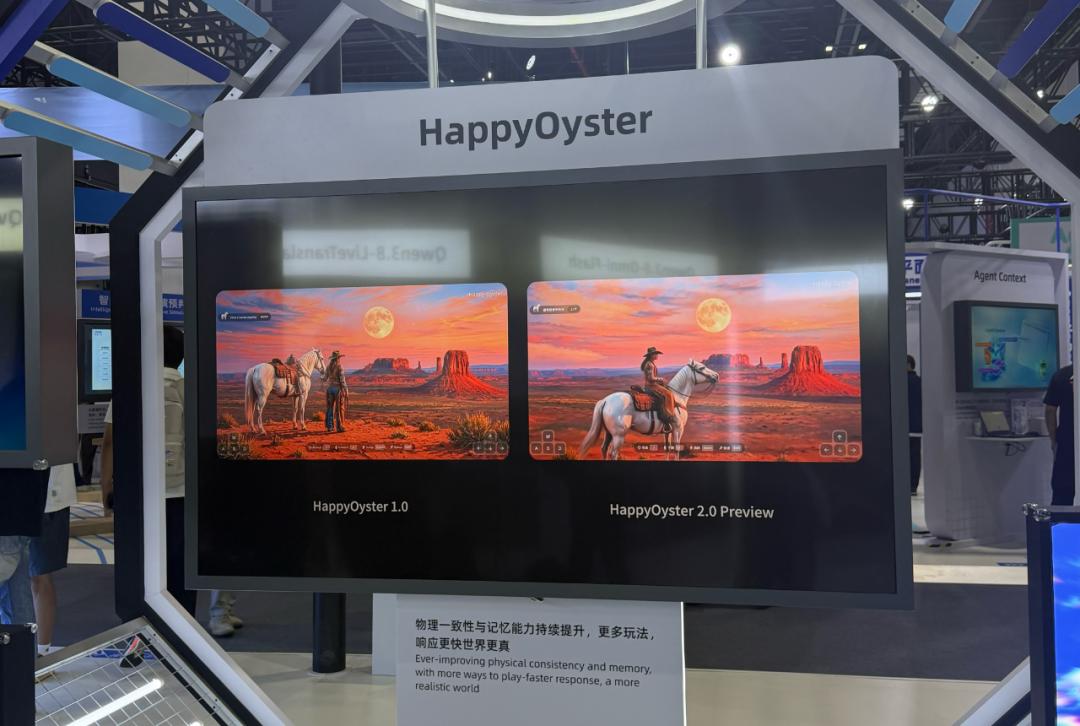
"HappyOyster" booth
At this stage, the relationship between AI and games will also change. The AI model is not only a tool on the game R&D pipeline, but may replace the pipeline and become the game itself that is being generated.
Looking back from the gaming exhibition area at the Apsara Conference, you will find that a more and more complete link has been formed from cloud infrastructure, to Agent, to models and specific game products.
What is worth observing in the future is no longer "whether AI can make games", but what other possibilities games as an important digital medium can have when these capabilities gradually mature.