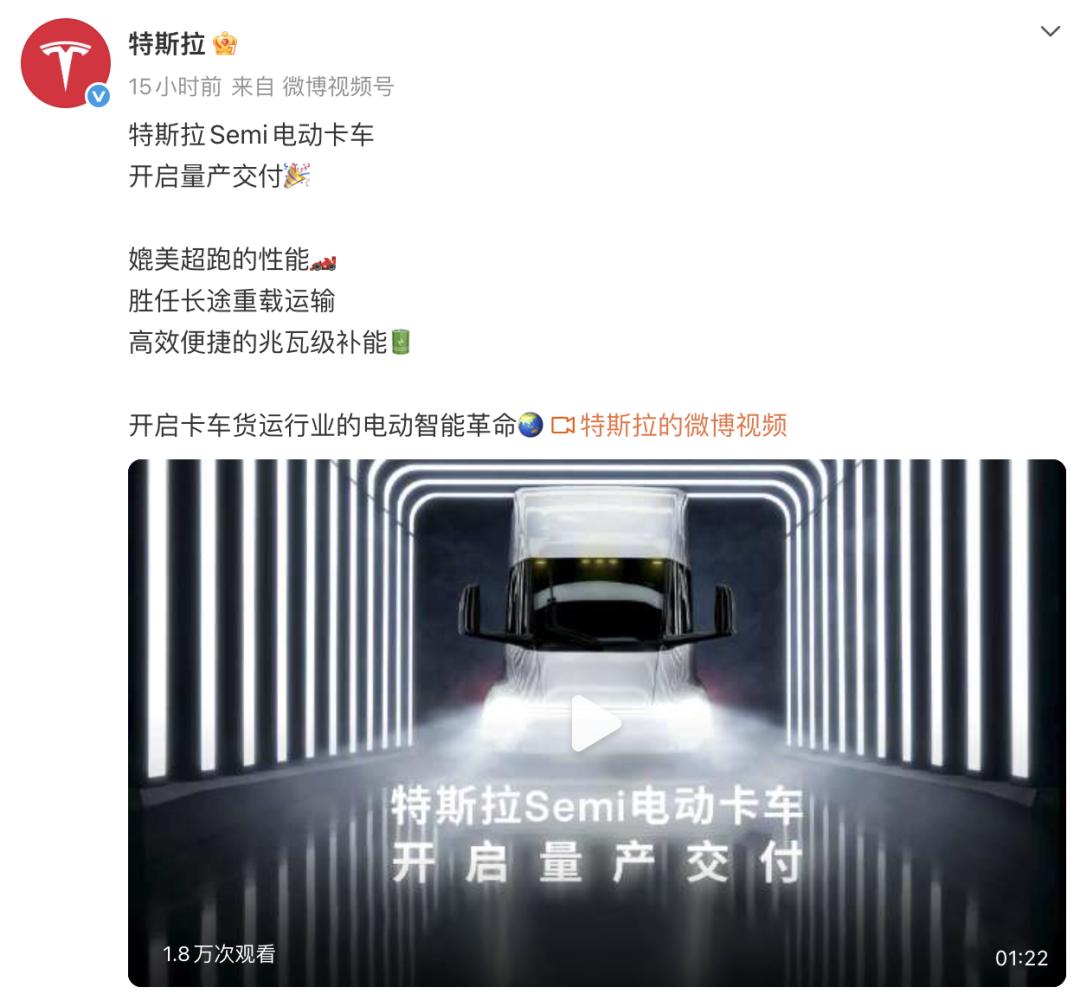
After nearly a decade of delays, the Tesla Semi has finally entered mass production.
Tesla's heavy-duty electric truck Semi, which was nearly a decade behind schedule, has officially entered mass production, and the first batch of customer deliveries kicked off this week. Against the backdrop of declining sales and mounting pressure on its brand image, whether this product can deliver on its original commitments is of great significance to Tesla.
On the evening of this local Thursday, Tesla held a delivery event at its dedicated Semi factory in Sparks, Nevada, announcing that a number of new and existing customers including PepsiCo, DHL, US Foods, WattEV, ABF, Einride, IMC and OK Produce have joined the order list.
Elon Musk said that the "waitlist for the Semi is quite substantial", and encouraged more customers to place orders, adding that "we are extremely excited".
Tesla stated that the annual production capacity of this factory reaches 50,000 units, equivalent to 1,000 units per week. At the technical level, Tesla released several figures that exceed the original targets: a range of 500 miles under full load, and up to 600 miles under lighter loads; energy consumption is about 15% lower than the original design target, at around 1,700 watt-hours per mile.
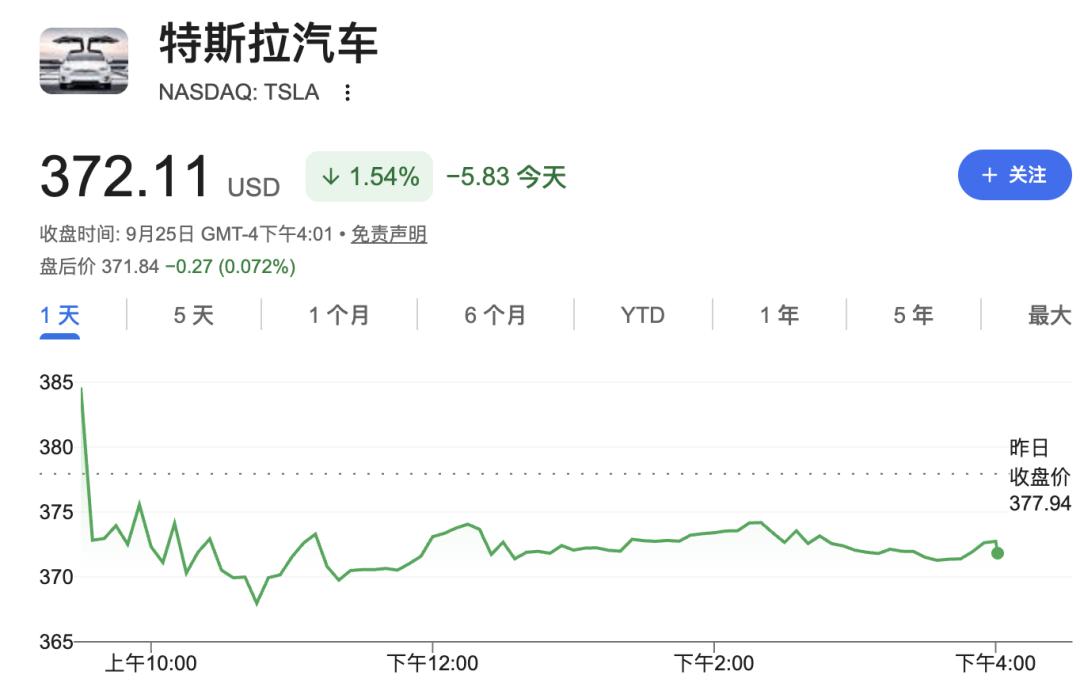
On Friday, Tesla's stock opened higher and moved lower, closing down 1.54%.
After a Decade of Delays, the Semi Officially Enters Mass Production
Tesla Semi made its debut as a concept vehicle in 2017, and after multiple subsequent delays, it did not enter mass production until April 2026.
This event was held at the dedicated Semi manufacturing site adjacent to the Nevada Gigafactory, and Tesla said the facility has an annual production capacity of 50,000 units.
On the eve of the event, a YouTube blogger flew a drone over the factory and leaked the list of multiple customers in advance. At the official event, Tesla confirmed that PepsiCo, DHL, US Foods, WattEV, ABF, Einride, IMC and OK Produce have all been included in the customer list.
Among them, autonomous truck startup Einride announced an order for 500 units last August; logistics enterprise IMC said earlier this week that it will purchase 50 units for port shuttle operations in California; this Monday, Tesla was also selected to supply 2,500 trucks to the "world's largest cargo owner alliance" to serve zero-emission freight operations in California.
Tesla did not disclose the total order volume and starting price, but Musk's remarks suggest that there is no shortage of demand on the customer side.
Engineering Upgrades: Higher Efficiency, Lighter Batteries
A large part of the event focused on the technical details of the Semi.
Dan Priestley, Engineering Director of Tesla's Semi truck, emphasized that the 500-mile range figure comes from full-load tests, rather than light-load tests where the range increases as cargo weight decreases, which is different from the industry's common calibration method. Lars Moravy, Tesla's Vice President of Engineering, said that when the load weight drops to about 60,000 pounds, the range can be further extended to approximately 600 miles.
In terms of battery technology, the Semi abandons the 2170 cells purchased for previous test versions and uses Tesla's self-developed 4680 cells. Tesla said that combined with the improvement of vehicle efficiency, this adjustment achieves a simultaneous reduction in battery pack weight and capacity without sacrificing range, which helps control costs.
The overall vehicle energy consumption has dropped from the initially set 2,000 watt-hours per mile to about 1,700 watt-hours per mile, a decrease of about 15%. Tesla also launched multiple range configurations to meet the needs of different operation scenarios, instead of only relying on a single long-range version.
Advancing Charging Network Construction to Avoid Risks from Diesel Price Fluctuations
The Semi is equipped with a huge battery pack with a capacity of 822 kWh, which requires higher-power charging infrastructure for support.
Tesla is pushing forward the construction of the Megacharger network, with a single charger delivering a maximum output of 1.2 megawatts. At the event site, Dan Priestley and Lars Moravy demonstrated in real time that it only took about 30 minutes for a Semi to charge from 3% to 60% on the new megawatt-level charging pile.
Tesla said that more than 30 Semi charging stations with a total of over 200 megawatt-level charging piles will be completed before the end of the year, while also supporting customers' self-built overnight charging solutions. The rollout speed of the charging network will directly affect the actual operational feasibility of freight customers.
In terms of cost logic, Tesla positions the Semi as a product with low total ownership cost, and its core arguments include lower electricity costs, fewer maintenance parts, and avoidance of exposure to diesel price fluctuations. Lars Moravy said at the event:
"Oil and diesel prices have historically been volatile. But over the past 20 years, electricity prices have remained largely stable. Wouldn't it be better if we could lock transportation costs at a steady level?"
In addition, Tesla has also launched functions such as cross-vehicle synchronization of driver profiles and dynamic load-based range prediction to improve fleet management efficiency.
Reputation Restoration and Execution Capability Remain the Biggest Test
Despite relatively positive demand signals, the core challenge facing Tesla lies in the execution aspect. Some freight customers have waited for several years, and any further delivery delays will exacerbate the outside world's doubts about the company's ability to keep its promises.
Tesla claims that its existing Semi fleet has an uptime rate of more than 98%, which is better than the 90% to 95% average level of the diesel heavy truck industry, and has built a dedicated service system for the Semi, covering mobile services, remote diagnosis and OTA software updates.
However, the above data comes from an early fleet of limited scale, and it remains to be verified whether this level can be maintained after large-scale mass production.
Against a more macro market backdrop, Tesla is in a period of dual pressure on its brand image and sales figures. As the company's first mass-produced product in the heavy commercial vehicle sector, the market performance of the Semi is not only related to the expansion of this niche track, but will also become an important reference for investors to evaluate Tesla's execution capability and product innovation momentum.
This article does not constitute personal investment advice and does not represent the views of the platform. The market is risky, and investment requires caution. Please make your own independent judgment and decision.
This article is from the WeChat official account "Wall Street CN", author: Yang Chen, published with authorization from 36Kr.