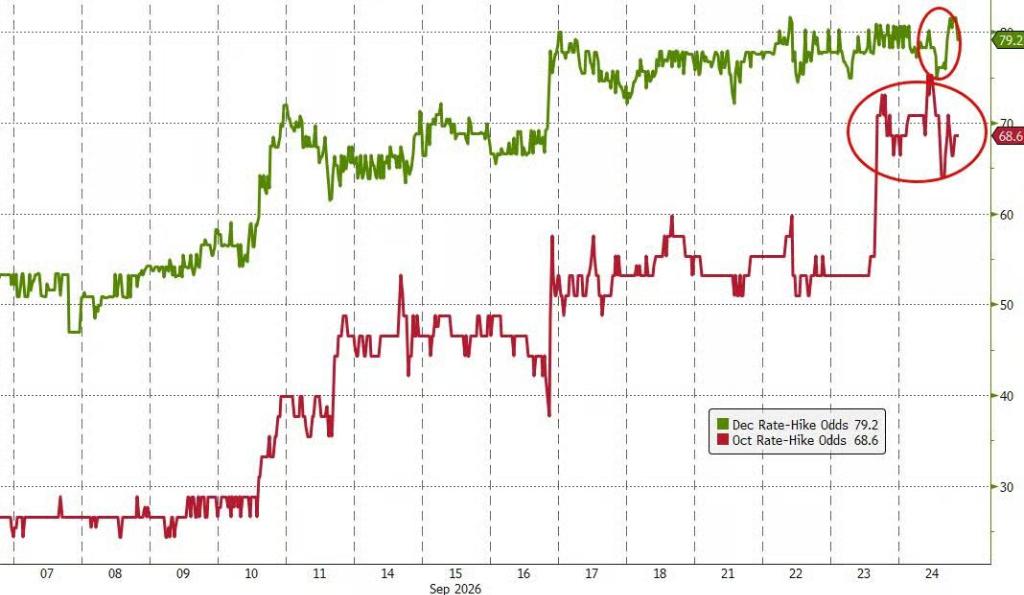
Three officials of the Federal Reserve made hawkish remarks on the same day, and the market's expectation of an interest rate hike in October rose to 69%
Multiple Federal Reserve officials have made intensive statements recently, warning that inflation remains persistently high and the current policy stance may still be insufficient to push prices back to the 2% target, which has sharply heated up market expectations for a rate hike in October.
On Thursday, Philadelphia Fed President Anna Paulson explicitly stated that if the economic situation evolves as expected, "a modest further tightening of policy may be necessary". New York Fed President John Williams also said in his speech on the same day that another rate hike before the end of the year is "reasonable" and more efforts are still needed to bring down inflation.
The statements of the two are highly consistent with the Fed's policy tone last week — the Federal Open Market Committee (FOMC) unanimously agreed to raise interest rates by 25 basis points at its last meeting, and released forecasts showing that there will be at least one more rate hike within the year.
Driven by the above statements of officials and recent strong economic data, the probability of investors expecting a rate hike in October has risen from 53% last weekend to about 69%. The Fed's next policy meeting will end on October 28, only six days before the midterm congressional elections.
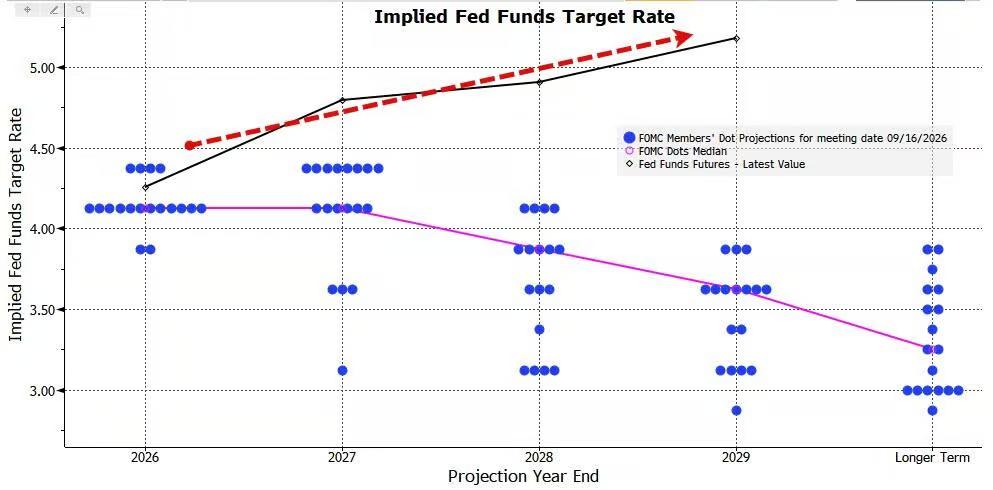
At present, the market's pricing of the terminal interest rate is significantly higher than the latest Fed dot plot.
Inflation Remains Sticky, Officials' Rhetoric Turns Hawkish
Speaking at an event in Philadelphia, Paulson said that the core inflation index excluding energy and food is still "stubbornly high", currently running in the range of about 2.5% to 3%, with almost no sign of converging to the 2% target.
"The best thing I can say about core inflation this year is that it has not continued to worsen," Paulson said. "Against this backdrop, the risk of persistently high inflation has risen."
She also pointed out that the US economy has shown strong resilience, with robust output growth and the labor market close to full employment, even showing signs of "gathering momentum". But this favorable situation also means that monetary policy has enough space to focus on the inflation control target without weighing too much on the downside risks to the economy.
Cleveland Fed President Beth Hammack also emphasized on the same day that in an environment where inflation has been high for a long time, successive external shocks will significantly increase the risk of "inflation expectations unanchoring".
Fed Governor Michael Barr said on Wednesday that "further policy adjustments are likely to be necessary" to ensure that inflation returns to the target in a timely manner.
Richmond Fed President Tom Barkin said on Tuesday that cooling inflation will not happen overnight. Supply-side shocks have evolved from "temporary" to persistent pressure, and there is a risk that the high inflation level will be solidified and transmitted to future expectations.
Multiple Supply Shocks Overlay, Inflation Pressure Sources Are Complex
Fed Chairman Walsh made a brief and tough statement at last week's press conference, saying, "Our main focus is on the mission goal of price stability. It is an indisputable fact that inflation has been too high for too long."
From the perspective of inflation drivers, measured by the Personal Consumption Expenditures (PCE) price index, the US inflation rate was 3.7% year-on-year in July.
Hammack pointed out that current inflation is largely driven by the aftermath of trade tariffs and the surge in energy prices. At the same time, price pressures related to conflicts in the Middle East and the demand driven by the construction of artificial intelligence data centers also constitute new sources of inflation.
Paulson added that although the direct impact of tariffs on consumer prices has eased, overall wage growth is still moderate and does not pose additional labor cost-driven inflation pressure.
Divergence Emerges Between the White House and the Federal Reserve
The intensive signals of rate hikes have begun to trigger public dissatisfaction from the White House. US National Economic Council Director Hassett said on Wednesday that the Fed is "extraordinarily partisan", saying that "over the past few days, many officials who were not appointed by President Trump have made speeches saying that more rate hikes are needed."
This statement marks a further explicit manifestation of the tension between the White House and the Federal Reserve.
Paulson is a voting member of the FOMC this year, and the collective statements of many of the above officials show that there is a relatively broad consensus within the Fed's policy committee on the direction of continued tightening.
This article does not constitute personal investment advice and does not represent the position of the platform. The market is risky, and investment requires prudence. Please make independent judgments and decisions.
This article is from the WeChat official account "Wall Street CN", Author: Yang Chen, published with authorization from 36Kr.