Collective crash, what's wrong with the optical communication industry?
On September 28, the first trading day after the Mid-Autumn Festival holiday, the optical communication sectors of the A-share and Hong Kong stock markets, which had been surging all the way before, ushered in a sharp plunge.
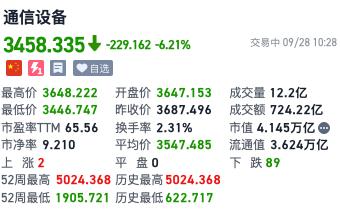
(Performance of the communication equipment sector; Futu NiuNiu)
As of press time, the Shanghai Composite Index fell by more than 1 percentage point, the ChiNext Index dropped by more than 3 percentage points, while the leading stocks suffered even steeper losses: Innolight fell 6.22% to close at 840.15 yuan, with a total market value of 990 billion yuan, falling below the trillion-yuan mark; Eoptolink dropped 5.47%, and TFC declined 7.09%.
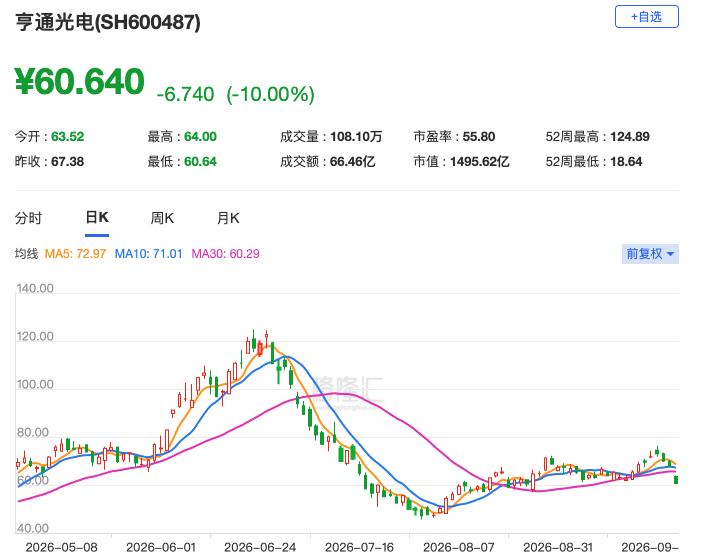
(Trend of Hengtong Optic-Electric; Gelonghui)
In sub-segments, the optical fiber leading stock Hengtong Optic-Electric hit the 10% daily limit down, FiberHome Technologies also fell by the maximum allowed limit, and Yangtze Optical Fibre and Cable dropped 7.92%. The Hong Kong stock market saw even steeper declines, with Yangtze Optical Fibre and Cable Joint Stock Limited Company plunging by more than 11.64%.
As of press time, the net outflow of main funds from the two markets exceeded 410 billion yuan, and the communication equipment sector ranked first in net outflow across all industries with 98.6 billion yuan.
This sharp drop did not happen without reason. Tracing to the root cause, it is mainly the resonance of three negative factors under the risk-aversion atmosphere before the holiday.
The first negative factor comes from overseas policy disturbances.
On September 25, Eastern Time, several U.S. senators jointly submitted a bill named S.5548, which proposes to ban the federal government from purchasing related products from Chinese optical module enterprises such as Innolight and Eoptolink for national security systems. This directly triggered market concerns about enterprises with extremely high overseas revenue proportions.
Secondly, it comes from the selling pressure brought by individual stock financing.
Hengtong Optic-Electric issued an announcement, planning to issue shares to specific targets to raise no more than 66.36 billion yuan. This private placement brings the expectation of nearly 30% equity dilution. At the same time, the company's operating cash flow was negative in the first half of the year, but it planned to use about 20 billion yuan of the raised funds to supplement working capital, which triggered the market's doubts about the company's cash flow and the exacerbation of future overcapacity in the optical fiber industry, directly crashing the sector sentiment.
The third negative factor is the valuation pressure transmitted by the delayed delivery of North American computing power infrastructure.
Recently, Oracle issued a force majeure notice to data center developers, stating that due to the rejection of the natural gas pipeline approval leading to insufficient power supply, the project may not be put into operation as scheduled in 2028.
Subsequently, Oracle's $18 billion syndicated loan saw discounted sell-offs, and the credit default risk indicator soared. This event made institutional investors realize that computing power data centers not only need to secure orders, but also need guaranteed power supply and delivery on schedule.
When the construction progress is stuck in power supply and approval, the market's expectation for the subsequent procurement pace of optical modules begins to shake, and the optical module stocks that have risen sharply in the early stage are thus facing severe valuation adjustments.
The superposition of these three negative factors directly dealt a heavy blow to the overheated optical communication sector.
However, investors still need to view the actual impact rationally.
Take the S.5548 bill as an example. At present, it is only in the proposal stage, and there is still a long process before it is finally passed. More importantly, the scope of restrictions of this bill is strictly limited to national security systems such as confidential and military systems, ordinary commercial data centers are not included.
The five-year transition period and exemption clauses set in the bill precisely show that the North American market cannot get rid of the production capacity support of Chinese optical modules in the short term.
From the perspective of industry fundamentals, the order schedules of leading companies such as Innolight and Eoptolink are still relatively full. This sharp drop is more the result of the combination of high-position selling and multiple risk factors.
Facing such short-term large fluctuations, we should not only pay attention to the actual risks brought by cash flow, overseas policies and delivery progress, but also do not need to panic and completely deny the subsequent potential of the sector. Calmly sorting out which are sentiment discounts and which are real fundamentals is a more prudent response approach.
This article is from the WeChat official account "Gelonghui APP" (ID: hkguruclub), author: Gejila, published with authorization from 36Kr.