Institutional Restructuring: Where Is the Foothold of Real Estate Market Policies?
In the third quarter of this year, real estate policies continued the tone of "stabilizing the property market". Multiple central government departments intensively issued a series of documents on real estate system reform, reconstructing basic systems for real estate development, financing, and sales, and promoting the implementation of the existing-home sales system, project company system, and host bank system. Meanwhile, the *Regulations on the Administration of Housing Provident Fund* has completed systematic revisions, expanding the scope of withdrawal and use and broadening the coverage of the system. In the third quarter, various regions actively optimized property market policies. According to monitoring by the China Index Academy, more than 280 optimization policies were issued across the country in the third quarter, with the policy focus concentrated on stimulating demand release, optimizing supply, and advancing urban renewal. Looking ahead to the fourth quarter, it is expected that all regions will accelerate the implementation of detailed rules for the real estate system reform, and improve policies from both the supply and demand sides to stabilize the market. On the demand side, the optimization of provident fund policies will be accelerated, and more cities will deepen the "trade-in" policy for housing and increase housing purchase subsidies. On the supply side, while strictly controlling new land supply, greater efforts will be made to revitalize the stock and implement the policy on the renewal of the right to use industrial and commercial land. In addition, supporting policies for urban renewal will also be a key direction of policy efforts across regions.
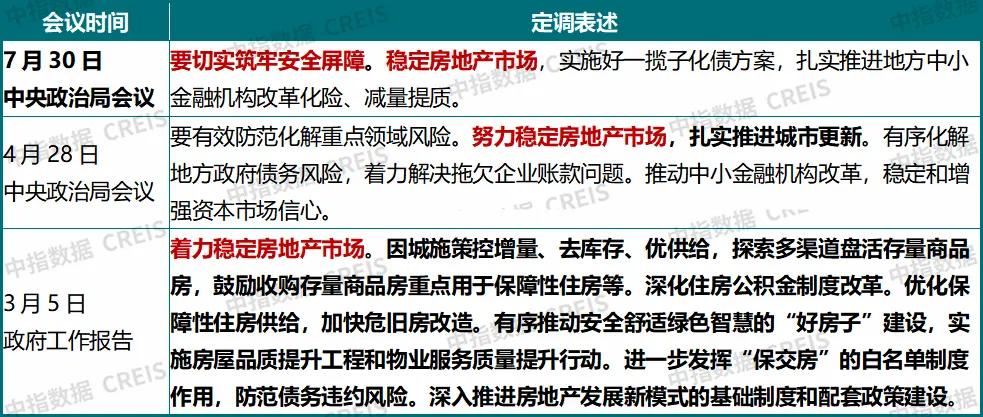
Table: Summary of the real estate policy orientation of important central-level conferences since 2026
Data source: Comprehensive collation by China Index Academy, CI Buddy
At the central level, real estate policies in the third quarter of this year are mainly focused on three dimensions. First, the "market stabilization" orientation is continued. The meeting of the Political Bureau of the Central Committee held on July 30 once again emphasized "stabilizing the real estate market", and incorporated the real estate sector into the framework of "effectively building a solid security barrier", further highlighting the importance of stabilizing the real estate market in the overall framework.
Second, landmark documents for real estate system reform have been released, and substantive progress has been made in accelerating the construction of a new real estate development model. On August 28, multiple departments including the Ministry of Housing and Urban-Rural Development, the Ministry of Natural Resources, and the State Administration of Financial Regulation intensively issued the "1+2+5" policy documents, which comprehensively reconstruct the basic systems of real estate development, financing and sales from sales and credit to capital market financing, marking the end of the old real estate development model and the accelerated construction of the new model.
Third, the revised *Regulations on the Administration of Housing Provident Fund* has been implemented, and the housing provident fund is further transformed to support full-cycle housing consumption. On August 18, the *Decision of the State Council on Amending the Regulations on the Administration of Housing Provident Fund* was released, containing 20 articles, which mainly include expanding the scope of withdrawal and use, improving the efficiency of management services, strengthening risk prevention and control, and expanding the coverage of the system.
In addition, after the release of the five-year urban renewal plan in June, the frequency of mentions of urban renewal in the third quarter also remained at a high level. On July 15, General Secretary Xi Jinping emphasized during his inspection in Shanghai that high-quality promotion of urban renewal is an important starting point for urban modernization. On September 8, the State Council held a special study session, where Premier Li Qiang emphasized that "urban renewal has become an important starting point for urban work at the current stage" and "adhere to the people-oriented principle to promote urban renewal with high quality". On September 18, the Ministry of Housing and Urban-Rural Development once again emphasized at the press conference of the State Council Information Office that "great efforts will be made to implement urban renewal".
At the local level, the frequency of policy issuance across all regions remained at a high level. According to monitoring by the China Index Academy, as of September 24, more than 870 real estate-related policies have been issued nationwide, of which more than 280 were released in the third quarter, continuing the high-frequency implementation trend of policies in the first half of the year. Local policies are mainly focused on three major directions: activating demand, optimizing supply, and promoting urban renewal, mainly involving optimizing restrictive policies, adjusting provident fund policies, issuing housing purchase subsidies, revitalizing stock housing, constructing "high-quality housing", and implementing supporting policies for urban renewal.
Figure: Frequency of city-specific policy implementation across regions since 2024
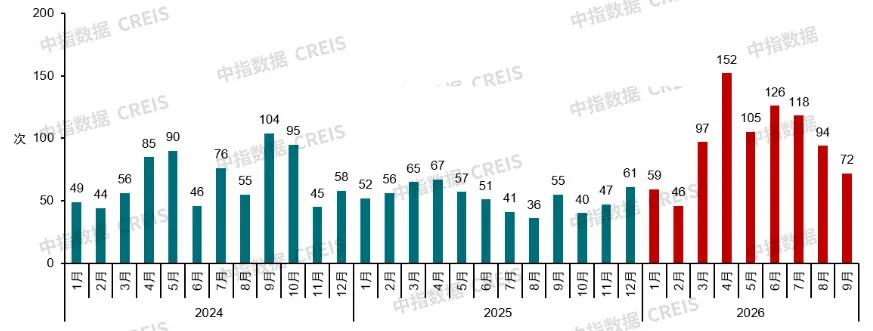
Table: Comparison of issuance frequency of major policy types since 2026 (as of Sep 24)
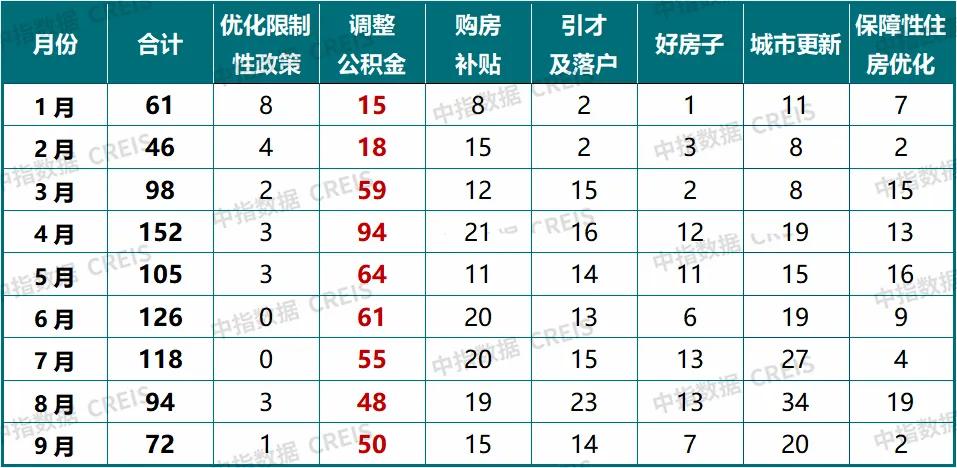
Note: One policy in the total column may cover multiple dimensions. Data source: Comprehensive collation by China Index Academy
01
Real estate system reform was implemented on August 28, and supporting detailed rules across regions are pending for implementation
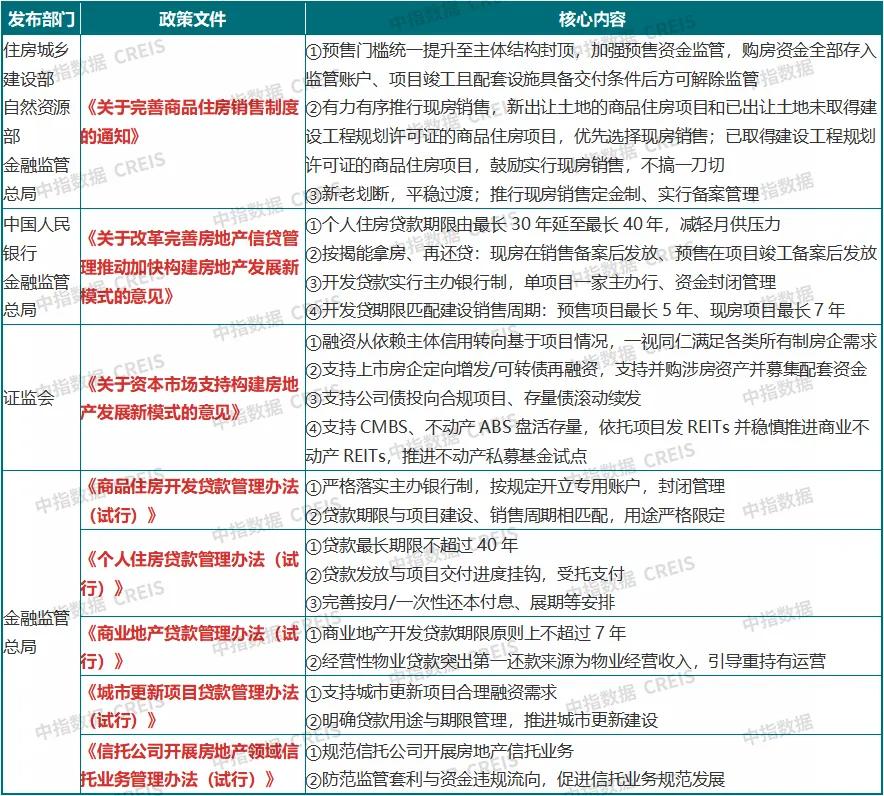
On August 28, multiple departments including the Ministry of Housing and Urban-Rural Development, the Ministry of Natural Resources, and the State Administration of Financial Regulation issued the "1+2+5" policy documents, which comprehensively reconstruct the basic systems of real estate development, financing, and sales, and accelerate the construction of a new real estate development model. Among them, the project company system clarifies "who is the independent implementation entity of the project", the host bank system clarifies "who provides project financing", and the existing-home sales system solves the problem of "paying for the house upon delivery", with the three systems promoted in an integrated manner. From the perspective of core policy changes:
First, the sales system reform includes raising the pre-sale threshold, strengthening capital supervision, and promoting existing-home sales in a categorized manner. The pre-sale conditions are uniformly raised to the point where the main structure of a single building is capped, and the specific conditions are determined by local governments according to actual conditions. Meanwhile, all housing purchase funds paid by homebuyers, including down payments and personal housing loans, are deposited into a capital supervision account, and supervision can only be lifted after the project is completed and accepted and supporting facilities such as water, electricity, gas and heating meet delivery conditions. In terms of existing-home sales, commodity housing projects on newly transferred land and on already transferred land that have not obtained the construction project planning permit will prioritize existing-home sales, and commodity housing projects that have obtained the construction project planning permit are encouraged to implement existing-home sales, avoiding a one-size-fits-all approach. At the same time, existing-home sales filing management is implemented and the deposit system is promoted. For a smooth transition, the policy clarifies that for projects that have obtained the construction project planning permit before the implementation date of the policy, the pre-sale conditions and pre-sale capital supervision shall be implemented in accordance with the original policy provisions.
Second, the credit management reform comprehensively optimizes personal housing loans and development loans. In terms of personal housing loans, the maximum loan term is extended from 30 years to 40 years, and the ratio of total monthly debt expenditure to income is relaxed from no more than 55% to no more than 60%. The loan issuance time is bound to the project delivery progress: loans for existing-home sales projects are issued after sales filing, and loans for pre-sale projects are issued after completion filing, realizing that "homebuyers can get the house before repaying the loan". In terms of housing development loans, the host bank system is implemented, where one project determines one host bank and relevant funds are under closed management. The loan term matches the construction and sales cycle: the term for pre-sale projects is generally no more than 3 years, with a maximum of 5 years, and the term for existing-home sales projects is generally no more than 5 years, with a maximum of 7 years.
Third, the capital market financing reform shifts the financing basis to project credit. The China Securities Regulatory Commission has for the first time systematically deployed the capital market to support the construction of a new real estate development model through a special document, promoting the financing of real estate enterprises to shift from relying on entity credit to being based on project conditions, supporting the refinancing and merger and reorganization of listed real estate enterprises, supporting CMBS and real estate ABS to revitalize stock assets, prudently promoting commercial real estate REITs, and allowing the rolling renewal of stock corporate bonds.
Table: Main contents of the policy documents released on August 28
Data source: Comprehensive collation by China Index Academy, CI Buddy
At the "Start of the 15th Five-Year Plan" series of press conferences held on September 18, the Ministry of Housing and Urban-Rural Development clarified that two transformations have taken place in the real estate sector: first, major changes have taken place in the supply-demand relationship of the real estate market, and second, the real estate sector has entered the stock era. From the perspective of the new real estate development model, the Ministry of Housing and Urban-Rural Development clarified the "1234" connotation for the first time: "1" refers to firmly grasping the fundamental goal of ensuring people's housing security, "2" refers to improving both the security system and the market system, "3" refers to the three systems of the project company system, host bank system and existing-home sales system, and "4" refers to promoting the linkage of the four elements of "people, land, housing and capital". At the same time, the Ministry of Housing and Urban-Rural Development emphasized that it will "make every effort to promote the implementation of the three basic real estate systems". The current policy leaves certain space for local governments to implement policies based on local conditions, and the specific implementation rules remain to be clarified by local detailed rules.
Some provinces and cities have introduced supporting measures. On September 24, Beijing took the lead in releasing the implementation detailed rules, clarifying that projects that obtained land before August 28 but have not obtained the construction project planning permit shall be implemented in accordance with the new pre-sale policy in principle, while leaving certain flexible space for each district and arranging a transition period. It stipulates that if the district government ensures that the project can be delivered on schedule, pre-sale can be carried out in accordance with the original pre-sale conditions before the end of 2027, but the mortgage lending conditions will be implemented in accordance with the new policy. It clarifies that the deposit generally does not exceed 1% of the total housing price, and that for projects announced after August 28, the land payment can be paid in installments, with no less than 50% of the total price paid within 30 days, the full amount paid within two years, and no interest accrued. In early September, Henan issued the *Several Measures on Coordinately Promoting Controlling New Supply, De-stocking and Optimizing Supply to Stabilize the Real Estate Market*, which clarifies that for real estate projects that carry out pre-sale in batches but have a low de-sale rate, the approval rhythm of subsequent pre-sale permits will be strictly controlled, the pre-sale threshold will be further raised based on the actual market supply and demand, and existing-home sales are encouraged. Changchun publicly solicited opinions on the *Notice on Several Measures to Stabilize the Real Estate Market (Draft for Comment)*, clarifying that the transfer price of newly transferred residential land can be paid in one lump sum or in installments, with 50% of the down payment paid within 1 month after the contract is signed, and the balance paid no later than one year. After paying no less than 50% of the total price, the planning permit can be applied for and development can be carried out according to the proportion of the paid amount. For projects that have paid the principal of land transfer in full but owe liquidated damages, the "separation of handling and payment" policy is implemented, allowing partial pre-sale according to the proportion of principal and liquidated damages. Dongguan issued the *Notice on Matters Concerning the Implementation of Phased Acceptance of Housing Construction Projects (Draft for Comment)*, which plans to support phased acceptance and delivery.
In addition, since the implementation of the new policy on August 28, cities including Xiamen and Lishui have clarified the implementation of existing-home sales for a few newly listed plots, and provided support in the payment of land transfer fees. For example, the two residential plots announced by Xiamen clarify that the transfer fee can be paid in two phases, with 50% paid within 20 days for the first phase, the full amount paid within 24 months for the second phase, and no interest accrued.
02
Deepen the reform of the provident fund system and implement the revised *Regulations on the Administration of Housing Provident Fund*
On August 18, the State Council officially released the *Decision of the State Council on Amending the Regulations on the Administration of Housing Provident Fund*, marking the most systematic adjustment of the housing provident fund system. This revision continues the main adjustment direction of the draft for comments released in June, greatly expanding the scope of withdrawal scenarios. On the basis of the original scenarios of house purchase, house construction and house rental, new scenarios such as self-occupied house decoration and property fee payment are added, and the payment of rent is no longer restricted by income. At the same time, the coverage of the system is expanded, clarifying that flexible employees can voluntarily deposit housing provident fund. The functional positioning of the provident fund has expanded from mainly supporting house purchase to supporting housing consumption, and further extended to the whole life cycle of housing. The *Regulations on the Administration of Housing Provident Fund* was officially implemented on September 20.
From the local perspective, provident fund policies continue to exert strength and are the most frequent policy tool on the demand side across regions. Since the beginning of this year, more than 460 optimized provident fund policies have been issued across regions, of which more than 150 were released in the third quarter, mainly focusing on raising the loan limit, expanding the scope of withdrawal and use, optimizing the deposit of flexible employees and the deposit of non-local employees. After the revision of the provident fund management regulations, many regions have followed up to support the withdrawal of provident fund for decoration, property fees and other purposes.
In terms of raising the loan limit, Beijing followed up in the third quarter to raise the upper limit of the provident fund loan amount. The maximum loan limit for families where both spouses deposit the provident fund is raised to 2.4 million yuan, and the maximum loan amount can reach 3.4 million yuan after superimposing the floating policy. At the same time, the mechanism linking the loan limit to the deposit period is optimized: now, applicants can apply for the maximum loan limit after 5 years and 1 month of deposit, effectively reducing the housing purchase cost for residents.
In terms of expanding the scope of withdrawal and use, the expansion directions of the policies currently implemented across regions mainly include housing decoration, property fees, housing purchase taxes and fees, parking spaces, and old housing renewal. Beijing supports provident fund withdrawal for decoration, with a maximum of 250,000 yuan per house; Shanghai supports withdrawal for deed tax, parking spaces and storage rooms; Guangzhou plans to support withdrawal for decoration, property fees and old housing renewal. In addition, some cities have optimized the withdrawal for serious illness scenarios. For example, Nanjing canceled the restrictions on the types of serious illness and the number of withdrawals for provident fund withdrawal, and Changsha expanded the scope of serious illnesses eligible for withdrawal to 35 types.
In terms of optimizing the deposit of flexible