NOOKLAB: Free yourself from to-do anxiety with the world's slimmest and lightest portable AI display.
Thirty years ago, Mark Weiser and John Seely Brown from Xerox PARC proposed a concept in their article Designing Calm Technology: calm technology, which refers to technology that provides information without demanding your full focus and attention.
They divide attention into "central" and "peripheral vision". A good technology can flow between the two, entering the center when needed and retreating to the peripheral vision when not in use.
The article cites an example called "Dangling String". Artist Natalie Jeremijenko hung a plastic rope about 2.4 meters long on a motor on the ceiling, which was connected to the nearby Ethernet. When the network is busy, it spins quickly; when the network is idle, it sways gently occasionally. Placed in an unused corner of the corridor, it can be seen and heard by many offices without causing any disturbance.
People do not need to stare at it all the time to roughly perceive whether the network is busy or idle.
But 30 years later, this vision is still difficult to realize. Every application around us is scrambling for attention, and there is hardly any space left for "peripheral vision" on the front of the screen.
In Shenzhen, a startup named NOOKLAB wants to fill this gap.
NOOKLAB's first product is called Moonphase Flip, which is an AI portable screen weighing 54 grams, roughly equivalent to the weight of several credit cards in hand feel. It can be magnetically attached to the back of the mobile phone, supports always-on audio recording, and has a battery life of more than two days. It can imperceptibly record conversations in the real world, understand the people, events and commitments involved, and present them in a low-disturbance way.
Recently, as the angel investor of NOOKLAB, Linear Capital had a chat with Raymond Zhao, the founder of NOOKLAB, at the NOOKLAB office: In the current era where various productivity applications already exist, why do we still need such a hardware to free our mind? What kind of human-centered design aesthetics lies behind the product?
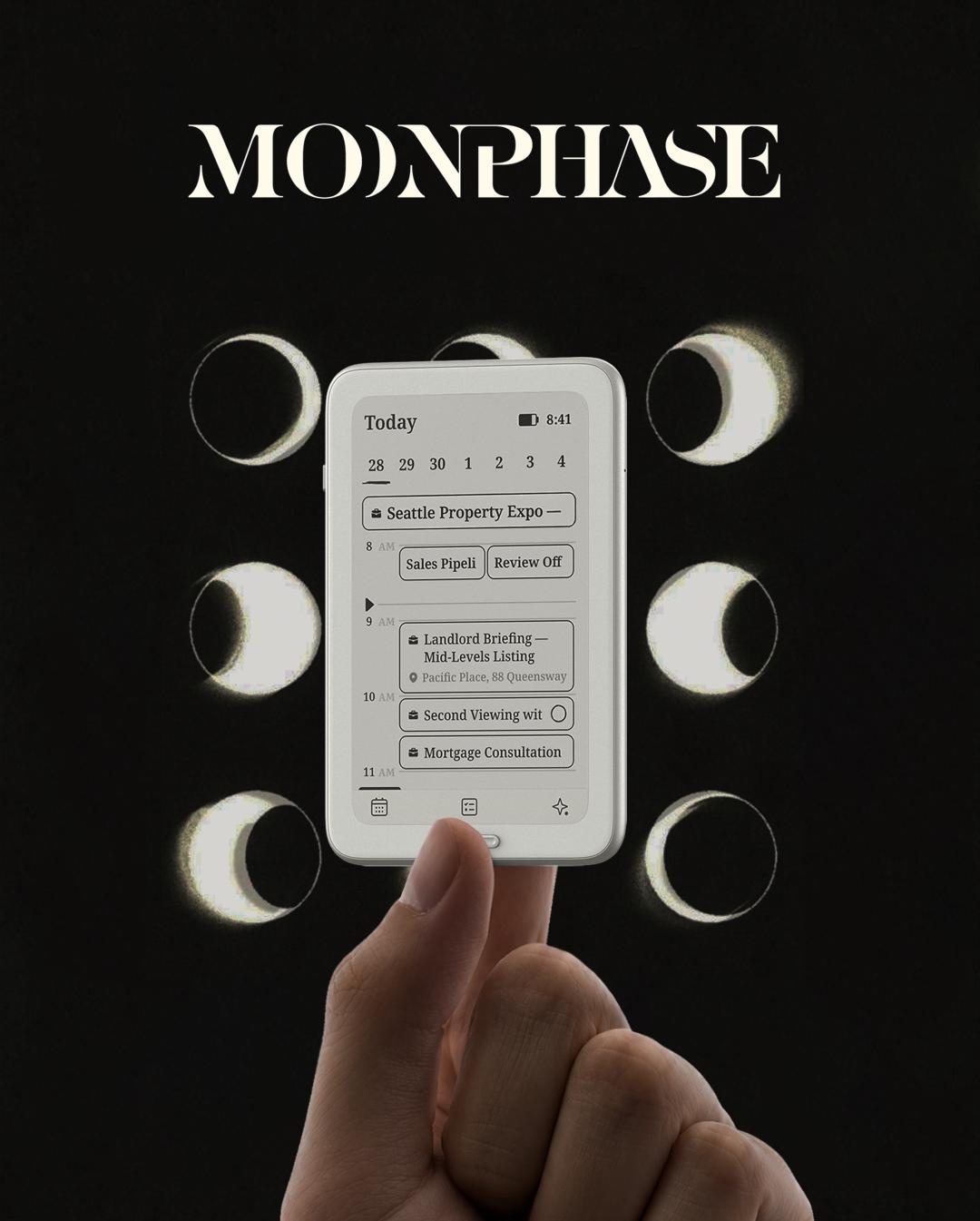
After the offline conversation ends, Moonphase Flip will organize the information into to-do items and display them continuously on the screen. No push notifications, no reminders, you can see it as soon as you flip your phone. The team claims that it is currently the lightest and thinnest AI portable screen in the world, and the first batch is expected to be sold in small batches in December this year.
Raymond, founder of NOOKLAB, defines it as "the world's first low-disturbance AI portable screen". In the past, people had to actively cooperate with tools to record, organize and manage information; now, NOOKLAB wants to let tools actively serve people.
As the company's angel investor, we pay attention to NOOKLAB because it targets a problem that has been solved many times but has never been truly resolved: When AI begins to enter daily life and there is more and more information, what is worth remembering and what is worth actually getting done? Now, let's dive in:
01 Find a New Position for AI
As a hardware product manager with almost strict pursuit of aesthetics, Raymond's team once led 9 products to be sold in official Apple Stores, with an aesthetic standard very close to the Apple ecosystem, and the ability to make products as small as possible. The smallest 3-in-1 wireless charger in the industry to date is still their work.
In October last year, Raymond left ByteDance. There, he was responsible for the second-generation AI glasses product, and he is also a heavy user of glasses himself, with more than a dozen pairs of glasses at home that he wears interchangeably according to different scenarios.
After starting his own business, Raymond first wanted to make innovations in glasses. Until the ID designer produced the 3D prototype, he began to seriously consider through which channel this product should be sold. Glasses need to adapt to the aesthetic and comfort of different people, and also rely on a large number of offline stores. Raymond found that the team might spend a lot of energy on these links instead of creating new value with AI.
After working on it for more than a month, he stopped and asked himself again: Is there a position with low enough friction and high enough value?
The first category that Raymond ruled out was all pure collection devices. "No matter where you put them on your body, they are just collectors. The final service still has to return to the App, and the experience has a certain gap." What Raymond is looking for is not another recording entry, but a position where the results can be directly returned to the user after information collection.
Watches, bands and the back of mobile phones became the final candidates, and the team made designs and samples for all of them. But watches and bands were quickly ruled out. This judgment came from Raymond's experience of making the first smartwatch at OnePlus. At that time, the team had to choose between supporting third-party applications and long battery life. User interviews showed that most people no longer install new apps after buying Apple Watch for a week, and only health, sports and watch faces are used for a long time.
The problem does not lie in the number of applications, but in the position of the screen. The posture of the wrist and the limited display area are not suitable for deep interaction. The OnePlus watch finally chose the long battery life solution, with sales of nearly 300,000 units, far exceeding the initial target of 100,000 to 150,000 units.
In contrast, the back of the mobile phone is a ready-made and stable position. In this scenario, the portable screen can stay with the mobile phone all the time without adding extra wearing burden. As independent hardware, it can continuously record audio, and also provide a screen that is not occupied by other Apps, so that the information sorted out by AI can always be in sight.
Raymond also observed that many people who heavily use AI programming tools will install plug-ins at the notch position on the top of the Mac, allowing AI to conduct phased interactions there. These users actively reserve a position for AI at the edge of the screen.
There is no such space on the front of the mobile phone, so Raymond chose to add a screen on the back.
02 Bring Information Closer to Action
Why does the information generated by people in real life always disappear before reaching the action stage? Probably because information management tools always require you to unlock your phone, and unlocking the phone itself may be the beginning of information loss of control.
The first problem Moonphase Flip solves is to reduce the cost of the "recording" step. It supports always-on audio recording, and users do not need to turn it on and off repeatedly. After a conversation, a one-sentence summary will appear on the screen, as well as 3 to 5 to-do items identified by the system, and users can decide which ones to keep.
This choice itself is feedback. If the user keeps the first and third items and deletes the second, the system can gradually distinguish which things will be actually executed and which are just accidental occurrences in the conversation. As the number of uses increases, the sorting given by this portable screen will be closer and closer to the user's own judgment.
Most software can hardly get such feedback. After the information is generated, it is put back into the App. You save 100 meeting records, but maybe only two of them will be reviewed later. After the information leaves the sight, the system does not know what is important, and users are increasingly difficult to find what is important.
Raymond said: "All information is like being buried in a drawer. You save 100 meeting records, but you may only look at two of them. The content generated inside is so far away from you that it does not know which one is useful to you."
What Moonphase Flip finally organizes is not just a list. It tries to build two clues: one revolves around projects, putting all related information together; the other revolves around people, recording who you have talked to recently, what promises you have made, and what to do next.
Raymond believes: "A good founder, a good salesperson, and a good professional manager must have two maps in their mind. One is for events, the other is for people."
The team once interviewed many CEOs, entrepreneurs, salespeople, lawyers and real estate agents in North America. The work of these people is highly dependent on verbal communication, and one omission may affect income and reputation.
At that time, a real estate lawyer said that because he misheard the information that the father and son in the client's family had the same name, all the relevant content of the entire document was wrong. Another concert planner heard the client ask him to book a flight when he was driving, and planned to deal with it after parking, but he forgot all about it until the day before the event, and finally had to pay three times the price. He said that money was not the worst part. What was more uncomfortable was that such omissions happened again and again, and both work and life would get out of order.
During the interview, the team directly asked one respondent: "The mobile phone can also do these things, why do you think we need a dedicated hardware?"
The user replied: "Every time I unlock the phone, a flood of information comes at me, and I will be distracted. 5 minutes later, I just remember what I was going to do just now."
This is exactly the problem NOOKLAB wants to solve. AI assistants that can only generate value when users "open" them often need to remind users more and more frequently; the more reminders, the lower the value of a single reminder.
In the framework of calm technology, peripheral vision is not the end point of information. The important thing is whether people can bring the information back to the center of attention when needed and act accordingly. Moonphase Flip chooses to leave this action to the user. It does not ask you to come back for information constantly, nor does it try to pull you back to the App through repeated reminders. After the information is generated, it stays on the screen on the back of the phone first; it is up to you to decide whether to deal with it or not.
Therefore, Moonphase Flip hardly does active push notifications. Raymond says it is more like a calendar placed beside you, "you can see it as soon as you glance sideways".
But a "low-disturbance" device must not become a new burden in the first place.
After testing, the team found that devices weighing more than 60 grams are difficult to be carried around by people in real life, so they reduced the weight gram by gram starting from 60 grams, and finally achieved 54 grams. In terms of thickness, the team adopted the space stacking method of foldable screens. The magnetic attraction also did not follow the Apple standard, because the magnetic force of 6 to 9 Newtons will bring a corresponding thickness threshold, and the team finally adopted all non-standard solutions. Excluding sleep time, the actual measured battery life can reach three days.
These data come from Raymond's hardware experience in the past six years. He majored in integrated circuit design for his undergraduate degree, and joined OnePlus to work on mobile phones and smart watches after graduation. When working on "small foldable" mobile phones at OPPO, he accumulated experience in space stacking; his one and a half years of experience working on wireless chargers at Anker made him fully familiar with the engineering details of the MagSafe position.
It was also at Anker that he gradually formed his judgment on product value: "Since AirPods was launched, has it ever talked about its rich functions or sound quality? No. It only focuses on one thing, eliminating the trouble of organizing earphone cables. But after this step is multiplied by countless uses, it makes a huge difference."
For Moonphase Flip, the step saved is no longer organizing cables, but repeatedly unlocking the phone, searching for information, and recalling what you were about to do just now.
03 Return from Peripheral Vision to the Main Line
More than 30 years ago, that rope turned invisible network traffic into a kind of swing that can be perceived but does not require special attention.
Now, what Moonphase Flip wants to handle is another more complex kind of "traffic": intentions scattered in conversations, meetings, messages and daily affairs.
Peripheral vision is not a storage place for information. There is so much information generated in a day, what exactly is worth seeing? What is worth remembering? What is worth actually getting done? Raymond calls this the "main line".
Raymond drew a diagram to explain the position of Moonphase Flip: one end is the model, the other end is the person. The model can output stably as long as it gets enough context; people generate a lot of information every day, but the really important part is difficult to be continuously identified. Raymond places Moonphase Flip between the two.
In the past one or two years, many AI hardware products have emerged in the market. Most products are adding more senses to the device, making it hear more and see more. But Moonphase Flip chooses not to add another collection entry, but to let the results sorted out by AI stay in a position close enough to users without disturbing them.
At the most stressful time in his previous job, Raymond set up a whiteboard at home, with principles written at the top, goals in the middle, and progress of specific items recorded below. When all these contents are put together, he realized that many things that originally seemed urgent and important are actually irrelevant to the goals he most wants to promote.
"I used to think that information is messy and numerous, but in fact, it is not on my main line."
That whiteboard is still in his house now. But the whiteboard requires people to actively manage and check repeatedly. What Moonphase Flip wants to make is its portable version: continuously receive information, help people judge what is worth keeping, and then put important things in sight.
"The Internet has solved the problem of how information reaches everyone," Raymond said, "AI will further lower the threshold for generating new information. In the future, people will face more complex information and capabilities, but this does not mean that our lives will be better, and they may even become more chaotic."
"In the end, everyone has to answer a question: What exactly is important to me? Many people will get lost. Some people will find their own main line." Raymond said.
This article is from the WeChat official account "Linear Capital", author: Linear Capital, published with authorization from 36Kr.