NIO and Geely "joint venture"
The joint venture model of China's automotive industry is undergoing a profound generational shift — it is no longer defined by Chinese and foreign parties, no longer constrained by brands and products, but takes the core technology as the new anchor point.
Two major automakers in East China have announced their cooperation again after a three-year interval.
On September 28, 2026, NIO Holdings Co., Ltd. and Geely Holding Group simultaneously released official announcements: the two sides have reached a comprehensive strategic cooperation in the field of battery swapping and charging around the dimensions of technology, operation and capital.
This is not a simple expansion of the battery swapping alliance, nor a memorandum of understanding for technology and standard sharing. What NIO and Geely are doing is mutual shareholding and cross-investment, with both parties contributing their core energy replenishment assets to build a joint venture.
According to the official agreement between the two parties, Geely Holding Group subscribes for the newly issued equity of NIO Energy Investment (Hubei) Co., Ltd. with its 100% equity in Yiyi Internet Technology (Chongqing) Co., Ltd. plus RMB 640 million in cash.
After the transaction is completed, Geely will hold 30% of the shares of NIO Energy, NIO will retain 63.6% of the controlling stake, and Wuhan Guangchuang Fund will hold the remaining 6.4%; NIO will invest in Geely Haohan Energy with cash and hold 10% of the shares.
As early as 2023, NIO's battery swapping business already "brought" Changan and Geely into the partnership, and Yiyi Internet Technology was the product of that period.
The structure today is far beyond that of the past, targeting more than 10,000 battery swapping stations, 100,000 charging guns, and 10 billion kWh of battery swapping capacity.
What is more meaningful is the node of 2026 and the historical background of the turning point of the joint venture anchor point.
Will it build the largest energy replenishment business in the automotive industry?
In addition to the transaction amount, the integration of the business also deserves attention in this deal.
The battery swapping business for commercial vehicles operated by Yiyi Internet will be merged into NIO Energy, and NIO Energy will continue to improve the operation of the commercial vehicle battery swapping network to empower Yiyi Internet's commercial vehicle business.
Conversely, after NIO subscribes for the newly issued equity of Zhejiang Haohan Energy Technology Co., Ltd., the charging resources of both parties will be fully interconnected, and they will jointly improve the coverage capability and operational efficiency of the charging network.
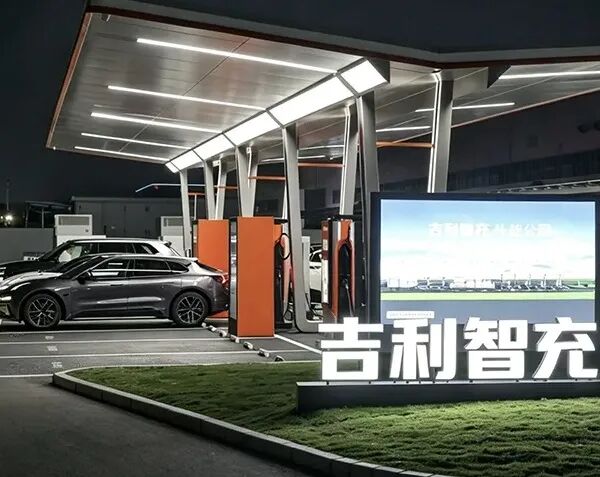
Essentially, this is a situation where each party leverages its own strengths and takes what it needs: NIO is the major shareholder in the battery swapping sector, while Geely holds the dominant position in the charging sector.
Under this division of labor logic, Auto Community has clearly seen the implication of several words: the largest energy replenishment business in the automotive industry.
What level have NIO and Geely's current energy replenishment businesses reached?
As of September 26, 2026, NIO has built a total of 9,431 charging and battery swapping stations across China, including 4,125 battery swapping stations, 5,306 charging stations, and 30,594 charging piles, providing more than 125 million battery swapping services in total. William Li, Chairman of NIO, revealed at the Power UP 2026 Energy Day that 4,125 battery swapping stations, with a battery reserve of about 2,000 kWh per station, can form an 8GWh energy storage network.
On Geely's side, Haohan Energy has launched a total of 2,028 self-built charging stations as of November 2025, covering 213 cities across China, including 1,190 ultra-fast charging stations and 5,349 ultra-fast charging guns, with the ownership of 800V ultra-fast charging piles self-built by automakers ranking at the leading level in the industry.
What is the plan after the two sides join forces?
By the end of 2027, Geely plans to build more than 22,000 charging stations and over 100,000 charging guns, including more than 15,000 Geely Smart Charging Stations and over 50,000 smart charging guns, taking the lead in achieving full coverage of all county-level cities across China.
NIO Energy plans to build a total of 10,000 battery swapping stations by 2030, and it is expected that the annual power demand of NIO's battery swapping network will exceed 10 billion kWh by then.
On the charging side, after NIO takes a 10% stake in Haohan Energy, the charging resources of both parties will be fully interconnected. Considering that NIO has accessed more than 1.73 million third-party charging piles, plus more than 2,000 self-built stations of Haohan Energy, the network effect brought by interconnection will appear in a very short time.
It should be noted that by April 2026, even Tesla, which has a strong new energy vehicle business, has the following energy replenishment scale in the Chinese mainland: more than 2,500 supercharging stations, more than 12,000 supercharging piles, more than 650 destination charging stations, and more than 2,500 destination charging piles.
In other words, one year later, the number of Geely's charging stations will reach 8.8 times that of Tesla's current number, and with the addition of battery swapping energy replenishment, the coverage can be imagined.
Why battery swapping, not chips?
Before the official announcement, a version was circulating in the industry that NIO and Geely would reach cooperation in the field of autonomous driving chips, and Geely might adopt chips from NIO's subsidiary Shenji Technology. In March 2026, media broke the news that after the M97 chip co-developed by NIO Shenji and Axera was successfully taped out, it was actively contacting automakers such as Leapmotor and Geely.
But what was finally officially announced is battery swapping, not chips.
The reason is not complicated. Geely's route on autonomous driving chips has been very clear. In early 2025, Geely released the "Qianli Haohan" autonomous driving system, covering five levels from H1 to H9. The high-end solution clearly adopts NVIDIA chips, and Geely has invested a lot of R&D resources in this route.
Switching the chip platform at this time means overthrowing the existing technical architecture and R&D investment, and re-adapting to a brand new chip solution and tool chain, which has extremely high cost and extremely long cycle.
In contrast, the cooperation logic in the battery swapping field is extremely smooth. The collaboration in the energy replenishment field is the direction where both parties can see actual benefits in the short term.
The latest "Geely Smart Charging" technology released by Geely relies on the Xingrui PowerMind energy large model jointly developed with Stepstellar, realizing a peak charging power of 2.2 megawatts per gun.
NIO's battery swapping system is currently the only battery swapping network in the Chinese market that has achieved large-scale operation. The two technical routes of charging and battery swapping realize underlying collaboration through the joint venture, and the room for imagination is far more realistic than chip cooperation.
There is a sentence in the official press release worth reading word by word: "The two sides will jointly build unified C-end battery swapping technologies and standards, Geely Holding Group will develop battery swapping models for the C-end, and NIO Energy will provide services for Geely Holding Group's C-end battery swapping models."
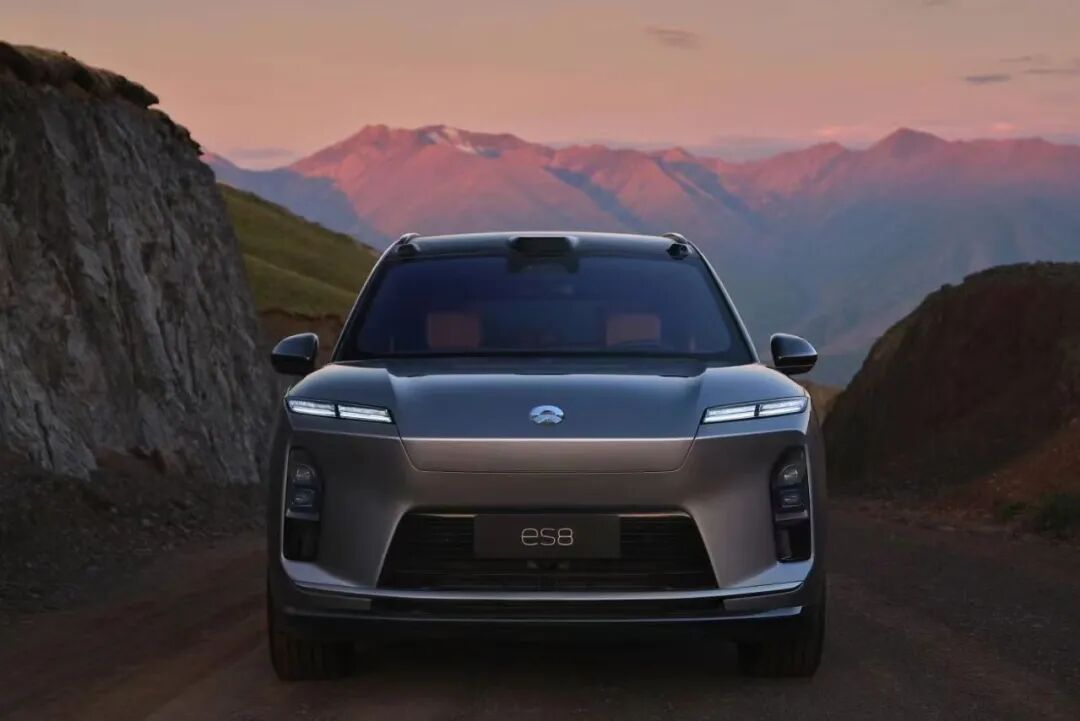
This means that it is a certainty that Geely will launch battery swapping models later, and the only questions are the timing and the brand to choose. It is almost certain that the battery swapping standards will refer to NIO's existing mature system.
In the words of a person close to the transaction, the essence of this matter is very simple: "The standards that NIO has already done very well are already there, and Geely will next consider which brand and which model to use to produce battery swapping vehicles."
Yiyi Internet is an easily overlooked but very critical piece in this transaction. This Geely subsidiary, which provides battery swapping services for the commercial vehicle market, has deployed and operated more than 460 battery swapping stations in over 40 cities across China including Guangzhou, with a total accumulated battery swapping mileage of over 25 billion kilometers, total sales of more than 50,000 battery swapping vehicles, and more than 30,000 connected vehicles.
After injecting this asset into NIO Energy, NIO's battery swapping business will officially expand from the original model mainly for C-end users to a full-scenario model covering both the B-end and C-end.
Intergenerational upgrading of the joint venture model
If this cooperation is only regarded as a commercial transaction between two automakers, its significance is underestimated.
The joint venture model of China's automotive industry is undergoing a profound generational shift — it is no longer defined by Chinese and foreign parties, no longer constrained by brands and products, but takes the core technology as the new anchor point.
Looking back at the first stage, starting from the 1980s, the anchor point of joint ventures was foreign brands and products.
SAIC Volkswagen, FAW-Volkswagen, GAC Honda, Dongfeng Nissan — the core value of joint ventures was to bring foreign mature models to the Chinese market for production and sales. Foreign parties provided brands and products, Chinese parties provided the market and production capacity, and technology itself was not within the scope of joint ventures.
At that stage, the role of China's automotive industry in joint ventures was "exchanging market for products", and it did not even touch the edge of technology.
In the second stage, starting from the late 2010s, the anchor point of joint ventures began to shift to technology. The most iconic case is the joint venture established by Volkswagen Group's CARIAD and Horizon Robotics in 2023, called CoreChips.
CARIAD holds 60% of the shares, and Horizon Robotics holds 40% of the shares. CoreChips has a registered capital of 6.757 billion yuan, focusing on the R&D of high-level autonomous driving application software and systems for the Chinese market, with Volkswagen Group as its main customer in the short term.
The anchor point of this transaction is very clear — intelligence, more specifically, autonomous driving chips and algorithms. Volkswagen needs China's local intelligent capabilities, and Horizon Robotics needs stable mass production orders, and both sides get what they need.
The cooperation between NIO and Geely has pushed the joint venture model to the third stage. The anchor point is no longer just a single technical module, but a complete set of infrastructure — the charging and battery swapping network. It is not a single chip, a set of software, or a platform, but an energy replenishment system that covers the whole country and is open to all brands.
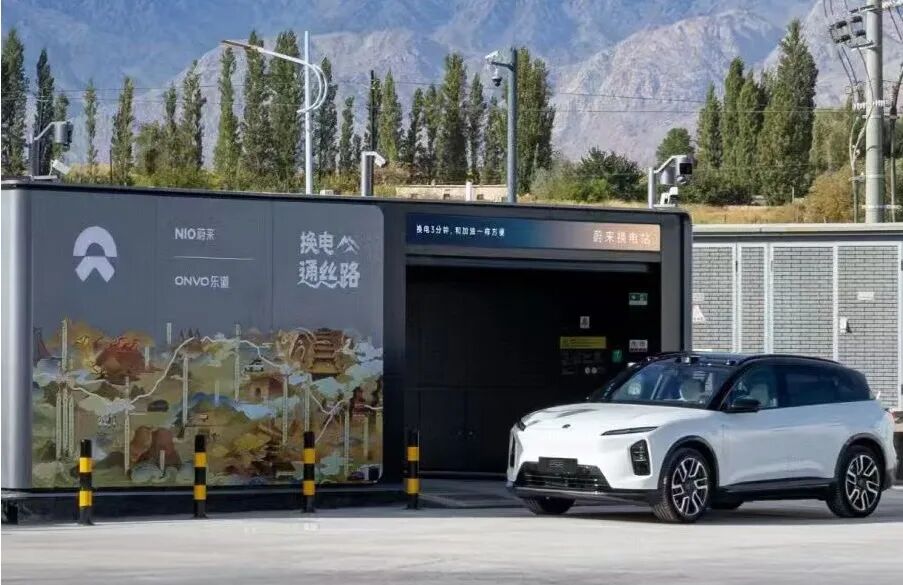
The significance of this change lies in that the energy replenishment network naturally has the attribute of public infrastructure. It cannot be encapsulated in a single vehicle like an autonomous driving chip, nor can it be internally digested like a platform architecture.
The battery swapping stations are built there, and vehicles of any brand can come to swap batteries; the charging piles are placed there, and vehicles of any brand can come to charge. The shared attribute of this infrastructure makes the value of the joint venture not only reflected in the shareholder parties, but also in the entire industry.
This cooperation between NIO and Geely is the first time to operate the energy replenishment network as the core asset of the joint venture. This means that the competitive landscape of China's automotive industry is shifting from "whose product is better" to "whose infrastructure is stronger".
The competition of infrastructure will inevitably move towards alliance in the end — the input-output ratio of a single automaker building its own energy replenishment network is getting lower and lower, and openness and sharing is the sustainable path.
There is a statement in the official press release that deserves attention: "This cooperation is a practical action of the two enterprises to actively respond to the "15th Five-Year Plan" for the Development of Intelligent Connected New Energy Vehicle Industry, practice "anti-involution", and improve the efficiency of industrial resource allocation."
It is almost unimaginable in the past to write "anti-involution" into the joint venture press release. The signal it conveys is very clear: what the regulators expect to see is resource integration and efficiency improvement, rather than redundant construction and cutthroat competition. As a heavy-asset infrastructure, the energy replenishment network especially needs this idea of open collaboration.
From another perspective, the post-investment valuation of NIO Energy is about 16 billion yuan, and Geely obtains 30% of the shares with 100% equity of Yiyi Internet plus 640 million yuan in cash.
This valuation level, for an energy company that owns 4,125 battery swapping stations, 300,000 charging piles, and more than 125 million battery swapping service experiences, obviously still has much room for growth. Geely has obtained the admission ticket to China's most mature battery swapping network at a relatively reasonable price, and NIO has obtained the much-needed capital injection and access to the B-end battery swapping market. Both get what they need and achieve each other.
In 2018, NIO put its first battery swapping station into operation in Shenzhen. At that time, almost no one believed that the battery swapping model could survive.
Eight years later, 4,125 battery swapping stations across the country have not only survived, but also become the most solid chip in the new wave of joint ventures in China's automotive industry.
William Li once said a widely quoted sentence — "Battery swapping is not a matter for NIO alone." Now it seems that the weight of this sentence is far heavier than when it was first said.
When battery swapping stations become the anchor point of joint ventures, when infrastructure replaces brands as the most solid chip, the joint venture story of China's automotive industry has truly turned the page written by itself.
This article is from the WeChat official account "Auto Community" (ID: iAUTO2010), written by Shi Jie and Du Yuxin, and authorized for release by 36Kr.