Are coal stocks still worth buying into?
On September 26, Shanxi Province held a provincial work promotion meeting for the safe, stable production and supply of coal. The meeting emphasized that on the premise of strictly adhering to the safety bottom line, all efforts should be made to promote the resumption of work and production, stabilize production and supply, and accelerate the reversal of the output decline trend.
On the other hand, since July, the coal sector as a whole has shown a volatile upward trend, with a cumulative increase of about 30%.
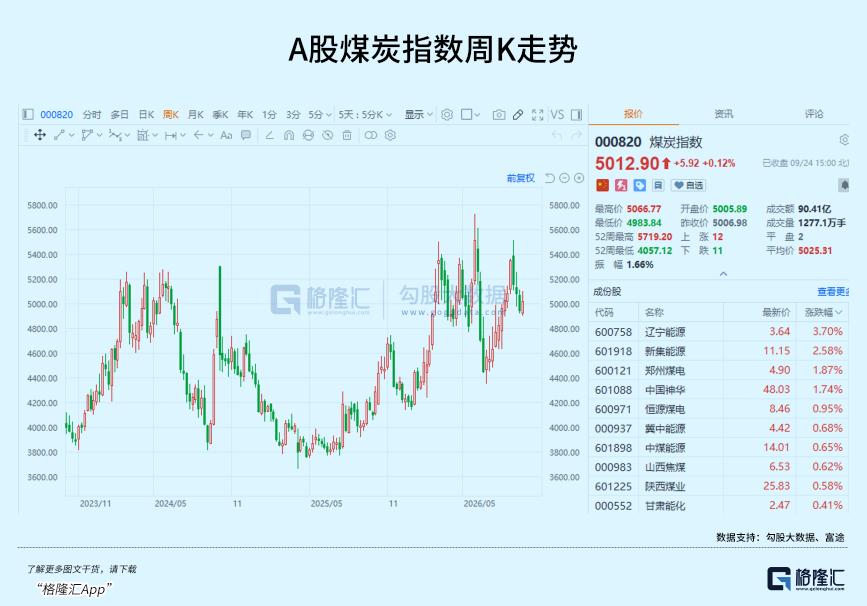
Some analysts believe that after the advancement of production resumption in Shanxi, coal output is expected to rebound rapidly, coal prices will peak, and this round of sector rally may come to an end.
However, this judgment only focuses on the increment brought by short-term production resumption, ignoring the underlying changes that have taken place in the industry's supply logic.
The regulatory tightening since the second half of 2025 has systematically removed the long-standing overproduction buffer of the industry from the institutional level. This resumption of work and production only repairs the phased gap of compliant production capacity, and cannot restore the excess supply space formed in the past few decades.
In addition, with the current turbulent situation between the United States and Iran and the sustained high international crude oil prices, coal prices may remain at a relatively high level for longer than the market expects.
In this context, is the coal sector worth paying attention to now?
01
To answer this question, we must first review what has happened in the coal industry since last year.
The cyclical elasticity of the coal industry in the past came from a large amount of overproduced output that was not included in the approved production capacity.
Overproduction is an open secret in China's coal industry. The approved production capacity is one thing, and the actual output is another.
For many years in the past, the actual output of coal mines could reach 120% or even 130% of the approved capacity. The excess part is not reflected in any official statistics, but it has flowed into the market in real terms.
This part of hidden production capacity is the core buffer force to stabilize coal prices and smooth cyclical fluctuations. Most of the production capacity elasticity of the industry also comes from the non-compliant increment outside the compliant production capacity.
What the current policy is doing has precisely blocked every path of overproduction.
The new version of "Standards for the Judgment of Major Hidden Accidents in Coal Mines" came into effect on July 1 this year, which changed the identification of overproduction from "qualitative ambiguity" to "quantitative restriction".
If the annual output exceeds 110% of the approved capacity, or the quarterly output of underground coal mines exceeds 30% of the approved capacity, it will be directly identified as a major hidden accident danger.
At the same time, this time, supporting measures to more strictly restrict overproduction have also been introduced.
Document No. 77 of the State Administration of Coal Mine Safety [2026] clearly prohibits superior companies from issuing production plans or operating indicators beyond the capacity, cutting off the organizational motivation for overproduction from the source of "who issues the indicators".
The new version of "Implementation Measures for the Work Safety License of Coal Mine Enterprises" includes changes in mining technical conditions into license changes. Once the gas level and hydrogeological type of the mine change, the license needs to be re-verified, and the legality of full-load production itself has become a problem.
The "Ten Articles" of Inner Mongolia and the "Seventeen Articles" of Shanxi have plugged the operational loopholes at the local level, such as hidden working faces, disguised overproduction by outsourced teams, and falsification of monitoring data.
Under this combination of policies, "overproduction" has become almost impossible, unprofitable and unacceptable in the system.
According to institutional analysis, the general premise of stable production and supply guarantee is "on the premise of ensuring safety". This resumption of work and production in Shanxi is only proceeding normally, the safety red line has not changed, and the overproduction constraint still exists.
The current operating rate data of producing areas can intuitively reflect the sustainability of supply contraction. The comprehensive operating rate of Shanxi, Shaanxi and Inner Mongolia is 78.77%, 3.5 percentage points lower than that before the coal mine accident. Among them, the operating rate in Shanxi is only 63%, down 8.3 percentage points from the previous period, and the trend continues to hover at a low level.
The industry presents a clear state of resuming work without resuming output, and the mines that have resumed work after rectification cannot restore the excess production level of the past.
In the next one or two years, there will be more local leadership transitions and important meetings, and the weight of safety will only be higher. Local authorities would rather be more stable than take risks to grab output.
In this general environment, supply contraction is not a short-term issue.
Looking at the new production capacity, it takes at least three to five years for a new mine from approval to production. Several large mines currently planned will basically start coal production one after another after 2028. In the next two or three years, there will be no large amount of new production capacity to fill the gap left by the withdrawal of overproduction, and the gap will not be filled.
The production data of leading listed companies can also confirm this point.
China Shenhua has publicly stated that all its mines have been organized for production at the maximum compliant capacity, and the supply guarantee policy cannot bring new output increments. The industry's compliant capacity utilization rate has reached the ceiling, and there is no room for further increase in existing production capacity.
02
The current situation of the coal industry is that while the supply side is rigidly contracting, the demand side remains steadily resilient.
In terms of demand, from September to October, the operating rates of domestic coal chemical, cement and metallurgical industries have rebounded, forming effective support for non-electric coal demand. At the end of October, the northern heating season starts, and the demand for electric coal stockpiling takes over, so the coal demand in the fourth quarter has dual supports.
Supported by demand, thermal power enterprises have a much stronger ability to bear coal prices than in previous years.
The market usually uses three price lines to judge the position of coal prices and the affordability of thermal power: 860 yuan/ton is the break-even line of thermal power statements, 1000 yuan/ton is the cash cost break-even line of thermal power, and 1155 yuan/ton is the sensitive line of policy regulation.
This year, coal prices held up twice when they fell near 860, and there was no large-scale shutdown of procurement by power plants after breaking through that level.
The core reason is that the assessment criteria for thermal power have changed. Now more attention is paid to cash flow instead of simply focusing on book profits, so the tolerance for coal prices is naturally higher.
This wave of prices rose to 1002 before pulling back, and stopped falling at 971, with a much more solid bottom than before.
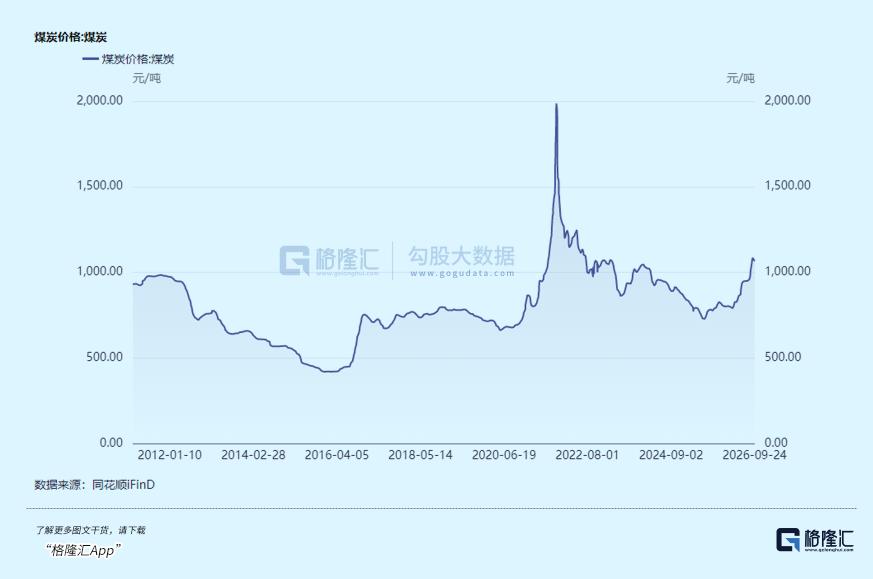
At the same time, overseas oil prices are also supporting domestic coal prices.
With high international oil prices, the cost of petroleum-based chemical products is high, the advantages of coal-to-chemicals will become prominent, and the demand for coal for chemical use will be stable.
Coupled with the uncertainty of the geopolitical situation, global energy prices cannot fall, and domestic coal prices will naturally not fall deeply.
It is also necessary to distinguish between thermal coal and coking coal, and their trends are different.
Thermal coal has long-term agreements and supply guarantee regulation, so its price fluctuation will be more moderate, and it will generally rise slowly. Coking coal has greater elasticity. On the one hand, the safety constraints of domestic coking coal mines are stricter, and it is difficult to increase production;
On the other hand, the import of Mongolian coal has narrowed, and a large part of the marginal supply has been reduced. Now the number of Mongolian coal customs clearance vehicles is only more than 500 per day. Even if there is progress in subsequent negotiations, it is good to return to 1000 vehicles, and it is difficult to return to the previous level of 1500 vehicles.
Therefore, the price of coking coal will most likely fluctuate at a high level for a long time.
03
Back to investment, after this round of rise and correction, the cost performance of the coal sector has emerged again.
It rose by 30% from July to the beginning of September, and gave back 10% since September, and the bubble has almost been squeezed out.
In terms of capital, the position of public funds in coal at the end of the second quarter was only 0.3%, much lower than 0.75% in the first quarter. The sharp rise of the sector in July and August was mainly driven by the marginal buying of a small amount of capital, and systematic allocation at the institutional level did not occur. Since September, the sector has corrected by about 10%, which is in line with the rhythm of "rising three steps and falling one step" of the coal sector.
At the same time, the current price-earnings ratio of the coal equal-weight index is about 18.53 times, and the dividend yield is about 5.02%. The dividend yield of leading companies is generally at the level of 4%-5%, and the allocation value is prominent under the background of declining risk-free interest rate.
In terms of dividends, China Shenhua's 2026 interim dividend is 0.98 yuan per share, with a total dividend of about 21.26 billion yuan, accounting for 74% of the attributable net profit in the first half of the year, which is higher than the promised lower limit. The company has distributed more than 500 billion yuan in cash since its A-share listing.
This is the characteristic of the entire coal sector - leading coal companies have strong cash flow generation capacity, the peak of capital expenditure has passed, and the dividend ratio is continuously increasing.
Therefore, when a sector has the characteristics of "institutional constraints on the supply side, resilient demand side, low valuation, low position and high dividend", it does not need a grand narrative to drive the rise.
It only needs a catalyst - for example, coal prices stand at 1000 yuan in the off-season - to trigger the reallocation of capital.
Of course, attention should also be paid to risks. If the supply guarantee effort exceeds expectations and output is released suddenly; or the macro demand is weak and coal consumption cannot rise; or the geopolitical situation eases and oil prices plummet, these will cause fluctuations in the market.
But these are all short-term disturbances, which cannot change the general direction of supply contraction, nor can they change the long-term value of the sector.
Conclusion
From a long-term cycle perspective, the compliant capacity utilization rate of coal mines has reached the ceiling, and the construction cycle of new production capacity is long. The tight supply balance is likely to be a medium and long-term norm, and the industry will gradually return to the tight balance state of basic supply and demand balance in 2023-2024.
The strong cyclical attribute of the coal industry with sharp rises and falls in the past is gradually weakening. Many people still look at the problem with old perspectives, thinking that it will fall back after a wave of rise, but the underlying logic of the industry has changed.
Coal is gradually transforming from a pure cyclical trading variety to a cash flow asset under institutional constraints. This transformation will not happen overnight, but the direction is certain.
For investors who are willing to make layout from a medium-term perspective, this round of correction is actually a relatively left-side allocation window.
Gelonghui Statement: All views in the article come from the original author and do not represent the views and positions of Gelonghui. Special reminder, investment decisions need to be based on independent thinking. The content of this article is for reference only, and does not constitute any practical operation suggestions. Trading risks are borne by the investors themselves.
This article is from the WeChat official account "Gelonghui APP" (ID: hkguruclub), author: Gejila, published with authorization from 36Kr.