From a Bilibili UP creator to the founder of a 50-billion-yuan listed company, the 33-year-old prodigy is making another foray into the Hong Kong Stock Exchange.
On the evening of September 20, Agibot held a launch event in Shanghai, where Peng Zhihui (Zhihui Jun) took the stage. He has a long list of identities: former "Genius Young Man" at Huawei, co-founder, President and CTO of Agibot, and Chairman of Sino Composite, a listed company on China's A-share Sci-Tech Innovation Board. However, at the launch event, he mostly referred to himself as a "Product Experience Officer".
Qiyuan Robotics is a consumer-grade robot brand under Sino Composite. Originally a Sci-Tech Innovation Board enterprise focused on wind turbine blade materials and environmentally friendly corrosion-resistant materials, Sino Composite saw Agibot acquire its 63.62% controlling stake for approximately 2.1 billion yuan in 2025 through a combination of agreement transfer and tender offer.
Although Agibot has repeatedly denied that this transaction constitutes a "backdoor listing", Sino Composite's share price has skyrocketed since then, which is undoubtedly boosted by the Agibot robotics concept behind it.
In 2025, Sino Composite's share price rose by more than 1800% for the whole year, and its market value grew from over 3 billion yuan to about 55 billion yuan at present. In contrast, Agibot, which confirmed the launch of its Hong Kong listing process on July 24, only received a target valuation of HK$40 billion to HK$50 billion from its cornerstone investors.
At this launch event, Qiyuan launched two personal robots, the Q1 and T1, with a starting price of 19,999 yuan, bringing the price of a bipedal humanoid robot that can walk and converse below 20,000 yuan at one go, and deliveries will start on October 1. Previously, the benchmark for this category was the 39,900 yuan price of the Unitree R1.
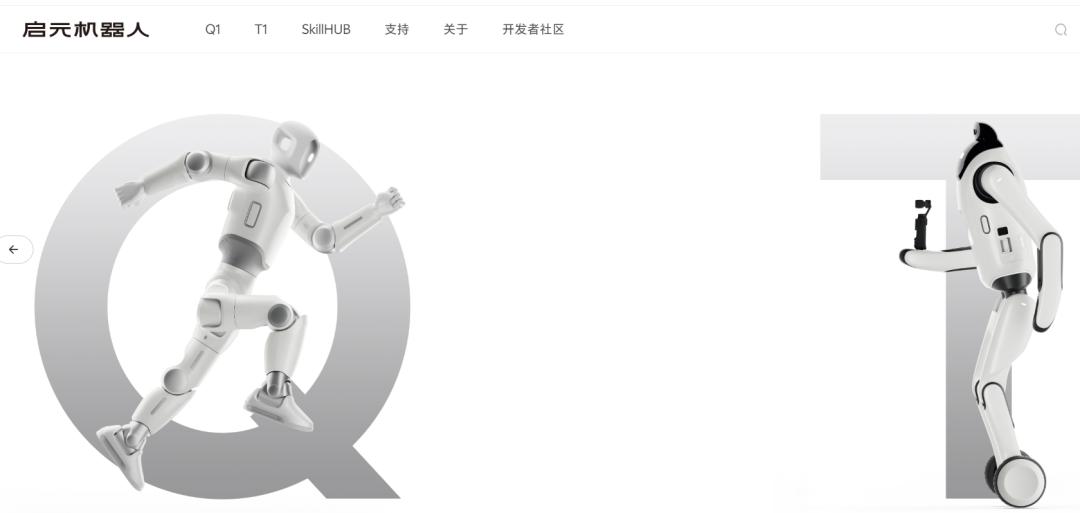
Source: Screenshot from Qiyuan's official website
From the perspective of capital operation, Agibot is engaged in B2B business with four major product lines: Yuanzheng, Lingxi, Jingling, and Kutuo, whose clients are mainly industrial and commercial scenarios, and the goal is to list on the Hong Kong Stock Exchange. Sino Composite, which remains in the A-share market, focuses on the C-end story. The two sides can share the technology, supply chain and brand endorsement of the "Agibot Ecosystem".
However, this story was valid in the overheated embodied intelligence market last year, but now it is being questioned more and more. More than a week before the launch event, Shao Tianlan, founder of Mech-Mind, posted a series of critical remarks on WeChat Moments, claiming that a number of "deal-making" embodied intelligence enterprises generate "false and unsustainable revenue" relying on data collection centers and related-party transactions.
The day after the launch event, Sino Composite's share price rose by nearly 7% intraday, but closed down 4.14% at the end of the trading session. One question is unavoidable: how solid is the revenue of Qiyuan Robotics? To what extent does it rely on the capital strength of Agibot?
Driving the Price of Bipedal Humanoid Robots Down to "Mobile Phone Level"
Qiyuan Robotics can be regarded as the first official foray of the Agibot Ecosystem into the personal robot market. The starting price of 19,999 yuan is roughly equivalent to buying a bipedal humanoid robot with the budget of a high-end mobile phone; the exploration version is priced at 26,999 yuan. The Q1 is 88 cm tall, weighs 15 kg, and can be folded to fit into a backpack.
Qiyuan's product development approach bears the distinct imprint of Agibot. Peng Zhihui stated that the team visited dozens of families and set the Q1's height at 88 cm, which is close to the eye level of a two or three-year-old child, allowing it to naturally integrate into the family space.
He spent a long time on stage explaining how users can 3D print and replace the robot's outer shell. The underlying support for this product definition is Qiyuan's self-developed "Egg Joint": it weighs 260 grams, has a diameter of 47 mm, and a peak torque density of 85N·m/kg. The joint is shrunk to the size of an egg, making it possible for the bipedal robot to fit into a backpack and be priced below 20,000 yuan.
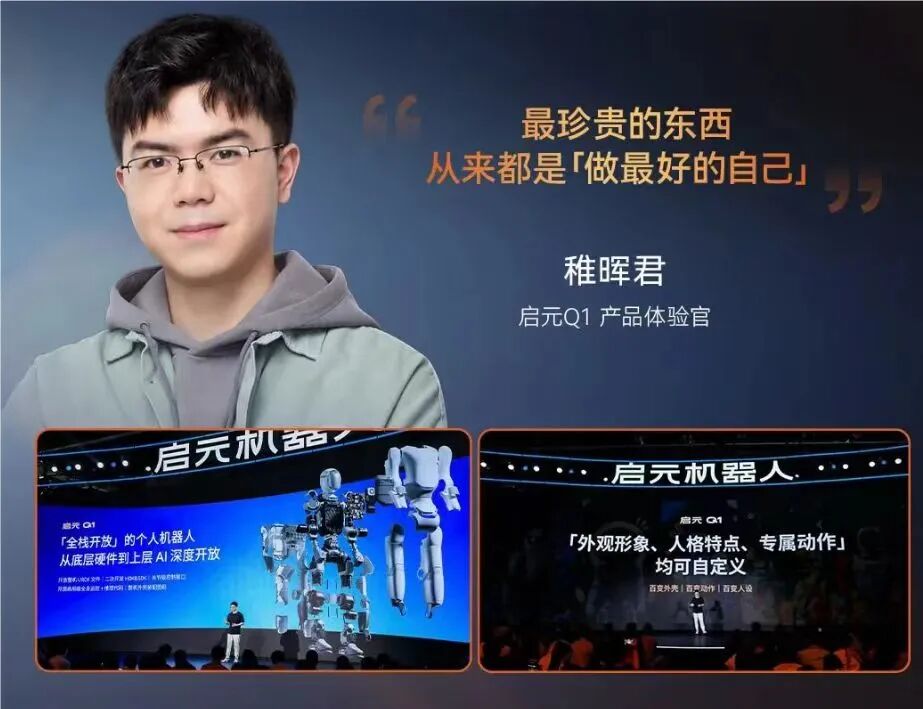
Source: Screenshot from Qiyuan Robotics' official WeChat public account
In terms of marketing strategies, Qiyuan clearly draws lessons from the consumer electronics industry: at the launch event, Huang Xiaoming, Hu Jun, Tian Liang and his wife appeared on stage one after another, and the main venue in Shanghai was linked with experience stores in 7 cities across the country, following the path of "building momentum first, then expanding channels".
In terms of business model, Qiyuan also leverages the supply chain and mass production capabilities of the Agibot Ecosystem to dilute costs — Agibot rolled out its 10,000th robot in March 2026, and the number reached 15,000 by the end of June. Growing in a system that has already achieved mass production is the biggest advantage that differentiates Qiyuan from other embodied intelligence startups.
At the capital level, the 2026 semi-annual report shows that Sino Composite's net profit attributable to shareholders was a loss of 167 million yuan, the core reason of which was the 164 million yuan R&D investment in the robotics business, accounting for more than 90% of the total R&D investment. Although the new business has not yet generated mass production revenue, it has brought in 210 million yuan of advance receipts.
In August, the equity incentive plan released by Sino Composite also clarified its future development goals: the proportion of new business revenue in total revenue in 2026 shall not be less than 25%, the year-on-year growth rate in 2027 compared with 2026 shall not be less than 160%, and the net increase in 2028 compared with 2026 shall be more than 700%.
In other words, Qiyuan is taking a standard productization path: defining products, cutting prices, expanding channels, and then responding to doubts with sales volume and revenue growth rate.
Peng Zhihui said that the logic of the Agibot Ecosystem's spin-off is "scene decoupling and specialized in-depth cultivation". Tian Hua, CEO of Sino Composite, explained that robots are divided into three layers: industrial, household and personal, and Qiyuan focuses on personal and family scenarios.
It can be said that the business logic of the two robot ontology companies is that one focuses on industrial and commercial scenarios, the other targets individual users, both share the endorsement of the Agibot Ecosystem externally, and divide the market by scenarios internally.
The "Name Card" of Agibot
In this story, Peng Zhihui is a key figure for both Agibot and Qiyuan.
He was born in a rural area of Ji'an, Jiangxi Province in 1993, and his parents are both ordinary salaried workers. He completed his undergraduate and master's studies at the University of Electronic Science and Technology of China. After graduation, he joined the OPPO Research Institute as an AI algorithm engineer. In his spare time, he uploaded his hardcore inventions on Bilibili — an autonomous driving bicycle with a cost of less than 10,000 yuan, a robotic arm that can suture grape skins — which earned him more than 2.8 million fans and the nickname "Wild Iron Man".
In 2020, he passed seven rounds of interviews and was selected into Huawei's "Genius Young Man" program with the highest annual salary of 2.01 million yuan, and joined the Shanghai AI Research Institute to work on Ascend chips and AI algorithm research. Ren Zhengfei later specifically mentioned this young man who developed the self-driving bicycle in an internal speech at Huawei.
At the end of 2022, Peng Zhihui left Huawei and partnered with Deng Taihua. Born in 1977, Deng Taihua has worked at Huawei for more than 20 years, and was promoted to Vice President of the company and President of the Computing Product Line. He invited this genius young man to start a business together, and Agibot was founded in February 2023. On public records, Deng Taihua serves as Chairman and CEO, in charge of operations, capital and supply chain; Zhihui Jun serves as President and CTO, in charge of technology, and also acts as the "name card" of Agibot.
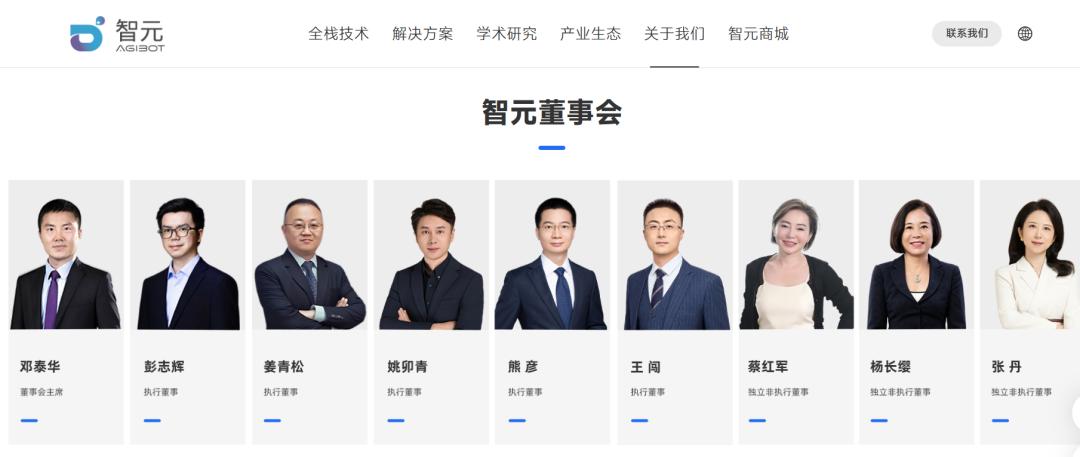
Source: Agibot's official website
After the two joined forces, Agibot's growth rate has almost no precedent in China's robotics industry. Deng Taihua disclosed at the partner conference in April this year that Agibot's revenue was about 300,000 yuan in 2023, about 60 million yuan in 2024, and exceeded 1.05 billion yuan in 2025, making it the fastest robot company in China to achieve revenue of over 1 billion yuan.
Growth is still accelerating in 2026: the revenue in the first quarter alone exceeded 1 billion yuan, earning as much in one quarter as the total revenue of 2025. Agibot's losses have also narrowed year by year, with net profit attributable to shareholders at -103 million yuan, -95.36 million yuan, and -83.54 million yuan in 2023, 2024 and 2025 respectively.
Mass production is another upward curve: by the end of June 2026, the 15,000th Agibot robot rolled off the production line. In the first half of this year, statistics from market research firm SAG showed that Agibot topped the global market with a 44% shipment share.
Around the robot ontology, Agibot has also incubated a number of ecological companies: Lingdianxing, which develops dexterous hands, Tianqingzu, which operates a leasing platform, Mifeng, which focuses on data collection, and the quadruped business has been spun off into Agibot Kutuo, which is led by Deng Taihua personally.
Deng Taihua set the "358 Grand Plan" for Agibot: revenue of 10 billion yuan in 2025, exceeding 100 billion yuan in 2027, and hitting 1 trillion yuan in 2030. He said at the April conference that the "Yuanzheng" series has shipped more than 2,000 units, and the production capacity for the second quarter of this year has been fully booked.
The Moment of Deflating the Bubble Has Come
However, behind the impressive shipment volume and revenue, who are the users buying Agibot robots?
At present, the main purchasers of Agibot's humanoid robots are still institutional clients. According to reports from *Caijing*, Agibot has won more than 10 projects with state-owned capital background directly or indirectly, and the amount of many projects is at the level of tens of millions of yuan.
For example, in July 2025, Agibot won the bid for the data collection and exhibition robot procurement project of Zhuhai Zhihui Yuanqi Technology Co., Ltd. with an amount of 12.736 million yuan. The purchaser itself is a joint venture co-founded by Agibot — Agibot holds 30% of its shares, and the 40% shareholder is a state-owned company under Zhuhai Huafa, which is also a shareholder of Agibot.
This business model is no secret in the industry. In February this year, a core insider told *China Entrepreneur* that many projects are operating in a similar way: with platform endorsement, a data collection center is established. The money from selling robots is recognized as revenue, and the money spent on repurchasing data is recorded as R&D expenses rather than costs, thus the income statement shows high revenue growth and high R&D investment.
Data collection itself is not a sin. The thirst for data is a common problem for the whole industry. Building a high-quality real machine data collection system and selling robots to institutions is a common phenomenon in the industry, the essential reason of which is that the commercial landing capability of robots is not yet mature.

Source: AI generated
However, once approaching the IPO, the quality of orders and revenue recognition methods are issues that must be included in the prospectus and subject to audit and regulatory inquiries. Agibot's IPO is underwritten jointly by China International Capital Corporation, CITIC Securities and Morgan Stanley. Calculated based on the HK$40 billion to HK$50 billion valuation given by cornerstone investors, the corresponding price-to-sales ratio for its 2025 revenue is about 32 to 41 times — which is a clear premium compared to the approximately 24 times PS of Unitree at the time of its IPO.
Peng Zhihui's final exam is also taking place at the moment when the entire industry is deflating its bubble.
Unitree, which went public on August 19, has seen its market value continuously correct from its peak of 444.9 billion yuan, and its latest market value has fallen below 2000 billion yuan. Mech-Mind was listed on the Hong Kong Stock Exchange on September 1, recording an oversubscription rate of about 3834 times for public offering, refreshing the subscription record for Hong Kong stock robot IPOs. However, its share price broke below the issue price on the first trading day after listing, and the maximum retracement in the following trading days was about 26%.
Compared with the capital market's enthusiasm, the end-user market for embodied intelligence is far from being fully cultivated.
According to statistics from the Humanoid Robot Scenario Application Alliance, in the first half of 2026, there were 218 publicly disclosed winning bid projects for humanoid and embodied robots in China, with a total amount of 1.723 billion yuan. Among them, education and scientific research institutions accounted for 55.5% of procurement, government and state-owned public platforms accounted for 20.6%, and industrial enterprise orders only accounted for 21.1%, most of which are prototype testing, exhibition display and training pilot projects, rather than regular repurchases on production lines.
Regulatory requirements are also gradually tightening. On August 28, the National Development and Reform Commission publicly stated at a regular press conference that the robotics industry must adhere to the principle of adapting to local conditions and achieving healthy and orderly development. According to reports from ifeng.com Finance, a leading embodied intelligence company had half of its revenue cut off during the IPO audit, because nearly half of its revenue came from related-party transactions and fragmented income.
Although there is real demand for data collection, at a time when more than 50 robot and embodied intelligence enterprises are under review by the Hong Kong Stock Exchange, the quality of revenue is a must-answer question that no