After shopping around, the organizer of Kamasi's China tour has been replaced.
At 18:00 on September 24, tickets for jazz musician Kamasi Washington's exclusive Beijing show officially went on sale.
This performance, which will be held at Dongsan LIVE Joy Park in Beijing on October 15, has sparked a wave of discussions on social media before its official announcement and ticket release.
On September 19, SoundFact (hereinafter referred to as "SoundFact") released a statement saying that Kamasi Washington's 2026 China tour will no longer be hosted by SoundFact, and detailedly reviewed its cooperation process with CAN Festival (hereinafter referred to as "CAN") that started in February. Subsequently, CAN released a response, denying that the two parties had formed the cooperative relationship described by SoundFact, stating that no written agreement had ever been signed between the two sides, and the core business terms, especially the price, had not been finally agreed upon.
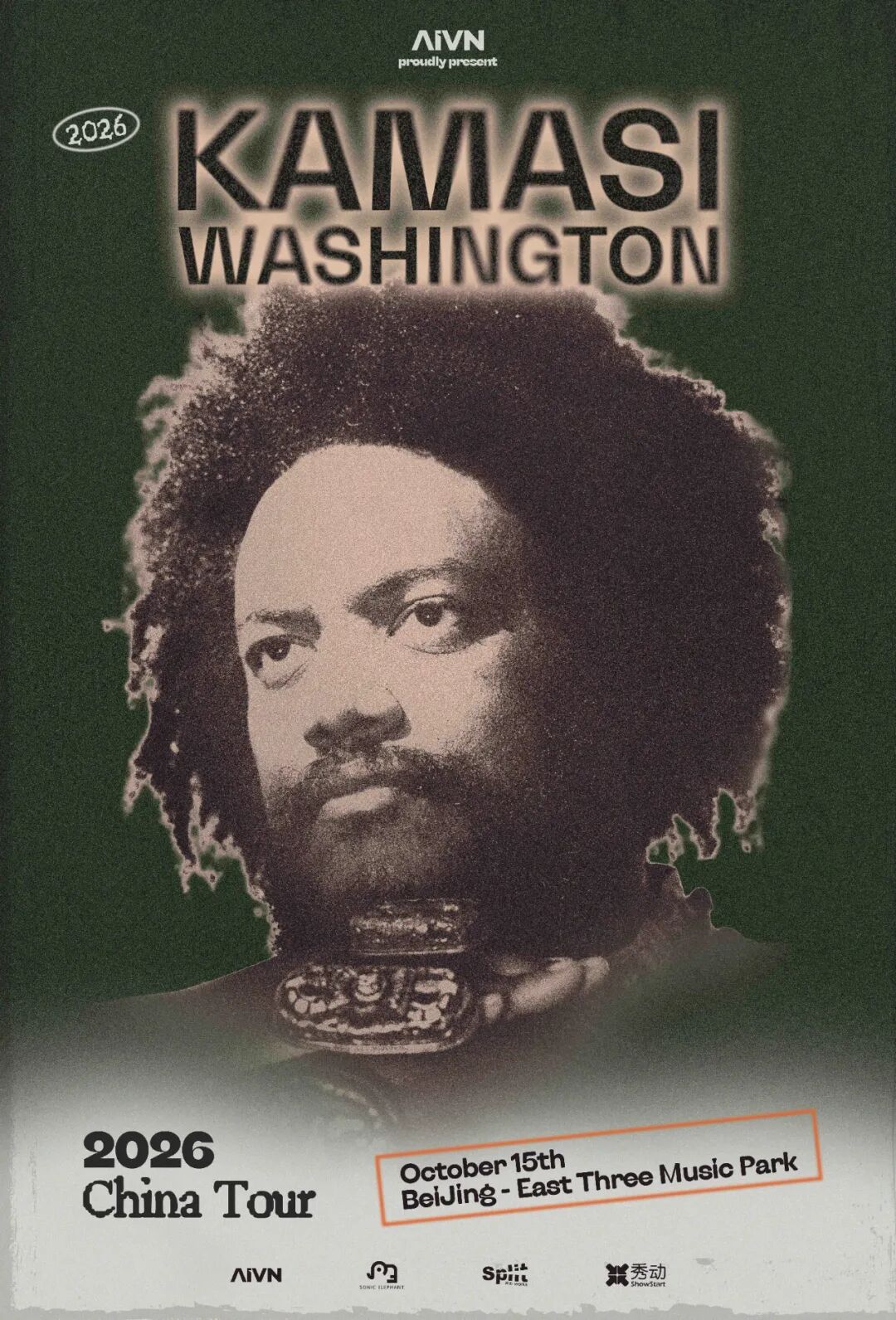
Three days later, Kamasi Washington's 2026 China tour was officially announced, emphasizing that "this is the only exclusive show in the Chinese mainland". According to the poster, the organizer is AIVN, and the LOGO column also includes Sonic Elephant, Split Works and ShowStart. That means, the final change is not the artist or the performance itself, but the performance organizer.
Judging from the interaction data on social media, this is still a relatively niche discussion within the industry. As of press time, on Xiaohongshu, SoundFact's statement has received more than 1,200 likes and over 200 comments; CAN's clarification has received more than 300 likes and over 500 comments. There is heat and discussion, but attention is mainly limited to industry practitioners and core music fans.
The editorial department of Music Business (ID: musicbusiness) sorted out the key contents in the two statements, interviewed senior industry practitioner Ni Bing, took the Kamasi Washington China tour incident as an entry point, reviewed the issues behind this controversy that are really worthy of attention for performance industry practitioners, and provided some references for the cooperation and execution of similar projects.
The four-party game behind Kamasi's China trip
Current public information mainly comes from the statements released by SoundFact and CAN respectively, and neither party has disclosed complete substantive materials such as chat records, emails, and contracts. Therefore, what the public sees is actually two versions of narrative from the two sides about the same cooperation process.
But from the two statements, the core divergence of the whole incident is very clear: SoundFact believes that the two sides have entered the cooperation implementation stage; while CAN believes that the two sides are always in the business negotiation stage.
According to SoundFact's statement, the two sides started cooperation around CAN Music Festival in February this year, with SoundFact responsible for contacting international artists including Kamasi Washington and Ezra Collective. By the end of March, the two sides had reached an agreement on core business terms such as performance fee, reception conditions, and performance date, and then continued to promote the contract signing and payment process.
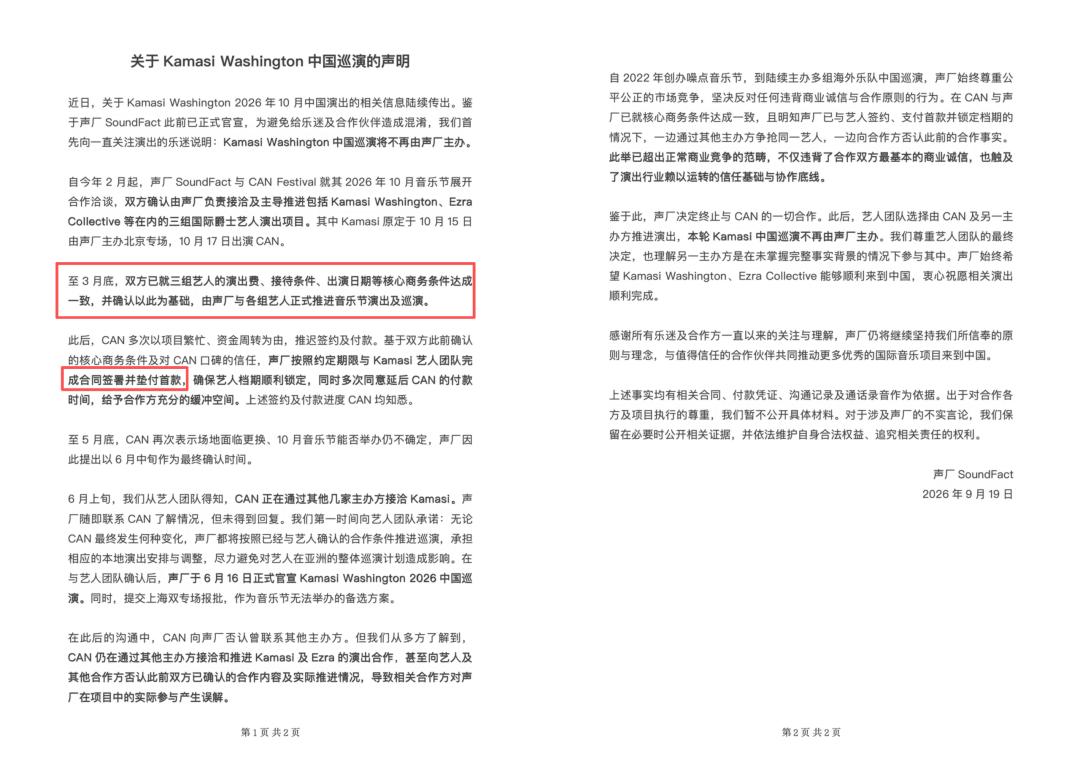
CAN denied this judgment in its response. CAN stated that the two sides did not reach an agreement on the basic cooperation conditions, especially the price was still in the negotiation stage, and no formal written agreement was signed.
Thus, two different timelines emerged for the same project. SoundFact stated that CAN had repeatedly postponed the contract signing and payment afterwards, while SoundFact continued to promote the artist contract and completed the first payment. By the end of May, due to the venue change faced by CAN, and even the uncertainty about whether the music festival could be held as scheduled, SoundFact proposed to take mid-June as the final confirmation node.
In early June, SoundFact learned from the artist team that CAN was contacting Kamasi through other organizers. Subsequently, SoundFact continued to confirm the China tour plan with the artist team, officially announced the tour on June 16, and submitted the approval for the Shanghai exclusive show at the same time. The performance was scheduled for October 16 and 17, with the venue being VAS Xuhui Store, as an alternative plan if the music festival could not be held.
In CAN's narrative, since the two sides did not sign a written agreement and the core business terms were not finally agreed, CAN later continued to contact the artist through other organizers and obtained new cooperation terms. The most concerned point is the USD 20,000 price difference mentioned by CAN.
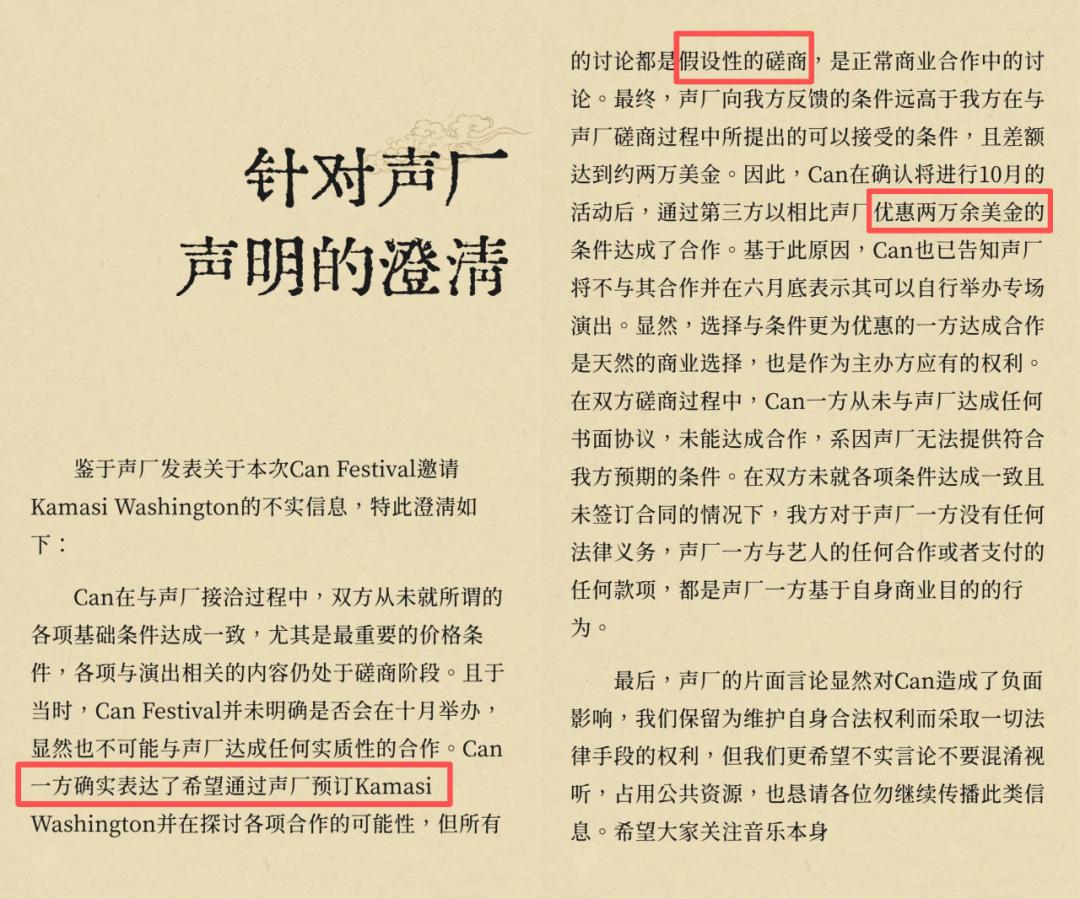
This number obviously makes a complex business dispute very specific. Because "USD 20,000" is first of all a cost difference for CAN, and cost is the most understandable and spreadable information in business cooperation. Compared with who has what kind of authorization and whether the two sides have completed the phased confirmation, this number makes it easier for people to question, "For the same artist, why is the price gap so large?"
However, Ni Bing, a senior practitioner in the music industry, analyzed to Music Business that the quotation of international artists is not just an artist fee, but may also include costs such as reservation, international transportation, hotels, local reception, production and cross-border payment. If you want to compare the two quotations, you should put the complete cost lists together instead of only comparing the final figures.
At present, neither party has made the complete quotation list public, so the outside world cannot further judge what specific costs this USD 20,000 corresponds to. But what is more worthy of attention than the USD 20,000 itself is the cooperative relationship behind it. Because in addition to SoundFact and CAN, there are actually two other roles that cannot be ignored in this incident.
One is the artist team. It holds the final schedule confirmation and artist cooperation authorization. If the contract and payment mentioned by SoundFact do exist, then the artist team is obviously at the key position of the entire transaction chain. However, the current public information does not disclose the specific terms of this contract, especially whether there are exclusive agreements, liability for breach of contract, and under what circumstances the cooperation party can be replaced.
But it is clear that the artist team once informed SoundFact that new negotiating parties had appeared in the market. As for the specific progress of the previous cooperation and whether this contract restricts the entry of subsequent cooperation parties, there is not enough public materials at present.

The other key role is the new organizer. From the perspective of business results, the new organizer finally got the artist cooperation and is promoting the implementation of the performance. At the same time, as the dispute between SoundFact and CAN enters the public view, the performance itself has also received additional industry attention. As for how the new organizer specifically entered this transaction and what kind of communication it had with the previous cooperation parties and the artist team, the current public information is not sufficient to fully restore the whole process.
But the reality is that the reputation of all four parties has been involved. Because statements posted online can easily be simplified into "who is cheaper", "who earns more", "who snatched whose project". Especially the specific number of USD 20,000, it is easy to turn a complex cooperation process into a simple price story.
It should be noted that Kamasi is not visiting China for the first time. He came to China for the first anniversary of Blue Note Beijing in 2017 and the opening of Blue Note Shanghai in 2019. At that time, the seat price was roughly between 400 and 600 yuan. The pre-sale price of this exclusive show is 480 yuan, and the full price is 560 yuan. The price range is not significantly different from the previous ones, and the performance venue has chosen a larger venue that can accommodate thousands of people. And after this round of controversy, how this performance will finally be delivered has also become a problem that the new organizer must face.
After all, for music fans, apart from following the gossip, what they really care about in the end is the ticket price and performance viewing experience.
How to avoid pitfalls in artist booking?
As a "veteran" with more than 30 years of industry experience, Ni Bing is one of the earliest practitioners engaged in international business in China, and has been involved in a large number of overseas musician tour businesses.
In Ni Bing's view, when overseas agencies initially judge a Chinese cooperation partner, what they often focus on first is not how beautiful the PPT is, but what the team has done in the past and whether it has real project experience.
Ni Bing has done many international DJ performances, but every overseas agency will ask him: "Who have you worked with before?" Sometimes the other party even asks him to provide posters of past events to prove his experience. The reason is very simple. China's performance market is still a tiny part of the global map. Overseas agencies have seen too many business games, they not only check the qualifications of Chinese organizers, but also know that some people will change sides for money.
In the actual cooperation of the performance industry, information asymmetry, insufficient cooperation credit, and situations where people change cooperation terms when facing higher quotations are not uncommon.
Based on this, Ni Bing gave three suggestions to help practitioners avoid possible risks in the process of artist booking as much as possible:
First, put all key business nodes in written form, and confirm them via emails as much as possible. The price, schedule, budget, cooperation identity, payment nodes, and who has the right to further negotiate and confirm should all leave clear records. Even if the formal contract has not been signed, phased confirmation should be completed through emails and other methods, instead of taking phone calls, voice messages or oral commitments as the basis for the project.
Second, use exclusive authorization agreements with validity period and liability for breach of contract. If the organizer wants an intermediary to spend one or two months or even longer looking for artists, it should clarify the authorization period, budget, permissions of both parties and the responsibilities after the termination of cooperation in advance.
Ni Bing himself once adopted this model: within the agreed period, the intermediary is responsible for finding artists. If the task cannot be completed within the period, the organizer can find a third party. But if the transaction is completed by bypassing the intermediary during the exclusive period, or the organizer temporarily withdraws after the intermediary successfully invites the artist according to the budget, the party in breach shall bear corresponding responsibilities as agreed.
Ni Bing admitted that this trick "scared away 80% of the clients, because people without sincerity dare not sign it at all."
Finally, treat business competition correctly, but clarify the boundaries of cooperation. For artists, if there is no exclusive agreement, choosing a new cooperation party when facing better business conditions is itself part of market competition. All the big bands in the world will eventually be snatched by giants, which is the law of the jungle in the business circle.
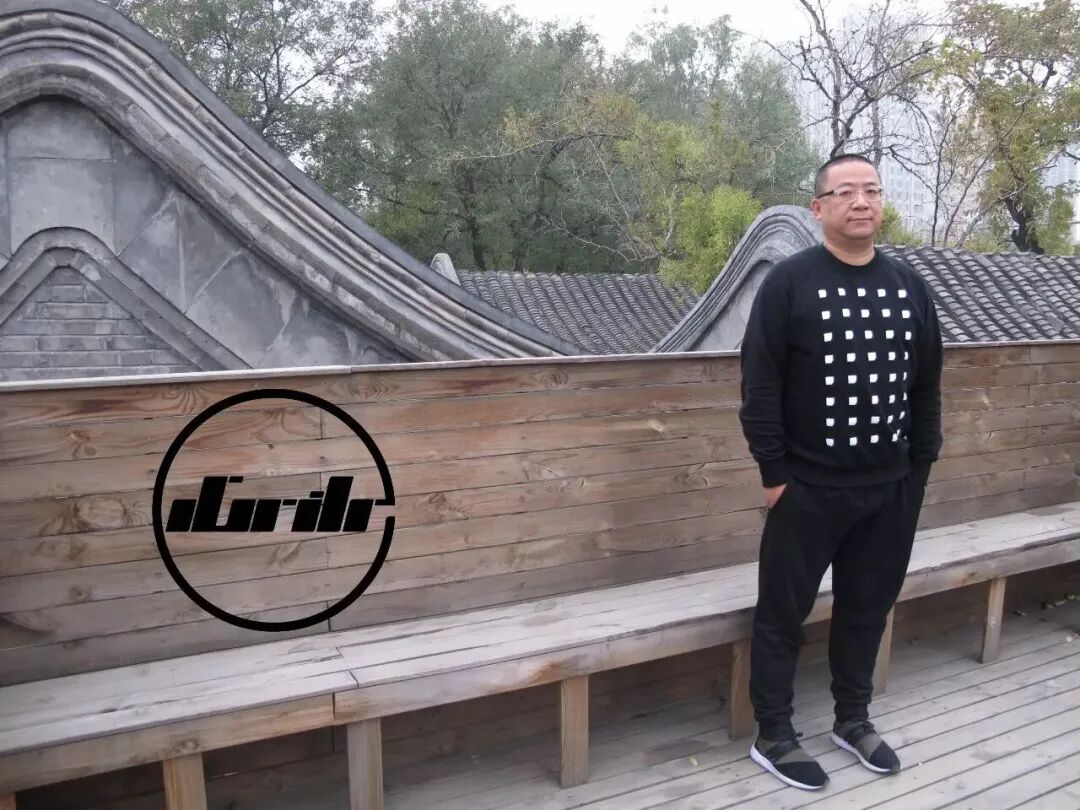
Photo: Ni Bing
"But if you clearly know that an artist already has an explicit cooperation partner in the Chinese market, and you still grab the project by constantly raising the price, the final result may be the rising cost of the entire market." Ni Bing mentioned that when he did international DJs in his early years, an agency once told him: "This DJ now has another person who wants to invite him, you only offer 8000 Euros, the other party offers 20,000 Euros, do you want to offer more?" He held back and did not follow the price increase.
"I can give up this performance, but I don't want to blindly make an artist's value rise unreasonably in this country." Ni Bing sighed. In the early years, Chinese nightclubs invited top 100 DJs, but later no one did it anymore, because everyone raised the price separately, and finally no one could afford it.
On the other hand, respecting the established cooperative relationship is a basic boundary beyond business competition. When Ni Bing once contacted a Nordic band for an international tour, the other party replied "We have already confirmed our partner in China", so he did not follow up further.
Ni Bing also added an observation from the perspective of the artist team and the agency: Many times the agencies are also "playing games".
If an artist often performs in China, there may be three companies that show strong interest, which means that someone will raise the price in order to get the artist. In order to get higher performance fees, the agency may not even discuss it with the artist. "So a senior in this industry once told me that for any performance, if you can't contact the artist directly, you'd better not do it."
This is not necessarily to get a lower price from the artist, but once the matter is transparent, the agency can't play tricks in the middle.
Therefore, what Ni Bing emphasized actually falls on two key words, "contract" and "credit". Business is business, and personal connections are personal connections. Signing a contract is a necessary action. Acting in accordance with the contract solves the problem of what to do when there is a disagreement in cooperation, and credit solves the problem of why the two parties are willing to continue cooperating.
Summary
The change of Kamasi's China tour this time seems to be a dispute between the booking party and the organizer on the surface, but behind it involves many common links in international artist booking, from business negotiation, price game, schedule locking to contract signing, as well as the power and responsibility boundaries between different cooperation parties.
To what extent can a cooperation be regarded as "already settled", or still in the "negotiation stage"? When these links lack clear written confirmation, it is easy to become a place where the two sides have different understandings.
From this perspective, the USD 20,000 price difference is not the only thing worthy of attention in this controversy.
For the industry, what is more important is how to confirm that a transaction is truly established, and who should bear the responsibility for the upfront investment and cooperation changes. Whether it is the organizer, the intermediary or the artist team, clarifying and writing down the cooperation relationship, leaving records through emails, contracts or phased confirmations, and clarifying the rights and responsibilities of each stage, is the basis for reducing risks.
In the end, Kamasi Washington will still step onto the stage in Beijing, and this performance itself will become the most direct test after this controversy. But today, when international artist projects are getting more and more complex, this controversy at least reminds industry practitioners that you should not wait until the breach of contract occurs to confirm whether the cooperation is established.