Heavy promotion across all channels, a trillion-yuan massive market — is another new industry trend on the horizon?
The 22.8 trillion yuan "Fixed Income Plus" product category is moving toward greater transparency, requiring rational judgment amid marketing hype
"The last time the industry held heated discussions on 'white box' versus quantitative strategies, this year's new trend has turned to 'white box Fixed Income Plus'," a source from a Shanghai-based fund company told the reporter from China Fund News. During the expansion of the "Fixed Income Plus" category, the term "white box" has become a high-frequency buzzword. From "white box quantitative strategies" to "white box Fixed Income Plus", the industry's transparency regarding the sources of investment returns has continued to improve.
The so-called "white box" refers to clearly disclosing the style exposure of the equity portion of a fund, that is, what the sources of returns for the "plus" part are. The core lies in moving the strategic logic of the enhancement part to the product design stage. For every product, the direction, method and constraints of the "plus" part must be clarified at the project initiation stage, so that the style is identifiable, the method is interpretable, and the division of responsibilities is traceable.
It is worth noting that in this round of the "Fixed Income Plus" category moving toward the white box model, distribution channels are far more active and enthusiastic than fund companies. Is "white box Fixed Income Plus" just another marketing gimmick of "old wine in a new bottle", or an innovation in product model? How should investors choose? How are fund companies laying out their related businesses?
After investigating multiple fund companies across the industry, the reporter from China Fund News found that the industry has reached the following consensus at present:
First of all, it should be affirmed that "white box Fixed Income Plus" conforms to the industry's advocated direction of clear product positioning and traceable strategies.
Secondly, among the two trends of "white box Fixed Income Plus", the "method white box" is more recognized by fund companies than the "track white box", and can better reflect the investment research capabilities of fund companies. Under the sales-oriented guidance, distribution channels will label products with distinct tags and advocate the "track white box" model.
Finally, "white box Fixed Income Plus" products have clear business opportunities, and will become an important starting point for fund companies to develop their institutional business. Industry insiders point out that there are currently not many secondary bond funds tracking the A500 Index, the supply side is insufficient, and institutional customers have strong demand for such products.
A source from a fund company said bluntly that the "plus" part in "Fixed Income Plus" requires fund managers to generate Alpha returns, but investors who have experienced years of ups and downs in the A-share market all understand that Beta is more important than Alpha. Therefore, the logic that institutional capital has a stronger need to allocate "Fixed Income Plus" products than retail investors makes sense, as such capital can better understand the interpretability of strategies and performance.
Top-tier distribution channels see the "white box" trend sweeping across the "Fixed Income Plus" track
Under the low interest rate environment, the return rate of traditional fixed income assets continues to decline, and the "deposit relocation" among residents and the allocation demand on the institutional side are released at the same time, driving the rapid expansion of "Fixed Income Plus" categories such as secondary bond funds. As of the end of the second quarter of 2026, the net asset value of secondary bond funds across the whole market has exceeded 22.8 trillion yuan, with the scale increment in the first half of the year surpassing 720 billion yuan.
While the scale is expanding, the refined development of products has become an inevitable trend. The essence of the "white box" model lies in the transparency of strategies. According to industry insiders, since 2025, the sales volume of "Fixed Income Plus" products with clear investment directions on third-party distribution platforms has increased significantly.
Therefore, in addition to positioning "Fixed Income Plus" products with different return and risk characteristics according to position limits and pullback intensity, current third-party distribution platforms have also reserved "Fixed Income Plus" products anchored to specific indices. For example, products including Fullgoal Baoli Enhanced Bond, Fullgoal Fengli Enhanced Bond, Yongying Jiangxin Zengli, and Penghua Changxiang Bond respectively adopt strategies such as CSI 300 enhancement, CSI 1000 enhancement, STAR 1000 enhancement, and CNI Growth enhancement in their equity portions.
At present, leading distribution channels such as China Merchants Bank, Ant Fortune, and Tian Tian Fund have launched relevant strategic products of "white box Fixed Income Plus" in line with the market trend.

The path choices of fund companies: the "method white box" model is widely favored
From the industry perspective, current exploration of "white box Fixed Income Plus" is generally carried out along two directions:
The first is the "track white box": equity enhancement is anchored to clear directions such as technology, cyclical sectors, and dividend strategies, so that investors are aware of the style exposure before purchasing the products. The second is the "method white box": it does not lock in a single track, but fully explains the enhancement method, such as quantitative stock selection, to let investors understand the discipline followed to build the portfolio.
Although sales channels have made great efforts in promoting "white box Fixed Income Plus", fund companies believe that these two paths need to be treated rationally.
First of all, for the "track white box", sectors such as innovative drugs, dividends, AI, and cyclical industries are adopted as investment directions in the "plus" part, and many "Fixed Income Plus" products have adopted this strategy at present. But from the perspective of fund companies, this practice can allow investors to clearly understand the source of product returns, but transparent strategies do not necessarily mean that investors can make profits. When implemented in the sales process, it will easily lead investors to follow the trend and chase high positions, especially in extreme market conditions, which will intensify the "grouping" of high-position stocks.
In contrast, the "method white box" is more widely chosen by fund companies. The layout of several fund companies is shown as follows.
Southern Fund stated that "white box Fixed Income Plus" is not simply adding more disclosure items, but moving the strategic logic of the enhancement part to the product design stage: for every product, the direction, method and constraints of the "plus" part must be clarified at the project initiation stage. The goal is not to pursue extreme returns, but to make the style identifiable, the method interpretable, and the division of responsibilities traceable, so that the logic of fixed income enhancement can be implemented in the long run. The "plus" logic of its four products, namely Southern Fengze Steady Profit, Southern Hongxiang Steady Profit 3-month Holding, Southern Rongxin Steady Profit, and Southern Qianyuan Steady Profit Bond, are respectively focused on the growth direction driven by industrial cycles, balanced enhancement under pullback constraints, the matching of two types of low-correlation assets, and disciplined quantitative enhancement.
For E Fund, it has currently laid out products including Yongying Yuexiang Bond, Yongying Jiangxin Zengli, and Yongying Jiaxin Zengli Bond around value enhancement, growth enhancement and balanced enhancement.
The "white box Fixed Income Plus" products of Citic-Prudent Fund cover four major areas: active equity, quantitative strategies, convertible bonds, and FOF. The company pointed out that the real challenge of fixed income enhancement lies in how to allocate among different assets, and whether the position should be adjusted after market conditions change.
Many fund companies pointed out that to build a "white box Fixed Income Plus" strategy, the product line needs to be complete, with at least three products covering three styles: value, growth and balance.
"We need to allocate fund positions based on uncertainties," Wu Qiujun, fund manager of Citic-Prudent Enhanced Income Fund once proposed a portfolio management idea. Taking this year's market as an example, when the volatility of bonds is relatively low while the volatility of stocks rises significantly, his approach is to increase bond exposure and moderately reduce the position of equity-containing assets to control the overall portfolio volatility. After the market environment changes, he will rebalance the risks between stocks and bonds.
Citic-Prudent Fund stated that what matters is not the number of tools, but the precise use of them. This precise matching is particularly clear in product stratification. Fund companies set three risk tiers: low volatility, medium volatility and high volatility, each with clear positioning and clear pullback targets, and matched with corresponding strategic tools.
From the perspective of fund companies, the "white box" is not a new concept, nor should it be a simple rebranding. Citic-Prudent Fund further explained that "fixed income enhancement" is not an assortment of different assets, but a way of thinking. The "white box" model further unfolds the originally existing investment logic. It takes fixed income as the foundation, with diversified enhancements: what to add is based on clear grounds; how much to add is within proper limits; and how to add is fully explained.
"We must first figure out what level of risk investors can bear, and then discuss how to design products. If the 'plus' part is too much, investors cannot hold the position steadily; if the 'plus' part is too little, the products cannot retain investors. The real difficulty lies in knowing where to stop," said a relevant person in charge of Citic-Prudent Fund.
The move of asset management products toward the "white box" model does not mean abandoning the "black box" model
The confusion on the product side also applies to investors. A relevant person from a fund company introduced that the main retail customer group of "Fixed Income Plus" is relatively risk-averse, with low tolerance for volatility. However, looking at the pullback of "Fixed Income Plus" products in July this year, more than half of the "Fixed Income Plus" products recorded negative monthly returns, and "Fixed Income Plus" once again turned into "Fixed Income Minus".
A person from the Financial Products Department of Kaiyuan Securities pointed out that the core of the "Fixed Income Plus" strategy is to expand the sources of returns and optimize the risk-return ratio through the flexible use of diversified assets and multi-strategies, select the asset portfolio with the best cost performance in different market environments, and resist market volatility through balanced allocation, rather than chasing returns by relying on a single track.
Therefore, for a "Fixed Income Plus" strategic product that can obtain stable returns in the long run in the future, it not only needs the label of "white box", but also requires the "black box" investment management and control capabilities of the asset manager.
The "white box" is responsible for delivering "what you see is what you get", but the clearer the style, the stronger the dependence of the product on the market style. When a certain style fails to generate returns for a long time, the attractiveness of this "white box" product will decline rapidly. The core value of the "black box" lies in the asset manager's cross-asset and cross-strategy management capabilities and strict transaction execution, to pursue the absolute return target for holders. This capability cannot be replicated by simply labeling products or splitting strategies, and must rely on the asset manager's long-term investment research accumulation and risk management discipline.
Some companies are already using AI to assist in improving this capability. Zheng Yisa, Director of the Fixed Income Department of Citic-Prudent Fund, said that AI is an increasingly important variable in the company's fixed income enhancement system. The value of AI for investment research is not only to generate reports, but more importantly, to improve the timeliness of information processing. In the research of convertible bonds, the team will combine macro asset allocation, industry theme judgment and quantitative momentum analysis to screen industries and individual bonds. However, Citic-Prudent Fund also emphasized that the AI here is not a new "black box", it plays an auxiliary role in information sorting, strategic analysis and risk tracking, and ultimately serves an interpretable investment framework.
Industry insiders: "Fixed Income Plus" is a tool product for institutions, and the way out for the retail side lies in investment advisory services
From the perspective of fund companies, although the trend of "Fixed Income Plus" moving toward the "white box" model is more driven by the retail side, such products are inherently more in line with the allocation preferences of institutional investors.
Data can also confirm this view. In the first half of 2026, in terms of the change in the institutional proportion of "Fixed Income Plus" funds, the institutional holding ratio of secondary bond funds rose from 70.5% at the end of the fourth quarter of 2025 to 75%, with the participation of institutions more prominent. At the same time, the institutional proportion of partial bond mixed funds and medium-low volatility flexible allocation products that are not explicitly labeled as "Fixed Income Plus" has also increased slightly, which may promote the demand for some differentiated strategy allocation.
In contrast, on the retail side, according to the research report of China International Capital Corporation Limited, the increment of the overall "Fixed Income Plus" fund retail business in the first half of 2026 is relatively limited, showing the characteristics of high performance requirements and strong channel promotion, and the concentration effect of top-tier products is relatively obvious. Most of the retail promotion thresholds may still focus on extremely low volatility products with a pullback of around 1%. In terms of absolute scale, the overall net purchase level of extremely low volatility products with high elasticity style is relatively good. This view of CICC has also been recognized by fund companies.
A relevant person from a leading "Fixed Income Plus" fund company told the reporter that under the background of low interest rates, "deposit relocation" not only exists among depositors, but institutional capital also has allocation demand. Fund companies classify "Fixed Income Plus" products into clear categories of low volatility, medium volatility and high volatility, and it is institutional capital that can truly understand this risk-return ratio. For retail investors' demand for bank deposit substitution, low volatility "Fixed Income Plus" products are sufficient, while the demand for medium volatility and high volatility products lies on the institutional side.
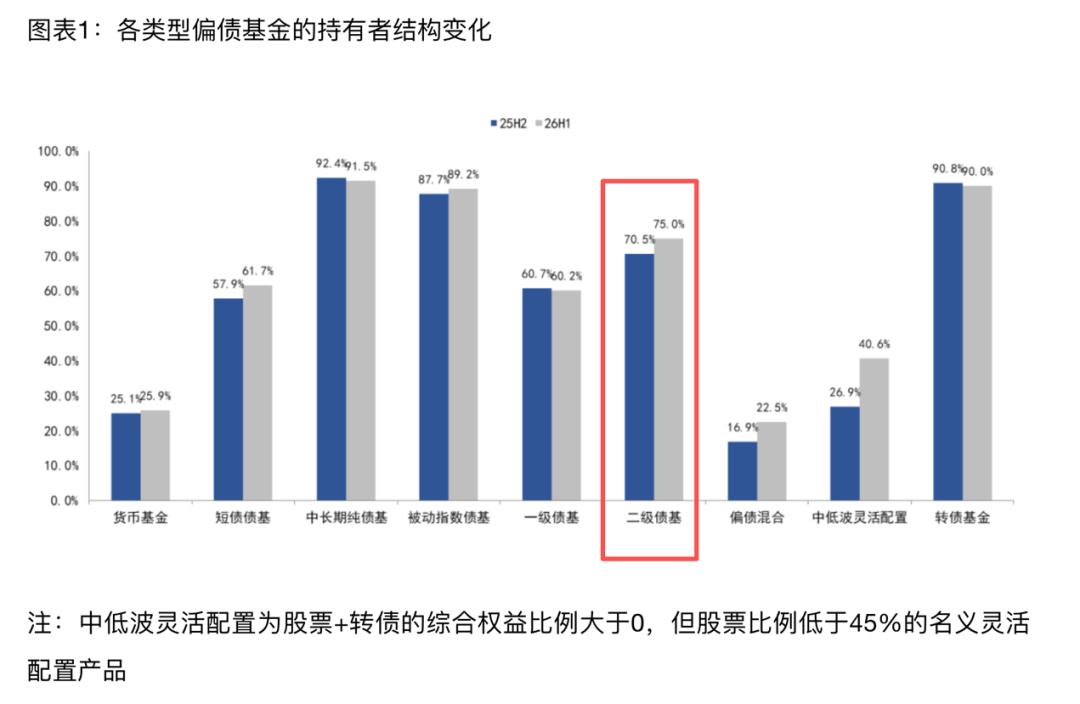
Another source from a fund company pointed out that the logic of "Fixed Income Plus" products such as secondary bond funds is more suitable for institutional capital. The retail side has better product forms, such as partial bond mixed funds, which can also provide strategies such as new share subscription and holding period arrangements, and are more suitable for the shelves of e-commerce platforms and banks.
When "Fixed Income Plus" is increasingly becoming an institutional allocation tool product, what path should retail investors take? The industry's answer points to investment advisory services. The real direction of resident wealth management should lie in investment advisory, through professional asset allocation suggestions to help investors understand their own risk tolerance, match suitable "Fixed Income Plus" products, instead of getting lost in the pursuit of track labels.
This article is from the WeChat official account "China Fund News" (ID: chinafundnews), author: Yan Jun, authorized for release by 36Kr.