Seven Turning Points of Optical Modules
Within a week, Goldman Sachs significantly raised its 1.6T shipment forecast once again, over 5,000 optoelectronic enterprises set up booths in Shenzhen, and the long-awaited U.S. FCC rule landed in a far milder form than market rumors. Overlaying information from exhibition booths, earnings calls, official standard documents and research institutions, the silicon photonics and optical module industry is shifting from the "first half focused on production capacity expansion" to the "second half centered on integration and system optimization".
On September 7, 2026, Goldman Sachs released an optical module industry update report, raising the 2027 1.6T shipment forecast from 42 million units (estimated two months prior) to 71.4 million units. Two days later, the 27th China International Optoelectronic Exposition (CIOE) opened in Shenzhen, with more than 5,000 participating enterprises. 1.6T pluggable modules, 3.2T and 6.4T near-packaged optical engines, 12.8T liquid-cooled pluggable products, co-packaged optical switches and optical path switches filled the entire information and communication exhibition hall. On the closing day of the expo, September 11, the U.S. Federal Communications Commission (FCC) final supply chain security rule was published in the Federal Register, and the "China optical module ban" that the market had worried about for more than a month did not appear.
Putting these three events together, they form a clear cross-section of the silicon photonics and optical module industry: sellers are revising their demand forecasts upward, module manufacturers and cloud vendors are competing on product form and speed at exhibitions, and the geopolitical uncertainty has temporarily settled. Based on public information collected during the three-day CIOE, combined with earnings reports and earnings calls of listed companies, documents from standardization organizations and public statements from research institutions, this article attempts to answer one question: Has the first half of the silicon photonics era ended, and what will the second half focus on?
01
Three events in one week: Exhibitors, sellers and upstream players are all talking about the same trend
The high information density of CIOE is first reflected in the exhibition booths. Innolight displayed its full 1.6T/800G product line and 3.2T NPO solution; Accelink announced that the world's first 3.2T silicon photonics single-mode NPO has completed verification at leading cloud service providers, and launched forward-looking 6.4T NPO and 12.8T XPO solutions; HG Genuine demonstrated 6.4T DSP-free NPO optical engines and 12.8T XPO products; Eoptolink and Source Photonics (Dongshan Precision) also presented 12.8T XPO samples; Coherent brought 6.4T slot-type CPO, 1.6T VCSEL NPO and 400G silicon-based indium phosphide modulator; Broadcom exhibited its third-generation CPO switch Tomahawk 6 Davisson, which integrates 16 6.4T silicon photonics optical engines, delivers 102.4T switching capacity and reduces power consumption by 70%; HiSilicon's silicon photonics product line is evolving from 1.6T to 3.2T and 7.2T, and uses 200G VCSEL multi-channel arrays to enable scale-up within server racks.
Upstream players have released another set of data. Leading open silicon photonics foundry Tower Semiconductor reported that its silicon photonics revenue in the second quarter increased by more than 270% year-on-year, with an annualized operating rate of 680 million U.S. dollars, and the company targets to exceed 1 billion U.S. dollars in the fourth quarter; customers have prepaid 290 million U.S. dollars to lock in 2027 production capacity. In March, NVIDIA invested 2 billion U.S. dollars each in Coherent and Lumentum and signed multi-year supply agreements to secure laser supplies. The title of LightCounting's April market newsletter is straightforward: "Optical connectivity demand continues to exceed expectations".
Although exhibitors, sellers and upstream players appear to be talking about different things, the signals they convey are highly consistent, which can be summarized in three points: First, 1.6T is no longer a technical problem but a delivery problem, and silicon photonics has secured more than half of the market share in this generation; Second, the competition for non-pluggable form factors has moved from concept to verification and small-batch production, and it is almost a consensus that NPO will be deployed in the Chinese market earlier than CPO; Third, the real bottleneck is shifting from module manufacturing capabilities to lasers, advanced packaging and system integration. A technical leader from ASE Group said a memorable remark when talking about CPO in August: The industry has not yet established the shared testing standards and simulation foundation required by this technology, and every supplier has to conduct independent verification, which leads to multiplied cost increases and delayed yield learning progress — in other words, wafers only account for half of the challenge, and packaging, testing and system integration account for the other half.
02
Demand side: The scissors gap between computing power and network, 1.6T shifts from "availability" to "delivery volume"
2.1 Network is the short board of AI infrastructure
The most intuitive public indicator on the demand side is token volume. Google disclosed that its monthly token processing volume surged from 9.7 trillion in April 2024, to 480 trillion in May 2025, 1.3 quadrillion in September 2025, and 3.2 quadrillion at the I/O conference in May 2026 — representing an approximately 7x year-on-year increase and 330x increase over two years, with almost all incremental demand coming from inference scenarios. The generational iteration pace on the network side is much slower: Broadcom's switching chips doubled in capacity every 2 to 3 years, from Tomahawk 5 (51.2T) in 2022 to Tomahawk 6 (102.4T) in 2025, and to Tomahawk 7 (about 200T) taped out in 2026; the NVLink bandwidth of a single NVIDIA GPU also doubled per generation, from 900GB/s for Hopper, to 1.8TB/s for Blackwell, and 3.6TB/s for Rubin. Inference demand grows 7x a year, while interconnection bandwidth only doubles every two years, which forms the scissors gap between computing power and network.
The cost of this scissors gap is idle computing power. As early as the 2022 OCP Summit, Meta disclosed that about 33% of the time in its AI training process was spent waiting for network transmission; in August 2026, the OCP "Open Silicon Photonics for AI Systems" architecture blueprint led by Lightmatter and participated by 20 companies stated that the current model computing power utilization rate of AI clusters is only 38%–43%, with a target of increasing to 55%–65%. Clusters are more sensitive to packet loss. Huawei's "Towards an Intelligent World 2024 · Data Communication" whitepaper notes: Even a 0.1% packet loss rate may reduce training efficiency by 50%. Large clusters do not equal large computing power, and communication time proportion, latency and reliability are three core upper limits that restrict performance.
The first two upper limits explain why super nodes are being developed, and why hollow-core optical fibers (where light travels about 47% faster than in glass, reducing latency by about one third) are frequently mentioned. NVIDIA's specification for GB200 NVL72 shows that a single NVLink domain composed of 72 GPUs can deliver real-time inference performance for trillion-parameter models that is 30 times that of the same number of H100 GPUs. Huawei disclosed in the CloudMatrix384 paper that after 384 NPUs are fully interconnected through a unified bus, the bandwidth attenuation of cross-node communication is less than 3%, and the latency increase is less than 1 microsecond. Domestic cloud vendors are moving in the same direction: Wang Yachen, Vice President of Tencent Cloud and General Manager of Tencent Networks, stated during the World Artificial Intelligence Conference in July that Tencent will deploy large-scale domestic computing power, and deploy NPO super nodes in the fourth quarter of 2026; according to public reports, Tencent's ETH-X Ultra optical interconnection super node achieves a scale of 512 GPUs through one layer of NPO optical switching. Developing super nodes is not blindly following NVIDIA, but a practical response to the tangible impact of communication bandwidth on computing power utilization.
This set of data also explains why optical interconnection demand is always "higher than forecast". Vladimir Kozlov, CEO of LightCounting, said at the 2025 ECOC Silicon Photonics Workshop that optical module demand "is roughly nearly double the supply", and the bottleneck lies in indium phosphide; he also mentioned that Google told the industry seven years ago that in AI clusters, more money is spent on optical components than on computing components. Since then, LightCounting has raised its 2026 Ethernet optical module sales growth forecast to 73%; Morgan Stanley raised its 2027 1.6T shipment forecast from 24 million units to 79 million units in May; Goldman Sachs raised its forecast from 42 million units to 71.4 million units within two months. Forecasts are constantly being revised upward to catch up with real market performance, which has been the most stable rule in the optical module industry over the past two years.
2.2 1.6T delivery gap and price structure
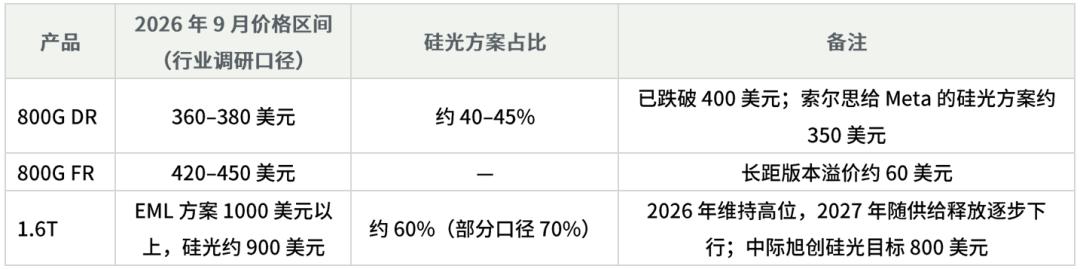
The 1.6T specifications released by all parties around CIOE can be compared together. Innolight's semi-annual report states that global 1.6T demand in 2026 is about 25 million units, with effective production capacity of about 15 million units; LightCounting expects global 1.6T shipments in 2026 to exceed 8.6 million units, and 1.6T will account for 45% of the high-speed optical module market in 2027; Morgan Stanley and Goldman Sachs' 2027 forecasts are 79 million units and 71.4 million units respectively (see the next section for details). The figures from different parties vary by 2 to 3 times, but the direction is consistent: 1.6T is constrained by production capacity in 2026, and will enter the cross period of volume expansion and price decline in 2027.
<Click the image to enlarge>
Behind the price list is a structural fact: The cost reduction logic of silicon photonics does not mainly come from the silicon wafer itself, but from reducing the number of lasers. According to LightCounting's explanation, in parallel single-mode solutions such as DR4 and DR8, each channel of EML requires one laser, while silicon photonics can use one high-power continuous wave (CW) laser to split light and supply multiple channels — for an 800G 8-channel module, the EML solution requires 8 lasers, while the silicon photonics solution usually only needs 2. Lasers are in short supply and expensive, silicon photonics is manufactured in 200mm and 300mm silicon fabs, while indium phosphide is still produced on 3-4 inch lines, so their supply elasticity is completely different. Based on this, LightCounting judges that 2026 is the "Year of Silicon Photonics": The sales of modules based on silicon photonics modulators will exceed half of the optical module market for the first time, this proportion was 10% in 2018 and 33% in 2024.
2.3 Cross-verification of a brokerage report: Goldman Sachs' upward revision in September
Two days before the opening of CIOE, Goldman Sachs released an optical module update report (dated September 7) with Innolight as the target, significantly raising the shipment forecast for 800G and 1.6T compared with the July version. Its value does not lie in the target price, but in providing a set of figures from the seller's perspective that can be mutually verified with the on-site situation of CIOE and upstream earnings reports. The core of the report is the following global optical module shipment forecast table layered by speed (redrawn based on the original table data).
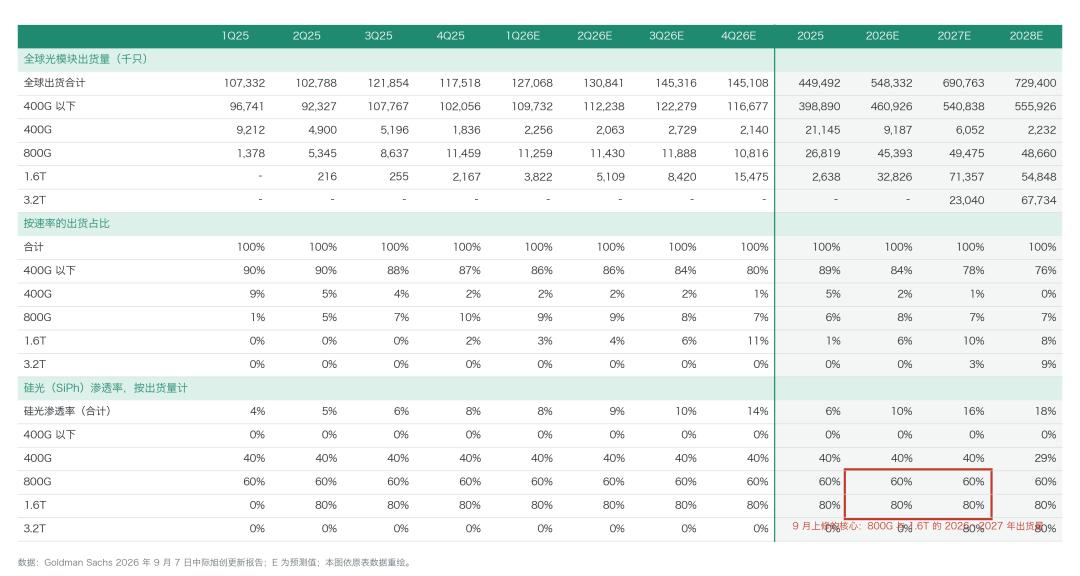
Figure 1 · Goldman Sachs: Global optical module shipment, speed structure and silicon photonics penetration forecast (2025–2028E, quarterly and annual). The red box is the key part of the upward revision in September.
This table is divided into three layers, as follows. The first layer is shipment volume (thousand units). Global optical module shipments will increase from about 449 million units in 2025 to about 729 million units in 2028, but the majority of the volume is always low-speed products below 400G (399 million units in 2025, accounting for 89%; 556 million units in 2028, accounting for 76%), which contribute to volume but not growth. The real variables are in the red box: 800G jumps from 26.8 million units in 2025 to 45.4 million units in 2026, and then remains stable at around 49 million units; 1.6T increases from 2.64 million units in 2025 to 32.8 million units in 2026 and 71.4 million units in 2027, representing a 12x increase in one year followed by another doubling; 3.2T appears for the first time in 2027 with 23 million units, and reaches 67.7 million units in 2028, surpassing 1.6T (54.8 million units) in the same year. It is more intuitive to view by quarter: 1.6T shipments increase from 3.82 million units in Q1 2026 to 15.48 million units in Q4 2026, quadrupling within one year, and accounting for 11% of the total shipments in Q4.
The second layer is speed structure. The proportion of products below 400G drops from 89% to 76%, 400G drops from 5% to zero, 800G remains stable at 6%–8%, 1.6T reaches a peak of 10% in 2027 and then drops back to 8%, and 3.2T rises to 9% in 2028. This implies a crucial judgment on the industry rhythm: The shipment peak of 1.6T only lasts for one year in 2027, and will be diverted by 3.2T in 2028 — the window period of each generation of products is shorter than the previous one, which also explains why 3.2T has entered sampling verification at CIOE while 1.6T has just started volume expansion. The third layer is silicon photonics penetration (calculated by shipment volume). Goldman Sachs' assumption is very clear: zero penetration for products below 400G, 40% for 400G (dropping to 29% in 2028), 60% for 800G, and 80% for both 1.6T and 3.2T. Since low-speed products are the main part of the total volume, the overall penetration rate only rises from 6% to 18%, but silicon photonics is already the absolute mainstream in incremental products; by quarter, the overall penetration rate rises from 4% in Q1 2025 to 14% in Q4 2026, and the growth slope comes from 1.6T volume expansion rather than penetration improvement of a single speed product.
Comparing this table with other public data, we can see the positioning of Goldman Sachs' forecast. The 32.8 million units of 1.6T shipments in 2026 is higher than Innolight's semi-annual report statement of "25 million units of demand and 15 million units of effective production capacity", and much higher than LightCounting's 8.6 million units — Goldman Sachs calculates total demand rather than deliverable volume, which is the main source of the gap between its 2026 market size estimate of 67.7