Zero-yuan phone purchase, died in 2026
"0-yuan phone purchase" has suddenly hit the brakes.
Recently, according to reports from Sina Tech, the financial installment business under the three major telecom operators has fully suspended accepting new applications starting from September 24.
China Mobile's "HeBao Credit Purchase", China Telecom's "Orange Installment", and China Unicom's "Wo Installment" — these products that were once packaged as "free phone collection" and "0-yuan phone purchase" in business halls — have now stopped accepting new applications. Employees of operators in many regions have received notifications, and customer service representatives of the three major operators have all confirmed the matter.
For many consumers, this is not good news.
Over the past few years, "0-yuan phone purchase" has been an important channel for many people to replace their mobile phones: sign up for a plan, get the phone for no extra cost, pay the monthly phone bill as usual, which seems almost like getting it for free.
For operators, this business can lock in high-value users and drive terminal sales; for offline business halls, it is an important lever to meet performance targets; for mobile phone manufacturers, it is a stable shipment channel.
Users get tangible benefits, channels hit their performance targets, operators retain their users. On the surface, this is a win-win business for multiple parties.
So the question arises: why would a business that benefits users, delivers performance for channels, and helps operators retain users be suspended? After the suspension, what impact will it have on ordinary users, offline business halls, operators, and even the entire mobile phone industry chain?
01 From "Getting a Free Phone" to "Carrying a Small Consumer Loan" — It Only Takes One Signature
If you open the Black Cat Complaint platform and search for the names of the three major operators, it is not hard to find from the popped-up results that installment-based phone purchase has become their most heavily complained business.
On the Black Cat Complaint platform, there are thousands of related complaints with highly similar types: being processed for a loan without prior knowledge, thinking they are getting a 0-yuan phone but actually signing an installment contract, overdue loans caused by unpaid bills, damaged credit records, and difficulties in unsubscribing and terminating contracts.
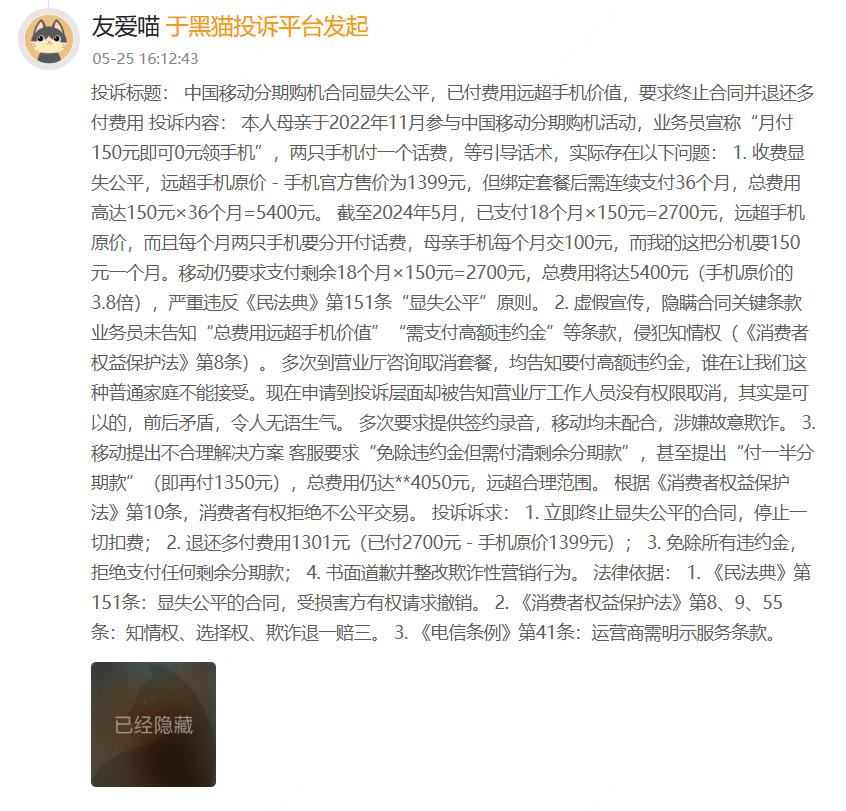
One consumer complained that his mother participated in China Mobile's installment phone purchase program in 2022, where the salesperson said "pay 150 yuan per month to get a phone for 0 yuan". The official price of the mobile phone is only 1399 yuan, but after binding to the plan, she has to pay for 36 consecutive months with a total cost of 5400 yuan, 3.8 times the original price of the phone. After repeated requests to cancel, she was told that a high penalty for breach of contract must be paid.
Users on social platforms also shared their experiences of applying for Orange Installment at telecom business halls: originally wanting to buy a tablet, the clerk said that changing the plan could get a direct discount of 1440 yuan, which seemed very cost-effective. During the application process, "I was asked to do face scanning and sign the document one after another". After returning home, I felt more and more that something was wrong, and after checking, I found that what I got was not a discount at all, and finally I had to make up the price difference of the so-called discount.
There are many such complaints, all pointing to the same problem: users thought they were enjoying subsidies, but actually took on loans. Complaints are only the superficial phenomenon, and the real problem lies in the business model itself.
When users apply for a designated plan and "incidentally" buy a mobile phone in installments, it is ostensibly "getting it for free" or "paying 0 yuan", but in essence they sign a consumer loan contract in their personal name, and the operator repays the loan for the user in the form of monthly phone bill subsidies.
The key to this model is that operators tie communication bill payment to credit performance.
In response to this problem, independent telecom analyst Fu Liang once pointed out to 21st Century Business Herald that in the operation process of Orange Installment, consumers pay for their plan on time every month, and China Telecom will return part of the phone bill to the "Best Pay" account in the form of red envelopes or subsidies, and then "Best Pay" will repay the loan to the commercial factoring company on behalf of the user.
This means that once the phone bill is in arrears and the service is suspended, the operator's subsidy will stop, but the user's loan contract will not. Without the subsidy to offset the payment, the loan will become overdue immediately, and the overdue record will be reported to the central bank's credit reporting system, which will affect the approval of housing loans, car loans and credit cards.
More critically, such products involve multiple entities including operators, payment institutions and financial institutions, and it is very difficult for ordinary consumers to understand the product structure behind them.
In other words, in the past, forgetting to pay the phone bill would only result in service suspension; but after you get a free phone and forget to pay the bill, it may leave a blemish on your personal credit record.
The previous free phone acquisition business could work mostly relying on the loose regulatory environment in the past. However, with the relevant authorities cracking down on illegal loans, the free phone purchase business has also been implicated by the "high-interest rental phone loan".
In recent years, regulatory authorities have carried out multiple rounds of clean-up on usury in disguised forms with an annualized interest rate of more than 24% and loan assistance institutions, and the "phone rental loan" market that undertakes sinking demand has also ushered in a full-scale clean-up.
Phone rental platforms use "low threshold, flexible rental" as their selling point, but the actual buyout price of the goods is far higher than the market retail price, with the annualized capital cost exceeding 80%, and some even exceeding 300%, which naturally becomes the target of crackdown.
China Securities Journal once pointed out that there are "phone rental for cash" businesses on the market under the guise of "credit lease", "0-yuan phone purchase" and "free delivery after rental", which are essentially illegal high-interest loans packaged in the name of leasing.
Since the beginning of this year, many phone rental intermediaries in multiple regions have been taken away for investigation, many phone rental apps have been notified for illegally collecting personal information, and courts in many regions have made penetrating qualitative judgments on this industrial chain through criminal or civil precedents.
More critically, the Administrative Measures for Online Marketing of Financial Products will be officially implemented on September 30, 2026.
This new regulation jointly issued by eight departments including the People's Bank of China clearly stipulates that: when selling financial products in combination, consumers shall be reminded in a prominent way, no illegal bundled sales are allowed, and the combined sales option shall not be set as default consent. For transactions involving installment payment, consumers shall not be induced by one-sided publicity of preferential first-installment fees.
The eight departments clearly require that before the official implementation, financial institutions and third-party internet platforms should speed up the rectification and clean-up of marketing content and behaviors that are inconsistent with the requirements of the Measures. The operators' previous sales model that relies on information asymmetry and downplays the nature of loans is fundamentally in conflict with these transparency requirements.
Regulation is tightening year by year, but the operators' revenue pool is getting smaller and smaller.
Starting from January 1, 2026, the value-added tax rate for mobile data, SMS and MMS, and broadband access has been raised from 6% to 9%, and the core businesses of the three major operators have fully returned to the category of "basic telecommunications services".
Under the current policy background of lowering tariffs while improving service quality, the price of tax-included plans must remain stable, and the newly added 3% tax cost can only be digested internally by operators. The industry's net income is expected to lose about 25 billion to 30 billion yuan, and the net profit of the entire industry is facing a targeted reduction of 10% to 15%.
Installment-based phone purchase used to be an important tool for offline business halls to acquire new users, lock in customers and increase customer unit price. Its low threshold attracts users, drives terminal sales, and the contract period locks users on the network for a long time.
Some business halls, in order to meet their KPI, simplified complex financial products into the wording of "0-yuan phone purchase" and "free phone collection", leading many consumers to think that it is only a phone bill contract, without knowing that they have signed a consumer loan contract.
The superposition of complaints, regulation and channel chaos has finally led to this full suspension. But what will happen after the suspension?
02 After the Suspension, Where Will the Operators Go?
In the report, insiders summed up the direct impact of this suspension in one sentence: "It is expected that it will have a certain impact on the performance of the operators' offline business halls." But the phrase "certain impact" carries completely different weights for different people.
"This has had a huge impact on our store." Lao Zhang runs an operator cooperative business hall in a third-tier city in East China. According to him, in the past, installment contracts accounted for the majority of the store's terminal sales, especially during holidays, the "0-yuan purchase" was the best hook to attract customers.
"Users may just come in to take a look at first, but once they hear that the phone is free of charge and they need to use the plan anyway, they will easily sign up. Now that this hook is gone, the number of people entering the store will definitely drop, and the performance in the next few months will definitely be affected. Not only will mobile phones not sell well, but without the contract period to lock users, subsequent businesses such as broadband and secondary SIM cards will also be affected."
But not all salespeople are frowning. Xiao Li, who has been in the industry for a short time, works in a telecom cooperative business hall. In her eyes, the suspended 0-yuan purchase seems to have lifted a burden off her shoulders.
She told Super Focus, "To be honest, I'm relieved. The Mid-Autumn Festival and National Day holidays used to be the busiest time of the year, and the performance pressure would definitely be huge in the past, as every order required face scanning, signature and process explanation. Some customers would come back to make trouble after they got home and thought something was wrong, and we were caught in the middle in a very awkward situation. Now that the business is suspended, there will definitely be much less disputes, and the workload is indeed reduced."
As for how to fill the gap left by the withdrawal of installment services, according to industry insiders, frontline teams have already come up with an "alternative" solution, which is to pre-deposit phone bills and get monthly refunds.
Some people have expressed doubts about how attractive this solution is to customers: "In the past, you got the phone first and paid later, which felt like getting it for free; now you pay a sum of money first and get refunds slowly, which is far less attractive, and it is absolutely impossible to fill the gap left by installment contracts", said Hua Jie, a staff member of a certain operator.
Some practitioners believe that the withdrawal of installment business may not be the end, but just a temporary suspension.
Lao Zhou, who works as a channel dealer in a prefecture-level city, said that this is not the first time the business has been taken offline. "There were adjustments before, and the business went online again after rectification. The key is to operate in compliance with regulations."
He said that what makes this time different from the past is that the regulatory caliber is clearer. "In the past, it was a gray area, but now you are required to put the loan contract on the table, make the risks clear, and return the right of choice to users. If these requirements are truly met, installment-based phone purchase may not be unable to come back. But the question is, if all these are done, will it still be the original 0-yuan phone purchase? Will users still make impulsive purchases as they did before?"
All these voices point to the same reality: after the suspension of installment-based phone purchase, the old tricks of offline channels no longer work.
In the short term, store performance is under pressure, and frontline employees have divided feelings; in the long run, users' credit security has an extra layer of protection, but operators and channels must find new ways to retain users, which may be the biggest challenge facing the three major operators' offline business halls.
This article is from the WeChat official account "Super Focus foci", written by Sean, and published with authorization from 36Kr.