As a wage earner, I really envy the 80% of robots that don't have to work in factories.

In 2026, is there any track more surreal than humanoid robots?
In the primary market, capital players are going all in, pouring a staggering 935 billion yuan in just half a year; in the secondary market, new listings break their offering prices, leading stocks see their market value halve, and investors are shouting "show me the performance first". On one hand, hot money of over 400 million yuan pours in on every average working day, on the other hand, there are barely any orders in factories.
Is the humanoid robot sector really booming, or is it all a false bubble? IT Juzi uses several sets of hard-hitting data to expose the unvarnished truth of this track. 👇
The "Bubble Arithmetic Problem" Under Hundred-Billion Valuations
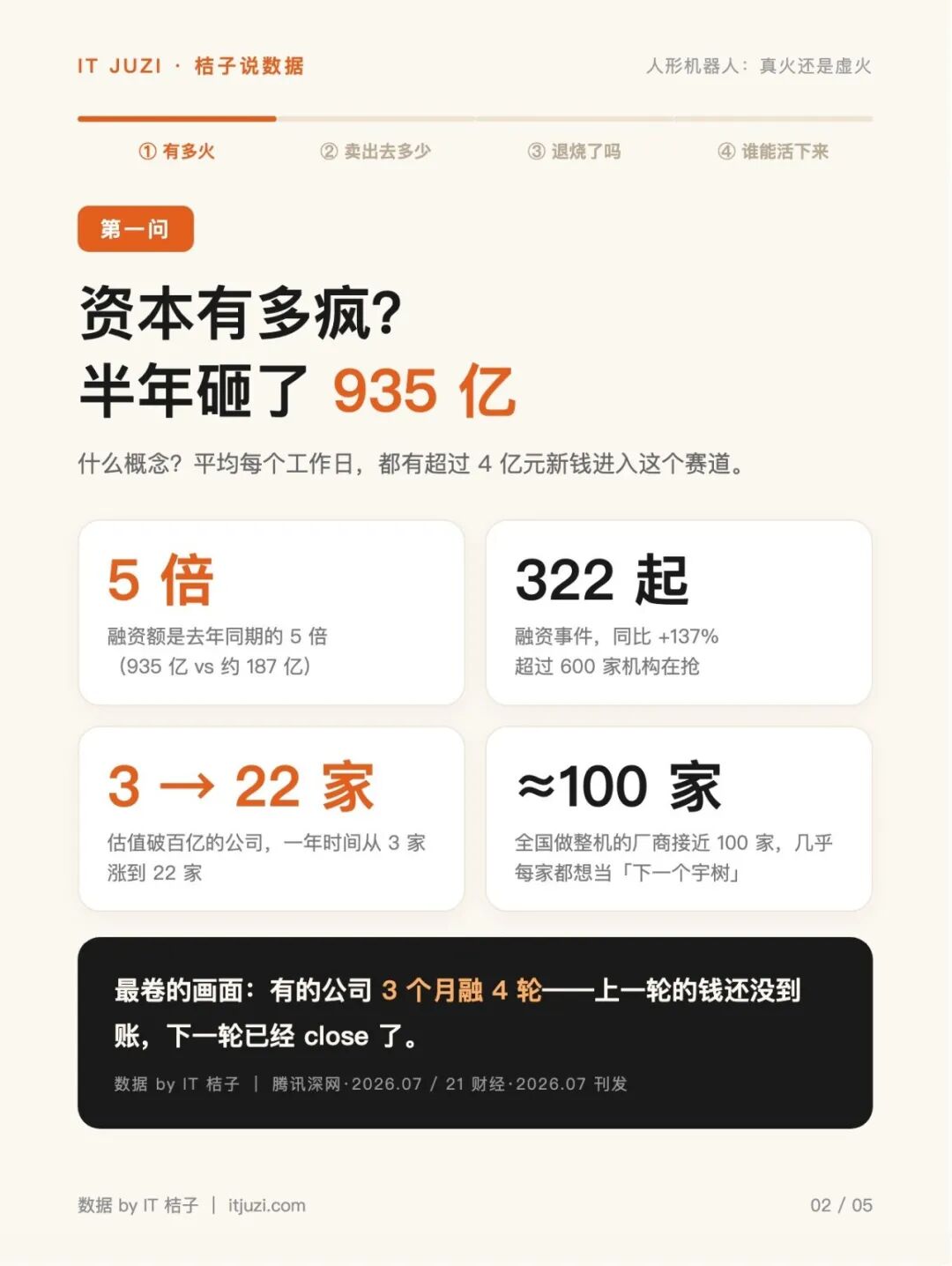
Within just one year, the number of companies with a valuation exceeding 10 billion yuan has surged from 3 to 22. Some companies have completed 4 consecutive financing rounds in 3 months, where the funds from the previous round have not even been credited to the account, but the TS (Term Sheet) for the next round has already been signed.
But if we do the math: the global annual sales volume is 22,000 units, which is divided among these 22 companies with 10-billion-yuan valuations, the average annual sales of each company is less than 1000 units, corresponding to a 10-billion-yuan valuation, which means a single robot supports a market value of 10 million yuan.
This is absurd in any hardware manufacturing industry. The reason why capital is going crazy is not that they have seen a clear commercialization path, but that they are suffering from "Fear Of Missing Out" (FOMO). After the breakthrough of large model technology, everyone is afraid of missing the next "iPhone moment", so hot money pours in blindly, forcibly turning a "large-sized toy" that is still in the laboratory into a unicorn with a 10-billion-yuan valuation.
The crazier the capital is, the more surreal the picture is.
Nearly 80% of Robots Are "Performing", With Almost No Self-Sustainability Ability
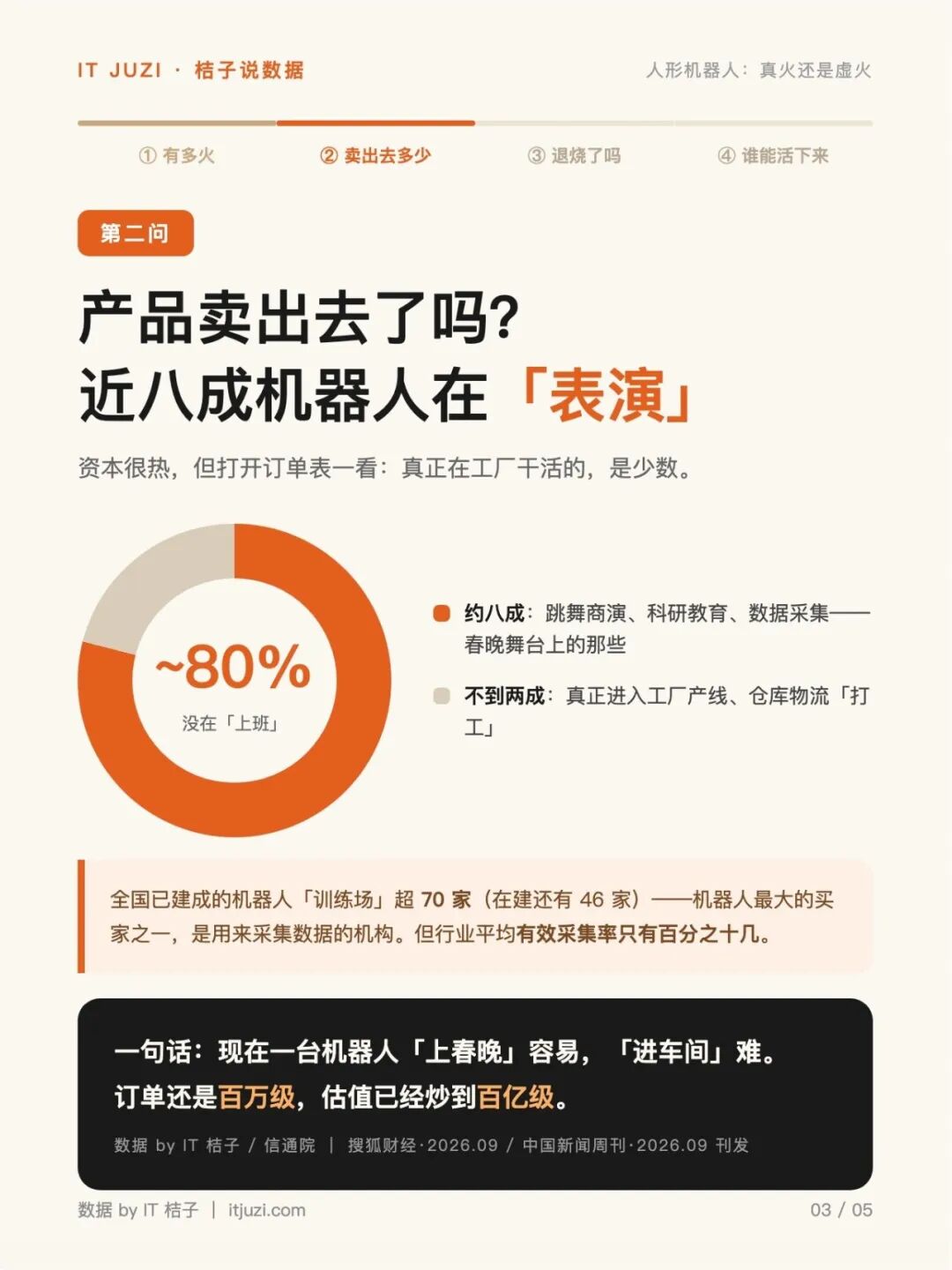
Capital is hot, but when you check the order book, only a small number of robots are actually working in factories.
According to data, only about 20,000 robots are sold worldwide in a whole year. Among these sold robots, about 80% are "not doing their proper jobs" — they are active in commercial dance performances, scientific research, education and data collection scenarios. Less than 20% are actually "working" in factory production lines and warehouse logistics.
This has also created a peculiar phenomenon: there are more than 70 robot "training grounds" that have been completed across the country (with another 46 under construction), and the largest buyer of robots is actually institutions that use them for data collection. However, the industry's average effective collection rate is only about 10% to 20%.
To sum up in one sentence: nowadays, it is easy for a robot to "appear on the Spring Festival Gala", but difficult for it to "enter the workshop". Orders are still at the million-yuan level, while valuations have already been driven up to the 10-billion-yuan level.
Unitree's Share Price Halving Tear Off the Fig Leaf of Inverted Pricing
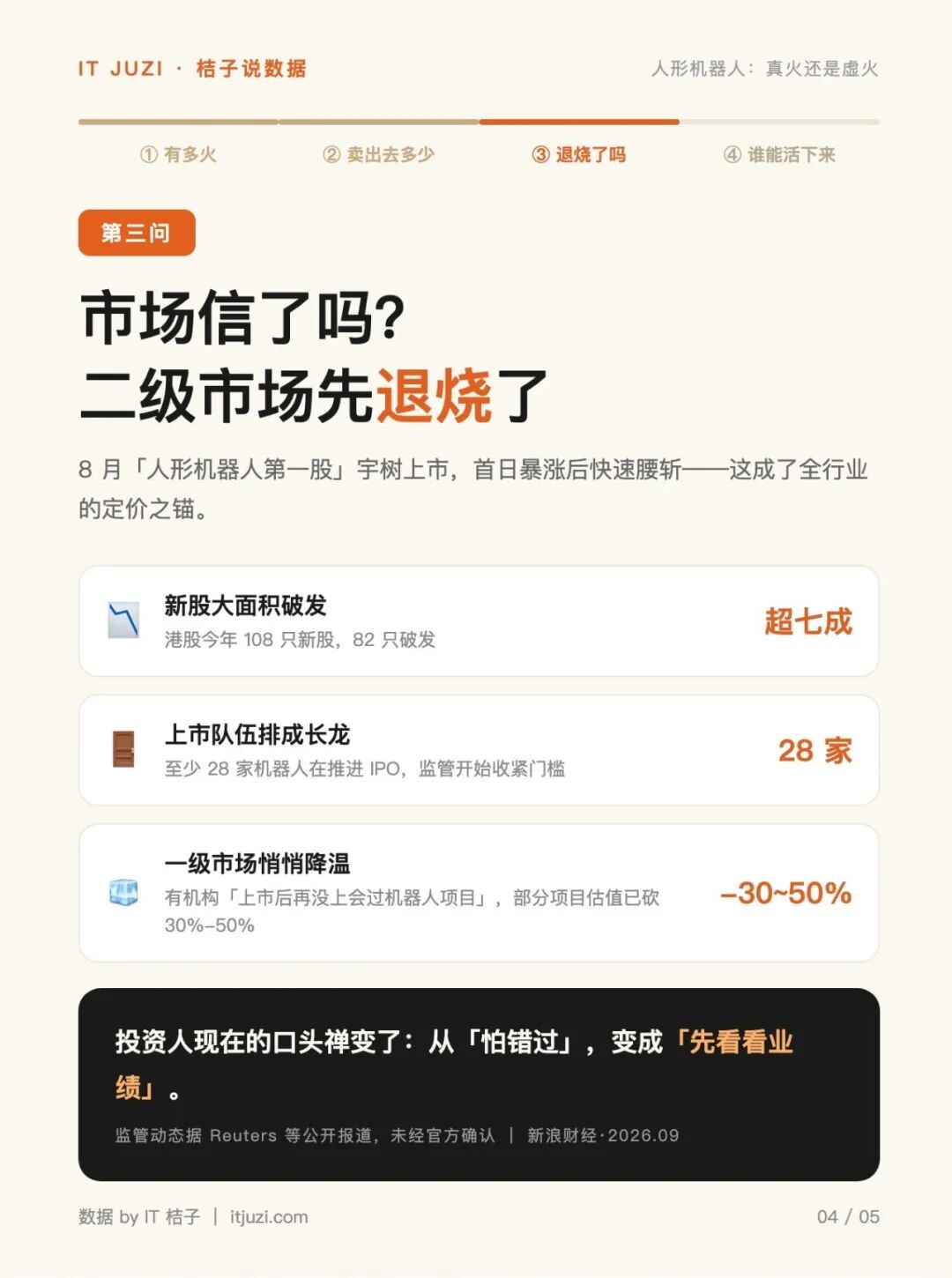
In August, Unitree, known as the "first stock of humanoid robots", went public. Its share price skyrocketed on the first trading day and then quickly halved — which has become the pricing anchor of the entire industry.
Among the 108 new stocks listed in Hong Kong this year, 82 have broken their offering prices (accounting for more than 70%). At present, at least 28 robot companies are queuing for IPO, while regulators have started to tighten the access threshold.
The primary market has also started to cool down quietly. Some institutions have explicitly stated that "we have not approved any robot project for review after the listing boom", and the valuations of some projects have been directly cut by 30% to 50%. Investors' mentality has changed from "afraid of missing out" to "afraid of being trapped". When the high valuation in the primary market cannot be realized in the secondary market, the negative consequence of the valuation inversion between primary and secondary markets will directly cut off the subsequent financing lifeline of these enterprises.
Investors' catchphrase has changed: from "afraid of missing out" to "show me the performance first".
Conclusion: The Boom Is Real, and the Bubble Is Also Real
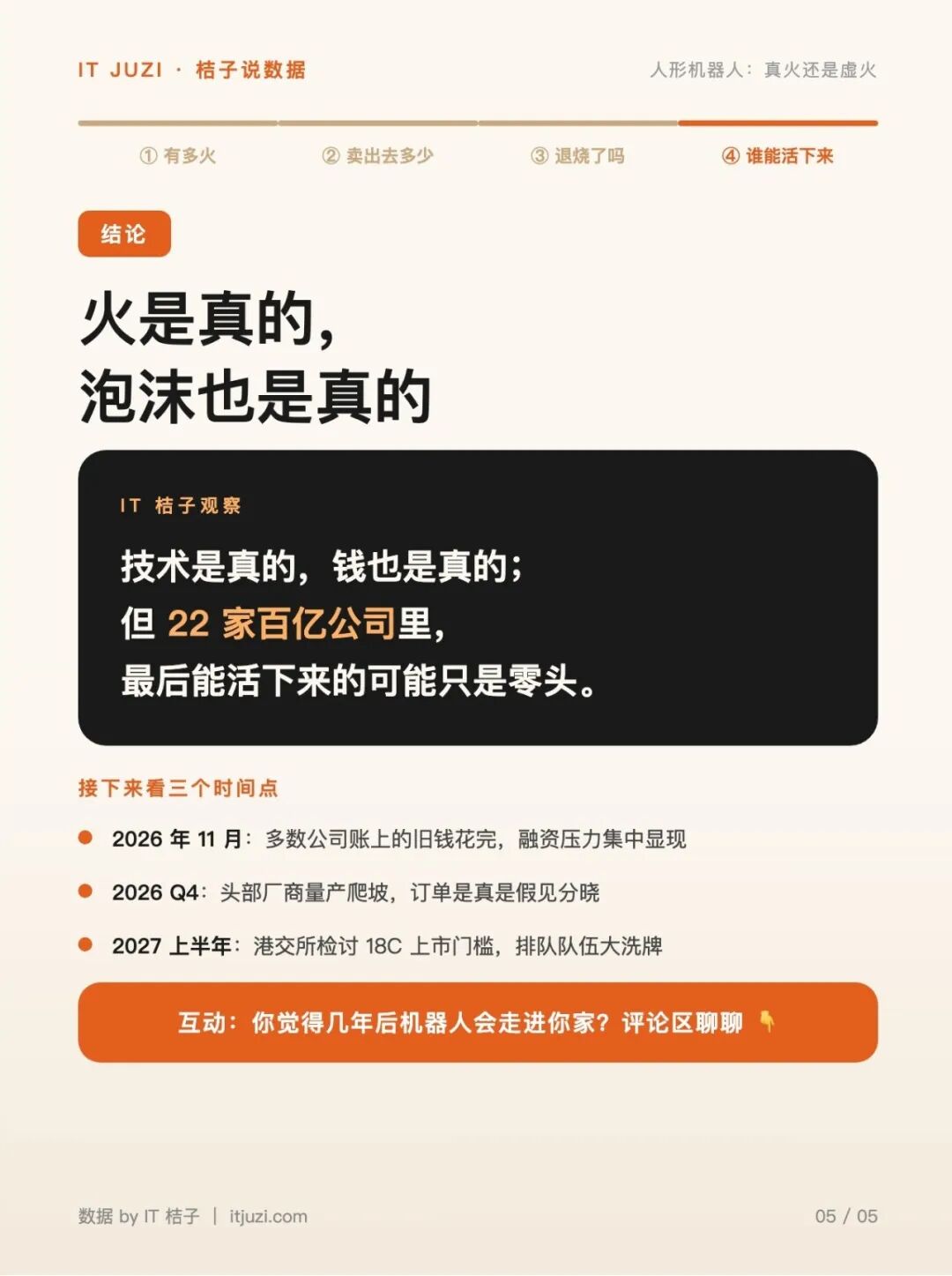
In the upcoming de-bubbling stage, the enterprises that can survive will never be the ones that make the most fancy PPTs now, but the enterprises with the following three characteristics:
Pragmatic Scenario Players: Companies that do not blindly pursue the "humanoid" form, but take the lead in running through the commercial closed loop in specific B-end scenarios (such as dangerous operations and specific logistics).
Supply Chain Cost Control Champions: Companies that can reduce the hardware cost to a price that the market is willing to pay, instead of piling up high-end components to raise costs.
Ample Ammo Holders: Companies that have enough cash flow to support their operations until 2028.
🤖 How many years do you think it will take before robots actually walk into your home? Feel free to share your opinions in the comment section!
This article is from the WeChat Official Account "IT Juzi" (ID: itjuzi521), author: IT Juzi, published with authorization from 36Kr.