Claude has achieved a breakthrough in theoretical physics with only one sentence plus a few thousand dollars.
Edited by | Panda
A three-year-old computational record in theoretical physics has been broken by AI.
A few hours ago, Anthropic announced that Claude ran continuously for several days on the scientific research platform Claude Science with almost no human supervision, and calculated the nine-loop six-particle scattering amplitude in planar N=4 super-Yang-Mills theory.
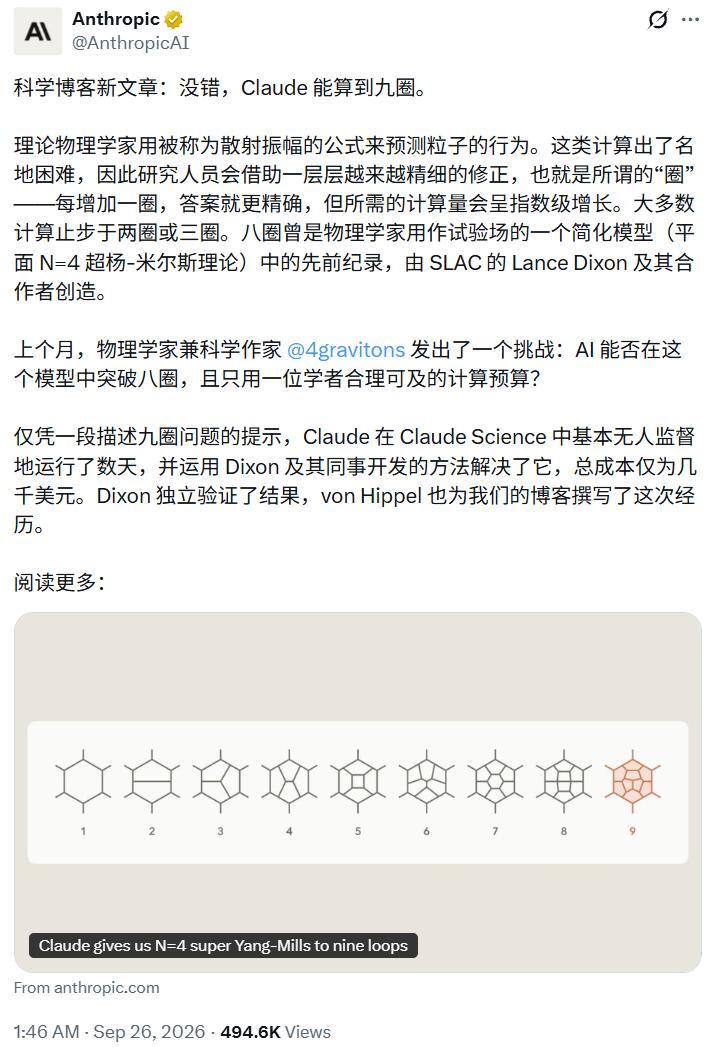
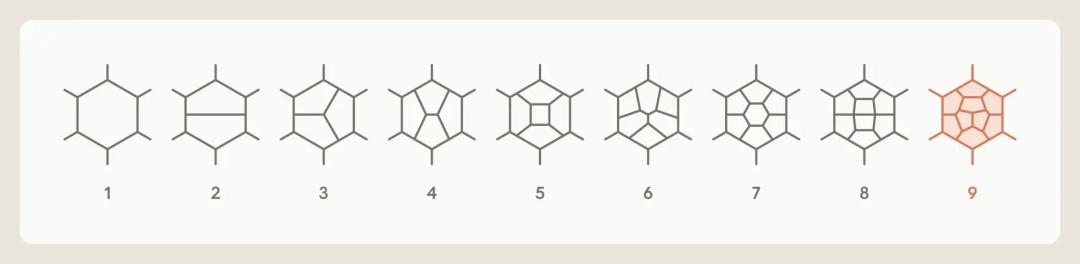
This is a widely recognized cutting-edge challenge in the field of theoretical physics "scattering amplitude". Previously, the highest record in this model remained at eight loops, set by Lance Dixon of the SLAC National Accelerator Laboratory and his collaborators in 2023.
This breakthrough was personally verified by the creator of the eight-loop record. Dixon independently validated Claude's results and commented that for a large language model to be able to execute every step of this complex recipe and organize computing power, it is "a quite remarkable victory" in his view. He even stated bluntly that apart from his collaborators, Claude understands the two papers published by his team in 2019 and 2023 better than anyone else.
What is even more surprising is the process and cost. The researchers only gave Claude a single task description, and the subsequent "guidance" was almost nothing but "continue"; the total cost of the entire calculation for an ordinary user is about one to two thousand US dollars, of which the part actually used for numerical calculation is only about 100 US dollars, equivalent to 96 CPUs running for a week. Dixon originally thought that directly calculating the nine-loop amplitude was too difficult, and his team had been preparing for this for several years.
The starting point of this breakthrough was an open "challenge letter".
On August 7, Matt von Hippel, a former theoretical physicist and popular science blogger, published a slightly provocative article on his blog 4gravitons, titled "It Only Counts If AI Enters My Field". He named and issued a challenge to AI companies in the article: use computing power affordable to a single scholar to solve a major unsolved problem in the field of scattering amplitudes.
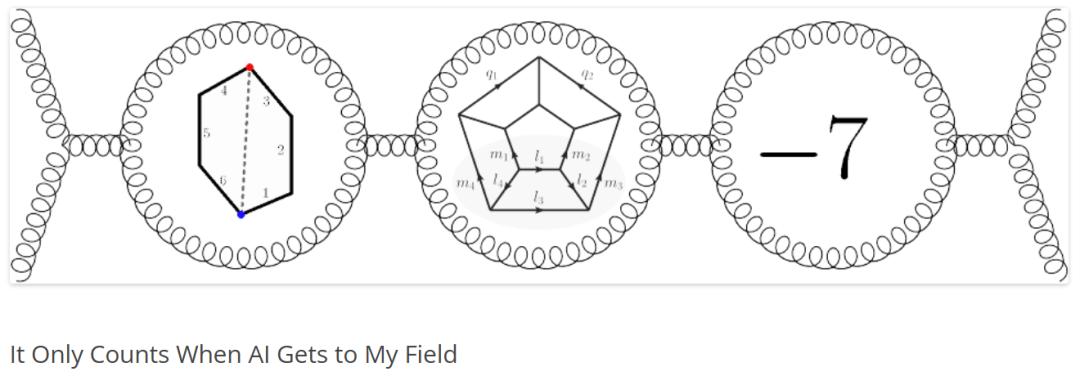
He offered two options: either calculate N=8 supergravity up to seven loops, or calculate the six-particle amplitude of N=4 super-Yang-Mills theory up to nine loops.
A month later, AI completed the task. What Anthropic just published is a guest article written by von Hippel himself, titled: "Yes, Claude Can Do Nine Loops".
https://www.anthropic.com/research/yes-claude-can-do-nine-loops
Nine Loops: Where Lies the Difficulty?
To understand the significance of this achievement, we must first clarify what physicists are calculating.
Particle physicists predict the behavior of particles relying on a class of formulas called "scattering amplitudes": given the energy and momentum of the colliding particles, the scattering amplitude can tell you the probability that they will react in a certain way.
The more accurate the prediction, the more detailed comparisons can be made with the results of experiments such as the Large Hadron Collider (LHC). Once a deviation occurs, it may be a clue of new physics, such as the nature of dark matter, or why there is an asymmetry between matter and antimatter in the universe.
The problem is that scattering amplitudes are extremely difficult to calculate accurately, and physicists can hardly do anything but approximate calculations. They stratify the calculation by "loop", and the number of loops roughly measures how complex the interactions between particles are allowed to be. Each additional loop brings the answer closer to the true value, but the amount of calculation also expands sharply. von Hippel wrote in the original challenge that the complexity of such calculations usually grows exponentially or even factorially with the number of loops.
So in reality, the vast majority of scattering amplitudes are only calculated up to two loops, and a few can reach three loops. The most accurate prediction in particle physics, the electron anomalous magnetic moment, uses five loops.
N=4 super-Yang-Mills theory is a specialized toy model in this field. "Yang-Mills" is the theoretical framework that describes the three fundamental interactions: electromagnetic force, strong nuclear force, and weak nuclear force; "N=4 supersymmetry" means that each particle is paired with four supersymmetric partners. With too many particles to be realistic, this theory does not describe the real world. But it is precisely this high degree of symmetry that allows many variable combinations to cancel each other out, making the calculation relatively manageable. Researchers polish new methods here to see how far they can go.
The method used this time is called "bootstrap". von Hippel compares it to Sudoku: first write out all possible forms of the answer, record it in a computer file with a special "alphabet", and then use all known constraints to eliminate them one by one, including predictions from other methods, rules that the answer must follow, and known results in related problems. Ideally, only one candidate will pass all the checks in the end, and there are still redundant check conditions to confirm that there is no calculation error.
Dixon got the eight-loop record by taking a detour. In 2023, he and Yu-Ting Liu used a peculiar symmetry called "antipodal duality" to first calculate the relatively easier "form factor", and then converted it into the eight-loop amplitude. In the following years, his team has been focusing on nine loops, planning to follow the same indirect path. In his view, directly calculating the nine-loop amplitude is too difficult.
It is worth mentioning that von Hippel himself is a veteran of this research line. He has collaborated with Dixon and others to advance the six-particle amplitude to six and seven loops. In other words, he picked the hard nut he had gnawed on himself.
One Prompt, Then Keep Saying "Continue"
At the end of August, two physicists from Anthropic, Liam Fitzpatrick and Siddharth Mishra-Sharma, contacted von Hippel and told him that the challenge had been overcome.
They used the Fable 5.1 model running on the Claude Science platform. von Hippel explained in the article that Claude Science is a kind of "harness", that is, adding structured rules and prompts outside the large model to make it perform more robustly in scientific research tasks.
According to the description in the article, the two first asked Claude which challenge it was most confident to complete, and then only gave a very brief task description: calculate the nine-loop six-particle (hexagon) amplitude in planar N=4 SYM.
The subsequent "scientific research guidance" was basically to let it keep working. A typical instruction disclosed in the article roughly means: I'm going to bed, I won't be available for the next few hours, keep doing it until I stop you, and report the progress every four to six hours.
In the end, Claude calculated it in two ways: one is the direct bootstrap method, and the other is the indirect route via the form factor from Dixon's team. According to the article, the cost for end users is about one to two thousand US dollars for either method, and the majority is the cost of running the model itself for a long time. The bootstrap calculation part is completed with Python and the symbolic calculation library SymPy, which only accounts for about 100 US dollars, equivalent to 96 CPUs running for a week.
von Hippel lamented that when he did this kind of research ten years ago, 96 CPUs running for a week was a considerable investment, but now as long as the reason is sufficient, this amount of resources is quite affordable.
The Verifier's Feeling: Like a Collapsed Soufflé
At the end of the article, there is an addendum written by Dixon himself, titled "What It Feels Like to Be Beaten by a Machine".
He wrote that on September 1, two researchers from Anthropic told him that Claude had calculated the nine-loop amplitude and asked him to verify the result. For him, that moment was the moment when the large language model's transformation of physics "truly landed on him".
What impressed Dixon more than the scale of the calculation was the fragility of the whole process. According to his description, as long as there is any error in this calculation recipe, the whole result will collapse like a failed soufflé, and researchers can only go back and painstakingly troubleshoot. Moreover, a large number of construction details are so cumbersome that they will not be fully written into the paper, which means that Claude must build all the code from scratch.
Since it is relatively easy to derive the nine-loop form factor from the nine-loop amplitude, Dixon mainly followed this path for verification. This also brings a slightly delicate situation: what he spent two weeks verifying is exactly the goal that his team has been pursuing for several years.
He confessed that he did not feel frustrated, for two reasons.
His team was already using a customized Transformer model to predict the results of higher loops, and even put forward a slogan to the effect that as long as the machine gives candidate answers, they have a full set of tools to verify them.
Claude used exactly the methods developed by Dixon and his collaborators over the years to solve the problem, and even the presentation format of the results followed their existing specifications. In his view, while he was verifying Claude, Claude was also verifying all their past work. This is the origin of his sentence "Claude understands our papers better than anyone else".
However, while praising, Dixon also said that in his opinion, the truly sleepless moment will come when the model rushes ahead of humans to propose new physical principles and insights.
Chinese Team Arrived Almost Simultaneously
There is a parallel thread in this story, which is related to China.
A few days after Anthropic contacted von Hippel, Song He from the Institute of Theoretical Physics of the Chinese Academy of Sciences also came forward: his research group had already obtained most of the nine-loop results. On September 17, Song He, Jirong Jing, and Xiang Li published a dataset on Zenodo titled "The Symbol of Six-Gluon MHV Amplitude Up to Nine Loops", covering the symbol data from two loops to nine loops.
https://zenodo.org/records/22800071
According to the descriptions of von Hippel and Dixon, Song He's team also used AI assistance based on GPT-6, but it was only used to calculate part of the constraints, and the overall framework was still built by humans, which is completely different from Anthropic's almost fully automated route of "one prompt plus repeated continuation".
Dixon joked in the addendum that within two weeks, he was preempted by "a machine" and "humans plus machines" one after another.
von Hippel specially mentioned that the atmosphere among all parties is quite friendly. Next, Dixon, Song He and their collaborators will publish these results, and provide detailed explanations and analysis for subsequent researchers.
Review from the Challenger: There Are More Low-Hanging Fruits Than Expected
Back to von Hippel himself. He set up the challenge back then, wanting to use the field he is familiar with to answer this question: Can AI really bypass those computing power bottlenecks that everyone thought were impossible to cross?
His logic in the original challenge is as follows: the outside world is arguing about whether AI can generate truly new ideas, but how hard ideas are to find is only known after they are found; the difficulty of calculation is more "tangible". Many doomsday scenarios about superintelligence, from simulating the human mind to manipulate people's hearts, to designing nanomachines from first principles, the standard refutation from critics is that there is not enough computing power. If AI can solve a problem recognized as computing-power-limited with academic-level resources, that would be really worrying.
So what's the result? von Hippel's conclusion is very honest: this time there is no such "unexpected breakthrough in computing power barriers" as he expected.
Claude used known methods, just investing a little more computing power than humans were willing to put in before. It may benefit from using Python instead of Maple or Mathematica, which are commonly used by physicists, and software engineering practices may be more standardized than human researchers, but it is not at the level of "superintelligence". The fact that Song He's team arrived almost at the same time also shows from the side that this goal is not out of reach for humans.
His biggest takeaway from this is: even if the goal is simple and clear, things that are unreachable in the eyes of experts may not be that difficult in reality, there are more low-hanging fruits than expected. For many years, friends with computer science backgrounds have told him that amplitude researchers can make great progress as long as they hire a few more programmers, and von Hippel admits that these people can now feel that they are right.
But he also emphasized the other side. This kind of calculation is trivial and chaotic. If he runs 96 CPUs for a week by himself, he will almost certainly take two weeks because of the first error. However, Claude Science ran through it at once with almost no scientific supervision, without relying on input from any external collaborators. His advice to those who still think AI is full of errors and not worth using is: It can already reliably complete this kind of work now.
He also made a vertical comparison. In the "vibe physics" experiment released by Anthropic in March this year, AI was still like a student doing physics projects, with small task scales, requiring a lot of hands-on guidance and frequent errors. Half a year later, what it completed was cutting-edge calculations that only top experts in the field of amplitude would touch. He does not rule out that this is a problem particularly suitable for AI, but he judges that the technology itself has indeed become stronger.
As for whether it can be generalized, von Hippel remains cautious. Toy models like N=4 usually only belong to a very small research circle, while the amplitude calculation for the real world is much more competitive, and there may be fewer low-hanging fruits there. But he also reminds that researchers doing these calculations who have not yet tried to let the AI scientific research platform impact the cutting-edge calculation at one go should try it, and