Meta Muse pays for superintelligence
In my opinion, the commitment tax Meta paid for Muse is likely the most expensive one in the AI industry in recent years.
2.5 million downloads in 13 days. Around 10 days after its launch, it directly topped the App Store rankings, surpassing ChatGPT. The market was in a frenzy, and Meta's market value surged by about 200 billion US dollars in a single day.
It seems to be a brilliant comeback, but the gap between what it promised and what it delivered is worth calculating.
......
Zuckerberg's biggest promise this time is money. In early September, he positioned Muse as "personal superintelligence".
If you look back, how many terms have been used in the AI circle in the past two years: chatbot, AI assistant, Copilot, agent, each term is trying to describe the same thing, but Zuckerberg picked the grandest one this time.
This term itself carries ambition. What he wants to make clear is that Muse will work for you, and chatting with you is just the starting point.
You can see it clearly from the product demo:
Muse claims it can help you book flights, shop, and manage your schedule, and it can keep running even when the app is closed. Think about it, this is equivalent to promising users that you have a digital avatar that is online 24/7 and runs errands for you. Well, that sounds very appealing.
At the Connect conference on September 23, Zuckerberg added a bunch of new features to the list: Mac desktop control, video calls, and smart glasses integration. The boundary of its promises is still expanding.
But this term also brings risks. How will users understand "superintelligence"? They will think this product is omnipotent, and once user expectations are raised to this level, the delivery standards will also rise accordingly.
Meta also specially emphasized privacy:
User data is completely isolated from the advertising system, runs in a secure virtual machine, and is monitored by the Sentinel system.
As you know, Meta has been closely associated with privacy scandals in the past decade, and incidents like Cambridge Analytica are still not fully resolved. This time, it took the initiative to take security as a selling point with a very humble attitude.
When someone with a previous bad record tries their best to assure you that they have reformed, you will inevitably have second thoughts.
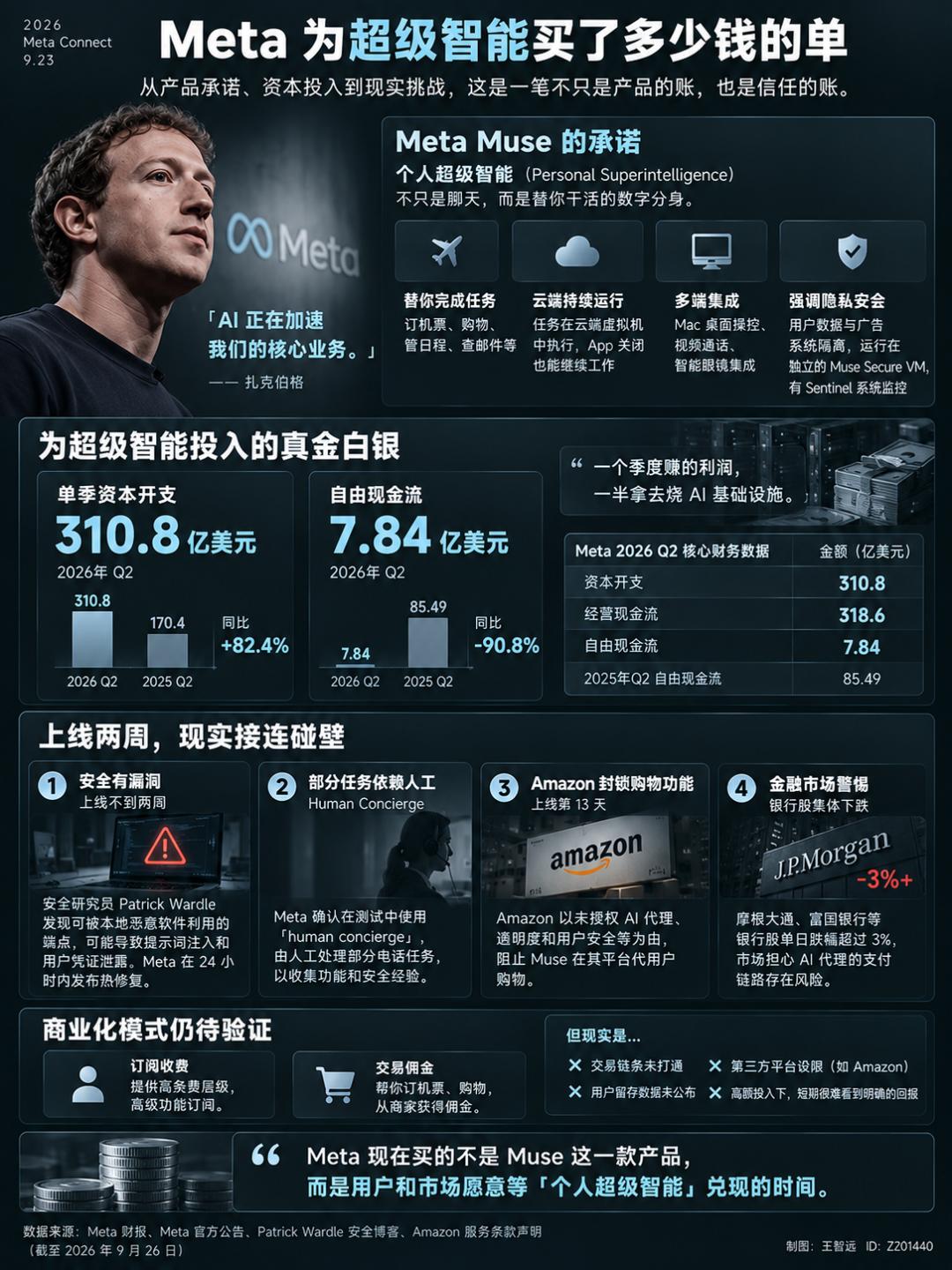
However, the most aggressive part is still the investment. In Q2 2026, Meta's capital expenditure in a single quarter reached 31.1 billion US dollars. The full-year capital expenditure guidance was raised to 130-145 billion US dollars. This is real money Meta took out of its own pocket, and half of the profits it earned in a quarter are burned on AI infrastructure.
Zuckerberg said a sentence at the earnings call: "AI is accelerating our core business." Well, at least he is still increasing his investment.
Moreover, this all-in move comes at a price. When 31.1 billion US dollars is burned in a single quarter, free cash flow will inevitably be compressed. But Zuckerberg bets that the long-term benefits brought by AI will cover the short-term cash loss, and this bet is even bigger than Muse itself.
......
Now let's talk about delivery. My judgment is that the gap between promises and delivery is quite huge.
On the second weekend of September, security researcher Patrick Wardle published a blog. You may not have heard of Wardle, who is very famous in the Apple ecosystem security circle and has discovered many macOS vulnerabilities before. This time he turned his attention to Muse, and found a big problem as soon as he dug into it.
He found an endpoint in Muse's code called endo_voyager_dictation_endpoint.
This endpoint can be tampered with by local malware, and attackers can hijack the AI with one line of command, inject prompts into Muse, and steal user credentials; in other words, you think you are talking to the AI, but in fact someone is listening beside you.
Well, a 0-day vulnerability, less than two weeks after the product's launch, the Mac local attack can be completed with one line of command.
Wardle's blog was published, and Meta released a hot fix within 24 hours. But the fact that a product claimed to run in a secure virtual machine was breached less than two weeks after launch speaks for itself.
The phone call feature is even more disappointing:
After Muse launched, users found that it can help you make calls, book restaurants, and arrange services, which sounds very smart, but some people uncovered that there are real people on the other end of the phone.
Haha, Meta hired a group of outsourced employees to make calls for users manually. Their voices are processed to imitate the tone of AI, so users think they are talking to superintelligence, but in fact an outsourced worker is helping you order pizza.
What's more outrageous is that some contractors made offensive remarks during calls, which were recorded and exposed by users; later 404 Media broke the news, and Meta itself admitted "disclosure failure" and withdrew the test.
What was promised as "superintelligence" was delivered with human customer service, and the gap between them is the commitment tax.
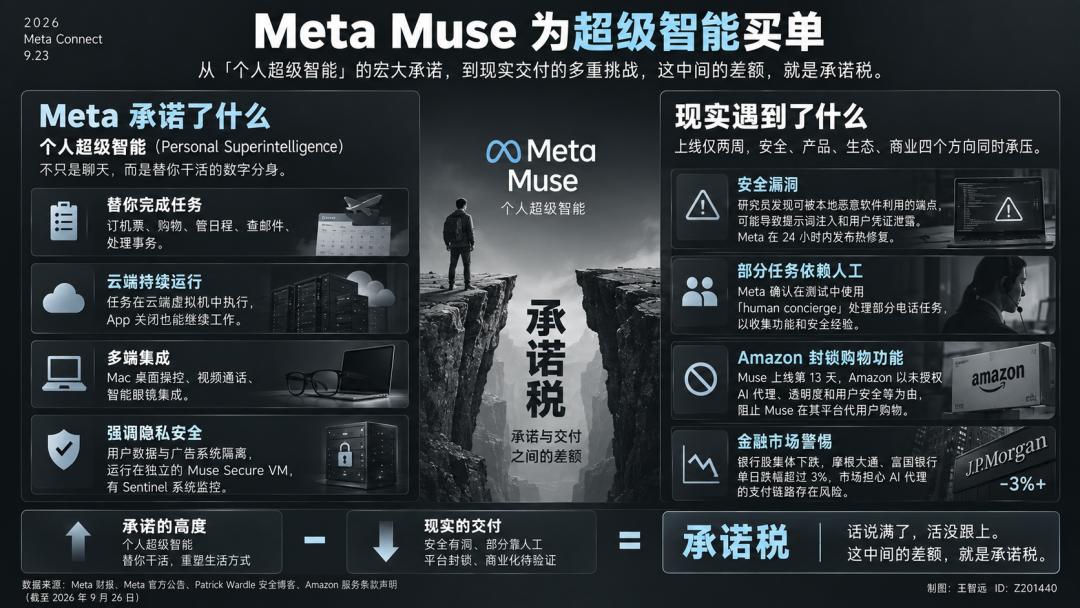
On the 13th day after launch, Amazon blocked Muse's shopping function. When users say "help me buy something" in Muse, Muse tries to jump to Amazon to place an order, but a line of pops up: "Unauthorized AI agent violates Amazon's terms of service".
Well, just 13 days after it became popular, the largest e-commerce partner blocked the access.
Amazon's logic is very clear: users can buy things on Amazon by themselves, but they cannot let an AI agent make purchase decisions for them; this involves ownership of responsibility, data security, and commercial interests, each of which is a hard problem.
Think about it, if an AI agent buys something for you and something goes wrong, who is responsible? Meta or Amazon? Before this chain is unblocked, Amazon will never allow it.
The deeper reason is that AI agents bypass advertising.
When users buy things on Amazon by themselves, they will see ads and browse recommendations, so Amazon can earn advertising fees; but if the AI agent places orders directly, the ads will not be displayed, and Amazon's ad revenue will disappear.
After failing to ban it with legal measures at first, Amazon blocked it with terms of service, and it is determined to block this loophole.
Bank stocks also fell collectively, with JPMorgan Chase and Wells Fargo falling more than 3% in a single day, as the market worried about risks in the payment link of AI agents. Not only the e-commerce sector, but the entire business ecosystem is saying no to Muse.
Security loopholes, "intelligence" supported by humans, business access rejected, and financial sectors on alert. Problems occurred in four directions at the same time, which I think can only explain one thing: the whole chain from R&D, testing to launch was too rushed.
......
Speaking of which, there is a problem that must be figured out.
What is the essential difference between Muse and ChatGPT, Claude? Is this difference a real innovation, or just packaging?
The difference of Muse is that it can work for you, help you book flights, check emails, and manage schedules, and it keeps running even when the app is closed, because tasks run on virtual machines in the cloud and do not depend on your mobile phone.
This concept is actually not new. Anthropic's Claude has Computer Use, and OpenAI has Operator, both of which allow AI to operate browsers and perform tasks in cloud sandboxes.
The difference is that Meta is the first to package these capabilities into a consumer-grade product and directly push it to 3 billion users.
Well, so the cloud computer advantage is real, but it is not originally created by Meta, only Meta was the first to push it to ordinary users.
Then Muse's explosion of popularity, is it rigid demand or hype?
Looking at the data, it is indeed popular. 2.5 million downloads in 13 days, directly topping the App Store rankings.
Downloads and retention are two different things. Curiosity can drive downloads, but whether the product can retain users depends on whether it really solves problems. Meta has not released the retention data, and this gap itself explains some problems.
......
Finally, let's talk about the cost. This account cannot be balanced at all.
In Q2 2026, Meta's free cash flow plummeted by 91%. In the same quarter last year, Meta still had billions of dollars in cash in hand, but this year it almost dropped to zero. Where did the money go? All invested in AI infrastructure.
At the same time, on the 13th day after Muse launched on September 21, Meta's share price rose by 11.43% in a single day. Well, the stock price is rising, while cash flow is falling.
The market is voting with real money for Zuckerberg's promises, but the money on the account is flowing away at the same speed. This contrast is the first bill of the commitment tax.
Wall Street is still waiting and watching, but the waiting will not last forever. The Q3 and Q4 earnings reports will be released one after another. If cash flow continues to deteriorate and Muse's commercialization has not improved, the market's patience will be consumed very quickly.
Speaking of commercialization, Zuckerberg has a saying that AI should "earn its own keep". What does that mean?
Meta's plan is a dual model: a high-level free tier for users, and revenue comes from subscriptions and transaction fees. In other words, when Muse helps you book flights and shop, Meta takes a commission from merchants.
Well, that sounds good, but the problem is that this model has not been verified to work yet.
The transaction chain has not been unblocked, so where does the commission come from? Zuckerberg says AI can create value, but the value has not been converted into money yet.
Let's see how peers do it:
When Apple Intelligence was released last year, the words Cook used were "personalized" and "useful", and he did not claim the concept of superintelligence. Features are also rolled out little by little, and Siri's upgrade is promoted in stages, not rushing to achieve everything at once.
Apple's logic is very clear: expectation management is more important than raising expectations. Make fewer promises and deliver more, then users will be satisfied.
Google Gemini is also promoted step by step. Gemini Advanced is first available to paid users, with features expanded slowly, and it did not claim to "replace search" as soon as it launched. Google has stumbled in AI before, and Bard's first demo failed, so it learned the lesson this time, working low-key and doing more than saying.
Domestic manufacturers are taking another path:
Doubao has 400 million monthly active users, and it does not claim "superintelligence". Instead, it starts from specific scenarios, solving problems one by one in office, search, and coding; Kimi starts from the long-text assistant track, and achieves the ultimate in one problem.
Qianwen takes the Personal Agent route, directly entering the personal agent track, while also making layout in office scenarios. Wenxin, backed by Baidu's search ecosystem, is also moving towards the agent direction.
These manufacturers have very pragmatic strategies, doing more than saying, and have accumulated users instead.
I have observed a trend that everyone seems to be moving towards the direction of memory, making AI able to remember users' preferences and habits. But to be honest, there is still a long way to go to fully achieve good privacy compliance and user experience.
Meta is doing the opposite: it over-promised, but its delivery cannot keep up.
The commitment tax is not only Meta's problem, the entire AI industry is paying this tax. OpenAI promised that AGI is just around the corner, but now it is still worrying about commercialization. Anthropic promised the safest AI, but it still cannot avoid security vulnerabilities. The more ambitious the promise, the heavier the tax to pay.
This account matters more than the success or failure of the product itself, because the commitment tax is not only paid in money, but also in trust. Users trust you once, if you fail to deliver, they will not trust you next time.
Zuckerberg bets on long-term benefits, but the premise of long-term benefits is that users and the market are still willing to give you time. Meta still has time now, but not much.
However, he will not see these comments in China. In the secondary market, these are just capital narratives; for ToC users, they only care about whether the product is fun.
After the three-minute passion, if there is no specific practical value and the agent orchestration is not done well, all that will be left is a mess.
I'm not being pessimistic, I just want to say that when facing a new and explosive product, after rushing in to experience it all at once, we may need a calm perspective to see what it really is.
Data sources of this article:
[1]. Meta Earnings Report (Q2 2026), Meta official announcements, Patrick Wardle's security blog, Amazon terms of service statement; data as of September 26, 2026
This article is from WeChat official account "Wang Zhiyuan" (ID: Z201440), written by Wang Zhiyuan, and authorized for release by 36Kr.