On average, prices have doubled! Diamonds are barely selling, yet their prices keep surging higher and higher.
The Author | Freddy
Data Support | Pythagoras Big Data
Since the beginning of this year, the market value of core targets in the superhard material track (Sifangda, Huanghe Whirlwind, Huifeng Diamond, Power Diamond, Worldia) has doubled on average, or nearly doubled.
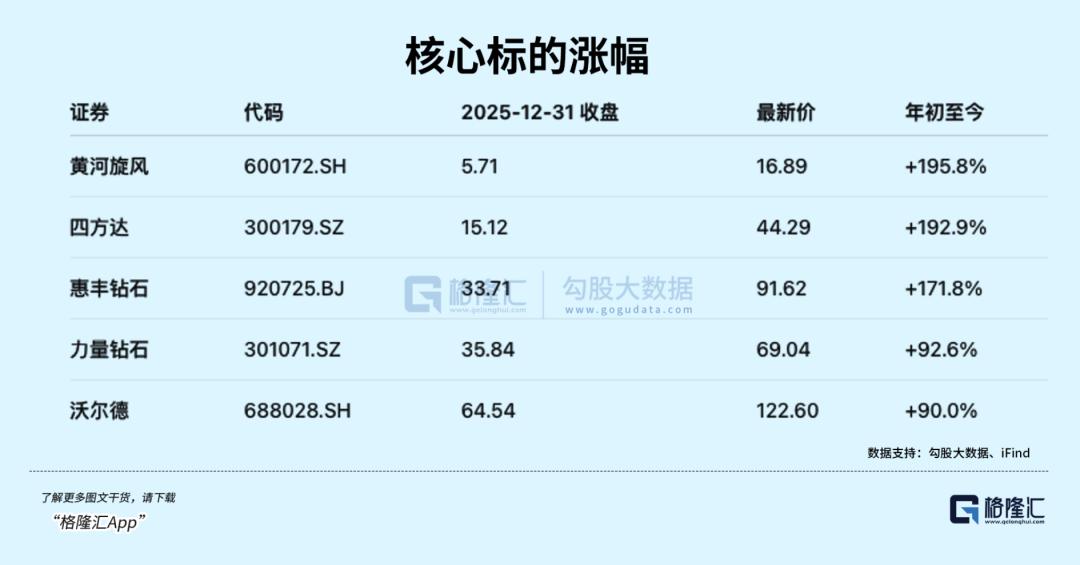
It is worth mentioning that another theme in this industry that has attracted widespread attention from investors - lab-grown diamonds, once fermented last year, and it was basically these targets that saw price increases.
However, in just two years, the narrative logic has switched.
In 2025, the market traded on "export control" and "price increase chain", coupled with the emergence of financial inflection points in the first quarter, the sector was in a stage of rebound from the bottom.
At this time, a strong catalytic logic just arrived.
Since 2026, the overall narrative of the track has switched to "AI heat dissipation" - overseas computing power solutions, supercomputing deployment, and raised funds diverted to heat dissipation materials.
Has diamond really defied the odds and changed its fate?
01 New Bottleneck of AI
The next bottleneck for AI computing power does not lie in the manufacturing process, but in heat dissipation.
And the bottleneck of heat dissipation, is shifting from system-level heat exchange to local hot spots on chips.
The power consumption of Nvidia's single GPU chip has climbed from 400W of A100 in 2020, all the way to 700W of H100 in 2022, 1000W of B200 in 2024. The Rubin architecture in 2026 will further increase to more than 1200W, and the power consumption of a single chip of the planned Feynman architecture in 2028 is expected to exceed 2000W.
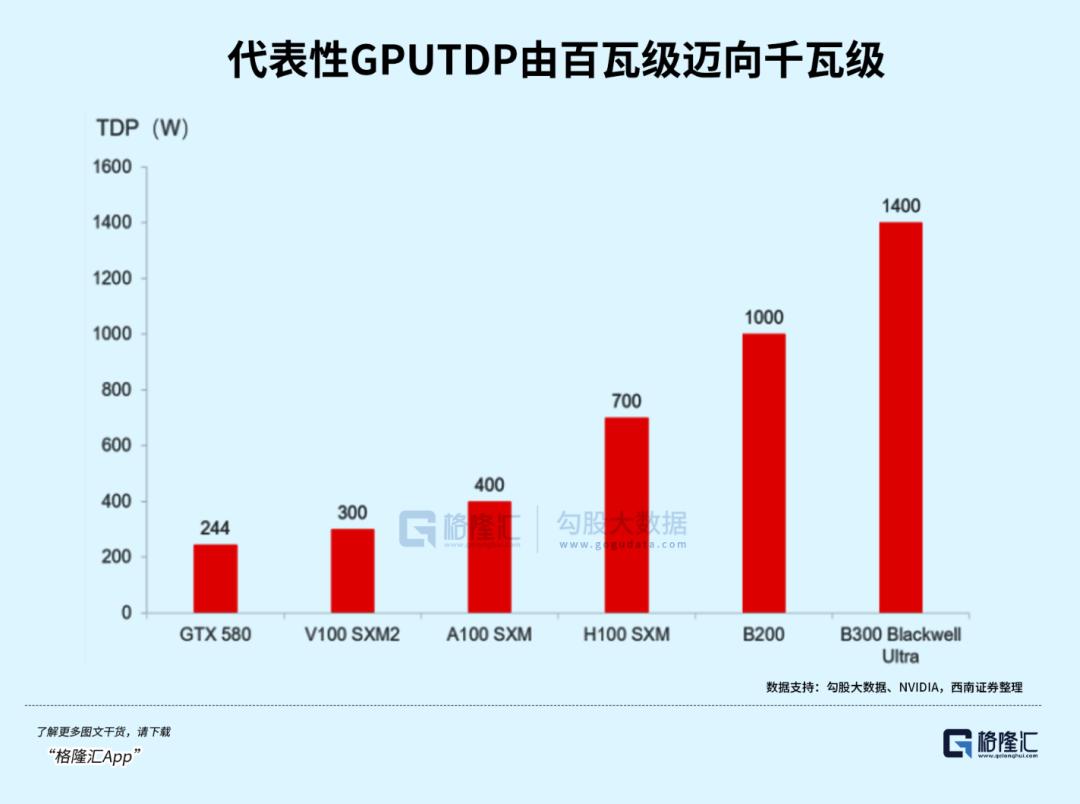
With GPU power consumption climbing all the way, heat dissipation has changed from a supporting project to a precondition for computing power expansion. The focus of competition has also shifted from the cooling system to the heat dissipation material itself.
As we have always emphasized in previous articles, the air-cooling era has come to an end, and liquid cooling is already the standard configuration for AI servers, but it can only cover the packaging shell, not the inside of the chip.
Liquid cooling solves system-level heat exchange. What really determines the difficulty of heat dissipation is not the total power consumption, but the local heat flux density. The heat flux density at the hot spot of AI chips has reached 1000-2500 W/cm². This magnitude has crossed from the level of nuclear reactors to the level of the sun's surface, fully exceeding the upper limit of traditional air cooling, copper liquid cooling plates and even two-phase liquid cooling solutions.
This means that no matter how strong the liquid cooling is, it can only take away the heat that has been transferred to the packaging shell. However, under such a high local heat flux density, the heat does not have time to diffuse laterally from the local hot spots inside the chip, and accumulates sharply at the near-junction interface.
The thermal conductivity of traditional copper-based heat dissipation materials also cannot achieve fast enough lateral heat diffusion at the near-junction interface of the chip. This is not a problem that can be solved by optimizing the cooling solution. The problem is not how to cool down, but what material to use to cool down.
It is time for the material system to be upgraded.
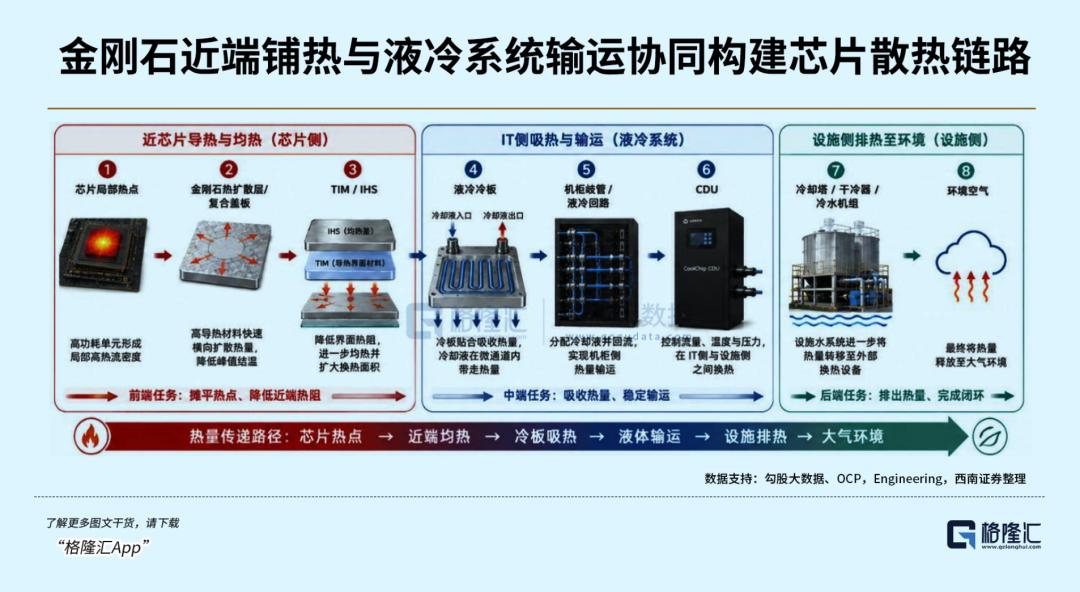
Diamond is currently the material with the highest thermal conductivity known in nature, with a room temperature thermal conductivity of 2000-2200W/m·K, which is 5 to 6 times that of copper and more than 9 times that of aluminum. At the same time, the thermal expansion coefficient of diamond is about 1.0-1.2×10⁻⁶/K, which is highly matched with mainstream semiconductor materials such as silicon, GaN and SiC; it also has excellent insulation performance and can be in direct contact with chips.
It can be said that diamond has almost no substitute in the combination of "high thermal conductivity + low thermal stress + electrical compatibility".
The market once priced diamond heat dissipation as the ultimate solution for AI chip heat dissipation, and the endorsement of giants such as Nvidia further provided a catalyst for the entire concept to set off a wave in the A-share market.
At CES in January 2026, Nvidia officially announced that the next-generation Vera Rubin architecture GPU will fully adopt the "diamond-copper composite heat dissipation + 45℃ warm water direct liquid cooling" solution. In July, Jensen Huang confirmed that Vera Rubin has been put into production, and the power consumption of a single GPU reaches 2300W.
Intel CEO Pat Gelsinger also mentioned the importance of diamond heat dissipation in public, announcing that it has invested in a synthetic diamond wafer company, and is optimistic about the application potential of diamond as a heat dissipation material in the field of chip packaging.
According to data from Puhua Youce, the overall global server liquid cooling market space will grow from 12.57 billion US dollars in 2026 to 53.51 billion US dollars in 2030. Assuming that the value of diamond heat dissipation accounts for 10% of the liquid cooling market in 2030, the market size will reach 5.4 billion US dollars.
In addition to being used as a heat dissipation material, diamond has another use closely linked to the AI industry chain - PCB drill bits.
The upgrade of AI computing power drives the PCB industry to upgrade from the number of layers to the material system. The advantages of high-end PCB materials in hardness and wear resistance, in turn, put forward higher requirements for the service life of drill bits.
The logic is similar to heat dissipation. Diamond drill bits are expected to change from optional tools to necessary processing tools for high-end PCBs. The unit price of diamond drill bits is as high as 1500-2000 yuan per piece, which is dozens of times that of traditional tungsten steel drill bits, and the number of drilled holes is also far ahead, leaving huge room for market expansion.
Diamond will most likely become a profitable business in the next step.
Whether it is diamond heat dissipation or drill bits, in the current AI industrial landscape, their cost proportion is actually negligible. But based on the very expensive computing power nodes, no factory dares to take the risk of scrapping a motherboard just to save a few dollars on consumables.
But for suppliers, the only demand from downstream manufacturers is "absolute yield and absolute reliability".
This forms a relatively high time and verification barrier, which means that once passing the quality test, competitors not on the whitelist cannot shake its market share even if they cut prices significantly.
The industrial logic is clear, and the next question is: what is the actual progress at the application level, and when will orders at the supply end be released.
02 Application Side Entry, Supply Side Capacity Expansion
Diamond heat dissipation is indeed moving from the laboratory to the production line, but the pace is not uniform. Symbolic deliveries have appeared on the application side, the supply side is actively expanding production, and most links are still in the stage of sample delivery and small-batch verification.
The real watershed is to see who can run through yield, cost and bulk orders first.
On the application side, from February to March this year, overseas enterprises have taken the lead in completing the first batch of server deliveries equipped with diamond heat dissipation, covering both Nvidia and AMD computing power platforms at the same time.
Now the global industrial chain is accelerating the layout of semiconductor-grade diamond supply. Enterprises in the United States and Japan are basically leading in mass production and order progress, and they also plan to promote the commercialization of large-size diamond substrates this year to reduce the cost of diamond materials used in a single GPU.
The late-mover advantage in China lies in the global leading position of the synthetic diamond industry, and the large-scale supply provides raw materials, equipment, talents and industrial supporting foundations for the development of functional diamonds. Accelerating the transformation of production capacity to such high-end applications can reduce the cost of large-scale production faster.
China's synthetic diamond output accounts for more than 90% of the total global output, and all key special equipment is independent and controllable. In the past few years, the demand for diamonds has shrunk, and the expansion of low-end production capacity in the industry has caused the price of synthetic diamonds to collapse.
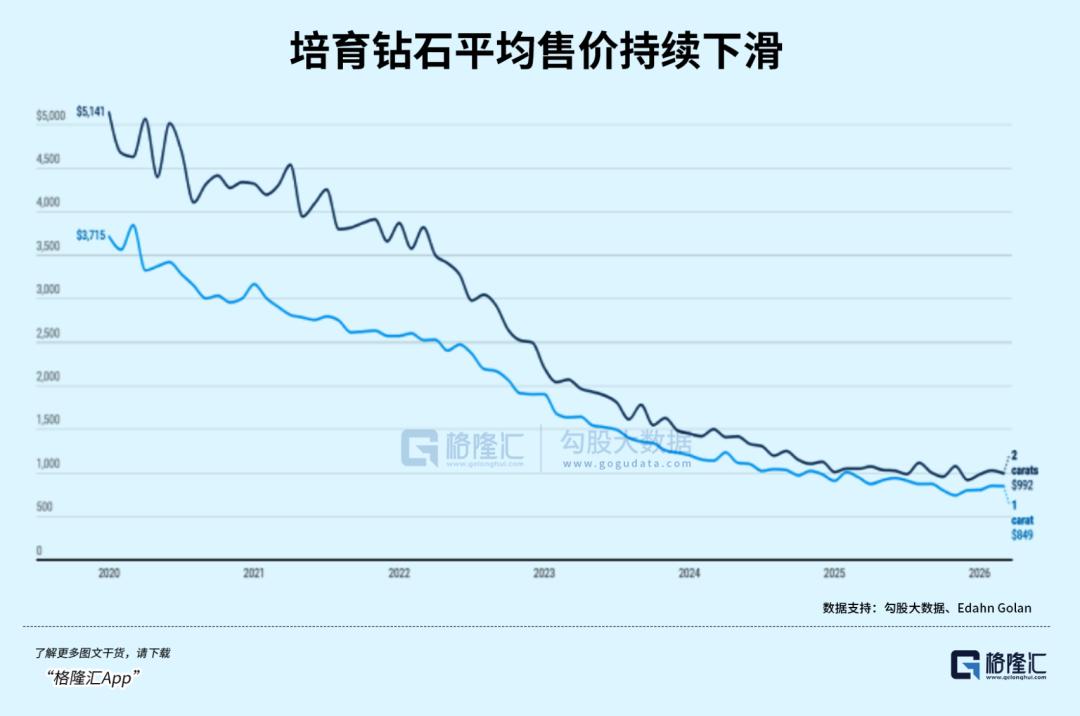
In October 2025, the Ministry of Commerce of China launched the diamond export control policy, forming full-chain control from equipment, materials to technology. In the long run, the control policy has a positive effect on forcing low-end production capacity to clear, helping leading enterprises transform into high-end application links, and promoting the high-end development of the industry.
In the first half of the year, many diamond enterprises such as Zhongnan Diamond, Huifeng Diamond, Houde Diamond, and Jiangxi Hengzuan intensively issued price adjustment notices. Huifeng Diamond has uniformly increased the prices of related products by 5%-15% since March 1, 2026.
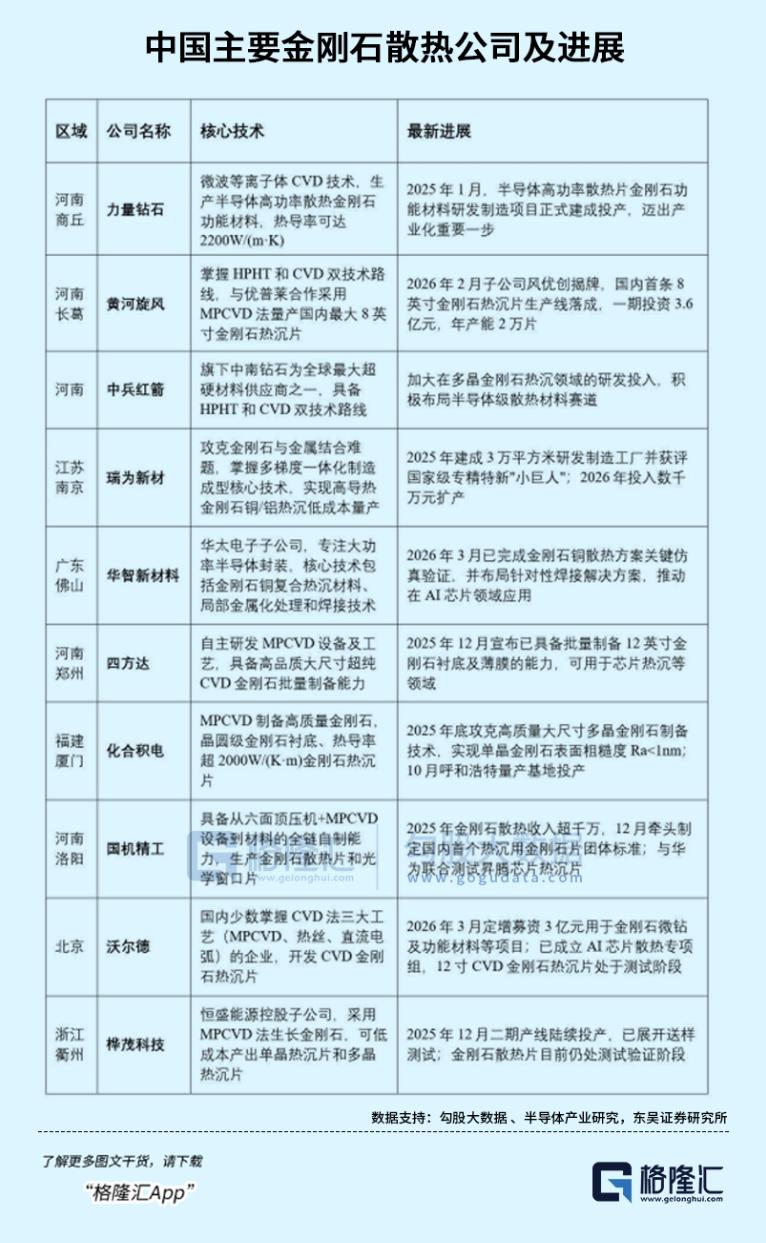
Looking at the industrialization pace of diamond heat dissipation in China, superhard material enterprises such as SINOMACH Precision Industry, Sifangda, Huifeng Diamond, Huanghe Whirlwind, and Power Diamond have all laid out this direction, making progress in product routes, capacity planning and downstream verification respectively.
Domestic supercomputing in China is promoting the application. Huawei's "Taolü V2" solution, aiming at high-power stacking scenarios such as Ascend AI chips, adds a CVD diamond heat dissipation layer on the upper and lower layers of the package, and cooperates with micron-level liquid cooling channels between layers to form an active heat dissipation structure.
One of its core suppliers is Huanghe Whirlwind. In February this year, the first 8-inch diamond heat sink production line of Henan Fengyouchuang, a subsidiary of Huanghe Whirlwind, was put into operation in Henan, with an annual output of 20,000 pieces. In August, Fengyouchuang signed a sales contract for single crystal diamond heat sinks with a leading overseas enterprise, officially entering the world's top semiconductor supply chain.
According to incomplete statistics, as of the end of August, five listed superhard material companies including Power Diamond, Sifangda, Huanghe Whirlwind, Huifeng Diamond, and Worldia have involved a total capital scale of more than 60 billion yuan through private placement plans, changes in the use of raised funds, and foreign investment.
From the perspective of investment direction, the funds are mainly used for the development of functional materials, precision tools and supplementary working capital. Some projects have even been established for a long time, and the timing of the adjustment just corresponds to the future demand for diamond materials from AI heat dissipation and PCB drill bits.
For example, Power Diamond had already established the project in 2022. At first, lab-grown diamonds were still the mainstream of the track, and now it has timely turned to the field of diamond heat dissipation. There is also the 2 billion yuan private placement of Sifangda, of which 1.76 billion yuan is invested in the industrialization of diamond drill bits. The total investment of the project is 1.846 billion yuan, with a construction period of 36 months. After completion, it can produce 7.1 million diamond drill bits per year.
Putting it together, we can see that diamond functional materials and high value-added precision processing tools are becoming new undertaking directions. This round of direction driven by the two major demands of AI computing power heat dissipation and semiconductor precision processing will be gradually realized in the next two to three years.
With the successive implementation of related projects, some listed companies' diamond heat dissipation products have entered the stage of sample delivery and small-batch supply.
Worldia is one of the few domestic enterprises that master the three major CVD processes (MPCVD, hot filament, DC arc). At present, it has realized the manufacturing of diamond heat sinks with a maximum size of 320mm*320mm, compatible with mainstream wafer sizes of 50mm-300mm in diameter, and has begun to deliver to customers for verification.
03 Epilogue
Having said that, judging from the current industrial process, diamond heat dissipation is still in its early stage. Existing commercial products and large-scale procurement for AI servers are two things that need to be verified separately.
The increase in liquid cooling penetration rate cannot directly lead to the conclusion that every cold plate will use diamond. Because customers will have the motivation to introduce it only when the new added performance can cover the cost, processing and reliability requirements. Therefore, do not make linear extrapolation based on the current increase, and think that the valuation is still very cheap just because the growth curve is steep.
But what the capital market is indulging in is actually a narrative miracle of using "old production capacity" to save "new bottlenecks".
From optical modules to PCBs, liquid cooling and diamonds, the early hype logic of capital for these sub-segments is extremely unified: what can really trigger a market rally is not just unattainable new technologies, but those enterprises that hold mature production capacity and precisely block the most fatal throat of AI evolution.
On the one hand, they use production capacity to block the new throat of AI and obtain high-tech premiums; on the other hand, the old track ushers in a price rebound due to supply clearance.
This logical resonance spanning old and new tracks is the most familiar hype narrative in the capital market.
Disclaimer: All views in the article come from the original author and do not represent the views and positions of Gelonghui. Special reminder, investment decisions need to be based on independent thinking. The content of this article is for reference only, and does not constitute any practical operation suggestions. Trading risks are borne by the bearer.