Who will receive the 1.4 trillion US dollars in advance payments?
This incident took place several days ago, but it is worth sorting out in retrospect.
In mid-September, a long article published online caused a widespread slump in global chip stocks. The author is Dario Amodei, head of Anthropic, and the title of the article is "We Must Control the Pace of Frontier Development". The gist is that the pace of frontier model development is moving too fast, and someone should step in to moderate the rhythm.
Sam Altman endorsed this initiative, and Elon Musk also responded publicly to it.
Just a few days later, these four companies were sued together. Four paid users in the United States took Anthropic, OpenAI, Google and xAI to the federal court in California. The lawsuit directly cited this article and the two public statements of support, claiming that the alleged coordinated slowdown is suspected of being illegal. None of the involved companies have made any comments on this matter.
Two days later, the Federal Reserve raised interest rates for the first time in three years. The market had long anticipated this move, but it still fell when the policy was officially implemented.
The next day, the market rebounded fully. The PHLX Semiconductor Index rose by more than 3 percentage points. Intel, which had just fallen 5.6% two days earlier, rose 7.7% that day, leading the rally most strongly.
Three days saw successive movements: fall, further fall, then rise. No explosive negative earnings reports emerged, almost no major events happened, but the market tightened on its own. There is another detail I checked: on the day of the sharp drop, software stocks rose instead of falling, and all the sectors that were hit were hardware. Software is light, while hardware is heavy.
In addition, the K-line of the AI sector these days is all jagged. The current AI market only has one trait, which is tightness.
What is it nervous about?
Nine out of ten articles discussing the bubble this round focus on valuation, while one thing is overlooked: how fast is the capital flowing exactly?
In the first quarter of this year, Microsoft, Google, Amazon and Meta spent a total of 131.6 billion U.S. dollars, 70% more than the same period last year, and this is only the expenditure for three months. Last year, the expenditure of U.S. cloud manufacturers rose by 65% for the whole year, and the number is still increasing this year.
What does this mean? It adds up to more than 1.4 billion U.S. dollars per day.
The bulk of this capital is converted into three things: chips, data centers and power. None of them are light assets.
Calculated for the whole year, the total expenditure of the four companies this year is expected to exceed 700 billion U.S. dollars; in China, the annual expenditure has also reached the order of 700 to 800 billion RMB.
The numbers are almost the same, but the units are different. One side is in U.S. dollars, the other in RMB. The seemingly similar figures differ by a multiple of the exchange rate.
Moreover, this is only the account of the four aforementioned companies.
If companies like Oracle are included, the figure will go even higher. There are even larger orders in the pipeline. The total computing power contracts signed by OpenAI alone exceed 1 trillion U.S. dollars, which will be fulfilled gradually over many years.
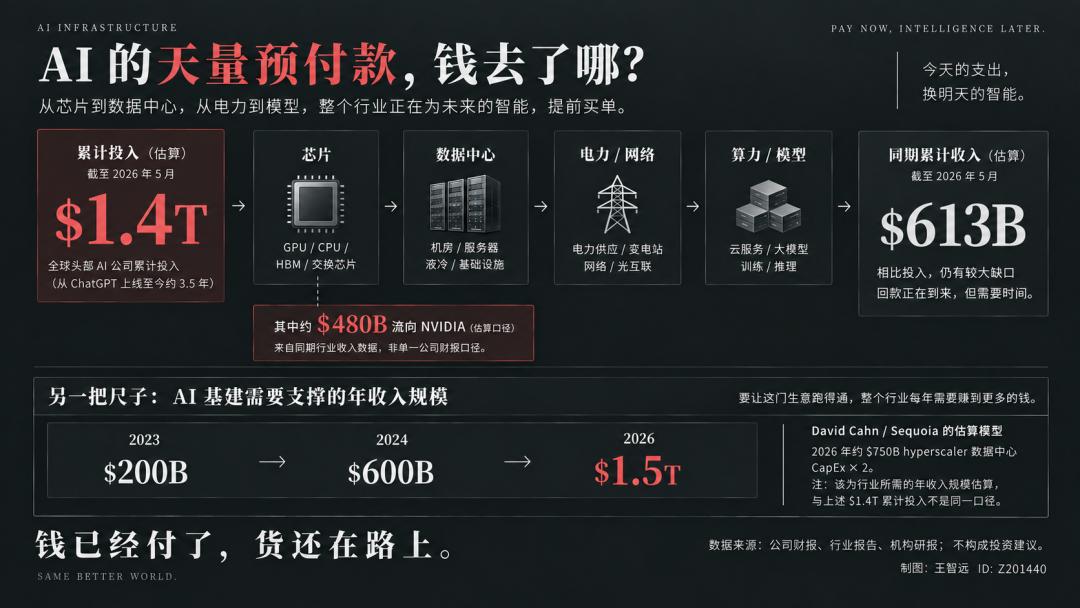
Capital flows fast, and the scale of the investment is more striking. From the launch of ChatGPT to May this year, in three and a half years, the world's leading AI companies have invested a total of about 1.4 trillion U.S. dollars, while the total revenue received in the same period is only 613 billion U.S. dollars.
Nearly 480 billion of this 613 billion U.S. dollars was taken by NVIDIA alone. The shovel seller has become the most undisputed winner of this round.
Joe Lonsdale of HSG has a famous calculation formula:
For every dollar earned from selling chips, almost the same amount of money needs to be spent on building data centers, supporting power supply and connecting networks; when these computing resources are resold, buyers still need to be left with profit margins. Stacking all these layers together gives the total revenue that the entire industry must generate in a year.
This measurement was first introduced in 2023, with the calculated figure being 200 billion U.S. dollars. One year later, the number rose to 600 billion, and in July this year, it became 1.5 trillion U.S. dollars. In three years, the figure has increased by more than six times, and the funding gap has not narrowed on its own.
The other side of the ledger is also changing. The revenue of leading model companies is doubling every year, but the growth rate still cannot catch up with the speed of capital expenditure.
Fundamentally, the trait of this business was determined from the very beginning: it runs counter to other businesses, which requires spending huge sums first and then waiting for revenue to come in.
Chips are purchased in batches, data centers are built one after another, and capital for power, land and water all needs to be paid in advance. As for returns, they will only flow back penny by penny after the equipment is actually put into operation and generates revenue.
Moreover, equipment is eliminated in batches. Once new chips are launched, the book value of the previous generation will drop significantly. The way this money is spent is like the entire industry collectively paying a huge amount of advance payment for the future.
Railway, power and internet industries all went through this path: build infrastructure first, and then start operation. In the years before operation, there was only expenditure on the books, and no users at all. A large number of companies went bankrupt in the process, and the only thing left in the end is the mature infrastructure.
Therefore, these days, even a tiny piece of information is enough to make the hardware sector fluctuate sharply.
......
Waiting has its price. When capital is cheap, this waiting is called vision; when capital becomes expensive, it is renamed bubble. This round of interest rate hikes sends only one signal: the direction of capital has reversed.
To judge whether capital is expensive or not, look at one key figure.
The 10-year U.S. Treasury yield has stood above 5% and is still rising, hitting 5.14% a few days ago, the highest level since 2007.
On the other side of this figure, the excess return of buying stocks over buying U.S. Treasury bonds has been compressed to nearly zero in the United States, while there is still a 3 percentage point buffer in the A-share market.
Interest rate is the price of capital, and it also marks the price of time. When it rises, the value of future accounts will be discounted. For the same amount of return, the longer you wait, the less valuable it is on today's ledger.
The AI business is entirely based on future accounts: you pay today and wait for several years to get the money back. The assets that need the longest waiting time will be the first to be impacted.
On the other hand, the way the market views accounts has also changed.
In the past, when people looked at AI, they focused on imagination, and the bigger the story, the more excited they were; now they check quarterly reports and verify every item one by one. On July 23, Google released impressive performance, with sales rising by more than 20% and cloud business revenue rising by 80%, but its stock price fell by 7% that day. The reason for the decline pointed to the capital expenditure side.
The current market is like this: good performance is not enough, it has to exceed expectations by a large margin to justify the current valuation.
The expenditure of cloud manufacturers is still rising, but the market is already calculating how long this momentum can last. The market can tolerate a slight slowdown, but cannot accept "continuous deceleration". Once the growth rate declines, the valuation story will have to be rewritten.
This kind of tension is the same on both sides of the Pacific Ocean.
I calculated that in the first half of September, the computing power sector of A-shares fell by 5.33%, and the data center sector fell by 8.70%; the optical module sector, which was the most popular track in previous months, led the decline, and leading companies had to come out to clarify performance rumors.
On those trading days, the sectors that fell the most sharply were exactly the ones that rose the most fiercely in previous months.
The explanation given by institutions is: profit expectations are set too high, and oil prices and U.S. Treasury yields are rising at the same time, so the pressure naturally falls on the most crowded positions.
The market has a more vivid description for this, called "killing valuation". The logic does not collapse, but the price is making up for the debt caused by the previous excessive rise. Capital has not withdrawn, it just moved from the most crowded places to less crowded corners.
Yuan Zhiyuan believes that the several percentage points of decline in the Chinese market and that huge advance payment are essentially the same thing.
Nowadays, news and emotions can cross the ocean in less than a night. An article published overseas will be digested by the domestic market right after opening. Capital on both sides is converting imagination into cash flow.
So what exactly is the market afraid of?
What it fears is the closed loop. Capital flows from the bond market to the accounts of cloud manufacturers, is converted into chips and data centers, and finally needs to be returned by the revenue of model companies. This chain has been stretched very long, and every link is based on the commitment of the next link. If one link catches a cold, all the links behind will be affected.
The cost of borrowing is getting more expensive. Amazon issued a 25 billion U.S. dollar large bond this year, with a subscription multiple of only 1.6 times, while for bonds of this size, 4 to 5 times subscription is the standard level in normal times.
The cash flow side is also tightening. In the second quarter, Google recorded its first negative free cash flow in more than 20 years. The money it earns is not enough to cover its expenditure.
Capital is still flowing in, but it has become more expensive and more selective.
At an event in Mumbai some time ago, the general manager of the Bank for International Settlements publicly reminded: Once the return of AI disappoints people, today's investment boom may turn into a recession. This institution is the central bank of all central banks around the world.
The optimists' answer has never changed: the performance is real, the revenue collection is also real, and none of the classic signals of a bubble have appeared yet.
The two sides have been arguing since 2023, and neither has convinced the other. In the Bank of America institutional survey last November, 45% of the surveyed investors listed AI bubble as the biggest tail risk.
By mid-September, this figure dropped to 28%, and the top risk was replaced by "disorderly rise in bond yields". After such a long debate, the market's biggest fear still returns to the price of capital.
......
All these tensions are related to the same question: "When will it happen". This question is starting to get answers, and the first one to arrive is a payment receipt.
The one who issued the receipt is Anthropic. This company has been targeting enterprise customers from the very beginning and never follows the hype.
By the end of July this year, its annualized revenue exceeded 65 billion U.S. dollars. At the end of last year, this figure was only 9 billion, and the latest expectation is that it will exceed 100 billion by the end of the year; in the second quarter alone, it received 11.5 billion U.S. dollars in revenue, and its adjusted operating profit turned positive. It is the first leading model company that can generate steady profit like this.
Another name that has to be mentioned is OpenAI, whose annualized revenue exceeded 40 billion U.S. dollars in July, doubling from the end of last year. 65 billion U.S. dollars a year translates to 1.8 billion U.S. dollars per day.
Anthropic's next step is to go public, with an expected valuation of 2 trillion U.S. dollars, and the fundraising scale may set a new record. The listing date was originally scheduled for October, but the latest news says it has been postponed to November, waiting for the third quarter report to support its valuation. The company with the fastest revenue collection is also the first to reach the threshold of listing.
The bulk of the revenue comes from coding scenarios.
Among all AI scenarios, programming is the first track that has really realized paid monetization. 70% to 80% of Anthropic's revenue comes from enterprise API calls, and the company itself says that programming tools contribute the largest part of its growth.
The situation in China is slightly different. The revenue of domestic model companies has not reached the level of their U.S. counterparts yet, but the implementation pace is very fast. ByteDance's AI annualized revenue reached 4 billion U.S. dollars by July.
The annualized figure of Alibaba's model services disclosed earlier this year exceeded 16 billion RMB.
Moving forward, AI products have entered the warehouses of enterprises. China Merchants Bank calculated an account:
In the first half of the year, AI helped save 13.88 million hours of workload, which is equivalent to the workload of 7000 people working for one year; the AI review system of Industrial and Commercial Bank of China generated 360,000 review opinions in half a year, with an adoption rate of 98.6%.
At State Grid, 18,000 operation and maintenance personnel are equipped with AI assistants, and a full-station inspection has been shortened from two and a half hours to 45 minutes; the consulting agency Gartner predicts that by the end of this year, intelligent agents will be embedded in 40% of enterprise applications around the world.
More products are still on the way, but the delivery schedule has been set.
Anthropic says it will reach break-even in 2028. OpenAI's timetable is to make profit in 2030, and it will burn a huge amount of capital before that, with an expected loss of 74 billion U.S. dollars in 2028.
The reason why they dare to show the timetable is supported by solid figures. Anthropic itself calculated that its capital burning rate will drop to one third of its revenue in 2026, and drop to less than 10% in 2027.
Many research reports have highlighted this timeline: 2027 to 2028 will be the verification window. By that time, this huge advance payment will face the first real reconciliation. Either all the products are delivered and the story continues, or the accounts have to be recalculated.
Conversely, if 2027 really becomes a big year of delivery, all these disputes today will at most be regarded as an episode when we look back in two years.
By the way, there is another issue: the order of delivery. In my opinion, the story of this round will be told in a queuing order.
The first to get the returns are hardware companies and the top two or three model companies, while most of the rest are still waiting in line. Some analysis says that only 1% or 2% of the players can finally get the bulk of the returns.
This round of market will not rise all at once, but advance in waves.
Financing interest rate is the first indicator to watch next. If it continues to rise, the companies that cannot get financing first will have to suspend their operation first. Another indicator is revenue: if the month-on-month growth rate of the top model companies stops, the nature of this entire account will change.
The first receipt has been marked with figures, and the rest will be verified one by one.
Data and fact sources in this article:
[1]. Corporate financial reports and public disclosures (Microsoft, Google, Amazon, Meta, Anthropic, OpenAI, China Merchants Bank, Industrial and Commercial Bank of China, State Grid, ByteDance, Alibaba, etc.), institutional research reports and estimates (CSC Financial, JPM