Beyond the model, where is the next threshold for Game+AI?
In a match of *Naraka: Bladepoint*, your teammates may not be "human".
The Qwen large model serves as the underlying foundation for these AI teammates. Teammates with collaborative capability are the most easily visible part of the iceberg amid the gaming industry transformation, and below the waterline, the judgment that "games are being remade entirely by AI" has become a widely recognized consensus.
At the 2026 Yunqi Conference, a full morning AI special session was arranged specifically for the gaming industry. Technical leads and creators from benchmark enterprises including NetEase and TapTap took the stage one after another, covering topics from intelligent NPCs to AI-native gameplay, and further to AI-driven game creation.
However, the extent of such remaking varies. Treating AI as an efficiency-improving tool and remaking games in an AI-native manner are evolving into two completely different businesses.
The former optimizes unit cost, while the latter completely rewrites production and experience. The gameplay patterns, production organization and operation modes of games are far more than just efficiency issues. So when developers decide to "remake games with AI", where exactly do they start? What are the core competencies they are competing for?
When AI Sits at the Table
To "remake games with AI", the first priority is still to guarantee the basic operation of the games themselves. Global server launch, elastic scaling and stable operation are the prerequisites for new experiences to land.
*Arknights: Endfield* exhibited at the gaming zone of this Yunqi Conference is a typical example. This large cross-platform 3D game targeting global users exceeded 30 million cumulative downloads worldwide the day after its launch. Facing the traffic peak, Alibaba Cloud's full-stack technical solution successfully ensured the stable operation of the game, delivering a highly smooth gaming experience for players around the world. Behind the support for the influx of global players lies not only the processing capability of millions of concurrent requests, but also the infrastructure of Alibaba Cloud covering 31 public cloud regions and 107 availability zones across the globe.
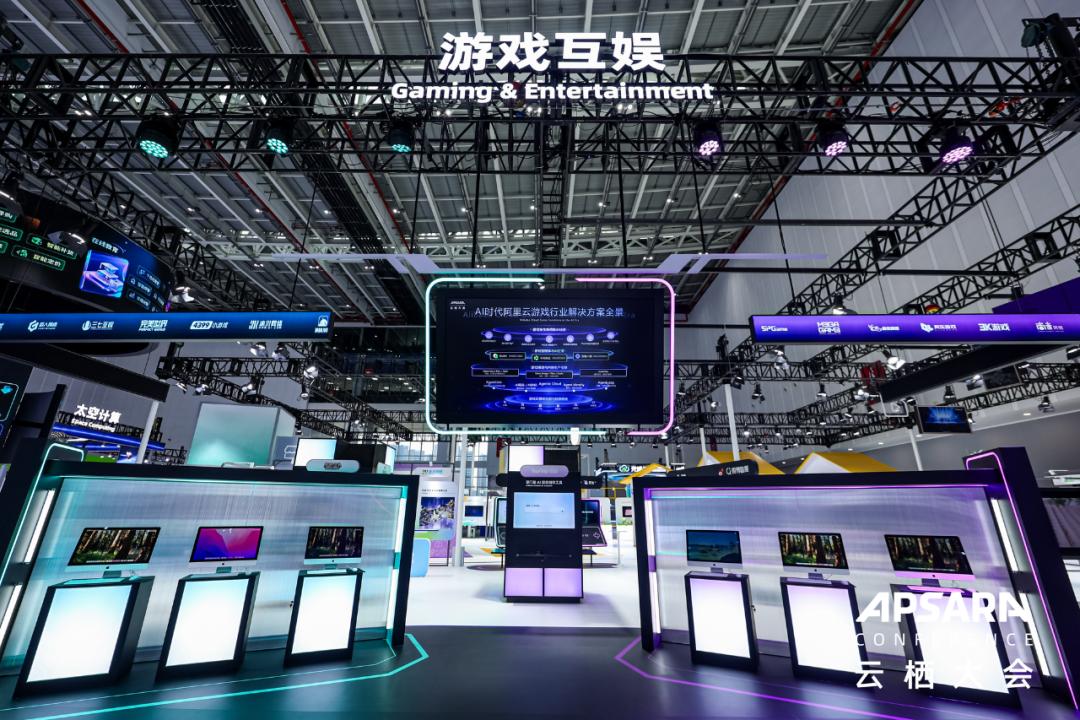
The gaming exhibition zone at the Yunqi Conference
When AI begins to participate in collaboration and decision-making in games, this underlying foundation undertakes new tasks: it needs to not only support players and traffic, but also enable agents to participate in matches in real time, turning model capabilities into a sustainably operable gaming experience.
In *Naraka: Bladepoint*, NetEase Leihuo Fuxi directly embeds AI teammates into matches, allowing players to collaborate with AI teammates via voice and in-game signals, adding a new possibility for in-match coordination.
The *History Simulator: Chongzhen* exhibited at the gaming zone of the Yunqi Conference puts large models into world evolution. This AI-native historical strategy game uses the Qwen large model to simulate the political situation in the late Ming Dynasty. Players can draft imperial edicts and issue government decrees in natural language, and every decision will trigger a chain reaction simulated by AI, leading to a new historical trajectory.
As a strategy game, its content boundary is further expanded: players no longer only advance through preset options, and game feedback also begins to depend on the model's dynamic deduction of the overall situation.
From training partners and opponents to rule makers, AI is gradually moving to the more core position of gaming experience.
Similar practices have emerged almost simultaneously at multiple leading game developers.
*Among Us* under Giant Network starts from another dimension of experience change. Relying on the underlying capability of Alibaba Cloud's Qwen large model, it explores the long-term memory and dynamic learning of game characters on players' behavior patterns, enabling AI players to remember players' historical interaction choices across sessions, adjust response logic in real time, and deliver a "customized experience for every unique player" gaming experience.
So far, the gameplay patterns on the table can be classified into three categories: intelligent NPCs, AI teammates and virtual players, and AI-native games where generation and evolution themselves are the core gameplay.
The three types of gameplay share the same real-time closed loop: perceive status, understand decisions, call tools, and feed back behaviors. To make this closed loop stably operate in real games, operating environment, model invocation governance, safety guardrails and post-launch observation and evaluation are also required. The well-known large model is only one part of the whole system, responsible for the "thinking" part, while the underlying infrastructure ensures that agents can run stably and be well managed.
This also means that the changes and barriers in front-end experience innovation are extending from model capabilities to the collaborative capability between models and engineering.
The Straightened Production Line
Part of game content production has long stayed in the "hand-copied manuscript era".
Concept art, original painting, modeling, texturing, animation, engine — the pipeline works like a waterfall, with each link handed over to a dedicated team, and the connection between links relies on manual work.
The waterfall-like pipeline flows down layer by layer, and each layer has to wait for the upstream link to be ready. That's why even many mature game teams still need a long cycle of development, testing and optimization to ensure that a game can operate stably for a long time without bugs.
Nowadays, this waterfall pipeline is being straightened by AI.
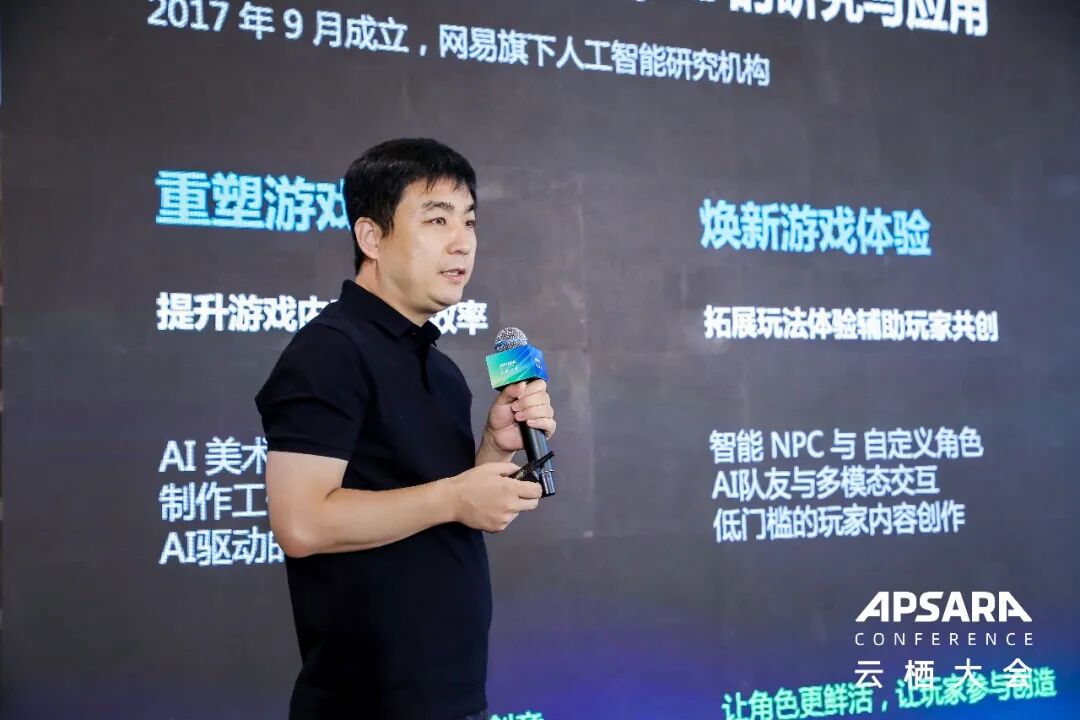
Wang Hongxian, Product Lead of NetEase Leihuo Fuxi AI Lab
NetEase Fuxi also demonstrated its workflow covering characters, scenes, interface motion design and video production at this year's Yunqi Conference, where AI-assisted creation is integrated into the toolchains that production teams use on a daily basis. Multiple links gain efficiency respectively, and when connected together, the working mode of the entire pipeline is essentially rewritten.
Such transformation is not an isolated case. Over the past period, many game developers have been exploring the application of AI in different scenarios, with the coverage scope extending from production to links such as marketing and operation.
Before the business landscape of AI in the gaming industry expands rapidly, a factor easily ignored by the outside world is that the infrastructure and tool layer has already taken shape.
Judging from the solution demonstrated by Alibaba Cloud at the forum, the product matrix provided by Alibaba Cloud for game companies corresponds to a complete game production chain: Qoder for R&D, Wanjing Yike for marketing and material production, and Qwen Office for organizational collaboration. Taking R&D and testing as an example, AI collaboration has evolved from the initial code completion to the full-link process of understanding projects, planning coding, verifying and fixing issues, and delivering results for human review. In this process, the original toolchains of enterprises can also be retained.
Deep in the operation process lies data, which is an unsolvable puzzle of cost and growth that the gaming industry can never bypass.
At the forum roundtable, Shiyue Network shared that AI has been integrated into the creation, production, delivery and data analysis of distribution materials: it hopes to connect scattered links, so that teams can be responsible not only for delivery, but also for business performance.
This integrated R&D and operation company has reduced total cost by 38% after migrating its entire data platform to Alibaba Cloud DLF and Serverless StarRocks. The cluster scaling time is shortened from one week to 5 minutes, and the data scale prepared for open-world games will reach the PB level.
This type of AI transformation may not directly change the gameplay, and stays below the waterline of player experience, but it enables data and feedback to enter the next round of decision-making faster, which is of far-reaching significance for the long-term operation of a game.
In the AI era, game developers have new requirements for infrastructure: agents need to continuously perform tasks, call tools, and manage memory, with traceable processes, controllable permissions and evaluable effects.
Alibaba Cloud's Agent Native Cloud covers different links: AgentCore is responsible for agent construction and governance, Agent Sandbox provides an isolated operating environment, AI Gateway manages model invocation, AI safety guardrails secure the input and output boundaries, and AgentLoop is used for post-launch observation, evaluation and optimization.
This also means that the competition dimension of game cloud is expanding, from supporting traffic with cloud services to managing agents with cloud services.
A hundred years ago, the electrification of American factories followed the exact same path.
From 1899 to 1929, most factories only replaced steam engines with electric motors, while retaining the old plant layout and shaft drive system, so the efficiency dividend was not realized for a long time. It was not until 1913 that Ford introduced the moving assembly line at the Highland Park Plant, cutting the total vehicle assembly time from 12.5 hours to about 90 minutes, that electrification was truly completed.
Many people change tools, but few rebuild the entire process.
Today's gaming industry is standing at the same stage. Handing art and code to AI for generation is just changing tools; selecting corresponding infrastructure according to AI's collaborative mode and rearranging the entire pipeline, distribution and operation processes is rebuilding the process.
Interestingly, these domestic game companies that have taken the "rebuilding route" have relied on cloud services for every leap of the mainstream game form, from cloud servers in the browser game era to the current Agent Infra. And almost all of their infrastructures are concentrated on the same cloud vendor.
Alibaba Cloud also demonstrated its continuous investment in Agent Native Cloud at this forum.
From elastic computing to agent infrastructure, why are game companies willing to keep investing in the same cloud vendor?
One of the reasons is that the more drastic the reconstruction is, the more game companies dare not take risks on the underlying foundation. Versions and gameplay can be tried and corrected, operations can be iterated, but infrastructure cannot afford failures.
Every technological leap is a new round of voting, and the capabilities of the technological and ecological leaders will be reconfirmed.
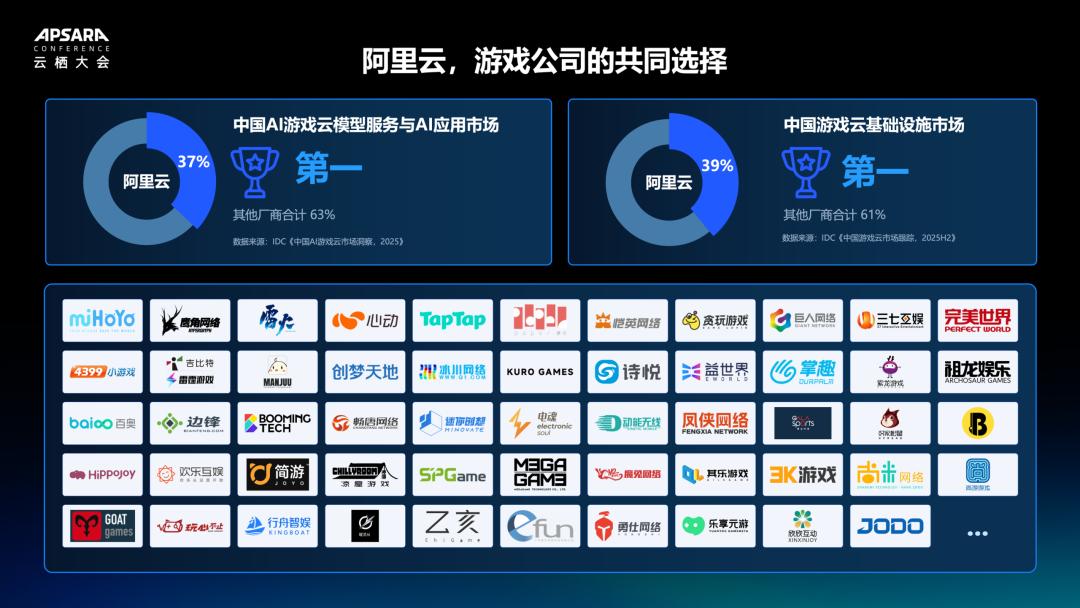
IDC data shows that Alibaba Cloud has ranked first in China's game cloud market for 5 consecutive years, with a 39% share of the infrastructure market; it also ranks first in China's AI game cloud model service and AI application market with a 37% share.
The three core capabilities that make leading game developers continuously choose Alibaba Cloud in the AI era are full-stack capability, scenario polishing and long-term commitment.
From chips and cloud infrastructure to models and Agents, Alibaba Cloud provides complete capabilities covering underlying computing power to upper-layer agents, reducing the complexity for game companies to splice infrastructure across different vendors at every technological leap.
At the same time, gaming is one of the most demanding scenarios on the cloud. Server launch peak, global cross-server access, real-time battles — every major version launch is a public exam and acceptance test. The demands of leading game companies have in turn polished Alibaba Cloud's capabilities layer by layer.
The first-mover advantage across generations is also critical. Alibaba Cloud prepared elastic cloud servers in the browser game era, laid out global nodes in the mobile game overseas expansion era, and continued to improve agent infrastructure including AgentCore, Agent Sandbox, AI Gateway and AgentLoop in the AI era.
What is needed for the next generation has been prepared in the previous generation. Capabilities are verified, and trust accumulates over time.
After the Entry Threshold Is Lowered
At the other end of the production line, the entry threshold is dropping at an unprecedented rate. Individual creators now have access to a complete toolchain that turns ideas into playable works.
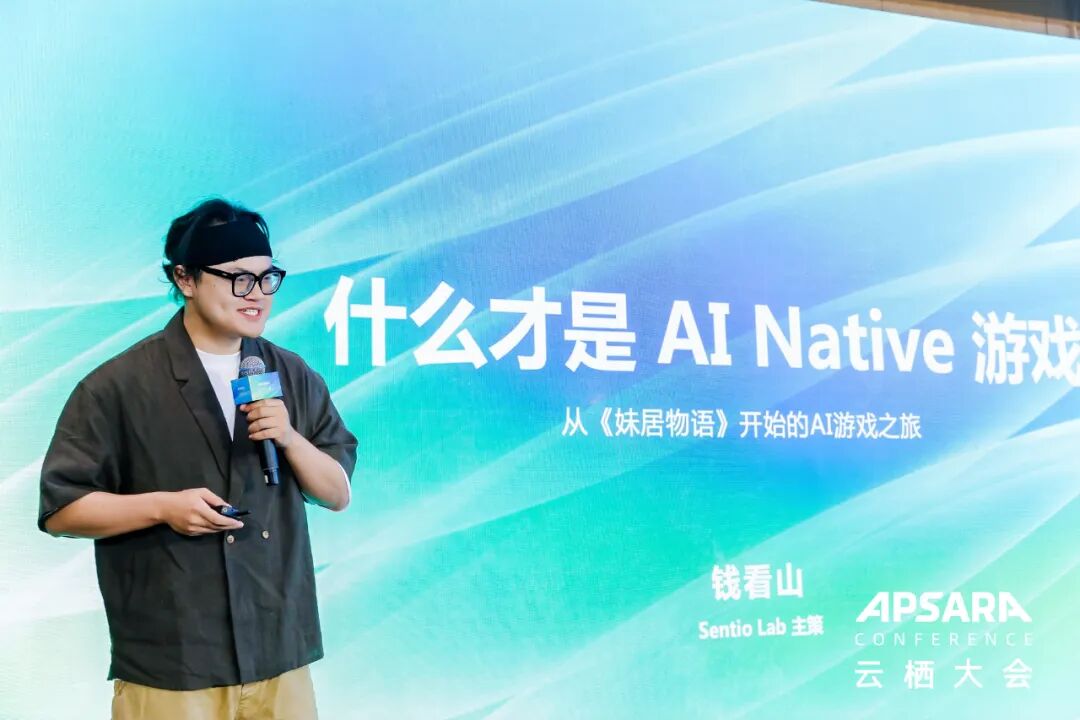
Qian Kanshan, Lead Designer of *Meiju Story*
Qian Kanshan, lead designer of *Meiju Story*, raised another noteworthy question at the forum:
Without AI, can the core experience of the game still hold? In *Meiju Story*, Qwen3.8-flash understands the photos uploaded by players and the content on the current screen, and CosyVoice-v3.5-flash generates character voices; the status, memory and action arrangement of characters are maintained by the team's own system. The team is still verifying whether the experience can be sustained and whether the cost can be recovered.
The exploration of *Meiju Story* shows that small teams have the opportunity to try new AI-native gameplay, and also sheds light on the other side of the issue: outside leading game developers, the long-tail market represented by the new development model has undergone structural changes.
In other words, the standard for judging whether AI can become the infrastructure of the gaming industry is very simple: how easy it is for small and medium-sized teams to use it.
At the Game AI Forum, Alibaba Cloud and TapTap jointly launched the AI Game Creation Competition for developers who want to turn their creative ideas into finished works.
The creation side is supported by TapTap Creators, with underlying access to Alibaba's models including Qwen-Image-3.0, Wan3.0 and Qwen3.8-Max, which can better integrate image, video and sequence frame generation into a single pipeline.
TapTap Creators allows creators to put forward ideas in natural language, generate codes and materials on the cloud, build and preview games, publish finished works on TapTap, and iterate based on player feedback.
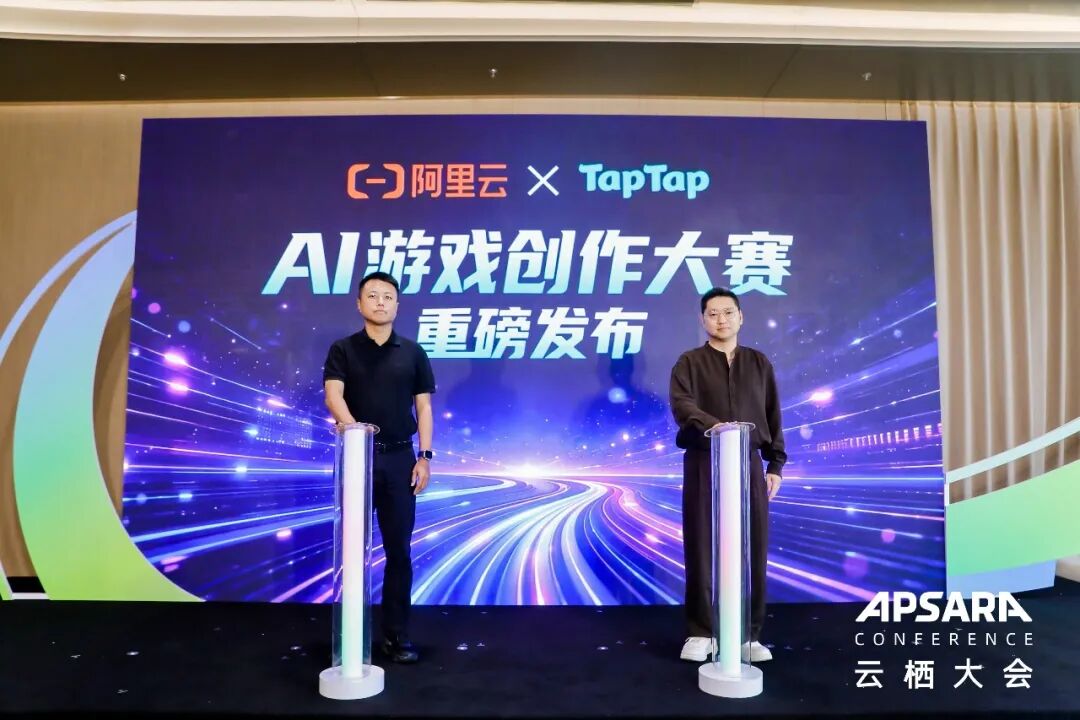
This competition was jointly announced by Jiang Li, Head of TapTap Creators, and Xie Hang, Vice President of Alibaba Cloud Intelligent Public Cloud Division, during the release session of the forum.
Three points of the competition are worth noting: first, the cost of turning ideas into playable works is greatly reduced, making niche ideas possible to be developed into verifiable games; second, the TapTap community connects playtesting and feedback to the creation process, providing a new path for high-potential works to be discovered; third, AI is integrated into the real delivery environment, and works will be tested by real players.
On the other side of the lowered entry threshold, there are more direct channels for work release and player feedback.
With production tools and distribution channels open to individuals at the same time, the supply side of the gaming industry will also embrace a new round of expansion.
There are more and more AIs in matches, the pipeline is rearranged in the way of human-AI collaboration, and the creation threshold is decreasing. We can clearly foresee that the next batch of works that can redefine the "gaming industry" may no longer come from a 100-person team with sufficient experience and budget.
All the beautiful imaginations about experience and production have just started in today's gaming industry.
The people making games are changing, but on the side of global launch stability and agent operation foundation, the Chinese gaming industry has