The AI war among major tech giants has extended into the hardware field.
The AI battle among major tech giants has spread from applications on screens to tangible, accessible end devices.
After the "Hundred Model Battle" in 2023, this is the fourth year of the large model competition. In the past, all players spared no cost on parameters, leaderboards and inference costs, and new changes have emerged recently.
On September 22, according to a report from LatePost, following AI glasses, the Wuying team under Alibaba Cloud is testing an AI tablet device named QwenBook, positioned as a native agent PC, with the full version expected to be released at the end of 2026 or early 2027.
Prior to this, ByteDance just launched the second-generation Doubao phone, Xiaomi open-sourced its AI hardware project, and Baidu also upgraded its DuerOS agent. In addition, in the first half of this year, Huawei launched several new smart terminals at one go, among which the first Hongmeng AI glasses became the key for it to seize the incremental entry point.
The moves seem scattered, but they actually point to a trend. That is, when AI evolves from dialogue to execution, it can no longer be satisfied with running on other people's hardware.
In other words, the Agent needs to perceive the environment, call system resources, and complete tasks across applications, and these capabilities are far from enough relying only on the model. Only by mastering the hardware entry can the entire logic be truly implemented.
However, problems also follow. Why exactly do major tech giants compete for hardware? In the Agent era, is the terminal the ultimate entry point? In what way will this war end?
In fact, the answer sheet has just been unfolded.
Major Tech Giants Are Scrambling for AI Hardware
Major tech giants are accelerating their layout in AI hardware. They are not simply launching co-branded products or OEM products, but are taking practical actions.
Let's look at Alibaba first.
On September 22, LatePost reported exclusively that the Wuying team under Alibaba Cloud is developing an AI device called QwenBook, positioned as a native agent PC, with a form factor closer to a tablet.
According to the report, the team has about 150 people. The system team is reorganized based on Wuying and Alibaba Cloud OS, and the hardware team has recruited many talents from leading mobile phone manufacturers.
It is reported that the product will also access Qwen3.8-Max and Qwen3.8-Flash, and cooperate deeply with Kingsoft to connect WPS. An insider said that this is an "early trial product", and the full version is expected to be released at the end of 2026 or early 2027.
But Alibaba is not only making tablets.
Previously, the Quark AI glasses equipped with Qwen and the DingTalk A1 Pro voice recorder have been launched on the market. If AI glasses are responsible for perceptual interaction and the voice recorder is responsible for office execution, then the tablet should answer a more fundamental question: what should the "home" of an Agent look like when it needs to call system resources and perform tasks across applications.
ByteDance is moving faster.
At the end of 2025, the first-generation Doubao phone was put into trial operation. In September this year, Doubao launched the second-generation Doubao phone Nubia NaviX Ultra. Moreover, this time Doubao chose to "exchange space with protocols, and exchange scale with openness" to avoid the pitfalls it encountered before.
Xiaomi follows the strategy of comprehensive coverage, with the logic of not betting on a single category, and deploying AI to as many terminals as possible. Its AI hardware strategy is based on self-developed chips and AI models, and systematically spreads AI capabilities to its own product lines through the terminal matrix of three scenarios: "people, vehicles and homes".
As for Baidu, based on its accumulated technical genes, it focuses more on the home scenario.
Previously, DuerOS announced that Super DuerOS has completed the agent-based upgrade, and launched new hardware products at the same time, including DuerOS companion screen, smart display, camera and speaker, etc. Baidu said it has formed a complete layout of "chip, cloud, model and agent" to quickly seize the entry point in the AI era.
Let's take a look at Huawei, which already has a full range of terminal products.
Huawei's strategy is to first solve the problem of "where AI capabilities come from", and then extend the capabilities to its own terminals. Relying on Ascend computing power and Pangu large model at the underlying level, Huawei sinks AI capabilities to hardware such as mobile phones, glasses and PCs through self-developed chips and Hongmeng system.
In April this year, Huawei launched more than ten new smart products at one go, among which the first Hongmeng AI glasses are also the key for Huawei to seize the AI wearable market.
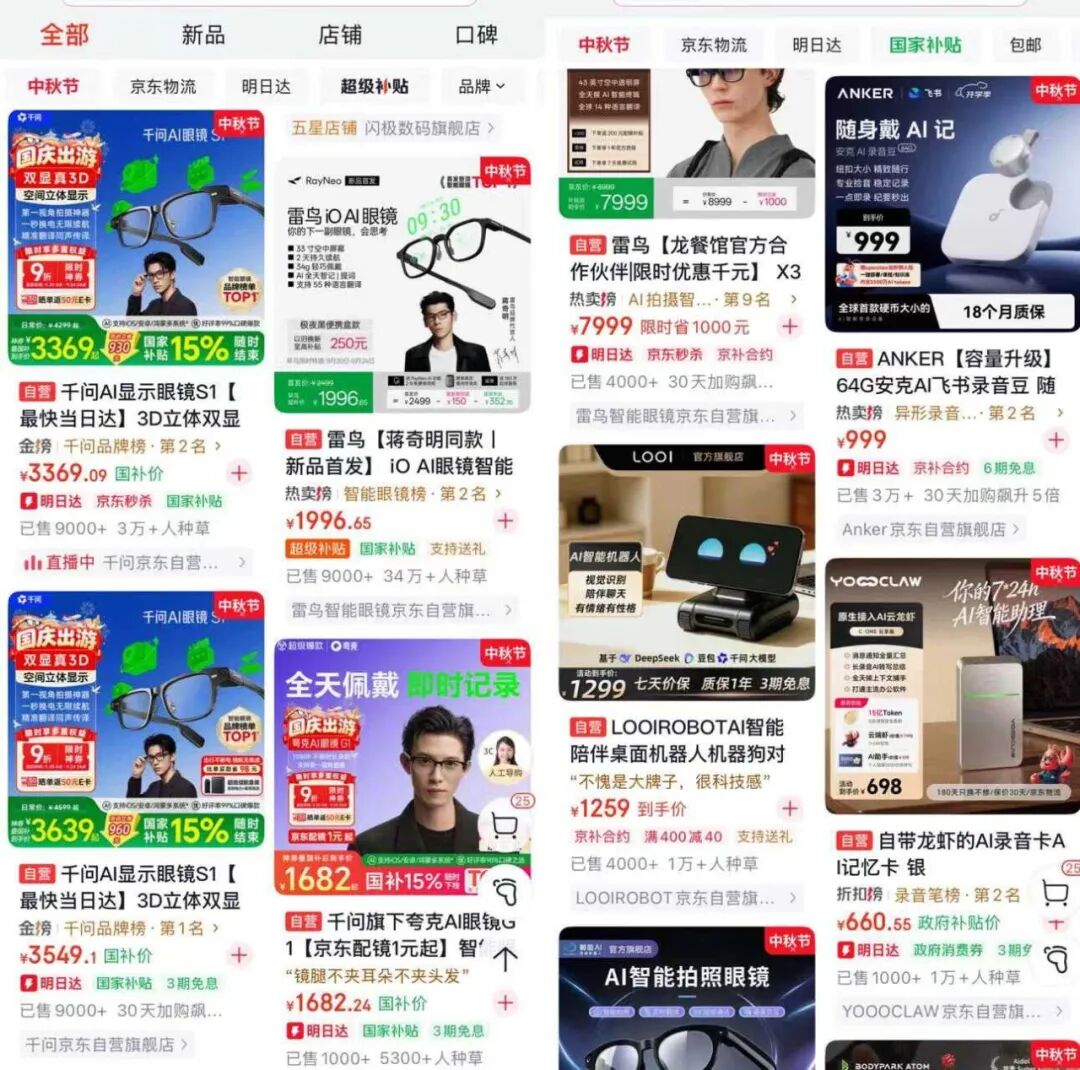
Figure: Part of AI hardware on e-commerce platforms, Source: Screenshot from JD & Tingtong Tech
Of course, there are other stories.
Whether it is Thunderbird or Rokid, these smart hardware companies are also accelerating their layout in the Agent field.
Data from Counterpoint Research shows that global smart glasses shipments increased by 263% year-on-year in the first half of 2026, of which displayless smart glasses accounted for as high as 96%.
The CEO of EssilorLuxottica also revealed that lightweight AI glasses for high-frequency use have become the first category to achieve scale effect in the hardware competition.
For a while, both Internet giants and smart hardware companies are accelerating on this track.
Is It Mandatory to Do So?
Why do major tech giants that are competing fiercely in the model field also refuse to let go of the hardware track?
Many analyses point out that the essence is that the rules and underlying logic of this round of AI terminal competition have changed.
In the past, the hardware business of major tech giants was mainly concentrated in mature categories such as mobile phones, PCs, tablets, speakers and TVs. The logic of making hardware is very simple, most of the giants want to sell devices, seize traffic and expand their ecosystem.
But the focus of AI hardware is no longer the hardware itself. In addition to mobile phones, there are glasses, voice recorders, tablets, robots and other forms with different shapes. In addition, products also reorganize interaction, computing power and system permission deployment around Agents.
Li Ge, an observer of the consumer electronics industry, said, "It is obvious that the last wave was adding AI functions to old hardware, and this wave is reconstructing hardware for Agents. To put it simply, the previous wave took intelligence as a selling point, while now we take AI as the core to drive users."
The reason is very simple. In the Agent era, major tech giants need to actively seize systematic control.
The most obvious change is that the entry points to reach consumer scenarios have changed.
In the PC era, the user entry point was the browser. In the mobile era, the entry points were app stores and super apps. In the AI era, the entry points have become smart terminals that can perceive the environment, understand intentions and provide active services.
"Whoever controls the user's glasses, earphones and mobile phones will control the first touch point of the user's immediate needs, which is a higher-dimensional power than traffic." Li Ge explained.
However, the competition for entry points is more complicated than imagined.
For example, after years of competition, the consumer electronics market pattern has been extremely mature, and mobile phone hardware, operating systems, app stores and sales channels are highly bound.
In addition, whether it is Huawei, Xiaomi, OPPO or vivo, they are all developing their own system-level Agents. Leading mobile phone manufacturers regard AI as the most important system capability, and naturally they are not willing to hand over the entry point to others.
Internet giants can only break through in forms such as glasses, voice recorders, tablets and smart displays, trying to reorganize interaction, computing power and system permissions around Agents.
In addition, the sinking of inference computing power from the cloud to the end side also forces major tech giants to take the lead in the AI hardware track.
Market analysis points out that since 2026, the growth rate of inference computing power has been faster than that of training computing power. As AI moves from training to inference, computing power requirements extend from the cloud to the edge and end side.
This requires that AI hardware is not old hardware with an additional AI function, but a redefinition of the hardware architecture. This also means that AI hardware has unlimited imagination space, and it is also a must-do for major tech giants.
However, in response to major tech giants testing the AI hardware track that they are not good at, Li Ge said frankly, "The most fundamental reason is that without hardware entry points, it is difficult for models to obtain system-level control and first-hand scenario data."
Taking Alibaba as an example, Alibaba's financial report shows that the revenue growth rate of Alibaba Cloud accelerated year-on-year from 36% in the December 2025 quarter to 45% in the June 2026 quarter, with strong growth in AI product revenue.
However, Bank of America Merrill Lynch's China AI strategy report puts forward a judgment that China's AI value chain is forming a dumbbell-shaped profit structure, with value concentrated at both ends of hardware and cloud platforms, while the large model laboratories in the middle are facing multiple squeezes of low conversion cost, fast imitation speed and weak pricing power.
To put it bluntly, relying only on model capabilities is difficult to form a lasting barrier, and the real moat lies in hardware entry points, user data and scenario closed loops.
Therefore, Quark glasses cooperate with Alibaba's ecosystem to connect search and business travel; the content of DingTalk voice recorder flows to the DingTalk workbench; QwenBook may give priority to accessing its own applications and WPS to strengthen the closed loop of data and services.
However, an insider also pointed out the problem, "If the Agent can only call the tools developed by Alibaba itself, QwenBook will be closer to a set of Alibaba customized office environment, and users cannot work in the original software ecosystem."
Obviously, this is not only a problem for Alibaba, but also a problem that all major tech giants making AI hardware have to face directly.
The Prospect Is Bright, But the Barrier Is Also Hard
In fact, although there is still a long way to go for AI hardware to connect the ecosystem and truly change lives, major tech giants are competing to seize the ecological position.
After all, the market is too attractive.
Gartner predicts that AI PC shipments will reach 143 million units in 2026, accounting for 55% of the entire PC market. The Research Institute of Zhongtai Securities believes that driven by AI, the global semiconductor market will exceed one trillion US dollars in 2026, far exceeding the 500 billion US dollars of the previous cycle.
As for AI glasses alone, IDC predicts that global smart glasses shipments will exceed 23.687 million units in 2026. Meta's Ray-Ban co-branded model sold more than 7 million units in one year.
The market is large enough and the growth rate is fast enough, but the prospect is one thing, and the barrier is really hard.
Li Ge said, it is undeniable that "the first barrier is the ecological barrier."
For example, previously, an AI mobile phone was collectively boycotted by applications such as WeChat, Meituan and Alibaba's ecosystem, and its functions were directly taken offline. "To put it bluntly, the major tech giants are only responsible for developing functions, and the platforms decide whether it can run. No one is willing to hand over their core lifeline to others." Li Ge said.
The second barrier is the security barrier.
"It is still a controversial topic for users to hand over the permissions of mobile phones, payment and communication to Agents. Although the data of end-side AI remains locally, the autonomous decision-making and application calling of agents are likely to cause privacy leakage and malicious instruction execution." Li Ge said frankly.
Taking AI mobile phones as an example, previously, a member of the Expert Committee on Information and Communication Economics of the Ministry of Industry and Information Technology pointed out that the most important difference between traditional mobile phones and AI agents is "autonomy". To obtain autonomy, AI agents need to obtain APP calling permissions and ensure security during the calling process.
In addition, cost is also a prerequisite for the track to be successfully implemented.
The business logic of the traditional Internet is that the more users there are, the marginal cost tends to zero. But the logic of AI hardware is the opposite. In the stage of cloud inference and free mode as the mainstay, the more users there are, the greater the inference consumption, and the more losses there will be.
Previously, a founder of an embodied intelligence company said that algorithm engineers could burn 300-500 US dollars in one afternoon, which is higher than the engineer's salary.
Another media report said that a Shenzhen-based AI education hardware company has 250,000 product users with an average daily usage time of 45 minutes, but it has never been profitable. The reason is that the Token cost is too high.
From the perspective of the industrial chain, the cost also includes the price increase of chips.
Public data shows that recently, the proportion of DRAM in the end-side hardware cost is approaching from 10% to 40%, the contract price has a double-digit increase, and the shortage will last at least until 2027. The large memory most needed by end-side AI, which used to be the cheapest component, has now risen to the level of luxury goods.
Of course, for users, "AI hardware is not easy to use", "smart glasses are too expensive and not worth the money", and "not used to it" are also direct feedback from the market.
In fact, on social platforms, many AI hardware products have been complained about, with insufficient function realization and response delay, and users finally have to take out their mobile phones.
In addition, due to limited functions, the return rate of AI glasses remains high. Some people in the supply chain said that the return rate of some products has reached 40-50%.
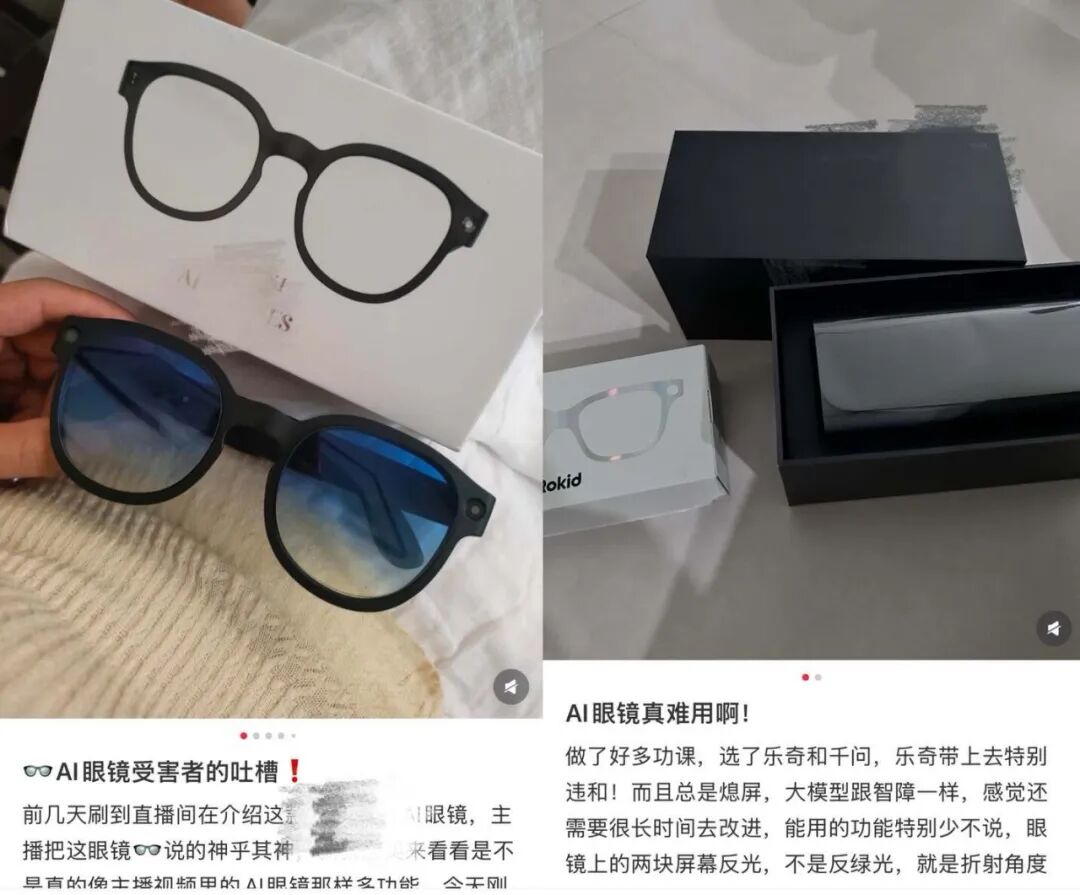
Figure: Discussions about "AI glasses" on social platforms, Source: Screenshot from Xiaohongshu & Tingtong Tech
"Lightweight and high-frequency use sounds good, but the premise is that it has to solve a problem that mobile phones cannot solve well, or even cannot solve at all. At least for now, most AI hardware has not achieved this." Li Ge said frankly.
Ecosystem needs negotiation, security needs institutional guarantee, cost needs breakthrough, and user habits need to be cultivated. These are all things that the industry needs to do. Essentially, these are not mountains that can be crossed simply by stacking parameters and launching new products.
Major tech giants need to fight these four battles at the same time. If any one battle is lost, the hardware will only be hardware, and the Agent will only be a cloud API.
"But conversely, whoever crosses this barrier first will get the real system-level admission ticket in the Agent era." As Li Ge said, taking QwenBook as an example, the official calls it a "trial product". But what is being tested is not just a tablet, but an exploration of the entire industry's AI hardware form.
"You won't know how deep the water is until you jump in. After all, the war will not end in the short term, and even the outcome will not be decided in three years." Li Ge said frankly.
(The cover picture is still from the movie Battle of the Bulge, and some of the pictures are generated by AI.)
(Statement: This article is for information exchange only, and does not constitute any investment reference or suggestion.)
This article is from the WeChat official account "T