It has been two full years, the total market capitalization of the A-share market has increased by 51 trillion yuan. Have you made any money?
On September 24, 2024, the Shanghai Composite Index staged a dramatic rebound from 2689 points (the lowest point in September), surging 4.15% in a single day and posting its largest one-day gain in four years.
As of September 24, 2026, which is today, the Shanghai Composite Index has stood at 3888 points.
Over the two years, the index has recorded a cumulative increase of 45%, with the total market value rising by about 51 trillion yuan.
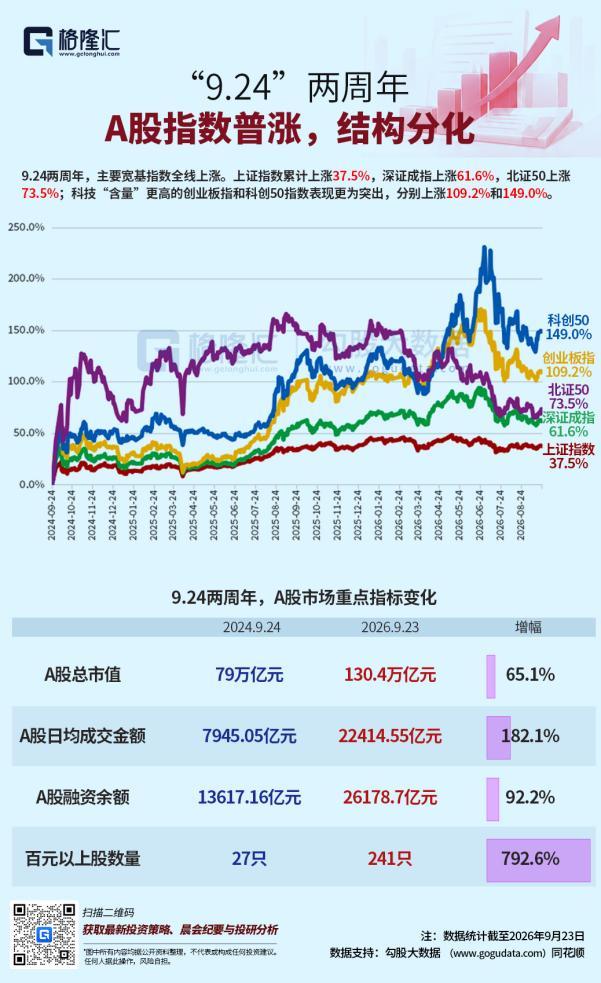
Theoretically, this should be a bull market that makes investors cheer.
But if you ask the investors around you: "Have you made money in the past two years?"
Most likely you will get a silent stare, or a helpless sigh.
01
Let's turn the clock back to September 24, 2024.
That morning, three authorities including the People's Bank of China, the State Administration of Financial Regulation, and the China Securities Regulatory Commission jointly held a press conference, where a series of "combined policy measures" including RRR cuts and interest rate cuts, the launch of swap facilities, and support for listed companies' share repurchases and additional holdings were implemented beyond market expectations.
As soon as the news was released, the market was ignited instantly.
The Shanghai Composite Index rose 4.15%, the Shenzhen Component Index rose 4.36%, the ChiNext Index rose 5.54%, more than 5100 stocks across the market went up, and the total trading volume soared from less than 550 billion yuan the previous day to 974.4 billion yuan.
But the question is, where were you on that day?
Before that, the A-share market had experienced 4 consecutive months of gradual downward drift.
On September 18, the Shanghai Composite Index just hit a new phase low of 2689 points, market pessimism reached its peak, and the trading volume shrank to below 500 billion yuan.
Most retail investors either had cut their losses and left the market, or were deeply trapped in losses and chose to hold their positions passively.
Faced with the sudden sharp rise, most people's first reaction was not to add positions, but that they were finally recovering their cost, so they chose to sell immediately.
Of course, a small number of people chose to stay.
Some of them are veteran investors who persisted through the 2022 and 2023 bear markets: their accounts have already lost half of their value, but they still believe that assets that have fallen enough will eventually rise;
Some are young people who have just entered the market not long ago, holding a small amount of spare money with a tentative attitude, and never expected to welcome the policy tailwind;
There are also a few investors with keen market sense, who quietly built positions in sectors like AI and chips when the market was at its most pessimistic in mid-September. They could not fully understand macro policies, but believed in the driving force of industrial trends.
Most of these persistent investors also went through a stage of "disbelief" on September 24.
Some people looked at their accounts turning red suddenly, and their first reaction was that the trading system must have malfunctioned; some stared at the surging K-line chart, hesitated about whether to add positions, and finally chose to wait and see for a while longer.
They did not cut their positions at the bottom, but they did not add positions immediately either. They just held their chips silently, waiting for the market to give an answer.
It is these persistent people who have become the main force of the subsequent structural market rally.
02
There is no quantifiable public data that can clearly show the average profit or loss of retail investors in the past two years; if you simply divide the increased market value by the total number of investors, the result will also be distorted. But it is very easy to profile ordinary investors in the market of the past two years.
Generally, they can be divided into four types.
Type 1: "Cost Recovery" Investors
This type of investor has very typical characteristics: most of them entered the market at high levels between 2021 and 2023, with positions concentrated in traditional core assets such as liquor, new energy, and pharmaceuticals, and their floating losses on accounts are generally between 30% and 50%.
After the September 24 rally started, the index rose rapidly, and some stocks rebounded to near their cost lines.
They struggled repeatedly between "selling to get back cost" and "holding for longer", and most of them finally chose to take profits and exit.
As a result, they missed the subsequent structural market rally, and could only watch the index rush all the way to nearly 3900 points.
Type 2: "Missed the Rally" Investors
This type of investor completely lost confidence in the gradual decline before September 2024, cleared all their positions and left the market, vowing "never to touch A-shares again".
When they saw the sharp rise on September 24, their first reaction was "this is another fake rally that will not last".
When the index rose from 2689 to 3674 (the high point on October 8), they finally realized what was happening, but at that time they did not dare to chase the high price anymore.
They would rather miss the rally than make a wrong move. The inertia of bear market thinking in the early stage of the bull market made them completely miss the big market rally.
Type 3: "Chased High" Investors
This type of investor only began to pay attention to the market after the September 24 rally started.
They saw widespread public opinion saying that a bull market was coming, and rushed into the market when the index was at a high level around October 8.
The result is predictable: they bought at the phased high point.
Subsequently, the market entered months of consolidation and adjustment, their accounts turned from profit to floating loss, and they finally cut their losses and left amid repeated market fluctuations.
Their mentality of "being more greedy when others are greedy" and FOMO (fear of missing out) made them the first group of people who took over positions at high levels.
Type 4: "Persistent" Investors
This type of investor is a minority group.
They already held positions in new productivity sectors such as AI, chips, robotics, and innovative drugs before September 24, or firmly held the main line sectors after the market rally started.
They undoubtedly enjoyed the structural dividends of this round of bull market, and some of their stocks have doubled or even brought several times of returns. Of course, in the process, they also experienced the test of multiple large pullbacks and paid a huge psychological price.
Which type of investor do you belong to?
The answer may be upsetting, because very few people can become the fourth type. Most people have survived all the hardships of the bear market, but end up making no money or even losing money in the bull market.
03
As for the problem of not making money in a bull market, the root causes boil down to three points:
First, the failure of position management.
Many retail investors hold light positions or even empty positions at the bottom, and keep adding positions as the market rises, which makes their average cost higher and higher.
Data shows that on September 24, the net inflow of main funds exceeded 200 billion yuan, the net inflow of super-large orders reached 175 billion yuan, while small orders recorded a continuous net outflow of 45 billion yuan.
In other words, retail investors were net sellers at the market bottom.
This is very easy to understand from the perspective of investment psychology: long-term losses have worn out people's confidence, and at this time, people's expectation has changed from making money at the beginning to just getting back their cost.
Simply put, this is human nature, and there is no need to blame anyone for that.
Second, the mismatch of position structure.
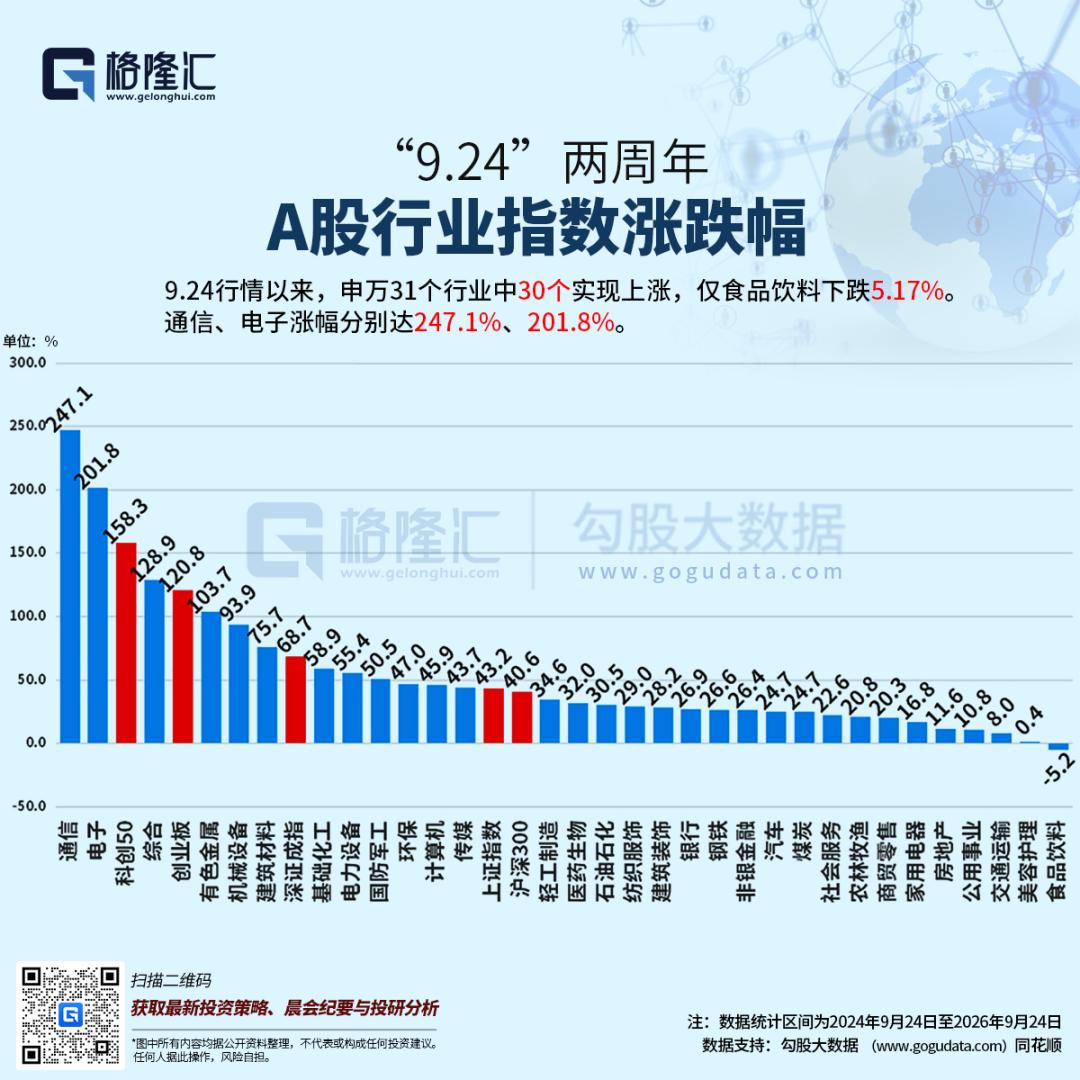
This round of bull market is a structural bull market, with the main line concentrated in new productivity sectors such as AI, chips, robotics, and innovative drugs.
However, a large number of retail investors still hold positions in traditional industries or previously popular but declining sectors, such as some consumer sectors and real estate industry chains.
As a result, the phenomenon that "the index is rising but my stocks are not" has become the norm.
Third, the trap of the sentiment cycle.
From the "disbelief" on September 24, to the "universal carnival" on October 8 when the daily trading volume hit a new historical high of 3.49 trillion yuan, and then to the subsequent market correction, retail investor sentiment always lags behind the market rhythm.
Being pessimistic at the bottom and optimistic at the top is also human nature.
What have we learned two years later?
First of all, we have to admit a fact: the 51 trillion yuan increase in A-share market value in the past two years is indeed a real wealth distribution, but it is not equally distributed to everyone, and the distribution direction is extremely uneven.
If you can't understand the trend of the AI industry, you can't hold the surging tech stocks; if you can't overcome your fear, you won't dare to add positions at the bottom; if you are still indulging in the afterglow of old industries, you will still lose money even if the stock market keeps rising.
Of course, we have to mention another equally upsetting fact: even if you firmly believe in the trend of the AI industry, after experiencing the tech stock correction in July 2026, the average return of retail investors further dropped to -28.3%, and the per capita floating loss expanded to about 24,800 yuan (statistics from relevant institutions), you may not be able to feel happy about the market.
Many AI tech investors who made a lot of money in the first half of this year suffered huge pullbacks in July, not only losing all their profits, but even losing part of their principal.
Among the investors who chased high prices to buy tech stocks at the end of the second quarter, the proportion of losing positions was as high as 65%.
It can only be said that the complexity and contradictoriness of the market sometimes exceed people's cognition.
04
At present, the probability of a September-24-style sharp rally in the market is low, but the pattern of fluctuating upward trend is still continuing.
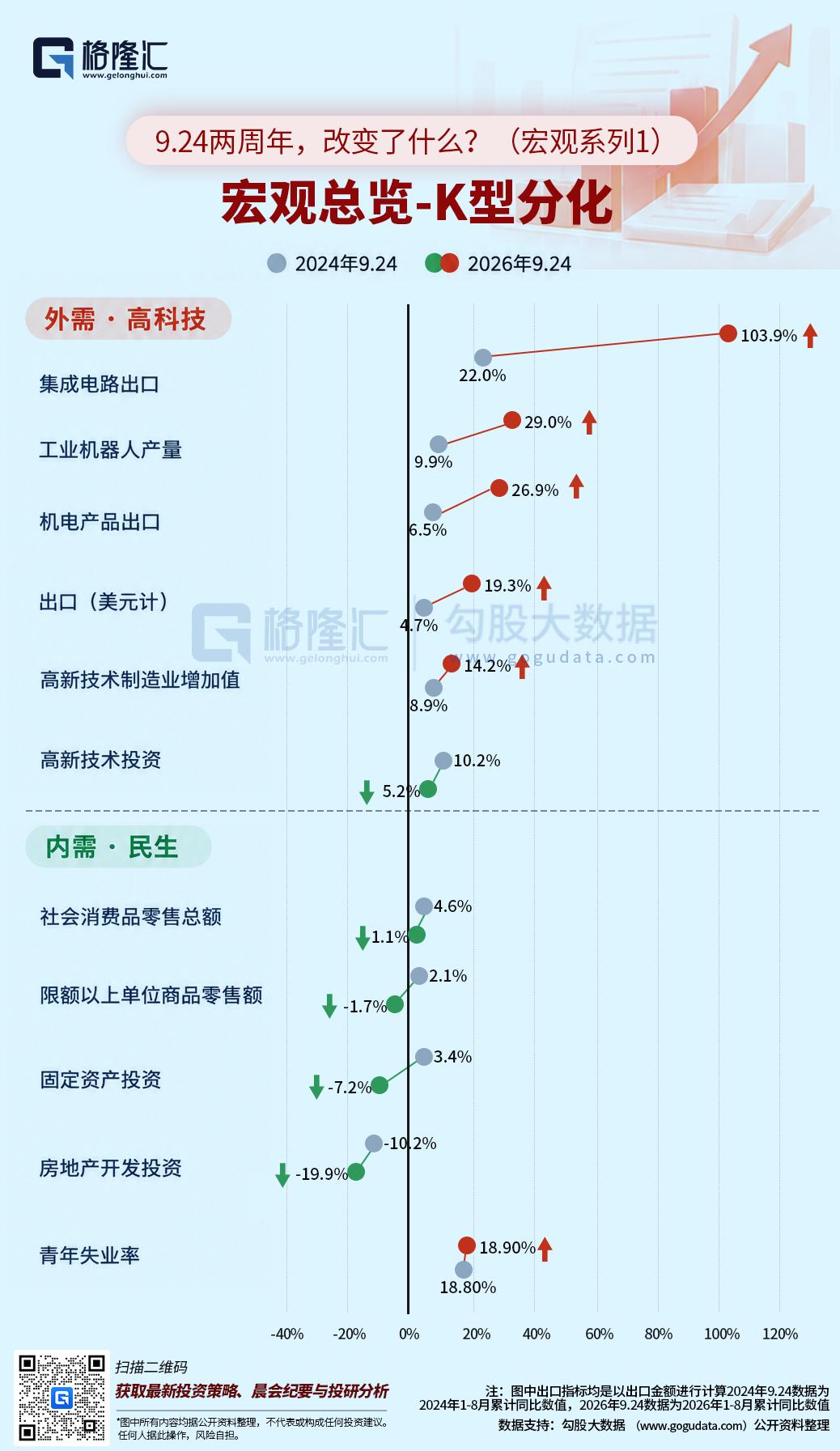
With the deepening of the national economic transformation and the rapid development of the AI industry, there will be new opportunities in the market in the future.
But the question is, when the next opportunity comes, can you seize it?
We don't know how everyone will answer this question.
However, there are three effective principles to follow if you want to seize the opportunity.
For example, don't predict the bottom, but you can identify the bottom.
When the trading volume shrinks to the extreme, when everyone around you is complaining about the stock market, when the policy bottom is clearly confirmed, at least you should not sell your positions anymore.
For another example, don't chase hot spots, but you can embrace the trend.
Directions such as AI, innovative drugs, and high-end manufacturing are long-term national strategies, and structural opportunities will appear repeatedly. The key is to choose the right track and hold your positions firmly.
Furthermore, don't invest all your money in one go, but you need to stay in the market.
No matter in a bear market or a bull market, the practice of putting all your money in at one go is prone to risks.
Maintain a reasonable position and a reasonable ratio between holdings and cash, keep yourself always in the market, so that you can continuously share the dividends of the market.
The A-share market on September 24, 2026 has closed, but as long as the trend represented by AI continues, we believe the stock index will be higher on September 24, 2027, September 24, 2028, and even many years later. (End of full text)
Gelonghui Statement: All views in this article come from the original author, and do not represent the views and positions of Gelonghui. Special reminder: Investment decisions need to be based on independent thinking. The content of this article is for reference only, and does not serve as any practical operation suggestion. Trading risks are borne by yourself.
This article is from the WeChat official account "Gelonghui APP" (ID: hkguruclub), author: Gejila, 36Kr published it with authorization.