The hot money and future of the AI sector at this moment belong to the Chinese counterparts of Alexandr Wang.
A company established for roughly one year has entered negotiation rounds with a valuation of 2.5 billion US dollars.
In September, foreign media reported that Alibaba plans to lead a $300 million financing round for UniPat, an AI training and evaluation company, with a post-money valuation of about $2.5 billion. Investors including Tencent and HSG have also shown intention to participate in this round.
This valuation figure once belonged to star projects in the previous two waves of AI entrepreneurship: Moonshot AI, the company behind Kimi, reached a valuation of around $2.5 billion when it was roughly one year old; the company behind the AI programming tool Cursor hit this valuation level when it was about two years old.
One builds large foundational models, and the other targets the most popular capability direction in the past few years. This time, the company in question provides training data and evaluation services for large models.
Previously, Li Kuan, founder of UniPat, worked on post-training analysis, data synthesis and reinforcement learning at Alibaba's Tongyi AI Lab.
What makes this combination interesting is: People who came out of model teams have started to produce training materials for model teams, while large tech corporations appear in the investor list.
The United States has already seen a landmark "reverse" figure. In 2016, Alexandr Wang and Lucy Guo co-founded Scale AI, starting with autonomous driving data labeling, and gradually expanded into large model training data and evaluation business. In 2025, when Meta took a stake, Scale's valuation exceeded 29 billion US dollars, and Wang also joined Meta. He has already demonstrated how close a data provider can get to the core of large models.
China certainly has data companies. Enterprises such as SailVoice have long provided data collection, labeling and large model data services. The new change now emerging is that people who have directly participated in model post-training, Agent products and internal evaluation have started to launch this type of business.
Apart from UniPat, former MiniMax members founded Copula Lab; the core team of Intelligent Knowledge comes from ByteDance's Seed team.
The opportunity they all see is that the closer the model gets to real work scenarios, the harder it is to find data required for training from existing Internet content.
The intelligent production and manufacturing industry is extending to data companies. Large tech corporations come with procurement demands, investors are eager to find target projects, and people from model teams step out to start their own businesses.
The "examiners" inside foundational model teams have started their own businesses one after another
The origin of this business can be traced from previous research outputs of the UniPat team.
Before becoming a founder, Li Kuan worked on post-training, data synthesis and reinforcement learning at Tongyi AI Lab, and had already begun to study how to design challenging tasks for models.
In the WebSailor paper published in July 2025, he was the first listed author and one of the three project leaders. The team synthesized complex search tasks to let models learn to find evidence, call tools and conduct continuous reasoning, and explored how to improve the task execution capability of Agents through reinforcement learning.

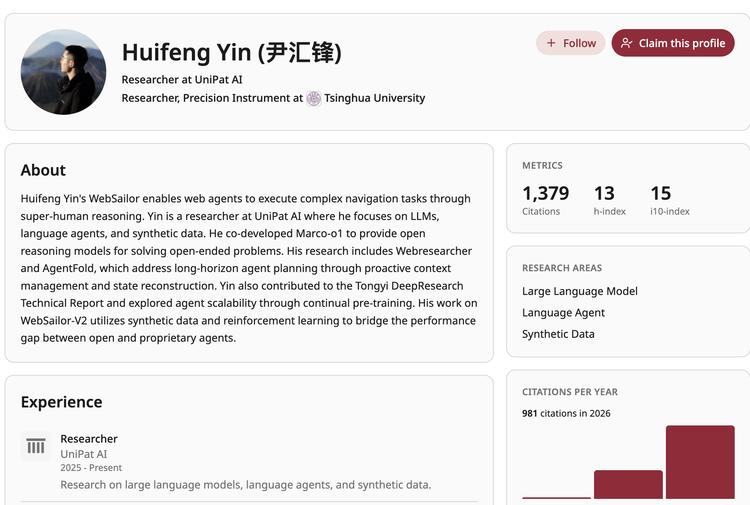
Yin Huifeng, who was also a project leader of the WebSailor project, later became a member of UniPat.
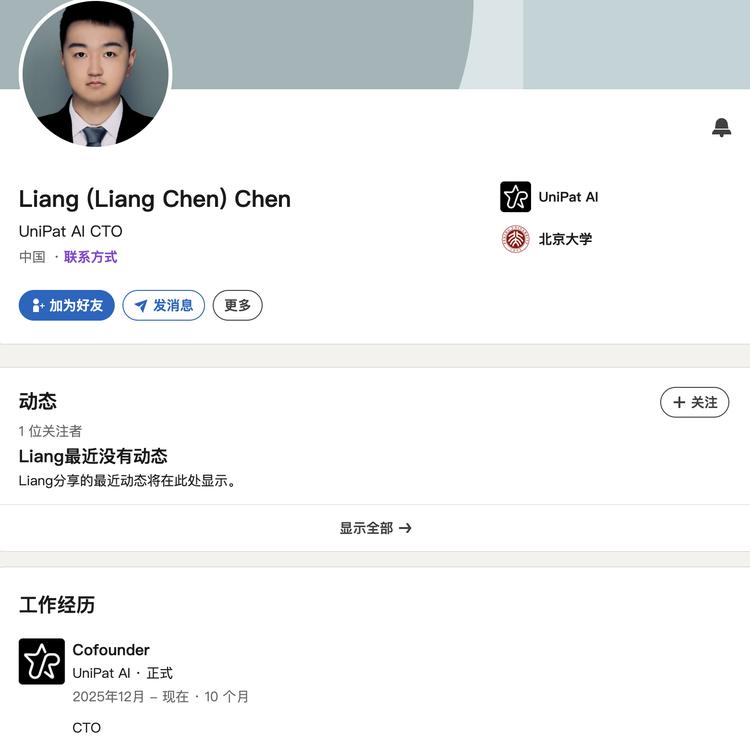
Chen Liang, co-founder and CTO, used to conduct research in the multimodal teams of Qwen and Moonshot. His personal academic homepage recorded the news of launching an Agent data and reinforcement learning environment company as early as August 2025.
What this team is familiar with is how to design tasks around the capabilities that models lack, and then use these tasks to train and test models. After establishing the company, these research experiences have been presented through a series of public evaluation projects.
In January this year, UniPat released BabyVision to test the basic visual reasoning capability of models. In May, Terminal-X was launched to test the capability of programming Agents to solve complex engineering tasks, respond to multi-round requirement changes and complete version upgrades; ExpertEval was released to evaluate professional judgment in medical, financial and legal scenarios; SaaS-Bench was used to test whether Agents can cross multiple business software to complete a full set of workflows. In July, the Vibe-Coding Arena was released, further bringing in real human experts to evaluate how Agents understand requirements, accept feedback and correct errors in multi-round programming collaboration.
The test questions have evolved from "whether the answer is correct" to "diverse real work tasks".
Papers and benchmarks were the only way for the public to learn about UniPat for a long period of time.
This low-profile style is also a common tendency of this new wave of data startups: they are willing to communicate about technologies, but rarely talk about specific businesses. After all, research results can be made public, but information about which capability they improve for which client, how they produce data, and how to conduct acceptance tests already involves the R&D direction of clients and their own commercial barriers.
A relevant practitioner told us that although the financing news was only exposed recently, UniPat has actually completed multiple rounds of financing. Alibaba, as the lead investor disclosed this time, provides both capital and computing power support, the annual cost of the latter is at the level of tens of millions of RMB.
Another practitioner introduced that the cooperation between UniPat and Alibaba focuses on reinforcement learning post-training data, including programming trajectories and multi-tool tasks under different Agent operation frameworks. They first conduct low-cost training experiments on small models to screen out effective data solutions, then expand production and delivery to train and verify on large models.
This is a deeply customized cooperation: what clients buy is not only materials, but also the experimental process of finding effective materials. Public benchmarks are only an entry point. Beneath the surface, UniPat is trying to become an external data R&D source for model vendors.
Different from UniPat, when facing the data demands of model manufacturers, Intelligent Knowledge focuses on how expert knowledge is organized and continuously produced.
Wang Sheyang, founder and CEO, was previously responsible for the model data engineering architecture of ByteDance's Seed team, and also worked on the data engineering of Douyin's medical large model; Li Kuanye, CTO, is a former foundational model data engineer at ByteDance, who worked on reinforcement learning data synthesis and environment construction.
In May 2025, Wang Sheyang publicly proposed that high-quality expert data is becoming increasingly important, but easy-to-use production tools are still concentrated inside large tech corporations. Therefore, Intelligent Knowledge uses "One Platform for Thousands of Minds" to find, screen and organize experts, and then uses Xpert Studio to support task production and quality inspection. In June this year, the company announced that it had received investment from Jinqiu Fund and YO Capital.
From the entry points of these two companies, we can see different destinations of internal model experience: UniPat is closer to model experiments, while Intelligent Knowledge is closer to production scenarios.
Copula Lab, which was founded by people who left MiniMax earlier this year, also has a similar experience background in its team.
A person close to the matter mentioned that Liang Li, the founder, left her job to start a business in the first half of this year. She was previously in charge of MiniMax's Agent business and built the internal evaluation system; Cai Jiaren, technical co-founder, once served as the open source leader and post-training data algorithm engineer at MiniMax, and participated in the post-training data construction of the coding direction of the M2 series models.
Their experience connects products and models: one end is to judge whether the user's work is completed, and the other end is to convert this judgment into training goals. As far as we know, Copula Lab has also obtained financing.
Model-related background, post-training scenarios, and booming financing constitute the three characteristics of new-type data companies at present.
It also provides a new possible division of labor in the industry: model manufacturers retain core training work, and entrust cross-scenario data production that requires continuous updates to external partners who have been "nurtured" through long-term practical experience; entrepreneurs convert the experience of serving one lab into products that serve multiple clients.
Models start to "purchase capabilities", the data business has changed
Behind this phenomenon, there is a larger background that the logic of model companies purchasing data is changing: In the past, they mainly purchased training materials, but now they hope to directly obtain capability improvement.
A researcher in charge of model evaluation and also participating in post-training gave us an example: if a batch of data can increase the score on the programming leaderboard by three points after post-training without modifying the model architecture, "Will you buy it? You definitely will."
These three points are not only the performance displayed to the outside world, but also the internal basis for measuring R&D effects.
For example, the model team will build a "capability tree", list the capabilities that the model needs to develop and the leaderboards that need to be targeted, and then find corresponding training materials. For parts that cannot be covered by public data, they will purchase or produce data by themselves: find out the tasks that the model fails to complete, design new and more difficult questions around the lacking capabilities, and then conduct training and re-evaluation.
As a result, leaderboards have become report cards, training plans and procurement guidelines at the same time.
This is also the reason why benchmarks have become an important entry point for this new wave of data companies. An evaluation that reveals common shortcomings, or a significant improvement of a model in a certain type of task, may lead other teams to look for data that can bring similar improvements.
However, to meet such demands, what data providers need to do has also become more complex.
What Agents need to learn is how to complete work. There is a large amount of code on the Internet, but it will not automatically come with the complete processing process of a software failure: how to locate the problem, call tools, modify failed attempts, retry, and finally confirm that the problem is fixed.
New data products therefore start to include tasks, operation trajectories, operating environments and scoring criteria at the same time. Take the publicly launched Terminal RL Data of Intelligent Knowledge as an example. What it delivers is not only test questions, but also software environments, test scripts and reference solutions, so that the model can actually execute tasks and verify the results through tests.
Overseas companies' actions have already shown this change.
In February 2026, Scale AI stated that nearly half of new data training projects involve reinforcement learning environments; in July, Mercor announced that it will acquire Deeptune, combining its own expert network with the latter's capability of reconstructing enterprise software and building training environments.
This type of data demand explains two things: Why this new wave of entrepreneurs are concentrated from model companies, and why model manufacturers need an external data supply layer.
The advantage of "companies like UniPat" is not only that they know the purchasers, but also that they themselves have been the demand side: they know how to discover the shortcomings of models, how to convert a task into training material, and how to design experiments to judge the effect.
At the same time, the more industries they enter, the higher the cost for each party to repeatedly organize experts and build systems. Compared with internal model teams, external companies have the opportunity to reuse tools, expert networks and environments, bring the capabilities accumulated in one project to the next delivery, and spread the cost through multiple sales.
At the moment, the growth rate of large tech corporations' demand for post-training data is much faster than the production rate of high-quality supply.
Many practitioners describe this business as "extremely profitable": although the amount of pre-training corpus is huge, the data that can directly make up for the shortcomings of models in post-training is much scarcer. Based on their experience, for a certain capability, ten thousand to one hundred thousand pieces of high-quality data can bring significant improvement to post-training.
This also makes the product pricing and company valuation of data companies increasingly close to the value of R&D.
The enlightenment brought by Alexandr Wang also comes from this. Scale AI has proved that organizing data production itself can become an important capability independent of model companies; and when it goes deep enough into R&D, the relationship between the two parties will evolve from procurement to long-term cooperation and capital binding.
This group of Chinese entrepreneurs is taking a different path with a different starting point. They first learned how to discover shortcomings, design tasks and verify effects inside model teams, and then turned these experiences into external services.
Model R&D increasingly requires professional division of labor, and a company can become an important participant in "making models stronger" even if it does not own a foundational model.
This article is from WeChat official account "Siliconist Pro", author: Huang Xiaoyi, published with authorization from 36Kr.