Consecutive years of losses, strategic misalignment and lagging behind across all business lines, Nayuki Tea is trapped in the most difficult predicament since its listing.
As the "first new-style tea stock" listed on the Hong Kong Stock Exchange, Nayuki (02150.HK), which went public in 2021, once witnessed the golden development period of China's high-end new-style tea beverage sector. With the dual-category model of "tea beverage + soft European bread" and the scenario-based layout of large stores in commercial districts, Nayuki once firmly occupied the leading position in the high-end new-style tea beverage track.
However, in the five years since its listing, the company's performance has continued to face pressure, and it has never got rid of the loss dilemma except for a brief small profit in 2023. Against the backdrop of the new-style tea industry shifting from incremental expansion to stock involution, normalized price wars, and the light-asset franchise model becoming the industry mainstream, Nayuki's shortcomings such as the legacy problems of heavy assets, lagging strategic transformation, and vague product positioning have been fully exposed, and the gap with leading competitors in the industry has gradually widened.
Continued Deterioration of Performance: From Industry Leader to Bottom Tier
In recent years, the profitability of Nayuki has collapsed visibly.
According to financial data, from 2021 to 2025, Nayuki recorded revenue of RMB 4.297 billion, RMB 4.292 billion, RMB 5.164 billion, RMB 4.921 billion, and RMB 4.331 billion respectively, representing year-on-year growth of 40.54%, -0.12%, 20.33%, -4.70%, and -11.99% respectively; its net profit reached RMB -4.525 billion, RMB -469 million, RMB 13 million, RMB -917 million, and RMB -239 million respectively, and in the first half of 2026, its net profit was still RMB -97 million.
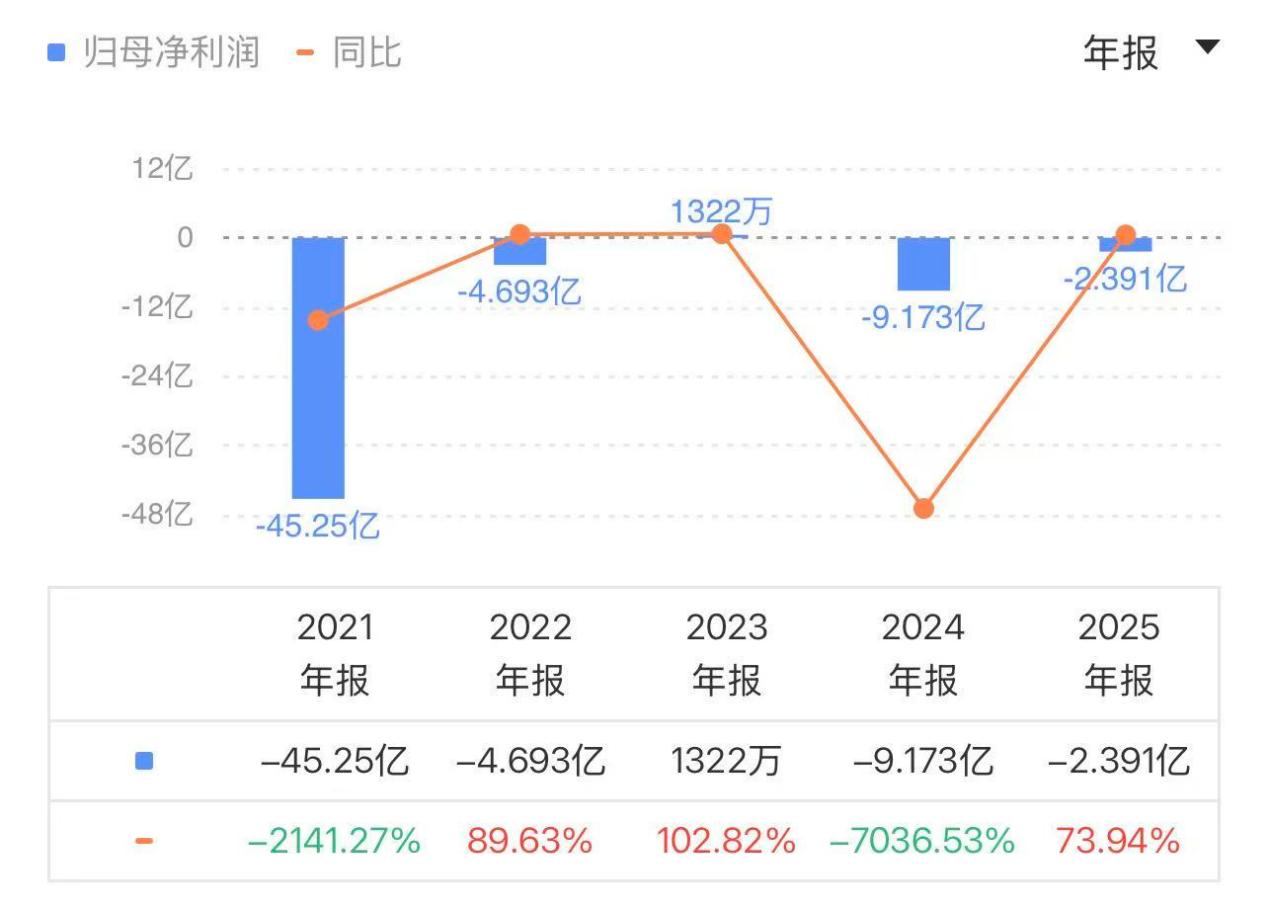
The data shows that Nayuki's net loss has been narrowing year by year, but it has never got rid of the loss status. The so-called loss reduction is not a result of improved operating capacity, but a passive outcome of large-scale store closures, cost cuts, and reduction of store scale, which does not signal an operating inflection point. Entering the first half of 2026, the downward trend continues, with revenue falling by another 13.1% year on year, consistently underperforming the industry.
As listed tea beverage enterprises, by comparison, Cha Baidao recorded revenue of RMB 3.644 billion, RMB 4.232 billion, RMB 5.704 billion, RMB 4.918 billion, and RMB 5.395 billion respectively from 2021 to 2025; its net profit reached RMB 756 million, RMB 954 million, RMB 1.139 billion, RMB 472 million, and RMB 805 million respectively.
Bawang Chaji recorded revenue of RMB 492 million, RMB 4.64 billion, RMB 12.41 billion, and RMB 12.91 billion respectively from 2022 to 2025; its net profit reached RMB -91 million, RMB 803 million, RMB 2.525 billion, and RMB 1.186 billion respectively.
Mixue Ice City recorded revenue of RMB 2.559 billion, RMB 2.658 billion, RMB 4.154 billion, RMB 5.814 billion, and RMB 7.55 billion respectively from 2021 to 2025; its net profit reached RMB 1.91 billion, RMB 1.997 billion, RMB 3.137 billion, RMB 4.437 billion, and RMB 5.887 billion respectively.
Aunt Fu Shang recorded revenue of RMB 113 million, RMB 202 million, RMB 511 million, RMB 449 million, and RMB 676 million respectively from 2021 to 2025; its net profit reached RMB 83 million, RMB 150 million, RMB 388 million, RMB 329 million, and RMB 501 million respectively.
It can be seen that as the earliest new-style tea beverage brand that became popular in the milk tea circle and went public first, Nayuki has gradually lost the operational resilience of a leading enterprise.
Heavy Assets as a Drag, Strategic Missteps Undermine Fundamentals
Operating in the same industry, only Nayuki is on the decline, indicating that its losses are not caused by industry fluctuations, but the inevitable result of years of accumulated strategic misjudgments, inherent model flaws, and delayed decision-making.
Nayuki's aesthetic, clean and bright stores, which used to be located in shopping malls across major cities, were consumers' first impression of the brand, with the aroma of milk tea wafting through the stores and the baked goods in glass cabinets looking extremely tempting. It is precisely this heavy-asset directly-operated model that has become a fatal burden that Nayuki cannot shake off.
The large-store model in commercial districts that Nayuki started with, featuring large dine-in areas, on-site baking, and high-end decoration, could cover up cost defects with high unit customer price during the industry dividend period, but completely failed in the era of stock competition and price wars. A large number of existing directly-operated stores bear rigid fixed costs such as high rents, staff salaries, and decoration depreciation, and the fixed expenses exist rigidly regardless of order volume fluctuations. When the overall unit customer price of the industry declines, the proportion of takeaway orders rises, and consumers become more rational, the cost disadvantage of Nayuki's large-store model is infinitely magnified, and a single store is extremely prone to losses, which is the underlying root cause of its perennial losses.
Under pressure, Nayuki began to take the initiative to adjust and gradually close its directly-operated stores. Data shows that in 2024, the number of its directly-operated stores decreased by 121 on a net basis, the number of franchise stores increased by 264 on a net basis, and the total number of stores increased by 143 on a net basis; in 2025, the number of its directly-operated stores decreased by 165 to 1,288 on a net basis, the number of franchise stores increased by 13 to 358 on a net basis, and the total number of stores decreased by 152 to 1,646 on a net basis. Most of the closed stores are located in first-tier and new first-tier cities, which used to be the core hinterland of the brand, but now have become the first positions to be lost due to high costs and consumption diversion.
It can be seen from the store closure data that Nayuki has both directly-operated stores and franchise stores. It is worth mentioning that Nayuki did not officially open up franchising until the second half of 2023, 1 to 2 years later than Heytea and Bawang Chaji. High-quality sinking locations and high-quality franchisees have already been occupied, and it missed the industry's franchise expansion window. As of the end of June 2026, there are only 370 franchise stores, accounting for only 22% of the total number of stores. The franchise scale is too small to hedge against the revenue decline and loss pressure of directly-operated stores.
To make matters worse, around 2023, the entire new-style tea beverage industry was caught in a crazy price reduction wave, and the "9.9-yuan" price war swept the industry; in 2024, the battle intensified, and the price bottom was repeatedly broken. Affected by this, Nayuki's unit customer price dropped from RMB 43.3 to RMB 24.4 from 2023 to 2025, and its main price range was adjusted to RMB 14-25. High costs and low-price high-volume operation coexist, putting the profitability of a single store under pressure.
In addition, Nayuki deployed bottled RTD tea beverages and Nayuki tea retail business, originally hoping to replicate Heytea's bottled products to build a second growth curve outside physical stores. However, according to the financial reports, the volume of bottled beverage and retail business is very small, and their revenue has declined in recent years, which cannot hedge against the revenue decline of the store side and form a stable profit source; the baking business has also continued to shrink, and the three main business lines (tea beverage + baking + retail) are under pressure synchronously.
All-round Lag: Loss of Advantages in Brand, Model and Efficiency
Looking at the current new-style tea beverage track, leading brands have formed a mature and stable profit model, but Nayuki continues to lose money and shrink. In comparison with competitors at all levels, it presents an all-round and systematic lag, and its former high-end leading position exists in name only.
Compared with Heytea in the high-end track, Nayuki has lost comprehensively in iteration capability and refined operation. As a brand that also started with direct operation and high-end positioning, Heytea recognized the drawbacks of the large-store model earlier, quickly completed the lightweight and miniaturization transformation of stores, decisively reduced fixed costs, and has a far lighter asset burden than Nayuki. In terms of channel reform, Heytea's business partnership model has been maturely implemented, and its expansion in sinking markets is progressing steadily. On the product side, Heytea maintains a stable brand tone and continuous hit products, while Nayuki voluntarily gives up its core advantages, with severe product homogenization, vague brand memory points, serious lack of strategic determination, and continuous loss of brand premium.
Compared with mid-range 10,000-store franchise brands such as Guming and Cha Baidao, Nayuki's business model has fundamental flaws. The two listed tea beverage brands rely on more than 97% of franchise stores to build a pure light-asset supply chain model, which does not need to bear the risks of store rent and labor, and can achieve stable profit by relying on material supply, with extremely strong cycle-resistance and risk-resistance capabilities. In contrast, Nayuki heavily invests in directly-operated heavy assets, undertakes all operating risks by itself, and suffers large losses as soon as the industry fluctuates slightly. At the same time, the supply chain bargaining advantage brought by the 10,000-store scale is unmatched by Nayuki, which has less than 1,700 stores, further widening the cost gap and continuously expanding the profit gap.
Compared with the emerging leading brand Bawang Chaji, Nayuki's product cost-effectiveness and model advantages have completely failed. Relying on low-loss pure tea products, lightweight small-store model, and low-threshold franchise model, Bawang Chaji quickly seized the mainstream mid-range price range, crushing Nayuki with lower operating costs, higher single-store profits, and faster expansion speed. At the moment when the price ranges of the two sides highly overlap, the drawbacks of Nayuki's fresh fruit tea, such as high loss, high cost and high investment, are fully exposed, with passenger flow continuously diverted and market space continuously squeezed.
Overall, Nayuki has fallen into a predicament of being squeezed from both above and below with no way out. At the critical stage when the industry shifts from incremental competition to stock fierce fighting, Nayuki has exhausted its first-mover advantages and capital dividends through repeated strategic missteps.
This article is from the WeChat official account "Lanfu Finance", authored by Lanfu Finance, and authorized for release by 36Kr.