The price of GPT has been halved, making it even cheaper than DeepSeek.
Sure enough, in this era, cost-effectiveness is the most straightforward killer move in commercial competition, and the AI industry is no exception.
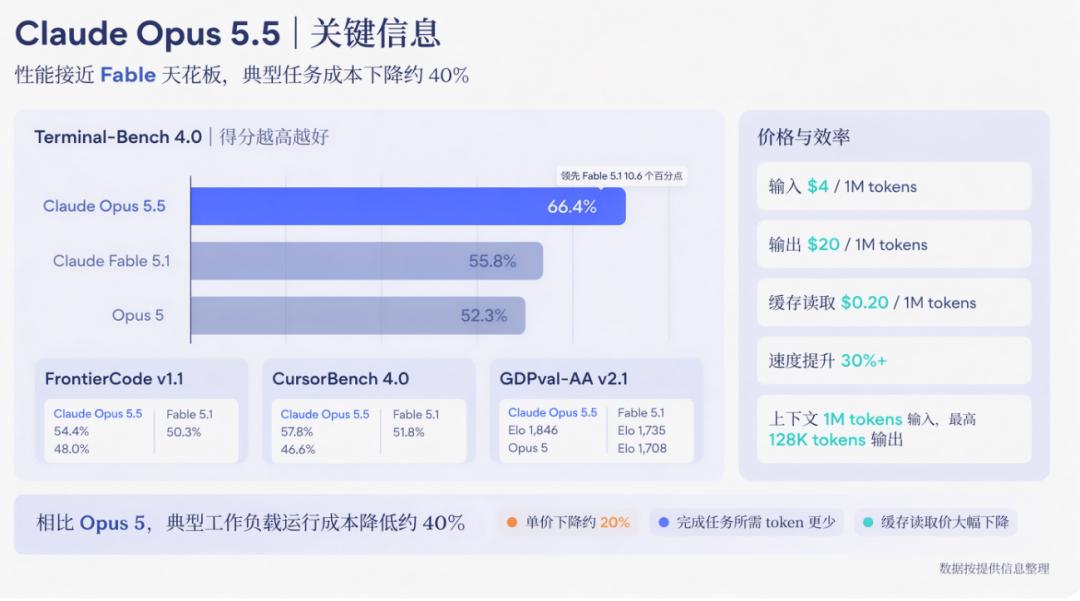
Right after Anthropic released Claude Opus 5.5.
Shortly afterwards, OpenAI supplemented two new models to the GPT-6 family: GPT-6 Sol and GPT-6 Luna.
Anyone with a discerning eye can see that OpenAI is directly competing head-on with its rival's models: it not only pursues higher benchmark scores, but also cuts prices sharply.
However, this time OpenAI did not simply add two "cheap versions" under the GPT-6 line.
Its strategy is: Downscale high-end capabilities, cut prices by half.
Astra continues to take charge of the most difficult and complex tasks; Sol focuses on complex daily work and Agent scenarios; Luna targets high-frequency standardized tasks such as summarization, extraction, classification, and routing.
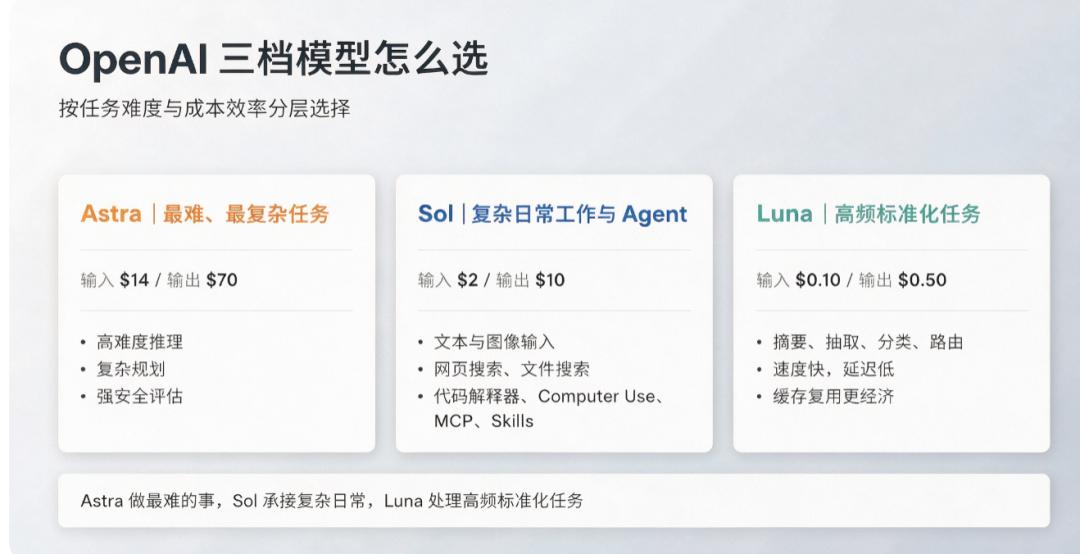
Both Sol and Luna support text and image input, and can also call web search, file search, code interpreter, Computer Use, MCP and Skills.
In other words, many tasks that previously could only be handled by flagship models now have cheaper alternatives.
The price war has reached the doorstep of DeepSeek
In terms of pricing, right after Opus drove down the market price, GPT also readjusted its pricing system.
The API listed prices of Sol and Luna are directly 50% lower than the promotional prices of GPT-5.6 at the same tier.
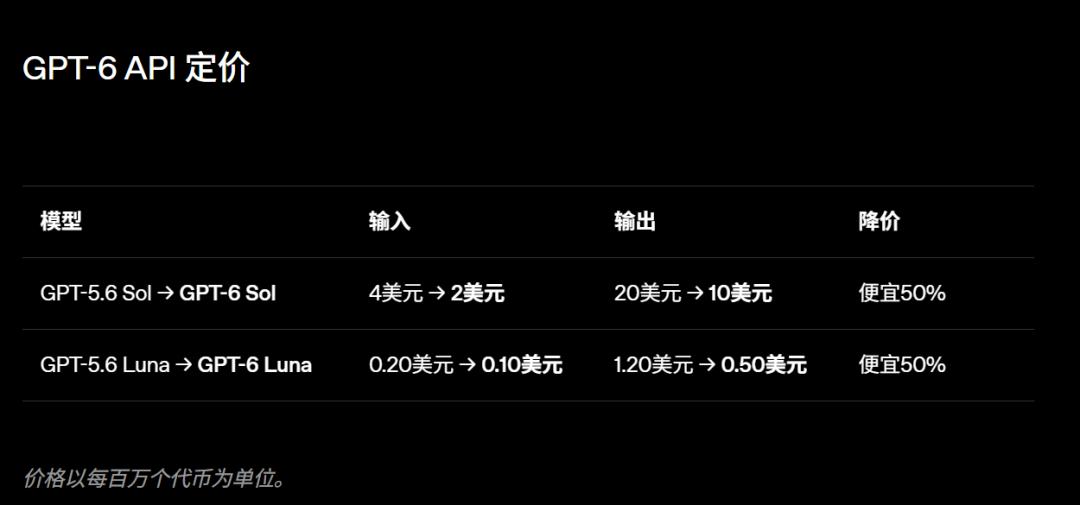
OpenAI stated that the main reason is the improvement of caching and inference efficiency, and this price is not a limited-time promotion but a long-term pricing policy.
What is really interesting is GPT-6 Luna, which is priced at $0.10 per million input tokens, and has been able to compete directly with DeepSeek-V4.1-Flash.
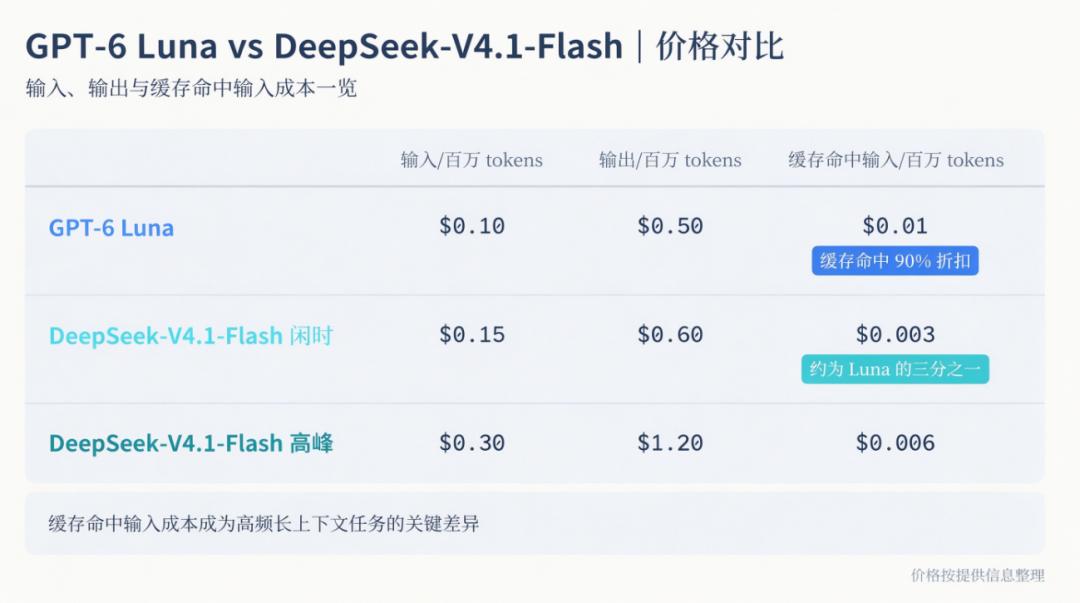
Of course, DeepSeek still has a trump card: lower prices for cache hits.
For scenarios where Agent repeatedly carries the same set of code, documents, system prompts and tool definitions, cache hits will directly affect the final billing amount.
In the past, when an Agent was running halfway, if the inference intensity was temporarily increased or the tool configuration was adjusted, the reuse of the previously cached context might be affected.
This time OpenAI also optimized the caching mechanism. Now GPT-6 allows developers to adjust the inference intensity, enable or disable tools during the conversation, while retaining the existing cached context.
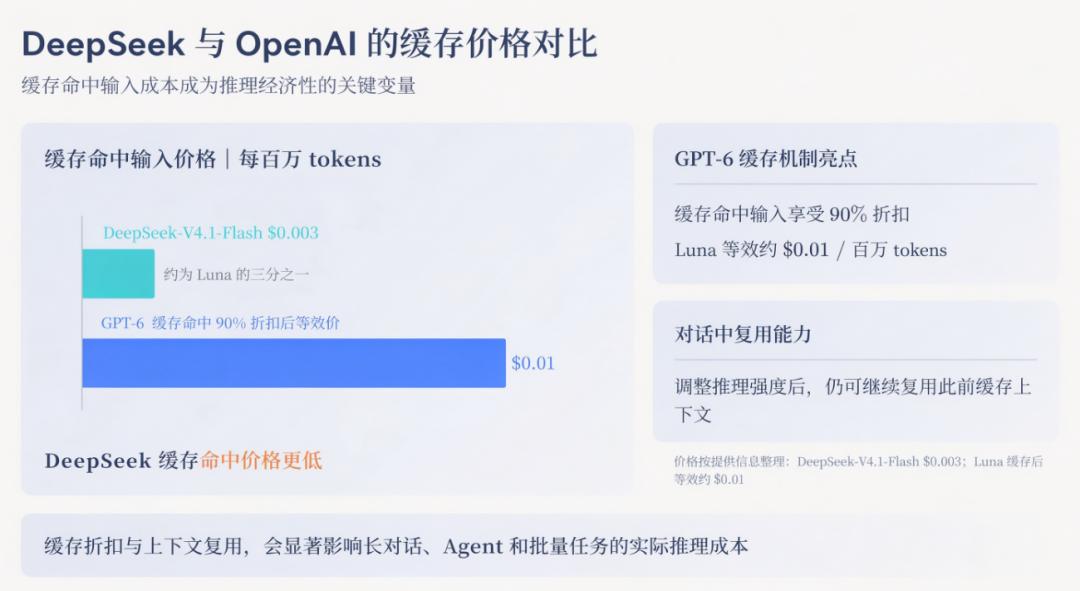
This means that even if the Agent runs continuously for dozens or hundreds of rounds and changes the configuration once in the middle, it does not need to recalculate the large segment of context that has already been processed.
Therefore, it is no longer possible to simply say "whose cache is cheaper", after all, the two parties have completely different ideas: DeepSeek presses the unit cache price lower, while OpenAI improves the reuse efficiency of the cache.
Prices are discounted, capabilities are not
After talking so much about prices, a question arises: It is indeed cheaper, but have its capabilities been discounted accordingly?
Judging from several public tests so far, OpenAI's idea this time is not to simply "sacrifice performance for lower prices", but to allow users to obtain capabilities close to GPT-6 Astra at a much lower cost.
The most prominent performance of GPT-6 Sol can be seen in the real long-chain software engineering test DeepSWE: under the max inference intensity, GPT-6 Sol achieved a score of 68.8%, only 1.1 percentage points lower than Claude Fable 5's 69.9%.
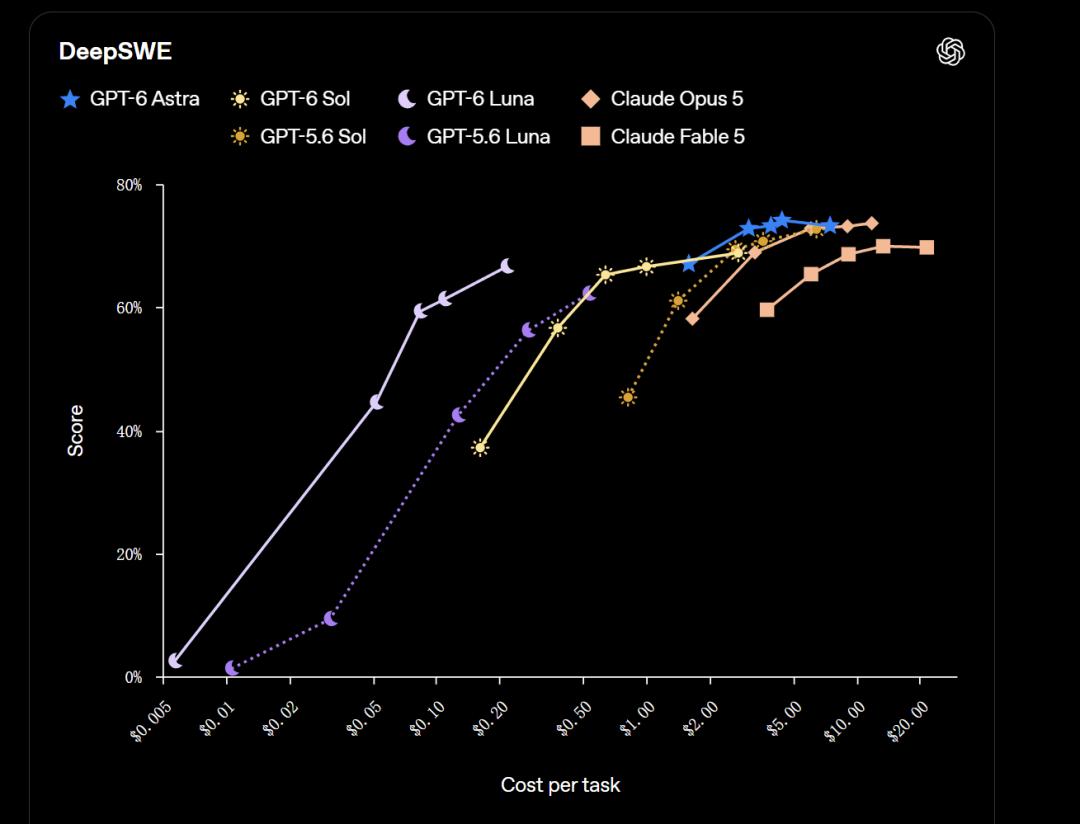
But according to OpenAI's estimation, its single-task cost is about 80% lower.
In other words, you can spend 80% less money on code Agent work such as code base understanding, code modification, and troubleshooting.
In the cross-application Agent test AutomationBench, the task completion rate under the xhigh inference intensity is 33.2%, which is higher than the 26.9% of Claude Opus 5 at the max tier.
In terms of cost, the single-task cost is only $0.27, while that of Opus 5 is about 11 times of it.
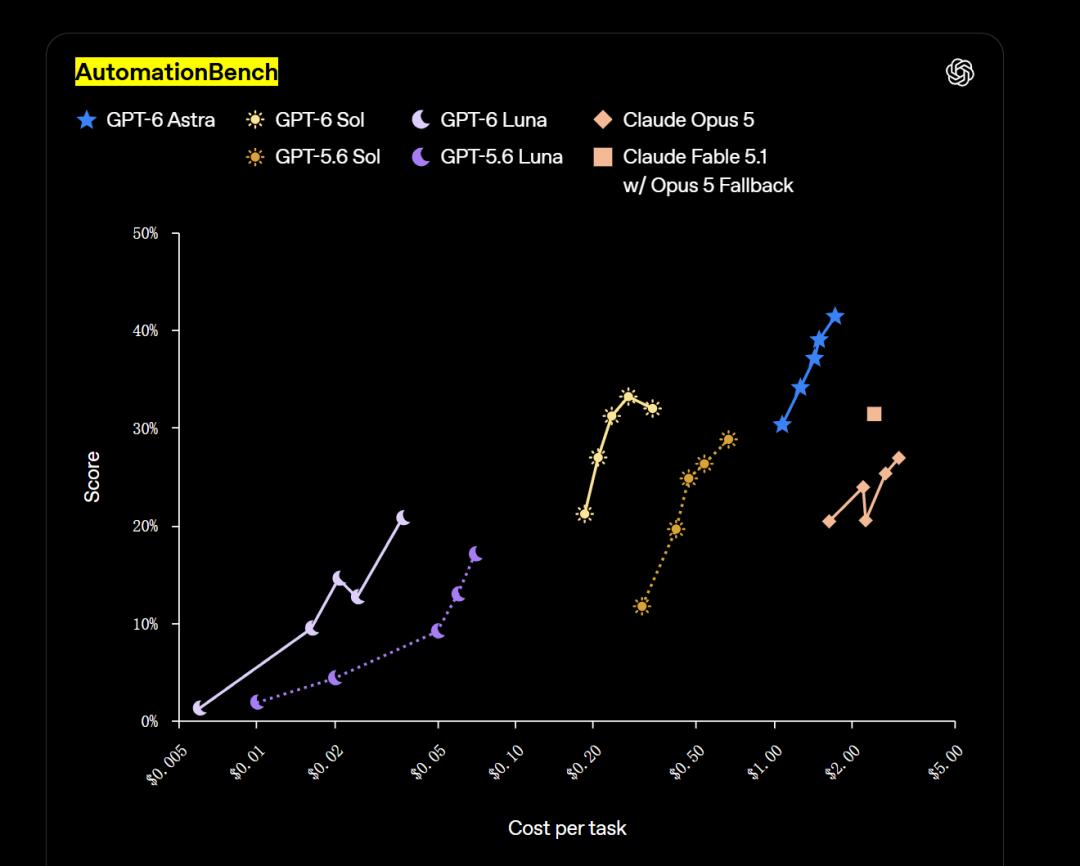
It can be seen that for scenarios such as code writing, tool adjustment, and multi-step task execution, GPT-6 Sol can deliver performance close to flagship models at a much lower cost.
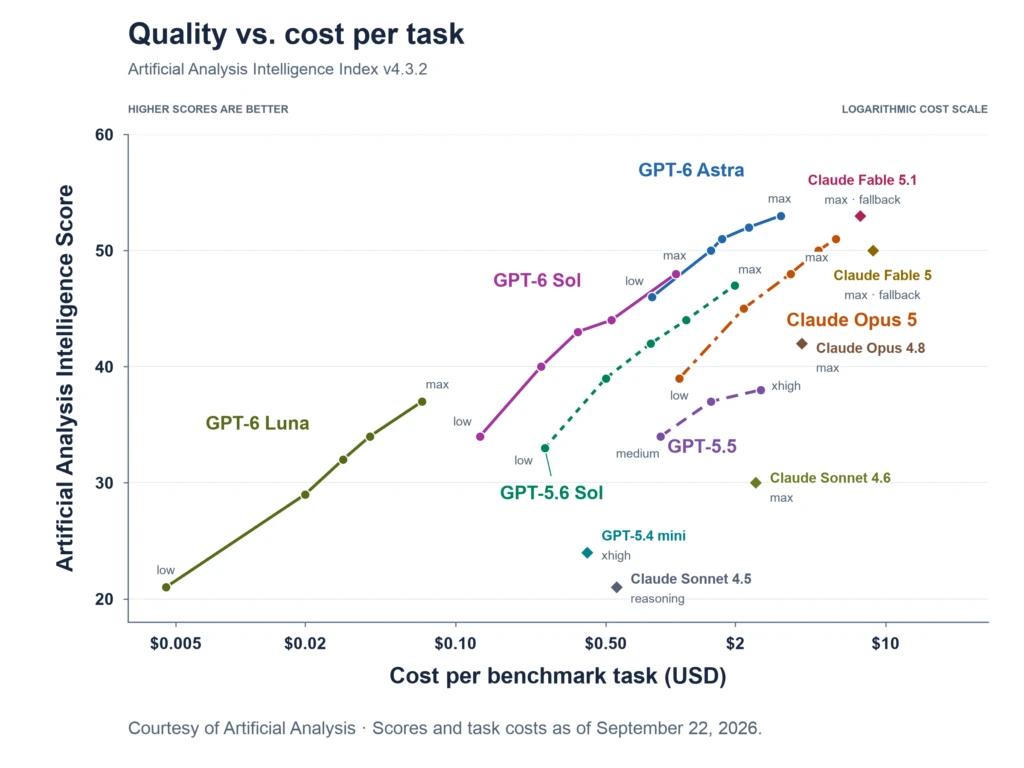
GPT-6 Luna is another trade-off: it packs sufficiently powerful code and Agent capabilities into a lower cost tier.
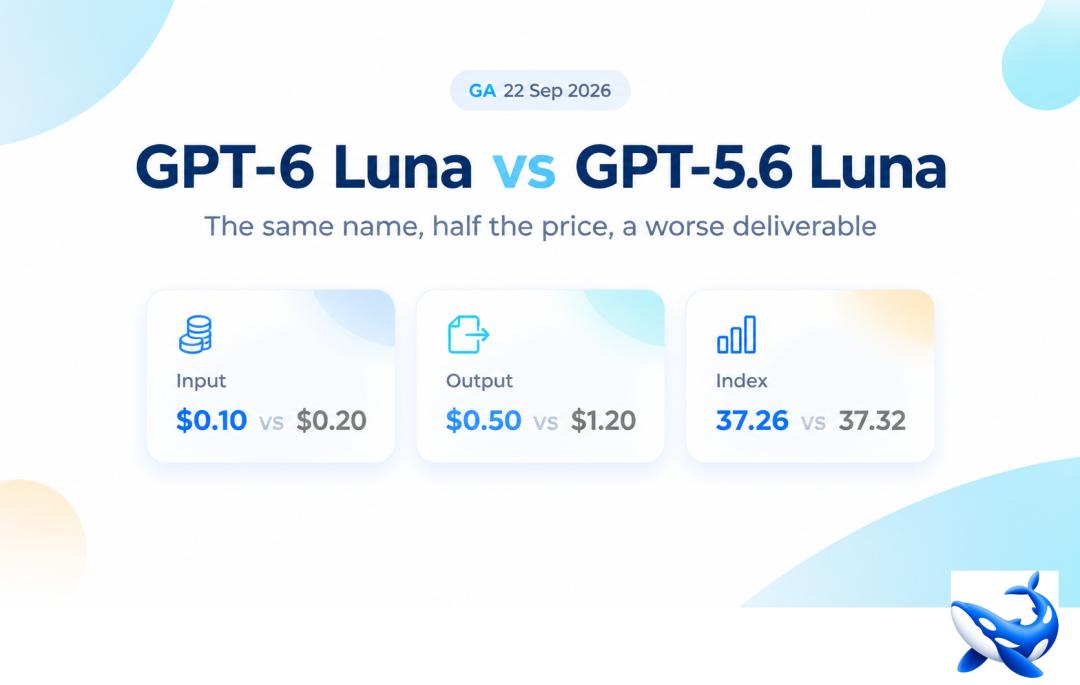
GPT-6 Luna also has a score of 66.6% under the max inference intensity, only 2.2 percentage points lower than Sol.
But what about the cost? OpenAI says it is 93% lower than Claude Opus 5 and 96% lower than Fable 5.
In addition, long context and inference capabilities are not cut at all.
Both GPT-6 Sol and GPT-6 Luna support a context of about 1 million tokens, with a maximum output of 128K tokens.
Large code bases, document collections, and multi-round Agent states can all be directly imported into it.
Both models also support adjustable inference intensity, and have an extra none tier that Astra does not have, which can completely turn off explicit reasoning.
For simple extraction, classification and routing tasks, you can turn off reasoning directly to maximize speed; for complex coding and cross-document analysis, you can raise the inference tier.
Actual measurement: With such a low price, what level can it actually reach?
Overseas developer Nate Herk used 10 real tasks to make GPT-6 Sol compete head-on with Claude Opus 5.5 for a whole day. The result was 7 wins for Opus, 1 win for Sol, and 2 tasks were invalid due to folder conflicts.
Opus has advantages in many aspects: for example, its website design has multi-layer depth and detailed details like a smoking effect when opening a can, its video editing has proper rhythm and sound effects, its 3D learning world is explorable and playable, and its Canva drawing is even closer to the reference image than Astra's previous performance.
The only task that Sol won is code review and repair, it passed all 30 checks and got full marks, while Opus got 29/30.
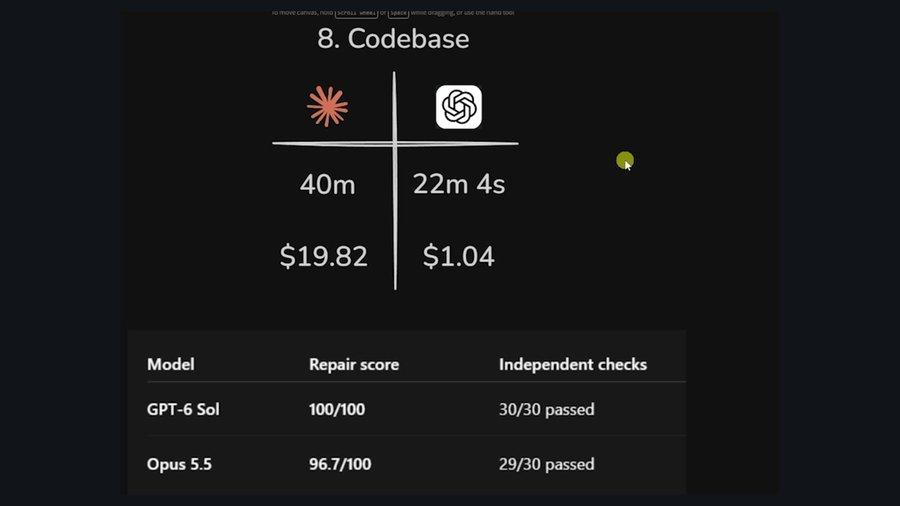
But the cost gap is also very obvious: Opus spent $213, while Sol only spent $74.46.
Nate came to the conclusion that the best practice is to use Opus for creative work and judgment, and use Sol to execute well-defined tasks.
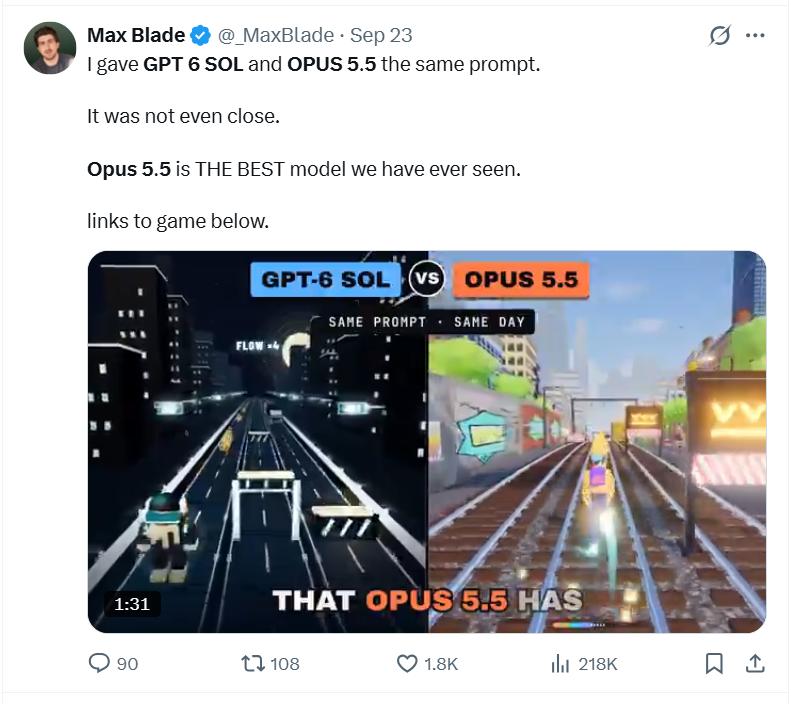
Feedback from other content creators is similar: Opus performs much better in most scenarios. For example, in the game design task below, Opus has significantly richer details.
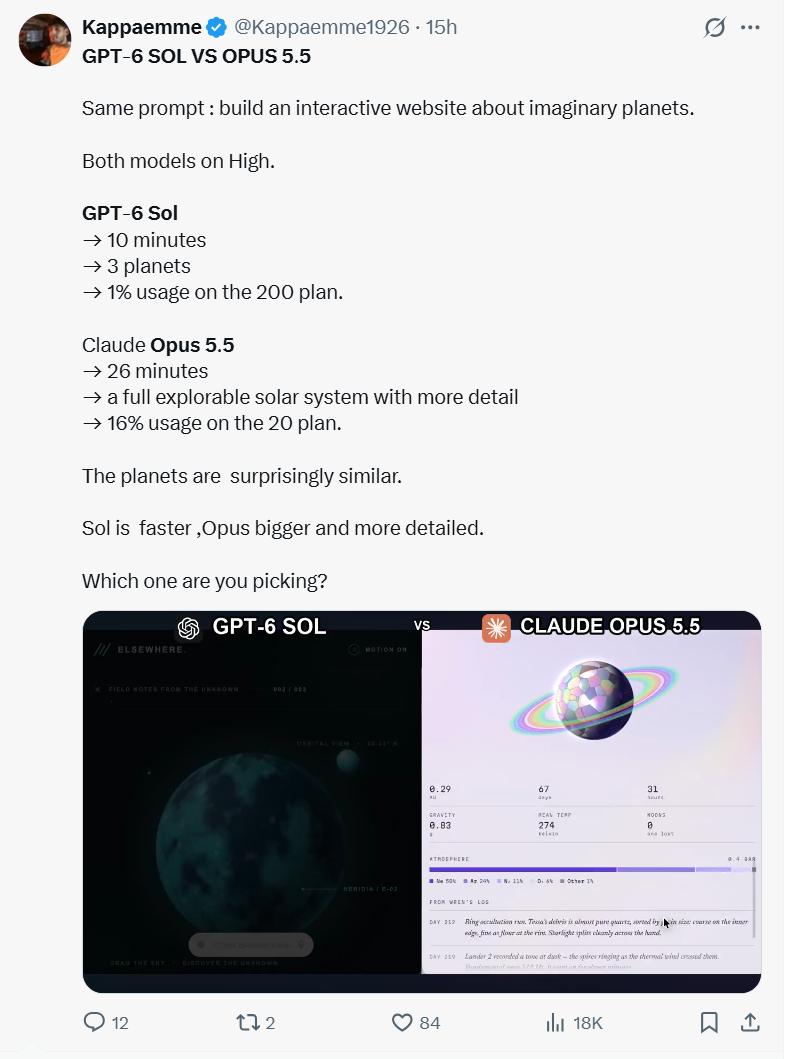
There is another more intuitive side-by-side comparison for the same task: "Make an interactive website for an imaginary planet". Sol finished 3 planets in 10 minutes, consuming only 1% of the $200 quota.
Opus spent 26 minutes delivering a complete solar system, consuming 16% of the $20 quota. The planets generated by the two look similar, the difference is that Sol is faster and cheaper, while Opus is more comprehensive and detailed.
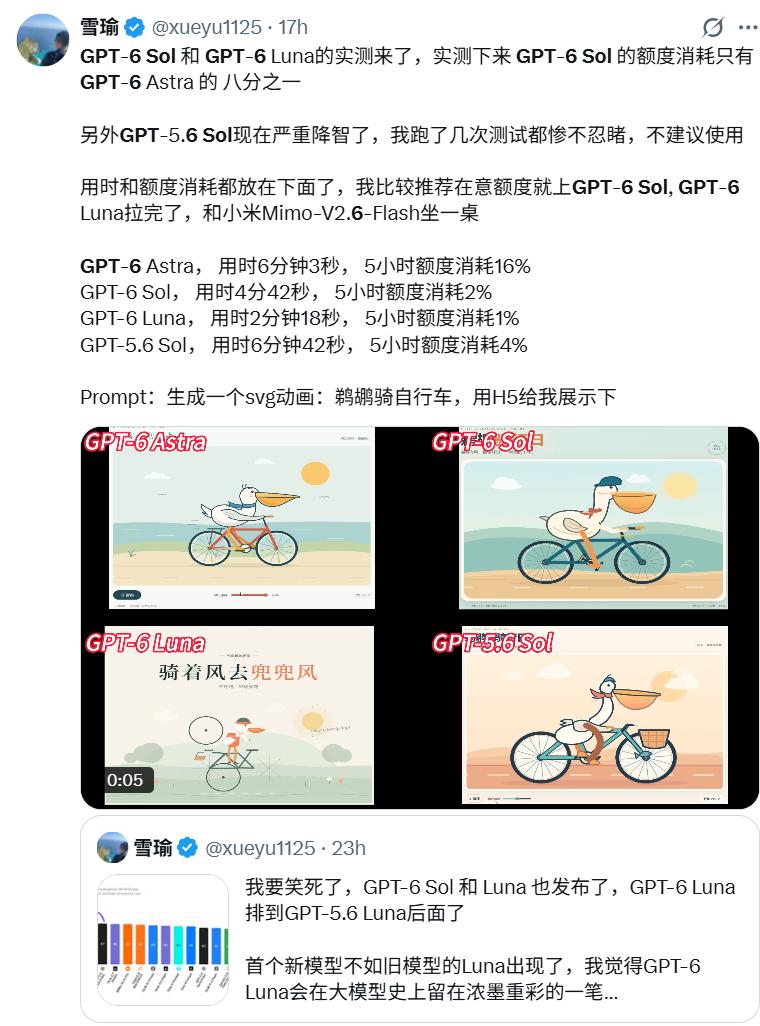
Content creator @Xueyu also did a set of quota measurement: for the same SVG animation task of "a pelican riding a bicycle", the quota consumption of Sol and Luna is significantly lower than that of Astra, but the outputs of the cheaper models are much rougher after all.
All in all, two tech giants are focusing on "cost-effectiveness" on the same day, which is always a good thing for consumers, with more options and lower trial and error costs.
After all, not everyone needs a top-tier flagship model, but everyone deserves an affordable price.
This price war will probably become more and more exciting.
References: OpenAI official website, X and other online platforms