Let AI develop the next generation of robots, take the top spot on the Physical AI evaluation rankings merely three months after its establishment, and place bets on Physical RSI.
Reported by Zhidx on September 24, Simate, a physical intelligence company, has just delivered an impressive technical report card since its establishment three months ago.
According to Simate, its general-purpose physical fast system model, developed with the AI automatic research system AutoResearch, has topped RoboDojo, the physical AI intelligence evaluation list, and demonstrated capabilities including complex long-horizon task execution, memory, and high-precision operation through real robots.

The company has completed cumulative financing of hundreds of millions of RMB, and its core team brings together technical talents in the fields of autonomous driving end-to-end mass production, world model and humanoid robot control.
In terms of technical route selection, Simate has set its sights on a recently high-profile research direction: enabling AI to participate in the R&D of next-generation AI.
Just a few days ago, Anthropic disclosed that as of August 2026, Claude has been able to "lead" about 26% of AI R&D work under human supervision.
What Simate is doing is to introduce a similar R&D paradigm into the physical world, allowing AI to participate in the development of next-generation robot intelligence. Recently, the company's official website has also been officially launched.
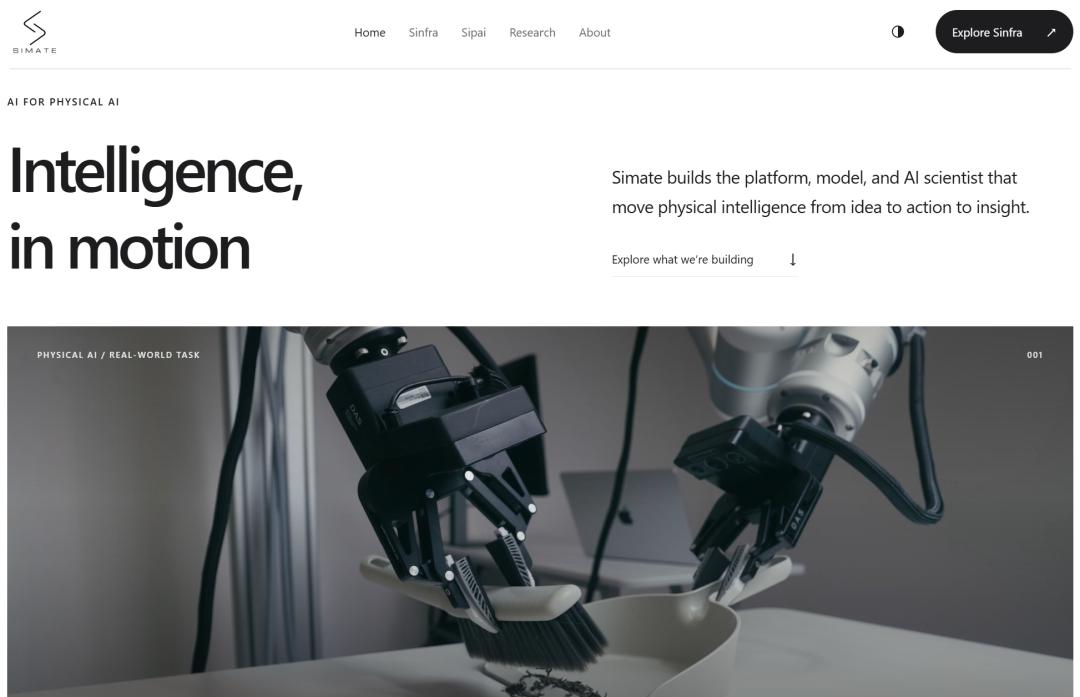
The company has proposed the Physical RSI (Recursive Self-Improvement for Physical Intelligence) route, which attempts to connect model R&D, data processing, experimental evaluation and real robot deployment, allowing AI Agent to take on more scientific research work, and use the experience accumulated in each round of research to continuously improve models and research methods.
01. Founded by technical leader of front-line autonomous driving company, gathering core talents in world model and real machine control fields
Zhang Ying, founder of Simate, previously worked at a leading autonomous driving company in the industry. Now, he brings these technical and engineering experiences into the field of physical intelligence, exploring the continuous iteration of robot intelligence driven by Physical RSI.
Autonomous driving and physical intelligence have similar technical requirements: intelligent systems need to perceive the real environment, make decisions, and continuously adjust actions according to external changes.
But the tasks faced by robots are more diverse. Taking grasping as an example, changes in the shape, material and placement position of objects may affect the execution effect of robots, putting forward new requirements for capabilities such as understanding the physical world and fine motion control.
To further advance Physical RSI to the continuous iteration of real robot capabilities, Simate also needs to supplement technical capabilities in world models, robot control and other fields.
To this end, Simate has gathered researchers from academia and industry.
Among them, Zhan Fangneng is an assistant professor at the Hong Kong University of Science and Technology and head of the World Mind Lab. His research covers world models, 3D perception and physical AI, and he has published more than 50 papers in academic conferences and journals such as SIGGRAPH, CVPR, ICCV and TPAMI.
Another core member of the team is Ji Mazeiyu, a post-2000 young scientist, who graduated from the University of California, San Diego. His research directions cover 3D perception, dexterous operation and full-body control of humanoid robots, and he has participated in the real machine verification of the general humanoid controller.
Ji Mazeiyu also served as a founding member of Assured Robot Intelligence (ARI), a physical AI company in Silicon Valley, which was later acquired by Meta.
Overall, this team has formed a complete closed loop from basic model cognition, engineering to physical real machine deployment, supporting Simate's Physical RSI technical route.
02. Let AI research robots, rank first on RoboDojo evaluation list within months of establishment
Recently, Simate disclosed that through the AutoResearch automatic research system, it carries out physical intelligence model R&D with the weak RSI paradigm of human-machine co-driving, and its general-purpose physical fast system model has achieved the first place on the RoboDojo evaluation list.
RoboDojo is an evaluation benchmark for general robot operation capabilities, covering different dimensions such as generalization, memory, fine operation, long-horizon task execution and open tasks, which can observe the comprehensive operation capabilities of the model from multiple perspectives.
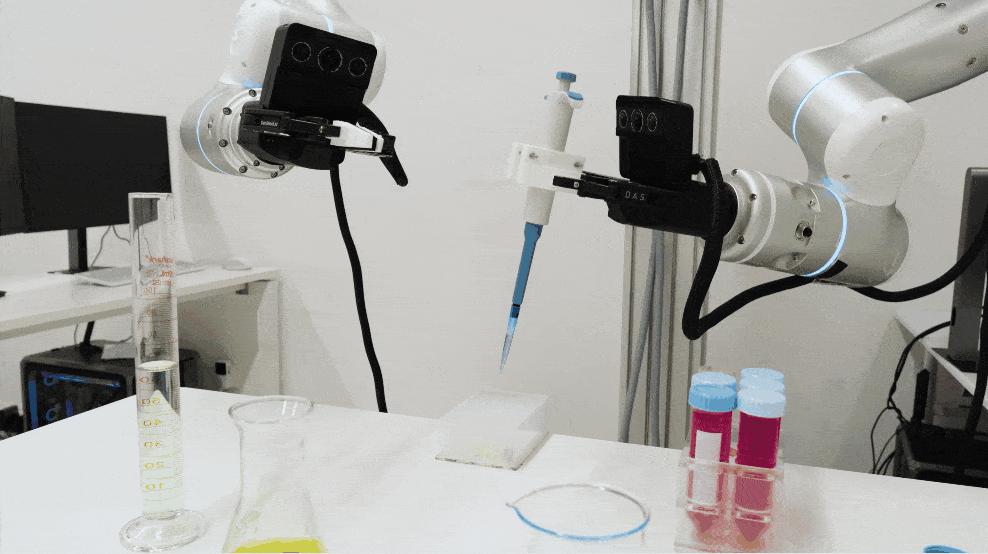
Simate demonstrated through real robot demonstration the capability of the model to perform the continuous multi-step task of "making tea" by using historical information to execute continuously and retain historical observations.
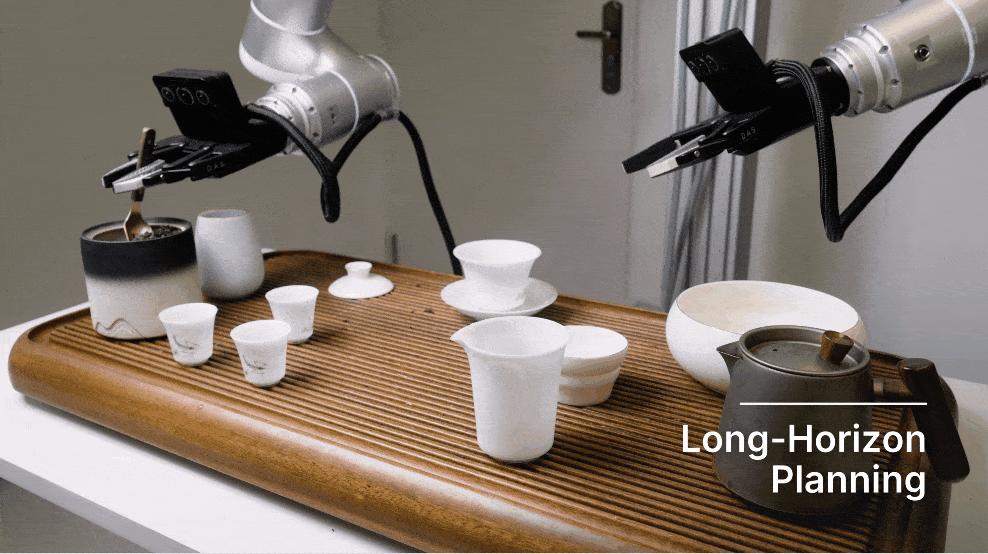
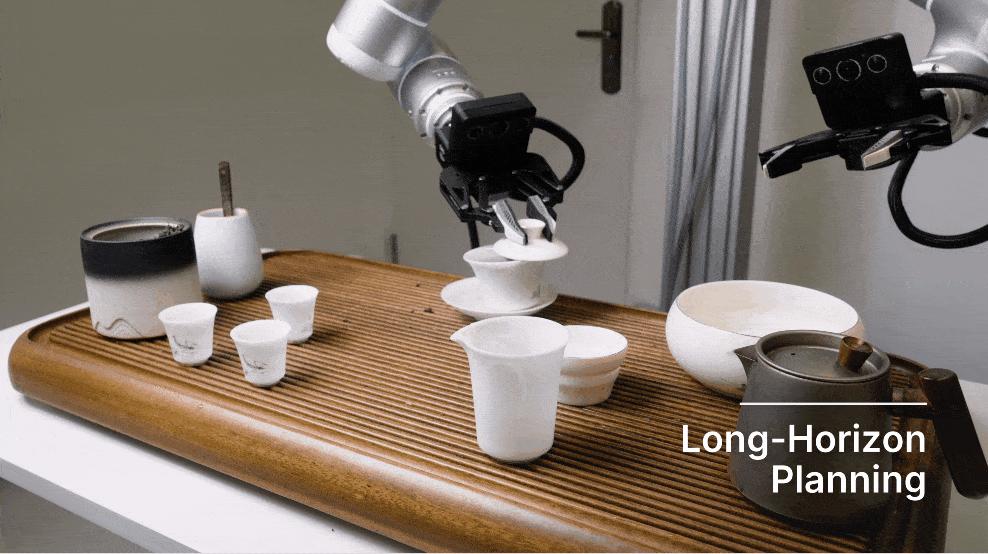
In long-horizon tasks, robots need to remember the steps that have been completed, the current progress of the task, and determine the next action according to environmental changes.
If only relying on the current frame, the model may not be able to obtain all the information needed to complete subsequent operations; if historical observations are continuously accumulated, the real-time computing burden will be increased.
To this end, Simate introduced 4D physical perception and memory mechanism into the general-purpose physical fast system.
The model understands the physical environment by processing information such as depth, geometry, motion and contact relations, and organizes historical information around task progress, continuous state tracking and real-time change feedback, exploring the balance between long-horizon task consistency and real-time response.
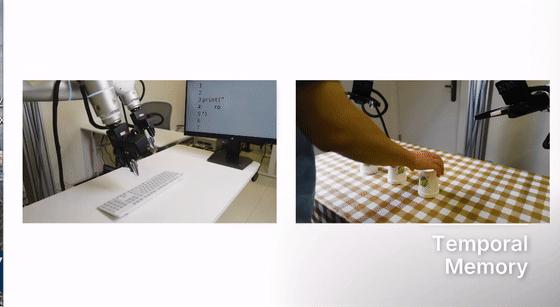
In order to make larger-scale models serve end-side real-time operations, the company has also explored technologies such as efficient visual coding, spatiotemporal modeling and feature compression.
According to the plan, this physical fast system will cooperate with the general reasoning slow system in the future, and advance to zero-shot and few-shot general operations. The specific model size and architecture are yet to be announced in subsequent technical reports.
Behind these model achievements, there is another noteworthy change: Simate tries to let AI Agent take on more robot model R&D work.
In the past, researchers needed to repeatedly modify the model, adjust data, train and evaluate, and then find new optimization directions according to the results. The AutoResearch developed by Simate attempts to connect these links, allowing Agent to take on more scientific research execution work.
Judging from the interface of AutoResearch, this system is no longer just a simple collection of experimental scripts. The screen not only shows the process dashboard of "From Experiments to One Policy", but also displays the cross-scenario evaluation result page, which is used to manage different experimental branches, track evaluation performance, and gradually converge multiple rounds of experiments into a more stable strategy.

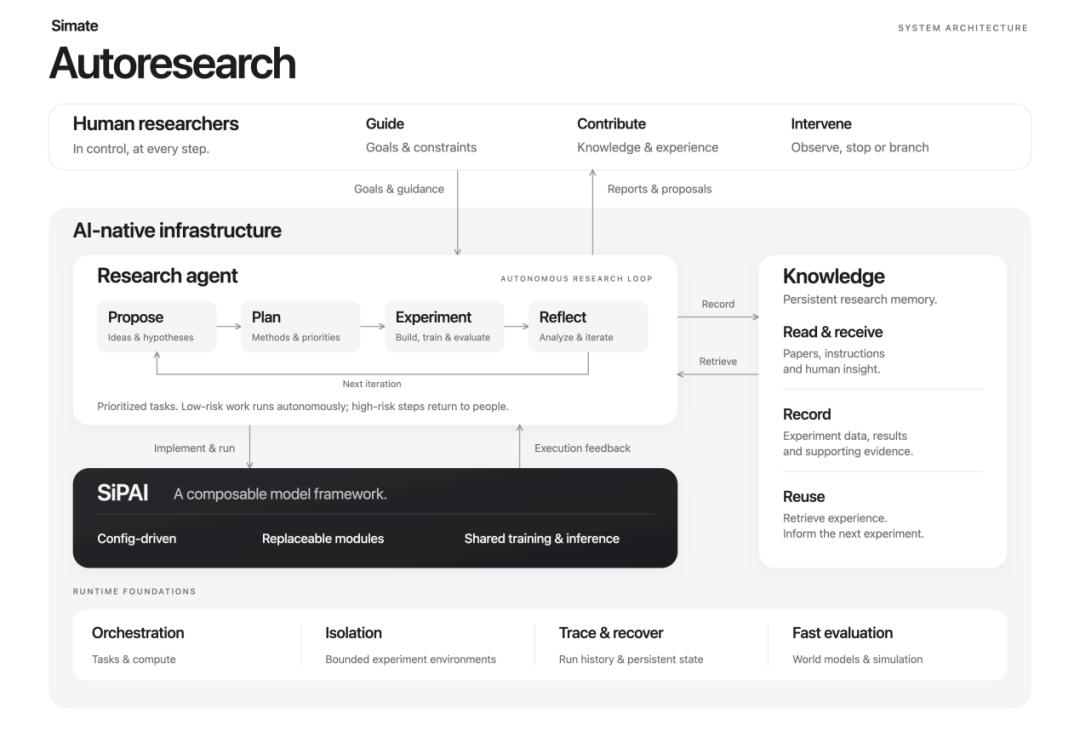
According to research objectives and constraints, Agent can read model codes, training configurations and historical experiment records, modify components and configurations through SiPAI, call infrastructure to complete training and evaluation, then decide to continue, adjust or stop experiments according to the results, and incorporate new discoveries into the next round of research.
In this way, Simate tries to improve the automation of scientific research execution, allowing researchers to devote more energy to hypothesis judgment and key technical decision-making. Its phased results also provide preliminary engineering verification for AI Agent to participate in physical intelligence research under human guidance.
According to the company, AutoResearch is now open for trial, and researchers from Tsinghua University, MIT, the Hong Kong University of Science and Technology and other universities have used it.
03. Bet on Physical RSI to enable continuous self-evolution of robot intelligence
If AI can modify models, perform experiments, and adjust the next round of research according to the results, then taking a step forward, can it independently discover problems and even improve its own research methods?
This is exactly the core idea of Simate's exploration of Physical RSI.
RSI, the full name of which is Recursive Self-Improvement, focuses on how intelligent systems use existing capabilities to improve themselves, and let these improvements further enhance the research and learning capabilities of the next round.
Around different research questions, Simate divides RSI research tasks into three categories: weak, medium and strong.
Weak RSI: It is mainly oriented to problems with clear boundaries and short feedback cycles, such as implementing a function, modifying data processing logic, or optimizing a piece of calculation under fixed constraints, and independently completing modification, testing and feedback.
Medium RSI: Oriented to human-machine collaborative research that requires multi-stage planning, similar to improving model memory and finding data ratio. Agent undertakes context sorting, implementation and experiment promotion, while researchers participate in hypothesis screening, contradictory result interpretation and key trade-offs.
Strong RSI: The system faces broad goals, such as improving generalization of new tasks, which requires continuous understanding of the essence of goals, discovering problems worthy of research, and maintaining direction and correcting paths for a long time; this still needs to be led by senior researchers at present.
Simate emphasizes that these three categories are mainly used to distinguish the types of research problems, which can exist in one R&D work at the same time. Its long-term goal is to gradually reduce human participation, so that the improvement of models, tools and research methods can continuously enhance the research capabilities of the next round.
The key challenge from weak RSI to strong RSI lies in whether Agent can further develop the capabilities of independently discovering problems, putting forward effective hypotheses and judging research directions from executing established experiments, which also constitutes an important difference between automated scientific research and scientific research with higher autonomy.
In this regard, Simate has built a technical system covering model framework, data processing, automated research and real deployment to support the continuous iteration of Physical RSI.
The first is the SiPAI pluggable model framework, which allows Agent to understand the model structure, locate the components that need to be modified, and perform unified training and evaluation after completing the modification through clear module boundaries, interfaces and verification processes.
SiPAI adopts a pluggable design and supports the accessed architectures such as world model, world action model, vision-language-action model (VLA) and vision-language model (VLM).
For example, when the research goal is to improve the memory mechanism of the model, Agent can modify the relevant components; when the problem involves data ratio, it can adjust the training configuration.
On this basis, the team explores transferable perception and action representation, and promotes the model to form capabilities such as new task adaptation, skill combination and accident recovery.
However, the improvement of the capability of the robot model ultimately needs to be verified by actual operation.
Real physical interaction often requires more complex experimental conditions, and also puts forward new requirements for the speed and reliability of scientific research feedback.
To this end, Simate uses the world model and simulation environment to provide fast experimental feedback, and then verifies the model performance through real robot execution, and re-integrates the failure cases in actual operation into the research process.
At the same time, AutoResearch verifies hypotheses through model and data experiments, identifies capability bottlenecks by using evaluation results, and promotes the next round of data collection and model training, forming a continuously iterative research closed loop.

04. Conclusion: AI drives robot evolution, large-scale implementation of physical intelligence accelerates
When data, models and computing power continue to scale, can the research process itself also achieve scaling? Simate is exploring this new possibility through Physical RSI.
Taking AutoResearch as the entry point, Simate tries to let AI Agent participate in model R&D, experiment and evaluation, and transform the feedback from real robot operation into the basis for the next round of research. It is understood that the AutoResearch scientific research platform has officially opened internal test recruitment.
With the gradual maturity of the Physical RSI technical route, robots are expected to adapt to more tasks and scenarios at lower R&D and deployment costs, exploring a new path for the large-scale implementation of physical intelligence.
This article is from the WeChat official account "Zhidx" (ID: zhidxc om), author: Xu Lisi, published with authorization from 36Kr.